
Most crypto exchanges charge you every time you trade. Even the big ones like Binance or Coinbase take 0.1% to 0.2% per trade. That adds up fast - especially if you’re trading often. But what if you could trade for free? That’s the promise of Merchant Moe is a decentralized cryptocurrency exchange built on the Mantle Network blockchain, launched in 2024 with a simple goal: eliminate trading fees entirely. It’s not just another DEX. It’s a niche player betting everything on one blockchain - and it’s working, but only for a very specific crowd.
Merchant Moe doesn’t have a team in a fancy office. It doesn’t have a customer support line. It runs entirely on smart contracts. That means no middlemen. No account freezes. No KYC forms. You connect your wallet - usually MetaMask is the most common - and start trading directly. The platform supports 9 coins and 16 trading pairs. That’s tiny compared to Uniswap, which handles over 1,500 tokens, or PancakeSwap, which supports around 800. But Merchant Moe isn’t trying to beat them. It’s built for the Mantle Network ecosystem - a Layer-2 solution that’s faster and cheaper than Ethereum.
How Merchant Moe Makes Money (Spoiler: It Doesn’t)
You read that right. Merchant Moe charges 0% maker fees and 0% taker fees. That’s unheard of. Most DEXs make money by taking a cut. Uniswap charges 0.3%. PancakeSwap takes 0.25%. Even Curve Finance, known for low-slippage stablecoin swaps, has hidden costs in slippage and gas. Merchant Moe removes all of that. The trade-off? It relies entirely on the growth of the Mantle Network. If Mantle succeeds, Merchant Moe succeeds. If Mantle fades, so does it.
How does it stay alive without fees? The MOE token itself is used for governance and staking. Holders can vote on upgrades, propose new trading pairs, and earn rewards from protocol revenue - but there’s no direct revenue stream yet. That’s risky. Most successful DEXs have fee-sharing models. Merchant Moe is betting that user growth and network adoption will eventually generate value, even without charging traders.
What You Can Trade (And What You Can’t)
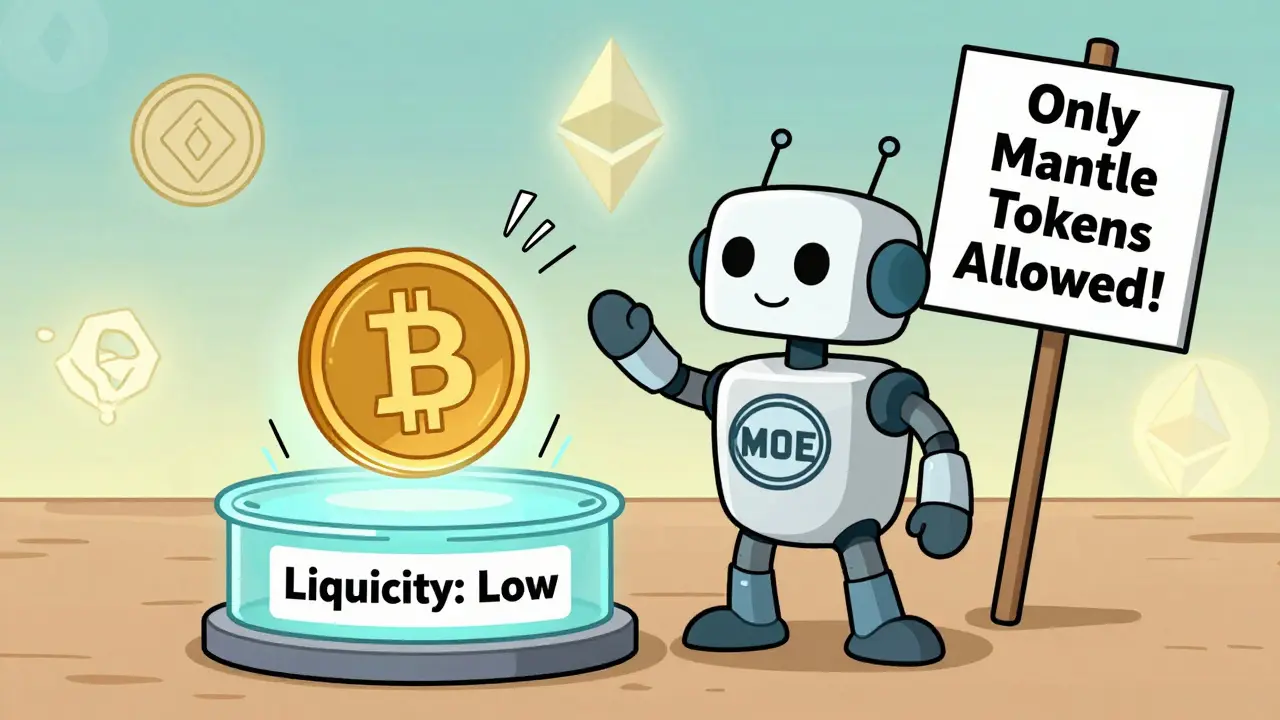
Let’s get real: Merchant Moe’s selection is thin. You won’t find Bitcoin, Ethereum, Solana, or Dogecoin directly on the platform. Instead, you’ll find tokens native to the Mantle ecosystem:
- WETH (Wrapped Ether)
- USDT (Tether)
- MNT (Mantle’s native token)
- MOE (Merchant Moe’s governance token)
- USDC (USD Coin)
That’s it. The biggest pair is WETH/USDT, which sometimes sees 5% daily swings. That’s not because the market is volatile - it’s because liquidity is low. A $100,000 trade could move the price by 10%. That’s dangerous for anyone trading more than a few hundred dollars.
Want to buy Bitcoin? You can’t. You need to buy it on a centralized exchange first, send it to your wallet as ETH or USDT, then swap it on Merchant Moe. That’s a hassle. It’s not a one-stop shop. It’s a specialized tool.
Who Is This For? (And Who Should Stay Away)
Merchant Moe isn’t for beginners. It’s not for casual investors. It’s not for people who want customer support when things go wrong.
It’s for three types of users:
- DeFi power users who already use Mantle for staking, lending, or yield farming and want a fee-free place to swap assets.
- Token holders who own MOE or MNT and want to trade them without paying fees.
- Early adopters who believe in Mantle as the future of Ethereum scaling and want to support the ecosystem.
If you’re looking for a wide selection of coins, high liquidity, or a simple interface - look elsewhere. This isn’t Coinbase. It’s not even Uniswap. It’s a backroom trading post for a very small community.
Traffic, Usage, and the Silent User Base
Here’s the hard truth: Merchant Moe is quiet. According to traffic data, it gets between 4,000 and 4,500 monthly visits. That’s less than 0.01% of Coinbase’s traffic. It ranks #398 out of 589 crypto exchanges. Most of that traffic - 99% - comes from organic search. No ads. No influencers. No marketing budget.
There are almost no reviews. No Reddit threads. No Twitter buzz. The few comments you find are from people using Atomic Wallet, which lets you buy MOE with a credit card - but that’s not the same as using Merchant Moe’s native platform. The platform itself has no tutorials, no FAQ, no live chat. You’re on your own.
That’s not a bug - it’s a feature. Merchant Moe assumes you already know how to use a wallet, understand slippage, and can read smart contract risks. If you don’t, you shouldn’t be here.
The Big Risk: Being Too Tied to One Chain
Mantle Network is promising. It’s Ethereum-compatible, has low gas fees, and has partnered with big names like Chainlink and The Graph. Its total value locked (TVL) hit $1.2 billion in mid-2024. That’s real growth.
But here’s the problem: DEXs built on a single chain rarely survive long-term. Messari’s DeFi Report (May 2024) says DEXs that don’t go cross-chain struggle to keep users. What if Mantle’s growth stalls? What if another Layer-2 like Arbitrum or Base pulls ahead? Merchant Moe has no backup plan. It’s all-in on Mantle.
And there’s no regulation. FxVerify confirms: “This company does not appear to be regulated by any government authority.” That means no investor protection. No insurance. No legal recourse if something goes wrong. You own your keys. You own your risk.
Alternatives: What Else Is Out There?
If Merchant Moe feels too small, here are your real options:
| Exchange | Trading Fees | Token Count | Chain Support | Liquidity |
|---|---|---|---|---|
| Merchant Moe | 0% | 9 | Mantle only | Very low |
| Uniswap | 0.3% | 1,500+ | Ethereum, Arbitrum, Polygon | Extremely high |
| PancakeSwap | 0.25% | 800+ | Binance Smart Chain, Polygon | High |
| Curve Finance | 0.02%-0.04% | 100+ | Ethereum, Polygon, Arbitrum | Very high (stablecoins) |
Uniswap is the safe choice. PancakeSwap is good for BSC tokens. Curve is unbeatable for stablecoins. Merchant Moe? It’s the dark horse. It doesn’t compete on size - it competes on philosophy: zero fees, pure decentralization, and loyalty to one chain.
The Bottom Line: A Niche Bet Worth Trying?
Merchant Moe isn’t the future of crypto trading. It’s a test. A small experiment in whether a DEX can survive without fees - and whether a single-chain ecosystem can sustain its own exchange.
If you’re already deep in the Mantle Network - staking MNT, farming yield, holding MOE - then yes. Use it. Trade freely. It’s the only place where you won’t pay to swap.
If you’re just starting out, or you want to trade Bitcoin, Solana, or Ethereum directly - skip it. You’ll waste time. You’ll get frustrated. You’ll end up on Uniswap anyway.
Merchant Moe doesn’t need to be big. It just needs to be useful to its users. Right now, it is - for a handful of people. That’s enough to keep it alive. But don’t expect it to replace your main exchange. It’s a side tool. A specialty shop. Not the supermarket.
Is Merchant Moe safe to use?
Merchant Moe is as safe as any decentralized exchange - which means it depends on you. Since it runs on smart contracts with no central team, there’s no one to contact if something goes wrong. You’re responsible for your own wallet security. Always use a hardware wallet for larger amounts, and never send funds to a contract you don’t understand. There’s no insurance, no regulation, and no recovery options.
Can I buy MOE with a credit card?
You can’t buy MOE directly on Merchant Moe with a credit card. But you can buy it through Atomic Wallet, which lets you purchase MOE using a card from $50 to $20,000 per day. Then you can transfer it to your wallet and trade it on Merchant Moe. This is the easiest way for beginners to get started.
Does Merchant Moe have a mobile app?
Yes, Merchant Moe offers a mobile app, but it’s not a full trading interface. It’s primarily a wallet connector and notification tool. You still need to use your browser on desktop or mobile to actually trade. The app helps you stay connected to your wallet and monitor your positions, but don’t expect to place orders or check charts on your phone.
Why does Merchant Moe only support 9 coins?
It’s intentional. Merchant Moe is built to serve the Mantle Network ecosystem, not compete with Uniswap. By limiting the number of tokens, it focuses liquidity on the most important pairs - like WETH/USDT and MNT/USDT. This reduces slippage and improves trading efficiency. Adding more tokens would spread liquidity too thin and hurt the experience for its core users.
What happens if Mantle Network shuts down?
If the Mantle Network stops functioning - whether due to technical failure, loss of developer support, or regulatory pressure - Merchant Moe would stop working too. All its smart contracts run on Mantle. There’s no backup chain. Your tokens would still exist on the blockchain, but you wouldn’t be able to trade them on Merchant Moe. That’s the risk of a single-chain DEX. It’s why most serious traders use cross-chain platforms.
anshika garg
March 18, 2026 AT 01:59Wow. Just... wow. I read this whole thing and I felt like I was sitting in a quiet room with a friend who just told me the secret to the universe. Merchant Moe isn’t trying to be everything - it’s trying to be *enough* for the people who already know what they’re doing. And honestly? That’s beautiful. In a world where everything’s screaming for attention, this is the whisper that matters.
Bruce Doucette
March 18, 2026 AT 15:54LMAO so we’re celebrating a DEX with 9 tokens and less traffic than my cat’s Instagram? 🤡 Zero fees? Cool. So is my toaster. Also, ‘no KYC’ means ‘no one cares if you’re a bot farm.’ I’m just waiting for the rug pull that’s gonna make this the next FTX… but with fewer lawyers.
Marie Vernon
March 20, 2026 AT 11:12I love how this isn’t trying to be the next Coinbase. It’s like a little neighborhood bakery in a world of Starbucks. You don’t go there for variety - you go because you know the person behind the counter, you trust the ingredients, and you’re okay with the fact that they only bake one kind of sourdough… but damn, it’s the best one you’ve ever had. 🙌
Ross McLeod
March 21, 2026 AT 01:14The fundamental flaw here isn’t the token count or the liquidity - it’s the philosophical assumption that zero fees can sustain a protocol indefinitely without a revenue model. Most successful DEXs use fees to incentivize liquidity providers, fund development, and create a feedback loop of growth. Merchant Moe is banking on a hypothetical future where Mantle becomes dominant enough to generate value through indirect means - which, while not impossible, is statistically improbable given the history of single-chain ecosystems. The risk is structural, not operational.
Lauren J. Walter
March 22, 2026 AT 21:29Imagine: you’re this one kid in high school who only listens to one obscure band… and you’re so proud of it… and then you realize no one else even knows the band exists… and you’re just… sitting there… holding the vinyl… alone… in your room…
Brenda White
March 24, 2026 AT 11:00so like… if i wanna trade eth for mnt… i gotta buy eth on coinbase, send it to my wallet, then swap it on here? and the slippage is wild? and there’s no support? and the app is just a glorified wallet? wtf is this even for? i feel like i’m being punk’d
Ernestine La Baronne Orange
March 25, 2026 AT 09:50This is the most dangerous thing I’ve seen in crypto since Terra. Zero fees? No regulation? No team? No backup? You think you’re being ‘decentralized’ - but you’re just being reckless. You’re gambling with your life savings on a blockchain that could vanish tomorrow like a dream. And for what? To save 0.3%? You’re not a pioneer - you’re a sucker. And don’t even get me started on MOE - that token’s got less value than my expired gym membership.
S F
March 26, 2026 AT 07:52USA built the internet. China’s building the future. And we’re here, celebrating a DEX that runs on a blockchain nobody outside of 300 people has heard of? This isn’t innovation - it’s nationalism for degens. If you’re not trading on Ethereum, Polygon, or Arbitrum, you’re not serious. You’re just playing pretend.
Angelica Stovall
March 26, 2026 AT 15:390% fees? No KYC? That’s how they get you. First they let you trade free. Then they steal your keys. Then they vanish. This is a honeypot. Every single one of these ‘decentralized’ projects ends the same way. You think you’re smart? You’re the mark.
Taylor Holloman.
March 27, 2026 AT 18:05There’s something poetic about Merchant Moe. It doesn’t shout. It doesn’t chase trends. It just… exists. Quiet. Patient. Like a tree growing in a forest no one visits. Most people will walk past it - but the ones who stop? They’ll understand. Not because it’s big. But because it’s honest. It’s not trying to change the world. It’s just trying to be a good tool for the people who already live in this world. And sometimes… that’s enough.
Bryan Roth
March 27, 2026 AT 19:00Let’s be real - if you’re holding MNT or MOE and you’re already deep in Mantle DeFi, this is a gift. No fees means more compounding. More trades. More opportunities. And yeah, liquidity is thin - but that’s why you trade small, stay aware, and don’t overextend. This isn’t a replacement for Uniswap. It’s a complement. A quiet corner of the ecosystem where the real builders hang out. If you’re not here yet - maybe you’re not ready. But if you are? Welcome home.
sai nikhil
March 28, 2026 AT 12:37This is exactly why I love crypto. Not the hype. Not the memes. But the quiet experiments - like this - that don’t need validation. No ads. No influencers. Just code, community, and conviction. If Mantle grows, Merchant Moe grows with it. If not? Well, at least we tried something different. Respect.