When you trade crypto on a decentralized exchange, you’re not just swapping tokens-you’re participating in a system that pays you to help it run. SushiSwap V3 (Core) is one of the few DeFi platforms that actually rewards you for using it. Not just a little. Not just once. But continuously. And that’s what sets it apart from most others.
Launched in 2023 as a major upgrade to its earlier versions, SushiSwap V3 (Core) isn’t just another Uniswap clone. It’s a fully independent decentralized exchange built on Ethereum, with live features that let you earn just by providing liquidity or holding SUSHI tokens. As of October 2025, over $3.99 billion in crypto is locked into its pools, and more than $69 billion has traded through it. Those aren’t small numbers. They mean real people are using it-and sticking with it.
How SushiSwap V3 Works (Without the Jargon)
SushiSwap V3 uses something called an Automated Market Maker, or AMM. That’s just a fancy way of saying there’s no order book. No middleman. No human trader deciding prices. Instead, smart contracts hold pools of coins-like ETH and USDT-and algorithms automatically adjust prices based on how much people are buying or selling.
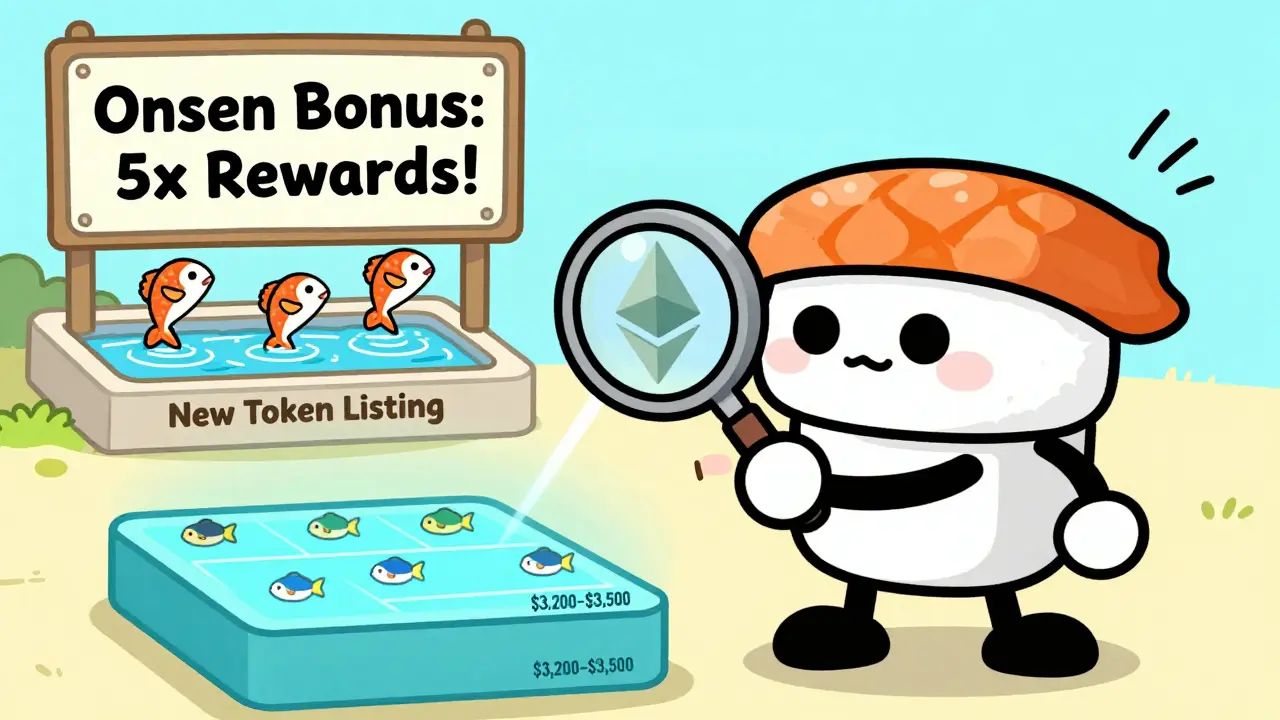
What’s different in V3? Concentrated liquidity. Think of it like this: In older versions of SushiSwap (and Uniswap), your money was spread evenly across all price ranges. Now, you pick exactly where you want your funds to work. If you think ETH will stay between $3,200 and $3,500, you can put all your liquidity there. That means more trading fees for you, but also higher risk if the price moves outside that range. It’s like options trading, but without the complexity of derivatives. You still need to watch your price ticks, gas costs, and impermanent loss.
This feature alone makes V3 more capital-efficient than V2. But it’s not for everyone. If you’re new to DeFi, you might want to stick with simple swaps until you get comfortable.
How You Earn on SushiSwap
Here’s where SushiSwap really shines: it pays you twice.
- When you provide liquidity to a trading pair (say, ETH/USDT), you earn 0.25% of every trade that happens in that pool.
- On top of that, if you stake your SUSHI tokens into xSUSHI (via the SushiBar), you get an extra 0.05% from every trade on the platform.
That dual reward system doesn’t exist on Uniswap. Uniswap gives all fees to liquidity providers. SushiSwap gives part of it to token holders. That’s a big deal. It turns holding SUSHI from a speculative bet into a functional income stream.
And then there’s the Onsen Program. If you add liquidity to a brand-new token listing, you get bonus SUSHI rewards-sometimes 5x or more than normal. This keeps new projects alive and gives early supporters a real incentive to help them grow. It’s not just about trading. It’s about building.
What You Can Trade (And What You Can’t)
SushiSwap V3 currently supports 3 coins across 5 trading pairs. That’s not a lot. You won’t find Solana, Chainlink, or Polygon here. The core pairs are ETH, USDT, and SUSHI. That’s it.
That might sound limiting, but there’s a reason. SushiSwap isn’t trying to be a crypto supermarket. It’s focused on high-liquidity, high-trading-volume assets. This keeps slippage low and fees predictable. The average bid-ask spread is 0.634%, which is better than most small DEXs and even some centralized exchanges for small trades.
But if you’re looking to trade obscure tokens or altcoins, you’ll need another platform. SushiSwap isn’t the place for that.
Wallets, Fees, and Gas Costs
You can connect six different wallets to SushiSwap: MetaMask, WalletConnect, Coinbase Wallet, Rainbow, Argent, and Frame. All of them are well-known and secure. No obscure wallets here.
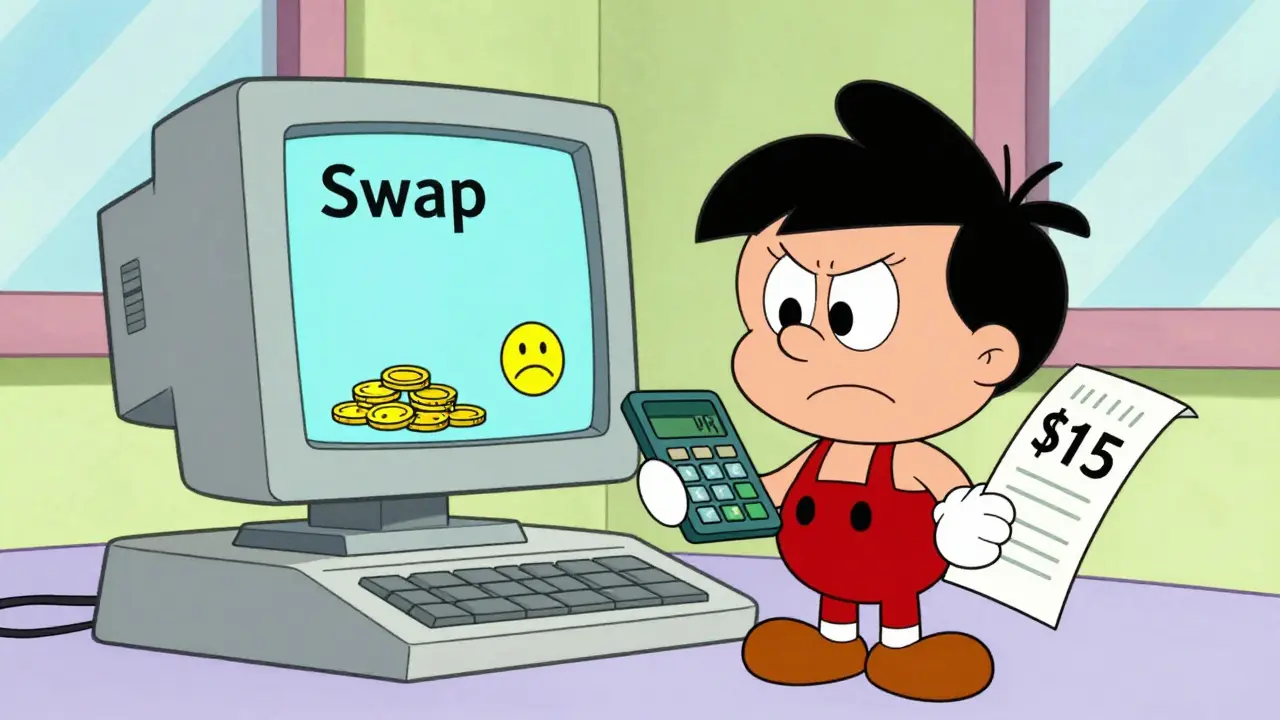
Trading fees are 0.3% per swap. That’s standard. But here’s the catch: because you’re on Ethereum, you also pay gas fees. If you’re trading $50, gas might cost $10. That’s not worth it. If you’re trading $5,000, gas is just $1.50. So size matters.
For small traders, SushiSwap on Polygon is a better option. The Polygon version has the same features-liquidity provision, staking, farming-but with near-zero gas fees and faster confirmations. If you’re just starting out, use Polygon. Save Ethereum for bigger trades.
Limit Orders and DCA: The New Features That Matter
In July 2025, SushiSwap rolled out two major upgrades: Limit Orders and Dollar Cost Averaging (DCA).
Limit Orders let you set a price to buy or sell crypto without having to watch the market. You can schedule a buy at $3,100 ETH and walk away. It’s like setting a stop-loss on Coinbase, but decentralized. No custodian. No middleman. Just code.
DCA lets you automatically buy a fixed amount of crypto on a schedule-every Monday, every 15th, whatever you pick. It’s perfect for people who want to build a position over time without timing the market.
These aren’t gimmicks. They’re tools that make DeFi usable for regular people, not just crypto degens. And they’re rare on decentralized exchanges.
Why It’s Not Perfect
SushiSwap isn’t flawless.
- No demo account. You can’t test trades with fake money. You have to risk real ETH to learn.
- No margin trading. You can’t leverage your position. That limits advanced traders.
- No customer support. If something goes wrong, you’re on your own. No chat, no phone, no email.
- No regulation. That’s a pro for some, a red flag for others. Your funds aren’t insured.
Also, the interface, while improved, still feels a bit cluttered. The advanced settings for concentrated liquidity can overwhelm beginners. That’s why Sushi Academy exists.

Sushi Academy: The Hidden Gem
Most DeFi platforms assume you already know how to use them. SushiSwap doesn’t. It has Sushi Academy-a free, well-structured learning portal with videos, guides, and interactive examples.
It explains things like:
- How impermanent loss really works (with real numbers)
- Why you should use xSUSHI instead of holding SUSHI
- How to calculate your APY from liquidity pools
This isn’t just marketing fluff. It’s the kind of education that saves people from losing money. And it’s rare.
Is SushiSwap V3 Right for You?
Here’s who should use it:
- You’re comfortable with wallets and crypto transactions.
- You want to earn passive income from trading fees.
- You’re interested in supporting new DeFi projects through Onsen.
- You prefer a platform that rewards holders, not just liquidity providers.
Here’s who should avoid it:
- You want to trade hundreds of altcoins.
- You’re new to crypto and don’t understand gas fees.
- You need customer support if things go wrong.
- You want margin or leverage.
For beginners, start on Polygon. Use Sushi Academy. Try a small liquidity pool with ETH/USDT. See how it feels. Then scale up.
The Bigger Picture
SushiSwap V3 isn’t just a trading platform. It’s a community-owned financial system. The SUSHI token isn’t just a currency-it’s a governance tool and an income generator. The fact that it’s still growing, adding features like DCA and Limit Orders, shows the team is listening.
Compared to Uniswap, it’s smaller. But it’s smarter. It doesn’t just take fees. It shares them. It doesn’t just let you trade. It teaches you how.
And in DeFi, that’s rare.
Is SushiSwap V3 safe to use?
SushiSwap V3 is a decentralized exchange, which means it runs on smart contracts, not a company. That makes it more resistant to hacks and shutdowns than centralized exchanges like Coinbase or Binance. But it also means there’s no customer support or insurance. If you send funds to the wrong address or interact with a fake contract, you lose them. Always verify contract addresses, use trusted wallets, and start with small amounts. Audits by reputable firms like CertiK and SlowMist have been passed, but no platform is 100% risk-free.
Can I use SushiSwap without owning SUSHI tokens?
Yes. You can swap tokens, provide liquidity, and use Limit Orders or DCA without ever buying SUSHI. But you won’t earn the extra 0.05% fee share from xSUSHI staking. If you’re just swapping ETH for USDT, you don’t need SUSHI. If you want to maximize your earnings over time, holding and staking SUSHI makes sense.
What’s the difference between SUSHI and xSUSHI?
SUSHI is the native governance token. xSUSHI is what you get when you lock SUSHI in the SushiBar. For every SUSHI you stake, you receive one xSUSHI. xSUSHI doesn’t trade on exchanges-it’s a receipt that gives you a share of platform fees. The longer you stake, the more fees you earn. You can unstake anytime, but you’ll get back SUSHI (not xSUSHI), and your accumulated rewards are paid out in SUSHI. Think of xSUSHI as a bond that pays interest in crypto.
Why does SushiSwap have fewer tokens than Uniswap?
SushiSwap V3 focuses on quality over quantity. It only lists tokens with enough liquidity to support stable trading and low slippage. Uniswap allows anyone to list a token for free, which leads to thousands of low-volume, high-risk pairs. SushiSwap’s approach reduces risk for users and improves the overall experience. It’s intentional-not a limitation.
Is SushiSwap better than Uniswap?
It depends on what you want. If you’re looking for the most tokens, highest liquidity, and widest asset selection, Uniswap wins. But if you want to earn extra rewards, support new projects, and benefit from a platform that shares fees with token holders, SushiSwap is better. Uniswap is the giant. SushiSwap is the smarter, more community-focused alternative. Many users use both.
How do I start using SushiSwap V3?
First, get a wallet like MetaMask. Fund it with ETH or USDT. Go to sushi.com, connect your wallet, and choose between Ethereum or Polygon. Start with a simple swap-swap 0.1 ETH for USDT. Then try adding liquidity to the ETH/USDT pool with $50. Use Sushi Academy to learn how concentrated liquidity works. Don’t rush into staking or Onsen until you understand the risks. Patience pays in DeFi.
Phillip Marson
February 23, 2026 AT 02:59Most of these exchanges are just glorified gambling dens with fancy smart contracts
But Sushi? They pay you just for showing up. No BS. No middlemen. Just code that works
And the Onsen program? That’s how you build real ecosystems-not pump-and-dump farms
Stop wasting your gas on Uniswap’s graveyard of dead tokens and get in where the action is
Tracy Whetsel
February 24, 2026 AT 19:24And Sushi Academy? Life saver. I used to think impermanent loss was some kind of magic spell
Now I get it-and I’m not scared anymore
DeFi doesn’t have to be scary if you take it slow
Alyssa Herndon
February 26, 2026 AT 10:01Most don’t realize that every time you provide liquidity, you’re helping others trade more efficiently
Not just earning fees-but enabling the whole system to function
That’s the quiet beauty of it
Kenneth Genodiala
February 26, 2026 AT 22:48And that 0.05% extra fee share? That’s not a revolution. That’s a coupon.
Real innovation is when you get actual governance power-not a tiny slice of trading revenue.
And why is it still on Ethereum? You’re paying $10 in gas to earn $0.30? That’s not finance. That’s charity.
Megan Lavery
February 28, 2026 AT 08:56They focus on quality. On safety. On education.
That’s rare in crypto. Most platforms want you to trade fast, lose money, and come back for more
Sushi? They want you to understand first. That’s why I trust them
Mae Young
March 2, 2026 AT 08:42Let me guess: next they'll offer options, futures, and a 24/7 customer service hotline?
Meanwhile, I'm over here watching my LP position get liquidated because ETH dipped 2% outside my range.
Thanks for the 'simplified' DeFi, guys. Real smooth.
Trenton White
March 3, 2026 AT 21:55SushiSwap gets that.
Not every platform needs 500 tokens. Not every user needs margin trading.
Some of us just want to trade ETH and USDT without getting lost in a sea of meme coins.
That’s not a limitation. That’s clarity.
Cheryl Fenner Brown
March 5, 2026 AT 10:30then i switched to polygon and now im chillin like a villain
also sushiacademy is fire btw
Michael Teague
March 6, 2026 AT 03:46Real yield? Nah. It’s just fee redistribution with a marketing team.
And don’t get me started on the ‘community-owned’ nonsense.
You think you’re building something? You’re just feeding the machine.
And gas? Still a nightmare on Ethereum.
Cory Derby
March 6, 2026 AT 21:56By decoupling fee distribution from liquidity provision, the protocol incentivizes long-term participation rather than speculative arbitrage.
The implementation of limit orders and DCA aligns the platform with traditional financial best practices while preserving decentralization.
This is not merely an improvement-it is a paradigm shift in user-centric DeFi design.
Colin Lethem
March 7, 2026 AT 17:30And the DCA feature? I set it to buy 0.01 ETH every Monday. Now I’ve got 0.5 ETH in 6 months without even thinking about it.
Also, Sushi Academy saved me from losing my entire bag last month. Seriously, go watch their videos.
lori sims
March 9, 2026 AT 10:42Now I see it’s about building something that lasts.
SushiSwap doesn’t shout. It doesn’t pump. It doesn’t need to.
It just quietly rewards people who show up, learn, and stick around.
That’s the kind of project worth supporting.
Reggie Fifty
March 9, 2026 AT 18:31Meanwhile, in India, China, and Europe, people are building real infrastructure.
This isn’t innovation. It’s a side hustle with a logo.
And don’t even get me started on Ethereum gas. You’re paying for a 2017 blockchain in 2025?
Deborah Robinson
March 11, 2026 AT 12:25It’s not about being a genius. It’s about being curious.
Sushi didn’t make me feel stupid. It made me feel capable.
That’s more than I can say for half the crypto apps out there
Michelle Mitchell
March 13, 2026 AT 07:42also i think they spelled sushiacademy wrong somewhere idk
Kaitlyn Clark
March 13, 2026 AT 13:46Uniswap has 10,000 tokens. Sushi has 3. That’s not smarter-that’s desperate.
And ‘community-owned’? Bro, I own a token. I don’t own a company.
Stop romanticizing this. It’s just another app with a loyalty program.
Sriharsha Majety
March 15, 2026 AT 13:26Gas fee is almost zero.
My earnings from liquidity are helping me pay my internet bill.
Thank you for making DeFi accessible.
I don’t need fancy features. I need reliability.