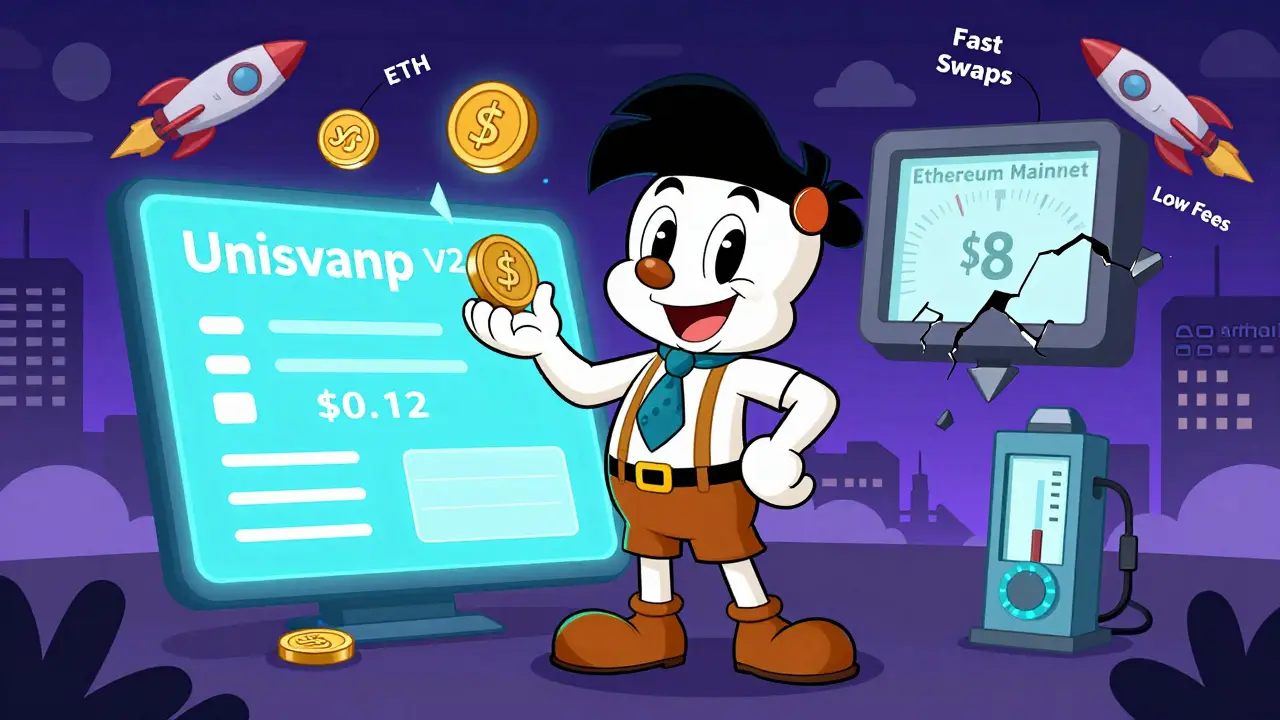
When you think of decentralized trading, Uniswap is usually the first name that comes up. But if you're using it on Arbitrum, you're not just getting the same old Uniswap-you're getting a faster, cheaper version built for real-world trading. Uniswap v2 on Arbitrum isn't just a side project. It’s one of the most active decentralized exchanges on one of the most used Layer-2 networks today. And if you’re still trading on Ethereum mainnet, you’re paying way more than you need to.
Why Uniswap v2 on Arbitrum Exists
Uniswap didn’t start on Arbitrum. It began on Ethereum, where every swap cost a fortune during peak times. In 2021, Arbitrum launched as an Optimistic Rollup, bringing Ethereum’s security but with 10x faster transactions and 90% lower fees. Uniswap quickly followed, deploying v2 on Arbitrum to give users a better experience without changing how the protocol works. The result? A DEX that feels like a centralized exchange-except you still control your keys. You don’t need to learn new rules. You connect your wallet, pick your tokens, and swap. The only difference? Your transaction confirms in under 3 seconds and costs less than $0.10.How Trading Works on Uniswap v2 (Arbitrum)
Uniswap v2 uses a simple formula: x * y = k. That means liquidity pools hold two tokens, and the price shifts based on supply and demand. It’s not complicated, but it’s powerful. When you swap ETH for USDC, you’re not dealing with a middleman. You’re interacting directly with a pool of other users’ funds. On Arbitrum, this process is smooth. Your wallet (MetaMask, Coinbase Wallet, etc.) sends the swap request to Arbitrum’s network. The transaction settles in under 10 seconds. No waiting for 10 confirmations like on Ethereum. And because Arbitrum batches thousands of transactions into one Ethereum block, gas fees stay low-even during busy times. You’ll notice the interface looks almost identical to Uniswap on Ethereum. The only change? The network indicator in your wallet shows “Arbitrum One” instead of “Ethereum.” That’s it.Fees: What You Actually Pay
Uniswap v2 charges three standard fee tiers: 0.01% for stable pairs, 0.05% for stablecoin pairs, and 0.3% for most others. Exotic tokens? 1%. These fees go to liquidity providers, not Uniswap. But here’s the catch: on Ethereum mainnet, those 0.3% fees could cost you $5-$15 in gas. On Arbitrum? You’re looking at $0.05-$0.20 total. That’s not a small difference. It’s the difference between trading regularly and only trading when you really need to. For example, swapping $1,000 worth of WETH for USDC on Ethereum might cost $8 in gas. On Arbitrum? $0.12. That’s 98% less. If you trade weekly, you’re saving over $400 a year.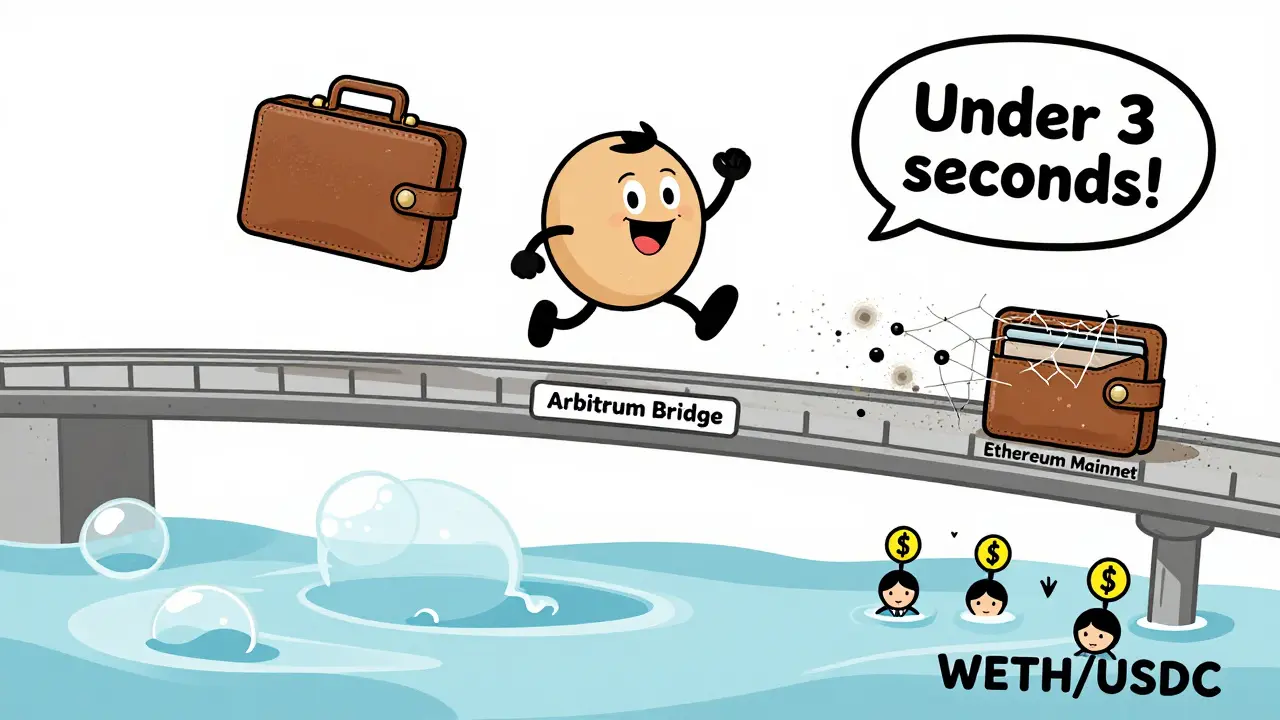
Liquidity and Trading Volume
As of early 2026, Uniswap v2 on Arbitrum holds over $2.1 billion in total value locked (TVL). That’s second only to Trader Joe on Arbitrum. But Uniswap leads in daily volume-averaging $380 million per day across all its Arbitrum pools. The most popular pairs? WETH/USDC, WBTC/USDC, and DAI/USDC. These are the backbone of the network. They’re deep, stable, and have tight spreads. If you’re trading stablecoins or major tokens, you’ll get near-perfect pricing. Even lesser-known tokens have decent liquidity. If a token has a Uniswap v2 pool on Arbitrum, it’s likely been created by a community or project team. You can search for it directly in the interface. No need to find a centralized exchange listing.Security and Reliability
Uniswap v2 on Arbitrum doesn’t introduce new risks. It uses the same audited code that’s been running on Ethereum since 2020. Arbitrum, meanwhile, inherits Ethereum’s security. If Ethereum is secure, Arbitrum is secure. The only real risk? Smart contract bugs. But Uniswap v2 is one of the most battle-tested protocols in crypto. It’s been live for over four years. No major exploits. No hacks of the core protocol. You’re still responsible for your own keys. If you send tokens to the wrong address, there’s no customer support to reverse it. That’s true everywhere in DeFi. But on Arbitrum, you’re less likely to make a mistake because transactions are cheaper-you can test swaps with small amounts without fear of losing $10 in gas.What’s Missing? v3 and Concentrated Liquidity
Uniswap v3, launched in 2021, introduced concentrated liquidity. That means liquidity providers can focus their funds around specific price ranges, earning more fees with less capital. It’s a game-changer. But Uniswap v2 on Arbitrum? It doesn’t have that. It’s the old version. No range orders. No dynamic fee tiers. If you’re a professional trader or liquidity provider, you’ll want to use v3 instead. So why does v2 still matter? Because it’s simpler. For casual traders, it’s easier to use. No need to set price ranges. No complex math. Just swap. And because v2 pools are older, they often have deeper liquidity for common tokens. Many users stick with v2 on Arbitrum because it’s reliable. It doesn’t change. It doesn’t update. It just works.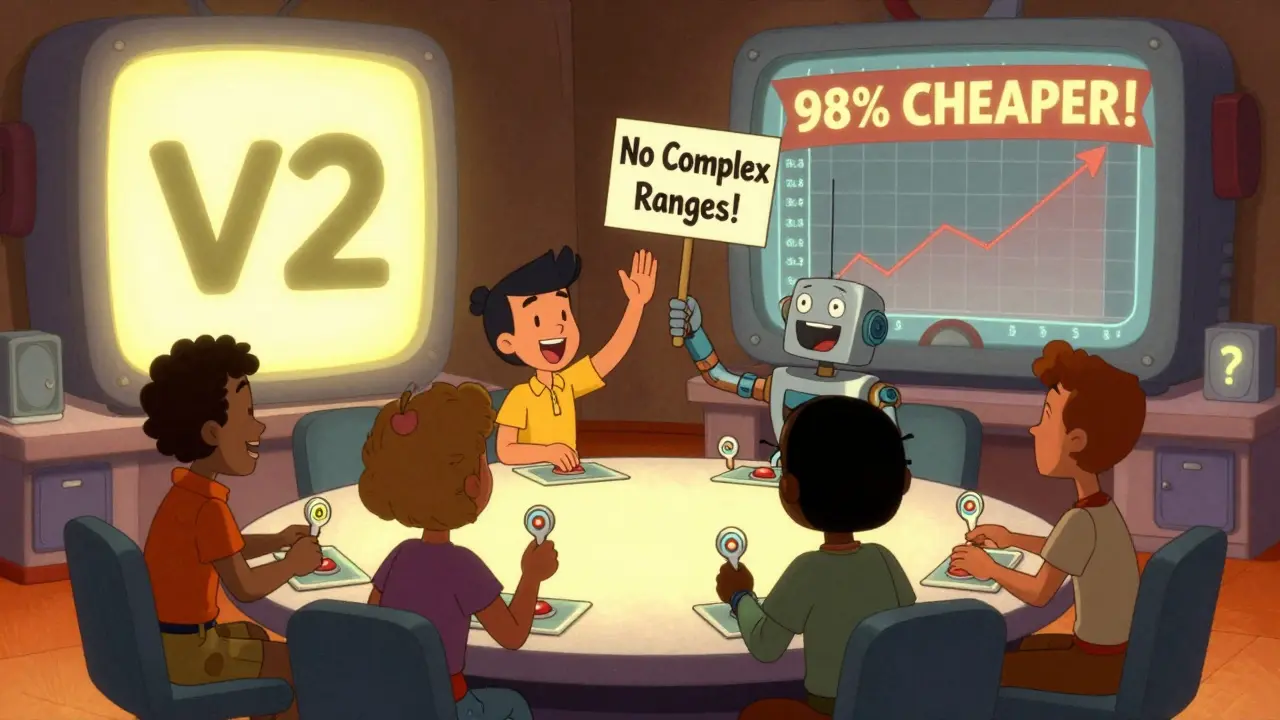
How to Start Trading on Uniswap v2 (Arbitrum)
If you’re ready to try it, here’s how:- Make sure you have ETH in your wallet. You’ll need it to pay Arbitrum gas fees.
- Switch your wallet to the Arbitrum network. In MetaMask, go to Settings > Networks > Add Network and input Arbitrum’s details (or use Chainlist.org).
- Go to app.uniswap.org and connect your wallet.
- Click “Swap.” Select your tokens. The interface will auto-detect the Arbitrum network.
- Review the price and fee. Click “Swap.” Confirm in your wallet.
- Wait 5-10 seconds. Done.
Who Is This For?
Uniswap v2 on Arbitrum isn’t for everyone. If you’re:- Trading stablecoins or major tokens daily? Perfect.
- Trying to avoid $10+ gas fees? This is your solution.
- Not comfortable with complex settings? Stick with v2.
- Trading under $500 per swap? You’ll save money here.
- Providing liquidity? Use Uniswap v3.
- Trading rare tokens with thin liquidity? Check other DEXes like SushiSwap or Curve.
- Wanting advanced features like limit orders? You’ll need a different platform.
The Bottom Line
Uniswap v2 on Arbitrum isn’t flashy. It doesn’t have NFTs, staking, or yield farming. But it does one thing incredibly well: lets you swap crypto quickly, cheaply, and safely. In 2026, with Arbitrum handling over 60% of all Ethereum Layer-2 activity, Uniswap v2 remains the most trusted DEX on the network. It’s not the future-it’s the present. And for most users, that’s exactly what they need.If you’ve been holding off because you thought DeFi was too expensive or too complicated, give Uniswap v2 on Arbitrum a try. You’ll be surprised how simple it is-and how much money you save.
Is Uniswap v2 on Arbitrum safer than on Ethereum?
Yes, in terms of transaction safety. Uniswap v2’s code is identical on both networks. But Arbitrum reduces your exposure to high gas fees and network congestion, which can lead to failed transactions or rushed decisions. The underlying security is the same, but the user experience is more stable on Arbitrum.
Can I still use Uniswap v2 on Arbitrum if I don’t have ETH?
No. Arbitrum uses ETH for gas fees, even though it’s a Layer-2. You need a small amount of ETH (around $0.50 worth) in your wallet to pay for transactions. You can get it by bridging from Ethereum or buying ETH on a centralized exchange and sending it to your Arbitrum wallet.
Does Uniswap v2 on Arbitrum support all ERC-20 tokens?
Not automatically. Only tokens that have a liquidity pool created on Arbitrum will appear. Most major tokens (ETH, USDC, WBTC, DAI) do. For newer or obscure tokens, someone must first create a pool. You can search for them in the interface-if the pool exists, you can trade. If not, you’ll see a “No liquidity” message.
Why not just use Uniswap v3 on Arbitrum?
Uniswap v3 is better for advanced users who want to earn more fees or trade with precision. But for simple swaps, v2 is easier. v3 requires setting price ranges, which can be confusing. If you just want to swap ETH for USDC, v2 is faster and more reliable.
Are there any hidden fees on Uniswap v2 (Arbitrum)?
No hidden fees. The only costs are the 0.01%-1% trading fee (which goes to liquidity providers) and the Arbitrum gas fee (paid in ETH). Uniswap doesn’t charge extra. The interface shows the total cost before you confirm.


Andrew Edmark
February 15, 2026 AT 10:38Dominica Anderson
February 17, 2026 AT 03:45sruthi magesh
February 17, 2026 AT 10:44Lisa Parker
February 17, 2026 AT 16:33Nova Meristiana
February 19, 2026 AT 03:28Aileen Rothstein
February 20, 2026 AT 11:36JJ White
February 20, 2026 AT 19:24Nicole Stewart
February 22, 2026 AT 18:39Alan Enfield
February 24, 2026 AT 01:14Jennifer Riddalls
February 25, 2026 AT 23:10Kyle Tully
February 26, 2026 AT 04:06kieron reid
February 26, 2026 AT 19:54Ian Plunkett
February 28, 2026 AT 14:55Avantika Mann
March 1, 2026 AT 14:18