There’s no shortage of crypto exchanges out there, but if you’ve heard of MahaSwap and are wondering whether it’s worth your time, you’re not alone. Unlike big names like Binance or Coinbase, MahaSwap doesn’t have a massive marketing budget or a decade-long track record. That makes it harder to find honest, up-to-date reviews. So what do you actually get when you sign up? Let’s cut through the noise.
What Is MahaSwap?
MahaSwap is a decentralized exchange (DEX) built on the Binance Smart Chain. It’s not a traditional platform where you deposit funds and trade through a central operator. Instead, it runs on smart contracts - meaning you keep control of your keys and your crypto stays in your wallet. That’s a big deal for users who care about self-custody.
It launched in early 2023 as a fork of Uniswap, with added features like yield farming, liquidity pools, and a native token called $MHA. Unlike centralized exchanges, MahaSwap doesn’t require KYC. You connect your wallet - MetaMask, Trust Wallet, or any EVM-compatible one - and start trading immediately.
But here’s the catch: being decentralized doesn’t mean it’s safe by default. There’s no customer support team to call if something goes wrong. No refund policy. No insurance fund. If you send funds to the wrong address or get caught in a rug pull, you’re on your own.
Supported Cryptocurrencies
MahaSwap supports over 200 tokens, mostly ERC-20 and BEP-20. You’ll find major coins like BNB, ETH, USDT, and USDC. But the real volume comes from smaller, newer tokens - the kind you won’t find on Coinbase or Kraken. That’s both a pro and a con.
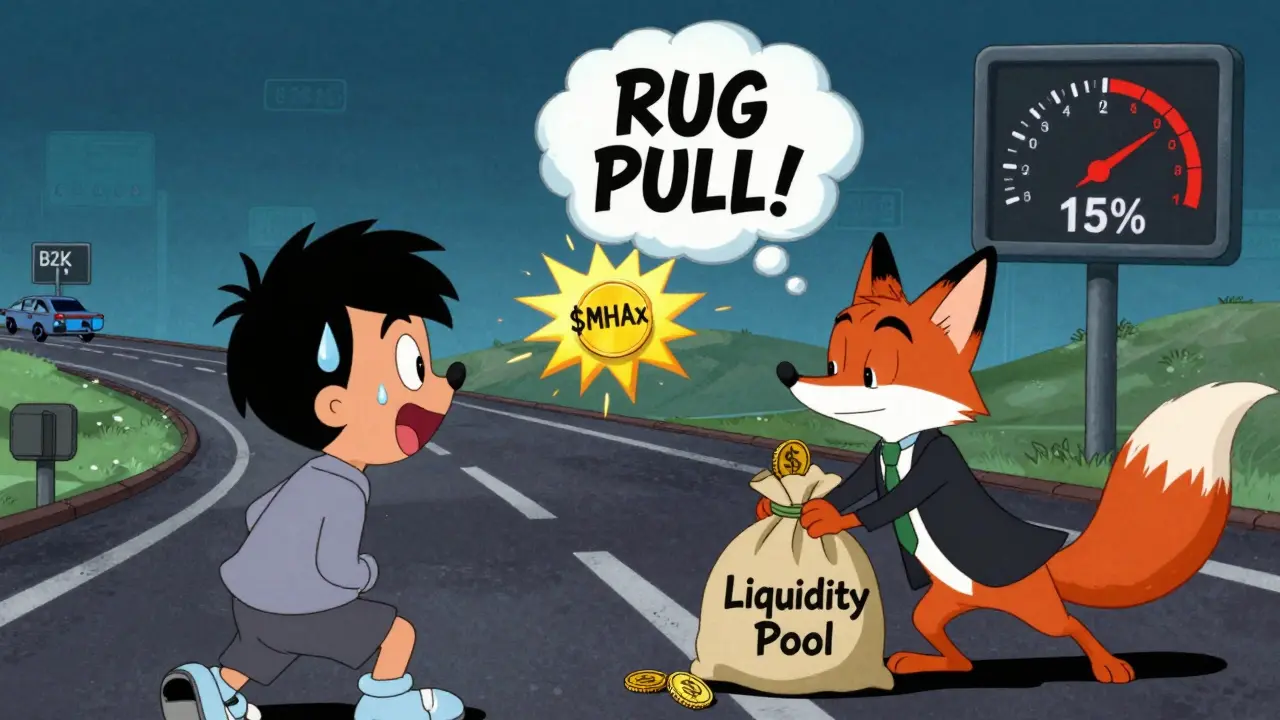
On one hand, you can get early access to projects before they hit big exchanges. On the other, many of these tokens are high-risk, low-liquidity bets. A quick look at the top 10 trading pairs shows several with less than $50,000 in daily volume. That means slippage can be brutal. If you try to trade $1,000 worth of a low-volume token, you might end up getting 15% less than you expected.
It’s not a place to trade Bitcoin or Ethereum as your main activity. It’s better suited for speculative plays on new DeFi projects. If you’re looking for stable, high-liquidity trading, stick with centralized exchanges.
Fees and Costs
MahaSwap charges a 0.2% trading fee on every swap. That’s standard for DEXs. But here’s where things get tricky: you also pay network fees - called gas - to execute trades on Binance Smart Chain.
On BSC, gas fees usually range from $0.10 to $0.50 per transaction. That’s cheap compared to Ethereum, but it adds up if you’re trading frequently. If you make 10 swaps a day, you’re spending $1-$5 just on gas. That eats into small profits.
There’s also a hidden cost: slippage tolerance. Most users set it at 1% by default. But if a token’s price moves fast - which happens often with low-cap coins - you could end up paying 3%, 5%, or even more in hidden slippage fees. There’s no way to know ahead of time unless you’re watching the order book in real time.
Compare that to centralized exchanges like Kraken or Crypto.com, where you pay 0.1% trading fees and no gas. They handle the network side for you. MahaSwap puts the burden on you.
Security and Risks
Security on MahaSwap is a double-edged sword. Since you control your wallet, no one can hack your account - unless you give away your private key. That’s good. But the platform itself has had issues.
In late 2023, a liquidity pool for a token called $MHAx was drained after a smart contract vulnerability was exploited. The team claimed it was an isolated incident and patched the code. But no audit report from a major firm like CertiK or PeckShield was ever published. That’s a red flag.
There’s also no insurance fund. If you lose funds due to a bug, scam, or mistake, there’s no recourse. Some users have reported fake MahaSwap websites that look identical to the real one. Always double-check the URL: mahaswap.finance. Any variation - like .com, .io, or .xyz - is a scam.
Wallet security is your responsibility. Use a hardware wallet if you’re trading more than a few hundred dollars. Never connect your wallet to unknown sites. And never click on links sent via Discord or Telegram claiming to be MahaSwap giveaways. Those are 100% phishing traps.
User Experience and Interface
The interface is clean, but it’s built for crypto natives. If you’ve never used a DEX before, you’ll feel lost. There’s no onboarding flow. No tutorial videos. No help button.
Adding liquidity requires you to understand impermanent loss. Trading requires you to set slippage manually. Staking $MHA tokens means you’re locking them up for a set period - and you can’t withdraw early without paying a penalty.
Mobile users have it even worse. The website works on mobile browsers, but there’s no official app. You’re stuck with a clunky mobile web experience. Compare that to Crypto.com or Coinbase, where the apps are polished, intuitive, and packed with features like price alerts and one-click buys.
Is MahaSwap Worth It?
Here’s the bottom line: MahaSwap isn’t for everyone. It’s not a replacement for Coinbase or Kraken. It’s a tool for experienced DeFi users who want to trade small-cap tokens, farm yield, or participate in early-stage projects.
If you’re new to crypto, stick with regulated exchanges. Learn how to buy, hold, and sell before jumping into DEXs. MahaSwap won’t protect you from your own mistakes.
If you’re experienced and comfortable with smart contracts, gas fees, and wallet management, then MahaSwap offers access to tokens you won’t find anywhere else. But treat it like a high-risk gambling table - not a bank.
Only use money you’re willing to lose. Never invest more than you can afford to disappear. And always, always verify the URL before connecting your wallet.
Alternatives to Consider
If MahaSwap feels too risky or too technical, here are a few alternatives:
- Uniswap (Ethereum) - More liquidity, higher gas fees, better security audits.
- PancakeSwap (BSC) - Same chain as MahaSwap, bigger user base, more established projects.
- Curve Finance - Best for stablecoin swaps with low slippage.
- Kraken or Crypto.com - If you want fiat on-ramps, customer support, and insurance.
Most of these platforms have been around longer, have public audits, and offer better user support. MahaSwap is a niche player. Don’t assume it’s better just because it’s smaller.
Final Thoughts
MahaSwap is a functional DEX with a real user base. But it’s not a safe or beginner-friendly platform. Its biggest advantage - access to new tokens - is also its biggest danger. Many of those tokens vanish within weeks.
If you’re serious about using it, start small. Test with $50. Learn how gas fees work. Watch how slippage affects your trades. Read the contract code if you can. And never trust a Telegram group that promises “10x returns.”
There’s no magic here. Just code, risk, and opportunity. And like any good gamble, you need to know the odds before you place your bet.
Is MahaSwap safe to use?
MahaSwap is as safe as your own wallet. Since it’s decentralized, there’s no central server to hack. But the platform’s smart contracts have not been publicly audited by major firms, and past exploits have occurred. Always verify the official website (mahaswap.finance), use a hardware wallet for larger amounts, and never connect your wallet to unknown sites.
Does MahaSwap have a mobile app?
No, MahaSwap does not have an official mobile app. You can access it through your mobile browser using MetaMask or Trust Wallet, but the experience is clunky and not optimized for touch. For a smoother mobile experience, use centralized exchanges like Crypto.com or Coinbase.
What are the trading fees on MahaSwap?
MahaSwap charges a 0.2% trading fee on every swap. You also pay network (gas) fees on Binance Smart Chain, which typically range from $0.10 to $0.50 per transaction. Slippage can add hidden costs - especially with low-liquidity tokens - so always check the final price before confirming.
Can I buy MahaSwap with fiat currency?
No, MahaSwap is a decentralized exchange and does not accept fiat deposits. You need to buy crypto like BNB or USDT on a centralized exchange first (like Kraken or Crypto.com), then transfer it to your wallet and connect to MahaSwap to trade.
Is MahaSwap regulated?
No, MahaSwap is not regulated by any financial authority. It operates as a decentralized protocol with no legal entity or compliance team. This means no KYC, no chargebacks, and no legal recourse if something goes wrong. Use it only if you understand and accept these risks.
What’s the MahaSwap token ($MHA) used for?
$MHA is the native token of MahaSwap. It’s used for governance voting, staking to earn rewards, and paying reduced trading fees. Staking $MHA locks your tokens for a set period and earns you a share of trading fees. But like all DeFi tokens, its value is speculative and can drop sharply.

Jacob Clark
January 13, 2026 AT 23:54Okay, so let me get this straight-you’re telling me I can just connect my wallet to some random DeFi platform with zero audits, no customer service, and a 0.2% fee that’s literally the *least* of my problems? And you call this ‘cutting through the noise’? Bro, the noise is the fact that people still think this is a good idea. I’ve seen three rug pulls this month alone that looked *exactly* like this-same UI, same token name, same ‘early access’ hype. MahaSwap? More like MahaScam Lite. 😅
Jon Martín
January 15, 2026 AT 04:13Look I get it-people are scared of DeFi because they don’t understand it. But MahaSwap? It’s not about safety, it’s about freedom. You’re not trusting a bank-you’re trusting code. And yeah, sometimes the code breaks. But that’s the price of innovation. I made 12x on a $20 bet on a token here last year. No KYC, no waiting, no corporate BS. If you’re not willing to take that risk, then stick to Coinbase and call it a day. But don’t knock the wild west just because you’re not riding a horse.
Mujibur Rahman
January 15, 2026 AT 22:56From a BSC ecosystem veteran-MahaSwap is a classic example of a fork with ambition but zero execution. The 0.2% fee is standard, but the real killer is the liquidity fragmentation. Most pairs have < $100k volume, which means your $500 trade could move the market 8%. Also, slippage tolerance at 1% is a death sentence for anything below $10M market cap. And no audit? That’s not negligence-that’s negligence wrapped in a DeFi hoodie. Stick to PancakeSwap if you want BSC exposure without the roulette wheel.
Danyelle Ostrye
January 17, 2026 AT 14:34I tried MahaSwap once. Bought a token, gas was $0.30, trade went through. Then I realized I’d sent it to the wrong address. No way to undo it. No email. No chat. Just… gone. I lost $87. I cried a little. Now I only use centralized exchanges for anything under $500. If you’re going to gamble, at least have a dealer you can yell at.
Jennah Grant
January 17, 2026 AT 18:56For those new to DEXes: slippage isn’t a fee-it’s a market impact cost. If you’re trading $1k of a token with $40k daily volume, you’re effectively front-running yourself. MahaSwap doesn’t hide this-it just assumes you know how to calculate it. The interface doesn’t explain impermanent loss because it’s not designed for beginners. That’s not a bug-it’s a feature for the self-selected. If you don’t know what APY means, don’t stake.
Dennis Mbuthia
January 18, 2026 AT 09:47Look, I’m an American, and I’ve seen this movie before: some guy in a hoodie builds a ‘decentralized’ platform, calls it ‘innovative,’ and then vanishes with $20M in liquidity. MahaSwap? It’s 2023’s version of Squid Game Coin. No audits, no team, no transparency. And yet people are still throwing money at it because ‘it’s on BSC so gas is cheap.’ Cheap? You’re paying in your peace of mind. If you’re not using a Ledger, you’re not serious. And if you’re not reading the contract code, you’re not even trying. This isn’t finance-it’s digital dumpster diving.
Dave Lite
January 19, 2026 AT 15:31Just wanted to say-MahaSwap is legit if you know what you’re doing. I’ve been farming $MHA for 6 months. Gas is cheap, the UI is clean once you get used to it, and the community Discord is actually helpful (unlike some other platforms). Just don’t go in with $5k. Start with $50. Test the waters. Watch how slippage works. And PLEASE-never trust a Telegram link. I lost a friend to a fake site last month. He thought it was real because the logo was identical. 🙏 Always double-check the URL. MahaSwap.finance. Not .io. Not .xyz. Not .app. Just that one.
Becky Chenier
January 20, 2026 AT 04:31I appreciate the balanced take. Most reviews either glorify DeFi as the future or demonize it as a scam. This one acknowledges both sides: access to alpha vs. total lack of safety nets. I think the real issue isn’t MahaSwap-it’s the expectation that decentralized means ‘safe.’ It doesn’t. It means ‘you’re responsible.’ That’s a hard lesson, but an important one. If you’re here to learn, this is a good sandbox. If you’re here to get rich, you’re already behind.
Staci Armezzani
January 21, 2026 AT 03:01For anyone thinking of trying MahaSwap: start with $20. Not $200. Not $2k. $20. Use it to learn how gas works. Learn how to adjust slippage. Learn how to read a liquidity pool. Then, if you’re still alive after a week, maybe go bigger. I taught my mom how to use MetaMask with $10. She lost it. She laughed. She learned. That’s the real value here-not the returns, but the education. This isn’t a bank. It’s a crypto bootcamp.
Don Grissett
January 21, 2026 AT 11:46Wow. So you wrote a 2000-word essay on why MahaSwap is a dumpster fire and then ended it with ‘only use money you’re willing to lose’? That’s not advice, that’s a cop-out. If you’re gonna say something’s risky, say it’s a scam. Don’t sugarcoat it with ‘opportunity.’ This isn’t Vegas-it’s a black hole where smart contracts go to die. And the fact that people still click ‘connect wallet’ without reading the terms? That’s why crypto will never go mainstream. We’re all just hoping someone else gets scammed first.
Veronica Mead
January 22, 2026 AT 05:51It is my solemn duty to inform you that the normalization of unregulated, non-audited financial instruments under the guise of ‘decentralization’ constitutes a systemic failure of both technological and ethical responsibility. The absence of KYC, insurance, or recourse is not a feature-it is a violation of fiduciary principle. To recommend such a platform as ‘functional’ is to endorse chaos as a business model. This is not innovation. This is negligence masquerading as liberation.
Mollie Williams
January 23, 2026 AT 05:17I think what’s really being asked here isn’t ‘is MahaSwap safe?’ but ‘do we still believe in permissionless innovation?’ Because if we’re going to shut down every platform that hasn’t been audited by a Big Four firm, then we’re not building the future-we’re just rebuilding Wall Street with blockchain labels. MahaSwap might be dangerous. But so was the internet in 1995. So was email. So was the ATM. We don’t eliminate risk-we learn to navigate it. The question isn’t whether MahaSwap deserves to exist. It’s whether we’re brave enough to let it.
Surendra Chopde
January 25, 2026 AT 05:07Been using MahaSwap since launch. Gas fees are low, UI is okay, but I avoid any token with less than $500k volume. Also, always check the contract on BscScan before depositing. Found one fake $MHA token with same name but different address-saved me $300. 🙏
Tiffani Frey
January 26, 2026 AT 20:36Just a quick note: if you’re reading this and thinking ‘I’ll try it with $100,’ please-stop. Go read the post again. Then go read the MahaSwap whitepaper. Then go read the contract code on Etherscan. Then come back. If you still want to try it, use a burner wallet. And if you lose it? Don’t complain. You were warned. Three times. In bold. In caps. In a footnote. This isn’t FOMO. This is survival.