Æternity isn’t just another cryptocurrency. It’s a blockchain built from the ground up to fix what’s broken in smart contract platforms like Ethereum. While most coins chase price pumps, Æternity (AE) focuses on one core problem: making smart contracts fast, cheap, and truly decentralized. If you’ve ever paid $10 in gas fees to send a $5 token, or waited minutes for a contract to confirm, Æternity’s approach might be the quiet revolution you didn’t know you needed.
How Æternity Works: Off-Chain Smart Contracts
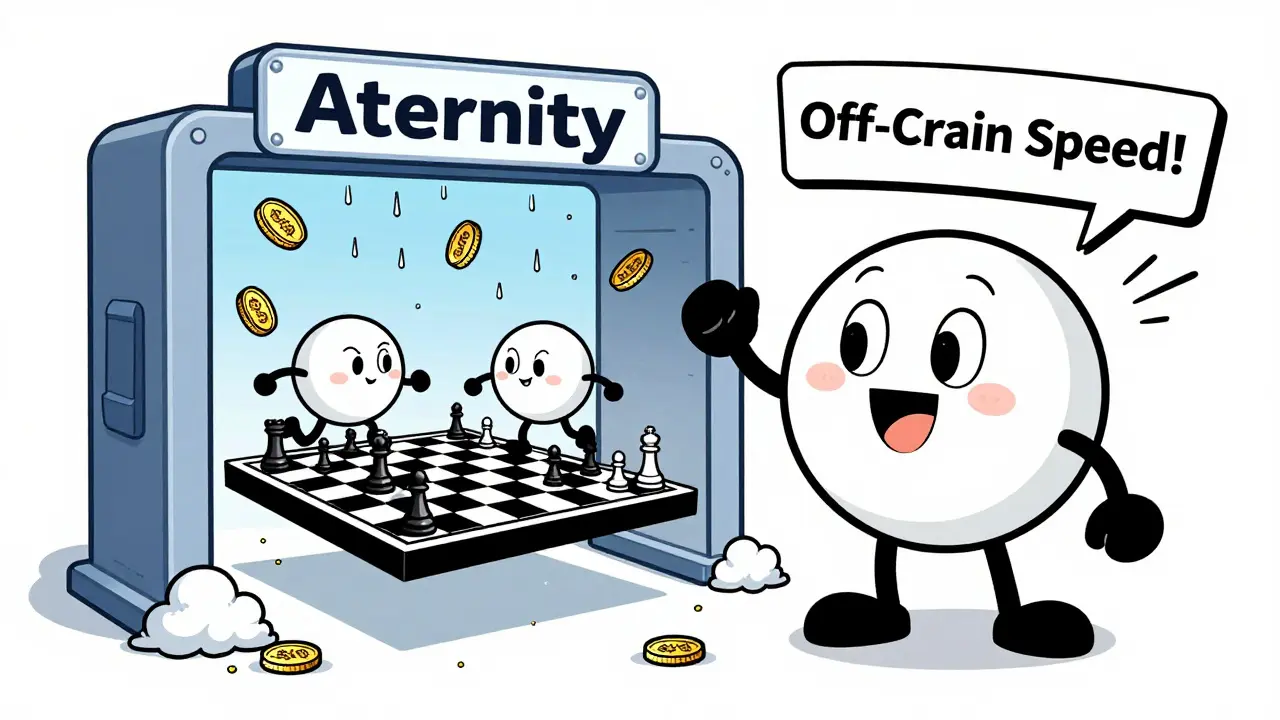
Most blockchains run every smart contract on-chain. That means every line of code, every calculation, every update gets recorded on the public ledger. It’s secure-but slow and expensive. Æternity flips this. It uses something called state channels. Think of them as private conversations between two parties, with the blockchain only stepping in if they disagree.
Imagine you and a friend play a game of chess a hundred times. Instead of recording every move on a public board, you play offline. Only if someone cheats do you show the blockchain the full record. That’s Æternity. Most transactions happen off-chain. Fees? Near zero. Speed? Instant. The blockchain only gets involved if there’s a dispute-acting like a neutral judge.
This isn’t theory. It’s built into the protocol. State channels aren’t an add-on; they’re native. That means contracts can run at web speed without bloating the chain. For microtransactions-like paying a few cents per second for streaming content or tipping creators-it’s the only practical way to make it work.
The FATE Virtual Machine: Smarter, Smaller Contracts
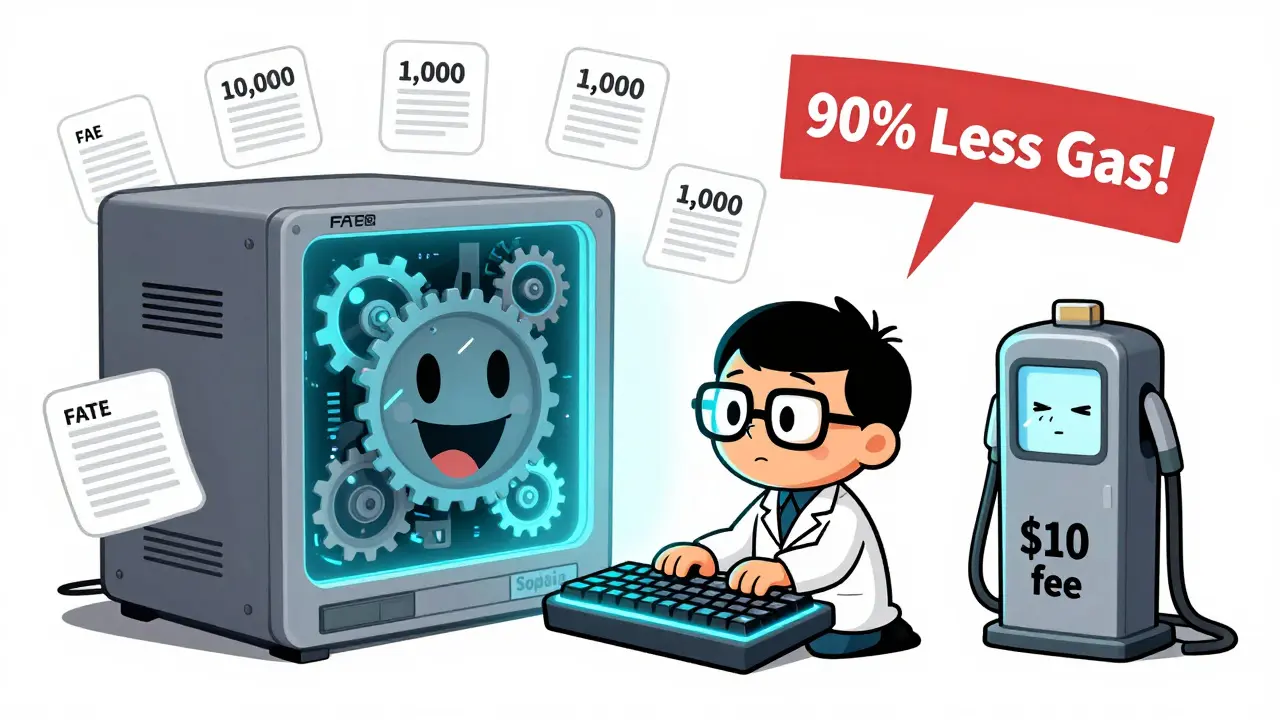
Behind the scenes, Æternity runs on the FATE (Fast Automatic Transaction Executor) virtual machine. Unlike Ethereum’s EVM, which uses a general-purpose design, FATE is built for efficiency. A smart contract on Ethereum might take 10,000 lines of code. On Æternity? Often under 1,000.
Why does that matter? Smaller code = less data = lower fees. According to Æternity’s own technical docs, FATE contracts use about 90% less gas than equivalent Ethereum contracts. That’s not a small edge-it’s a game-changer for developers building apps that need to scale. It also means fewer bugs. Less code is easier to audit, test, and secure.
FATE is written in Sophia, Æternity’s own smart contract language. It’s functional, not object-oriented like Solidity. That means it’s mathematically provable-meaning you can verify a contract does exactly what it says, without hidden loopholes. But there’s a catch: learning Sophia takes time. Developers report a 3-6 month ramp-up. That’s why adoption is still slow.
Native Oracles: Real-World Data Without Middlemen
Smart contracts need real-world data: weather, stock prices, flight delays. Most blockchains rely on third-party oracles like Chainlink. That introduces trust issues-who do you believe? Æternity solves this by building oracles into the protocol itself.
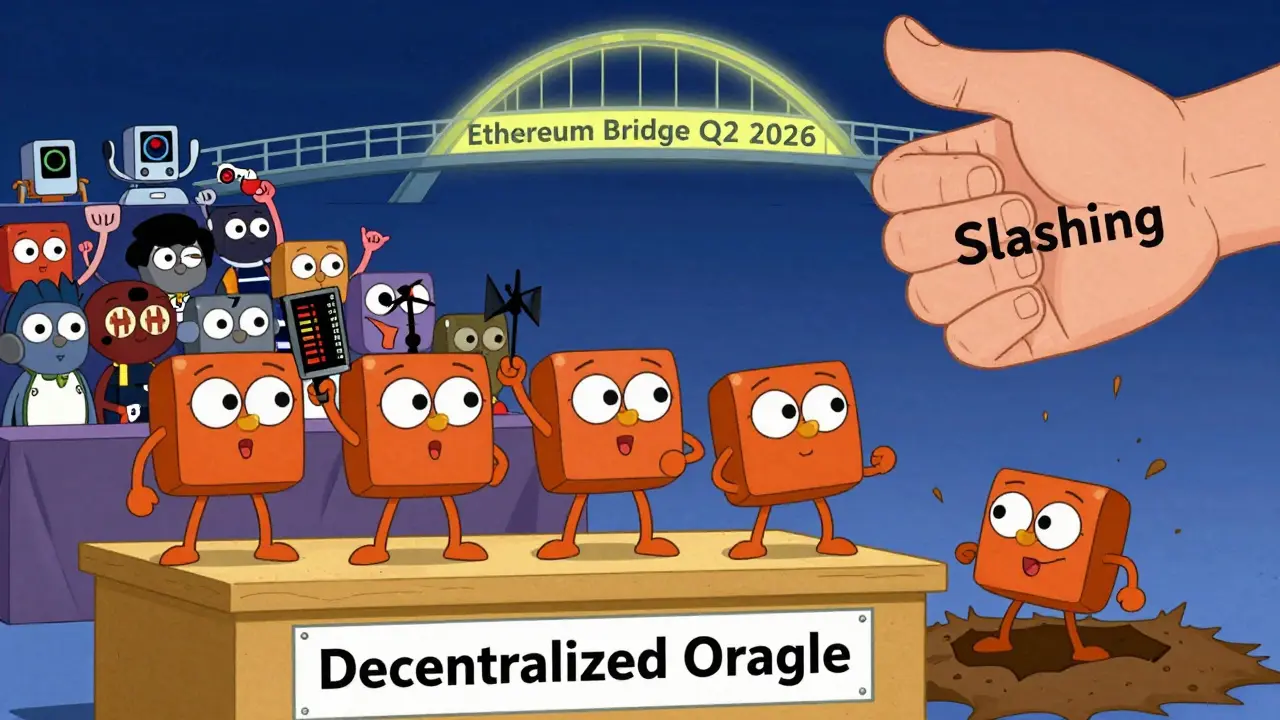
Instead of paying a third party to feed data, Æternity lets anyone become an oracle. You stake AE tokens to submit real-world info. If your data is accurate, you get rewarded. If you lie, you lose your stake. It’s a self-policing system. No middlemen. No single point of failure. This makes Æternity ideal for insurance contracts, prediction markets, or supply chain tracking where data integrity is non-negotiable.
It’s one of the few blockchains that doesn’t need an external oracle network. That’s rare. And it’s why some enterprise teams in Europe are testing it for logistics tracking-though no major public deployments have been announced yet.
AE Coin: The Fuel of the Network
The AE token isn’t just a currency. It’s the backbone of governance, security, and operation.
- Transaction fees: Every on-chain transaction costs about $0.0069. Off-chain? Free.
- Staking: You lock AE to become an oracle or validate state channels. Earn rewards in return.
- Voting: Holders vote on protocol upgrades. No centralized team decides. If 67% of staked AE votes yes, the change goes live.
The total supply is capped at 536 million AE. As of December 18, 2025, 385 million are in circulation. That means about 28% remain to be released over time-mostly through mining rewards and oracle incentives. Unlike Bitcoin, there’s no halving. The emission rate is steady, designed to support long-term network security without inflation spikes.
Performance and Market Reality
Let’s talk numbers. Æternity’s market cap sits at roughly $2.67 million as of mid-December 2025. That’s tiny compared to Ethereum’s $300 billion. Its 24-hour trading volume? Around $17,688. You won’t find it on Coinbase or Binance’s main platform. It’s listed on smaller exchanges like KuCoin and Gate.io.
Price volatility is extreme. One day, AE trades at $0.005. The next, it spikes to $0.007. That’s not speculation-it’s liquidity crunch. With so few buyers and sellers, even small trades move the price.
Analysts are split. CoinLore predicts AE could hit $3.98 by year-end 2025. That’s a 57,000% jump. CoinCodex says it’ll barely move-staying around $0.005. The truth? Nobody knows. But the fundamentals tell a different story: low fees, strong tech, but almost no users.
There are fewer than 50 active dApps on Æternity. Compare that to Ethereum’s 5,000+. Developers say the tech is brilliant-but there’s no community. You can’t find AE developers on Upwork. No bootcamps teach Sophia. The official Discord has 12,000 members, but most posts are about debugging, not building.
Who Should Care About Æternity?
If you’re a retail investor chasing the next 10x, Æternity is a gamble. The odds are low. The ecosystem is small. The trading volume is microscopic.
But if you’re a developer building something that needs:
- Zero-cost microtransactions (think gaming, IoT sensors, pay-per-use services)
- Verified real-world data without relying on Chainlink or oracles
- A truly decentralized governance model where users-not VCs-control upgrades
Then Æternity is one of the few platforms that actually delivers. It’s not for everyone. But for niche applications, it’s unmatched.
Upgrades are happening. The December 2025 protocol update cut state channel dispute times by 37%. A bridge to Ethereum is coming in Q2 2026. That could be the turning point-if developers start migrating.
Is Æternity Worth It?
Here’s the bottom line: Æternity has one of the most technically sound designs in crypto. It solves real problems others ignore. But technology alone doesn’t win. Adoption does.
Right now, Æternity is a brilliant engine in a car with no wheels. The FATE VM, state channels, and native oracles are ahead of their time. But without developers, users, and exchanges, it’s invisible.
If you’re curious, try the SDK. Set up a local node. Write a simple contract. See how fast it runs. You might be surprised. But don’t buy AE expecting to get rich. Buy it because you believe in the idea-and hope the world catches up.
What is Æternity (AE) used for?
Æternity (AE) is used for running smart contracts with near-zero fees via state channels, enabling microtransactions, decentralized oracles for real-world data, and community-governed protocol upgrades. It’s ideal for applications like gaming micropayments, IoT automation, insurance contracts, and supply chain tracking where cost and speed matter more than mass adoption.
How is Æternity different from Ethereum?
Æternity moves most smart contract execution off-chain using state channels, reducing fees to almost zero and increasing speed. Ethereum runs everything on-chain, leading to high gas fees and slower confirmations. Æternity also has built-in oracles and uses the FATE virtual machine, which is 90% more efficient than Ethereum’s EVM. But Ethereum has far more developers, apps, and users.
Can I mine Æternity (AE)?
Yes, Æternity uses proof-of-work mining, but it’s not the main way new AE enters circulation anymore. Most new tokens are released through oracle rewards and protocol incentives. Mining still exists, but it’s less profitable than staking or becoming an oracle. The network is shifting toward a hybrid model where users earn AE by providing data and securing state channels.
Where can I buy AE coin?
You can buy AE on smaller exchanges like KuCoin, Gate.io, and Bitrue. It’s not available on Coinbase, Binance, or Kraken. Always check the trading pair-AE is usually traded against BTC, ETH, or USDT. Due to low liquidity, even small trades can cause big price swings.
Is Æternity a good investment?
As an investment, Æternity is extremely high-risk. Its market cap is under $3 million, trading volume is minimal, and historical returns since launch are near zero. Some analysts predict massive growth; others say it will stay stagnant. Only invest if you believe in its technology and are willing to wait 5-10 years for adoption. Don’t buy it hoping for a quick profit.
What’s the future of Æternity?
The roadmap includes a cross-chain bridge to Ethereum (Q2 2026), improved oracle tools, and better developer onboarding. If it can attract even a small fraction of Ethereum developers, it could gain traction. But without a marketing push, developer education, or exchange listings, it risks remaining a niche project. Its future depends on whether builders see its tech as worth the learning curve.