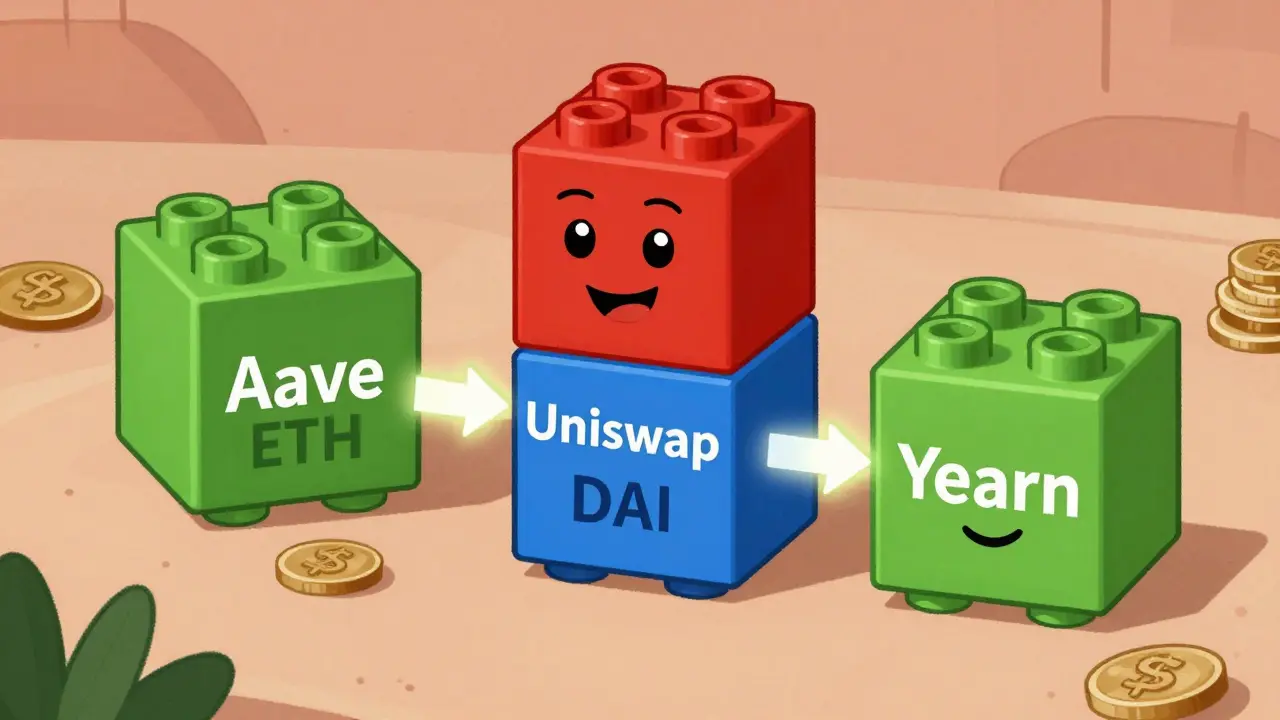
Imagine building a financial system out of Lego blocks. You grab one piece for lending, snap on another for trading, add a third for earning interest, and suddenly you’ve built a custom money machine that no bank could replicate. That’s DeFi composability-and it’s not science fiction. It’s happening right now on blockchains like Ethereum, where protocols talk to each other without permission, without middlemen, and without slowing down.
What Exactly Is DeFi Composability?
DeFi composability means that different decentralized finance protocols can connect and work together like apps on your phone. A lending protocol like Aave can talk to a decentralized exchange like Uniswap, which can then feed data to a yield aggregator like Yearn Finance-all in one transaction. No paperwork. No approvals. No delays. This isn’t just convenience. It’s a structural shift. In traditional finance, if you want to borrow against your stocks, you need to go to a broker, then a bank, then maybe a hedge fund. Each step has fees, waiting times, and gatekeepers. In DeFi, you write one smart contract that does it all at once. That’s composability: building blocks that snap together by design. The foundation? Smart contracts. These are self-executing code snippets stored on the blockchain. They follow rules like “if user deposits 1 ETH, then issue 0.95 DAI.” Because they’re public and automated, anyone can read them, test them, or build on top of them. That’s why protocols like Compound, Curve, and MakerDAO can be used as tools by other developers-no permission needed.Why Composability Makes DeFi Faster and Cheaper
In traditional finance, moving money between systems means multiple intermediaries. Each one takes a cut, adds time, and creates points of failure. In DeFi, composability cuts that out. Take flash loans. A user can borrow $1 million without collateral, as long as they pay it back within the same transaction. How? They use a lending protocol to get the funds, swap them on a DEX to make a profit, then return the loan-all in one block. No bank account. No credit check. Just code. That’s only possible because these protocols are designed to talk to each other. Gas fees, the cost of executing transactions on Ethereum, are lower when you combine actions. Instead of doing five separate transactions (deposit, swap, stake, claim, withdraw), you do one. That saves money and time. A 2025 analysis showed that users who leveraged composability reduced their average DeFi transaction costs by 42% compared to those using single protocols in isolation.Unleashing Innovation: From Simple Loans to Complex Strategies
Before composability, DeFi was mostly about lending and swapping. Now, it’s about building financial products that didn’t exist before. Think of yield farming on steroids. You deposit ETH into a liquidity pool on Uniswap. That pool earns trading fees. You then take those earned tokens and stake them in Aave to earn interest. Then you use that interest as collateral to borrow more assets, which you reinvest. All of this happens automatically through smart contracts chained together. You didn’t need to code it yourself-you used existing tools. Developers don’t have to build everything from scratch. They can use existing, battle-tested protocols as building blocks. That’s why new DeFi apps launch in weeks, not years. In 2024, over 60% of new DeFi projects were built on top of at least three other protocols. That’s the power of composability: innovation at warp speed.
Transparency and Control: You’re the Boss
In traditional finance, you trust banks, brokers, and regulators. You don’t see how your money moves. In DeFi, everything is visible. You can look up any smart contract on Etherscan and read its code. You can see exactly how your funds are being used. That means you can build your own rules. Want to only lend to protocols with a 95%+ audit score? You can code that in. Want to auto-switch your yield strategy when interest rates drop? You can set that up. You’re not stuck with whatever the bank offers-you design your own financial system. This level of control is unprecedented. And it’s only possible because protocols are composable. If they were locked down like proprietary banking software, you couldn’t mix and match. You’d be stuck with one provider’s limited options.The Hidden Risks: When One Block Falls, Others Follow
Composability isn’t risk-free. In fact, it’s where the biggest dangers hide. A bug in one protocol can ripple through the whole system. In 2022, a vulnerability in a popular oracle service caused a chain reaction: a lending protocol mispriced assets, triggering liquidations, which flooded a DEX with sell orders, which crashed token prices, which triggered more liquidations. Millions were lost-all because one small code flaw affected five connected protocols. That’s systemic risk. It’s like a house of cards. One weak card, and the whole structure collapses. The more protocols you connect, the more you rely on their security. You can’t just trust one. You have to trust all of them. That’s why audits matter. Protocols like MakerDAO and Aave have been audited dozens of times by firms like CertiK and OpenZeppelin. Newer protocols? Often not. Before you connect your funds to a new DeFi app, check its audit history. Look for public code reviews. See if it’s been live for over six months without a major exploit.
How to Use Composability Safely
You don’t need to be a coder to benefit from composability-but you do need to be smart about it.- Start small. Try one compositional strategy before stacking three or four protocols.
- Use well-known platforms. Aave, Compound, Uniswap, and Curve have years of real-world testing.
- Check the audit reports. Look for recent ones from reputable firms.
- Don’t put all your funds in one strategy. Spread exposure across different protocols.
- Use tools like DeFi Saver or Zapper. They let you visualize your exposure and manage multiple protocols in one dashboard.
The Future: More Complexity, More Responsibility
DeFi composability is still early. Right now, most users interact with one or two connected protocols. In five years, we’ll see automated financial agents-like AI-powered portfolio managers-that constantly rebalance across 10+ DeFi apps, adjusting for rates, risks, and market conditions. But that future depends on one thing: security. As systems get more interconnected, the cost of failure grows. That’s why auditors, developers, and users all need to take responsibility. Developers must write cleaner code. Users must do their homework. Auditors must keep up with complexity. The goal isn’t to stop innovation. It’s to make it safer. Composability gives us tools to build better finance. But only if we use them wisely.What’s Next for DeFi?
The next big leap? Cross-chain composability. Right now, most DeFi happens on Ethereum. But protocols on Solana, Polygon, and Arbitrum are growing fast. Soon, you’ll be able to borrow on Ethereum, swap on Solana, and earn yield on Avalanche-all in one automated flow. That’s the real promise: a global, permissionless financial network where money flows freely, efficiently, and transparently. No borders. No banks. Just code. It’s not perfect. But it’s the closest we’ve ever come to open, fair, and user-owned finance.What does DeFi composability mean in simple terms?
DeFi composability means different blockchain financial apps can connect and work together automatically, like Lego blocks snapping together. You can borrow, trade, and earn interest all in one step without needing permission from anyone.
Can I lose money because of DeFi composability?
Yes. If one protocol you’re using has a bug or gets hacked, it can affect other protocols connected to it. For example, a price oracle error in one lending app can trigger mass liquidations across multiple platforms. Always check audits and limit exposure to new or untested protocols.
Do I need to code to use composability?
No. You don’t need to write code. Tools like Zapper, DeFi Saver, and Yearn Finance let you combine protocols with just a few clicks. But you do need to understand the risks involved in connecting multiple apps.
What are the best DeFi protocols for beginners using composability?
Start with Aave for lending, Uniswap for swapping, and Curve for stablecoin trading. These are well-audited, widely used, and often integrated into user-friendly dashboards. Avoid new, low-liquidity protocols until you understand how they connect to others.
How is DeFi composability different from traditional finance?
Traditional finance uses closed systems-banks don’t let you plug your account into a hedge fund’s software. DeFi is open. Anyone can build on top of any protocol. That means faster innovation, lower fees, and full control-but also more responsibility and risk.
Is DeFi composability only for Ethereum?
Not anymore. While Ethereum is the most common, protocols on Polygon, Arbitrum, Solana, and Base are starting to connect across chains. Cross-chain composability is the next big frontier, though it’s still early and carries higher risks.
How do I check if a DeFi protocol is safe to use with others?
Look for audits from trusted firms like CertiK, OpenZeppelin, or Trail of Bits. Check the protocol’s GitHub for public code. See how long it’s been live and if there have been any exploits. Avoid protocols with no public code or no audit reports.
Can I automate my DeFi strategies using composability?
Yes. Tools like Gelato and Zapper let you set up automated actions-like rebalancing your portfolio or switching yield farms when rates change. These are called “bots” or “automated strategies,” and they rely entirely on composability to function across multiple protocols.



Heather Crane
January 24, 2026 AT 01:45This is the future, and it’s amazing!! Seriously-why are we still using banks when we can build our own financial ecosystems? I’ve been using Aave + Uniswap + Yearn for months now, and I’ve never felt more in control of my money. It’s like having a personal finance wizard who never sleeps, never charges fees, and never judges me for buying crypto instead of groceries. 🤖💸
Mike Stay
January 25, 2026 AT 02:07While the theoretical underpinnings of composability are indeed compelling, one must not overlook the systemic fragility inherent in such a tightly coupled architecture. The absence of centralized oversight does not equate to robustness; rather, it redistributes risk across an opaque network of interdependent smart contracts, each potentially containing latent vulnerabilities that, when triggered, propagate with exponential velocity. Historical precedents, such as the 2022 Oracle exploit, demonstrate that the illusion of decentralization may mask a centralized point of failure.
Taylor Mills
January 25, 2026 AT 07:08Kevin Pivko
January 26, 2026 AT 13:39Tammy Goodwin
January 27, 2026 AT 06:09I just want to say how inspiring it is to see people from all over the world experimenting with this. Even if you’re not a coder, just being curious and learning the basics is a form of resistance against old systems. Keep going, everyone. 💛
Andy Simms
January 29, 2026 AT 00:09For beginners: start with Zapper. It’s the easiest way to visualize your exposure across protocols. I’ve seen people lose money because they didn’t realize they were leveraged 3x across three different pools. Zapper shows you exactly where your funds are and what’s at risk. Also, always check the token decimals. I lost $200 once because I thought 10^18 was 1 token. It’s not. It’s 1,000,000,000,000,000,000. 😅
Bonnie Sands
January 30, 2026 AT 12:06george haris
January 31, 2026 AT 06:01I started with just one protocol last year-just staking ETH. Then I added a yield farm. Then I tried a flash loan just to see if I could. I didn’t make money, but I learned more in 2 weeks than I did in 2 years of reading finance books. This isn’t just tech-it’s a new way of thinking. You don’t wait for permission anymore. You just build.
Mark Estareja
January 31, 2026 AT 11:58The emergent complexity of composability creates an epistemological vacuum wherein user agency is ostensibly expanded but functionally diluted by cognitive overload. The illusion of autonomy is reinforced through gamified interfaces that mask the underlying entanglement of risk vectors across heterogeneous protocol layers. One must question: is the user truly sovereign, or merely a node in a distributed system designed to extract attention and capital?
David Zinger
February 1, 2026 AT 21:13Sara Delgado Rivero
February 2, 2026 AT 15:41Athena Mantle
February 4, 2026 AT 10:37Look, I’m not here to ‘educate’ you. But if you’re not using a vault that’s been audited by OpenZeppelin AND has a 99.99% uptime score AND is integrated with Chainlink, then you’re just a peasant with a wallet. 🫠
carol johnson
February 5, 2026 AT 01:04I mean… I just want to say… I’ve been doing DeFi since 2021. I’ve seen everything. I’ve lost everything. I’ve rebuilt everything. And now? I just sit back and watch the bots fight each other. It’s like watching chess… but with more panic and less dignity. 🎭
Paru Somashekar
February 6, 2026 AT 05:00As a user from India, I would like to emphasize that DeFi has provided financial access to millions who were previously excluded from formal banking. The composability model allows even small investors to participate in global markets without intermediaries. However, regulatory uncertainty remains a challenge. We need clearer guidelines-not bans-to protect users while encouraging innovation.
Steve Fennell
February 7, 2026 AT 17:50Just wanted to say thank you for writing this. I showed it to my mom-she’s 72, never used crypto before-and she said, ‘So it’s like a digital piggy bank that talks to other piggy banks?’ And I cried. Because yes. Yes, it is. ❤️
Chidimma Catherine
February 7, 2026 AT 19:18Nathan Drake
February 9, 2026 AT 13:45Composability forces us to confront a deeper question: if finance is code, then what is value? Is it the token? The liquidity? The consensus? Or is it simply the collective belief that this system, however fragile, is worth maintaining? The answer may not be in the contracts-but in the humans who choose to believe in them.
Melissa Contreras López
February 9, 2026 AT 23:23Y’all are overthinking it. I’m a single mom who works two jobs. I use Yearn to auto-compound my DAI. I don’t know what a reentrancy attack is. I just know my money grows while I sleep. And that’s enough. If you’re scared, start with $10. If you’re curious, try it. If you’re ready to grow? Go wild. You’ve got this. 💪✨
HARSHA NAVALKAR
February 11, 2026 AT 06:33I read this entire post. Then I sat in silence for 20 minutes. I didn’t comment. I didn’t react. I just… felt it. This isn’t just tech. It’s a quiet revolution. And most people won’t even notice until it’s already here. And then they’ll ask: why didn’t anyone tell me?