
Imagine trying to swap two different tokens on a decentralized exchange back in 2018. You couldn't just trade Token A for Token B; you had to trade A for Ethereum, and then trade that Ethereum for Token B. It was like taking a detour through a different city just to get to the shop next door. That all changed when Uniswap v2 is a decentralized exchange (DEX) protocol that allows direct ERC-20 to ERC-20 token swaps without needing ETH as an intermediary. Launched in May 2020, it basically rewrote the rulebook for how we trade crypto without a middleman.
Even though newer versions and flashy new chains have come out, Uniswap v2 still handles around $150 million in daily volume. Why? Because for some people, the simplicity of the "old way" is actually a feature, not a bug. If you're looking for a straightforward way to swap tokens without fighting with complex settings, this is where you start.
The Big Deal: Why v2 Changed Everything
The real magic of Uniswap v2 is the move away from the "ETH-centric" model. In the first version, every single pair had to be paired with Ethereum. v2 introduced the Pair Contract, which lets any two ERC-20 tokens form their own pool. This means if you want to swap DAI for USDC, the protocol finds the most efficient path to do it directly.
It uses what's called an Automated Market Maker (AMM). Instead of a traditional order book where buyers and sellers wait for a match, v2 uses a mathematical formula: x * y = k. In plain English, it means the pool always keeps a balance between two assets so that there's always a price available, no matter how large or small the trade is. This permissionless system allows anyone to list a token, which is why you'll find thousands of obscure coins here that aren't on big centralized exchanges.
How it Actually Works for the User
Getting started is pretty easy. You don't need to create an account, upload a passport, or wait for an email verification. All you need is a Web3 wallet-MetaMask is the most common choice, used by nearly 90% of the user base. Once you connect your wallet, you pick the token you have and the token you want. The interface does the heavy lifting, routing your trade through the best available pools to minimize slippage.
One thing you'll notice is the fee structure. Uniswap v2 set the industry standard with a 0.3% swap fee. A portion of this goes back to the liquidity providers-the people who put their own money into the pools to make trading possible. It's a simple, transparent system: you pay a small fee for the convenience of an instant trade.
| Feature | Uniswap v1 | Uniswap v2 | Uniswap v3 |
|---|---|---|---|
| Token Pairs | Only Token/ETH | Any ERC-20/ERC-20 | Any ERC-20/ERC-20 |
| Liquidity Model | Full Range | Full Range | Concentrated Liquidity |
| Capital Efficiency | Low | Moderate | Very High |
| Ease of Use | Simple | Very Simple | Complex (Range setting) |

The Trade-offs: Gas, Slippage, and Impermanent Loss
It's not all sunshine and rainbows. Because Uniswap v2 lives on the Ethereum mainnet, you are at the mercy of gas fees. During a massive market rally or an NFT craze, a simple swap can cost you $50 or more in network fees. While L2 solutions have mitigated this for newer versions, v2 users often feel the burn of congestion.
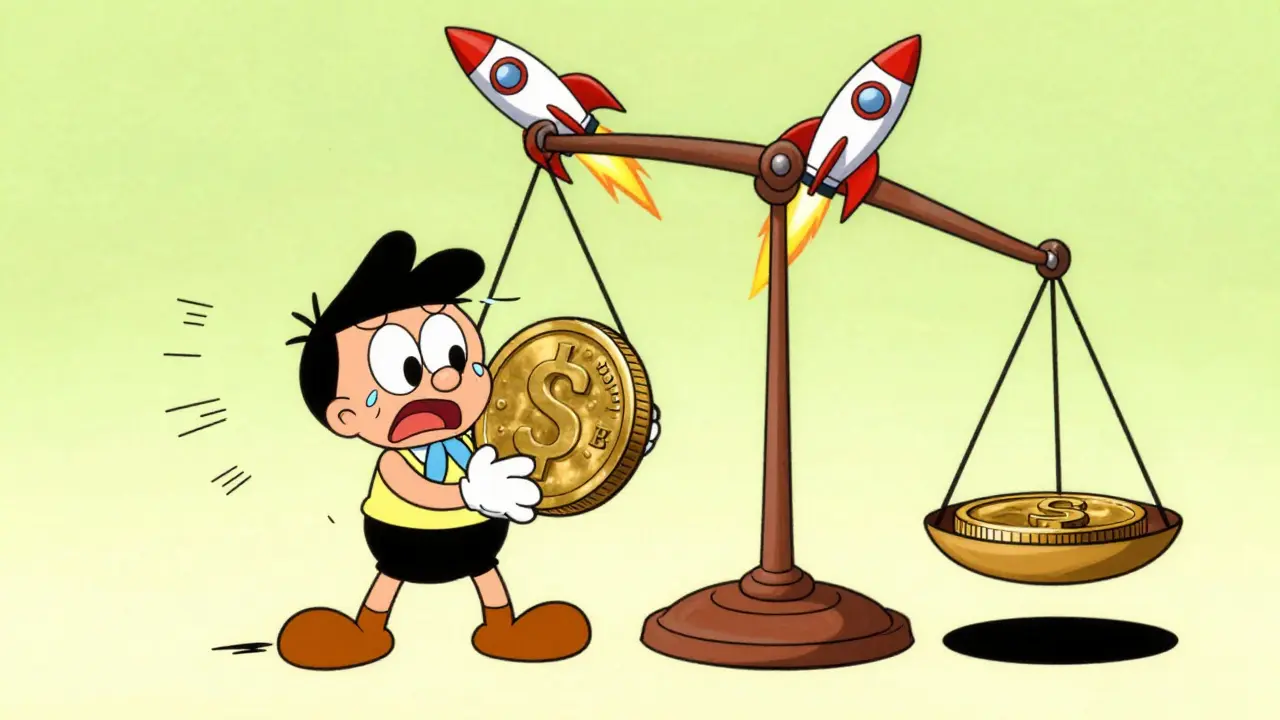
Then there's Impermanent Loss. This is the silent killer for liquidity providers. Since v2 pools are always a 50/50 split by value, if one token in the pair skyrockets in price while the other stays flat, the AMM formula forces the pool to sell the winning asset to maintain the ratio. You might find that you would have been better off just holding the tokens in your wallet instead of providing liquidity.
Slippage is another hurdle. If you're trading a token with very low liquidity (a "long-tail" token), a large order can move the price significantly against you. Most experienced traders set their slippage tolerance between 0.5% and 2% to avoid getting a bad deal or having the transaction fail entirely.
Is it Still Relevant in 2026?
You might wonder why anyone would use v2 when v3 offers concentrated liquidity (which is vastly more efficient) or why they wouldn't just use Unichain. The answer is usually "long-tail assets." Many smaller or older projects never migrated their liquidity to v3 because it's too complex to manage price ranges. If you're hunting for a niche token, v2 is often the only place with a deep enough pool to make the trade viable.
Furthermore, the v2 codebase is so legendary that it became the blueprint for dozens of other exchanges. If you've ever used Sushiswap or PancakeSwap, you're essentially using a modified version of Uniswap v2. Its influence is baked into the very foundation of decentralized finance (DeFi).
Quick Setup Checklist for New Users
- Get a Wallet: Install MetaMask or Rabby and secure your seed phrase.
- Fund with ETH: You'll need Ethereum to pay for the gas fees (transaction costs).
- Check the Contract: Since anyone can list a token, double-check the contract address on a site like Etherscan to avoid scams.
- Set Slippage: For stablecoins, 0.5% is fine; for volatile tokens, try 1-2%.
- Execute Swap: Connect, select tokens, and confirm the transaction in your wallet.
What is the difference between Uniswap v2 and v3?
The biggest difference is "concentrated liquidity." In v2, your money is spread across all possible prices from zero to infinity. In v3, liquidity providers can choose a specific price range to provide liquidity, which makes the capital much more efficient and potentially more profitable, though it requires more active management.
Are there any KYC requirements for Uniswap v2?
No. Because it is a decentralized protocol running on a blockchain, there are no sign-up forms, ID checks, or email verifications. You only need a compatible crypto wallet to interact with the smart contracts.
Why did my transaction fail on Uniswap v2?
The most common reason is "slippage." If the price of the token changes too quickly between the time you click "swap" and the time the block is mined, the transaction will fail to protect you from getting a terrible price. Try slightly increasing your slippage tolerance in the settings.
Is providing liquidity on v2 risky?
Yes, primarily due to impermanent loss. If the price of the assets in your pool diverges significantly, you may end up with less total value than if you had just held the assets separately. There is also the risk of smart contract bugs or "rug pulls" if you provide liquidity for a scam token.
Does Uniswap v2 support tokens other than ERC-20?
Uniswap v2 is specifically designed for the Ethereum ecosystem and its ERC-20 standard. While other versions or forks (like PancakeSwap on BNB Chain) support different standards, the core v2 protocol is built for Ethereum-based tokens.
Next Steps and Troubleshooting
If you're experiencing high gas fees, consider moving your assets to a Layer 2 solution or looking for the same token pair on a v3 pool if it's available. If you're a developer looking to build your own DEX, the Uniswap v2 GitHub remains one of the best educational resources for understanding AMM logic.
For those who are new to DeFi, the safest way to start is by swapping small amounts of stablecoins (like USDC to DAI) to get a feel for how slippage and wallet approvals work before diving into more volatile assets.
Robert Smith
April 26, 2026 AT 13:24V2 is just vibing 🌊
Jimmy vasquez
April 28, 2026 AT 10:45If anyone is struggling with the slippage settings, just remember that for highly volatile pairs, going up to 3% is sometimes necessary during peak volatility to avoid those annoying failed transactions. It's a trade-off between price precision and execution success.
Emily A
April 28, 2026 AT 13:13The explanation of impermanent loss is fundamentally correct, yet it fails to emphasize that this is a mathematical certainty in any constant-product AMM. One must realize that providing liquidity is essentially betting that the trading fees collected will outweigh the loss incurred by the price divergence of the assets. Many novices ignore this risk and are shocked when their portfolio value drops despite the underlying assets increasing in value. It is a basic tenet of DeFi that requires rigorous understanding before committing capital.
Felix Eduardo Velasquez
April 30, 2026 AT 09:56The enduring nature of v2 reflects a fundamental truth in software: stability and predictability often outweigh marginal efficiency gains. While v3 is a technical marvel, the cognitive load of managing ranges creates a barrier to entry that v2 simply doesn't have. We are seeing a return to the 'set and forget' mentality in liquidity provision, which speaks to the psychological needs of the average investor over the optimization needs of the professional trader.
Michael Repak
May 1, 2026 AT 15:40This is such a great breakdown!!! I really love how you explained the x*y=k part!!! It makes it so much easier to understand for beginners!!! Keep it up!!!
Bevon Findley
May 2, 2026 AT 13:59Honestly, using v2 in 2026 is such a vintage move. Very classy :)
edie rosa
May 3, 2026 AT 02:08Typical DeFi glorification. People act like these 'permissionless' systems are a utopia, but they just shift the risk from a centralized entity to the user's own inability to read a contract. It's honestly exhausting seeing people treat a 0.3% fee like it's some revolutionary act of charity when the LPs are the ones actually taking all the risk for pennies. The lack of oversight isn't a feature, it's a glaring hole that allows scams to flourish while the 'community' just shrugs it off as a learning experience. It's morally bankrupt to push these tools on people who don't understand how a liquidity pool actually drains their value during a crash.
Lloyd I
May 4, 2026 AT 06:35I totally agree with the point about long-tail assets! Let's all try to help newcomers find the right pools so they don't get caught in those rug pulls mentioned in the FAQ. We're all in this together to learn and grow!
debra hoskins
May 5, 2026 AT 03:05The whole 'simplicity is a feature' argument is just a fancy way of saying people are too lazy to learn how to set a price range. It's quaint that we still pretend this dinosaur is relevant when the capital efficiency is practically subterranean compared to modern standards. I'll stick to my ranges and leave the 'vintage' trading to those who enjoy burning money on gas fees for the sake of nostalgia.
Ryan Nakielny
May 6, 2026 AT 16:00Imagine paying $50 in gas for a swap and calling it 'classic'. Truly a peak financial experience.
VIVEK SINGH
May 7, 2026 AT 09:35Oh, look at us, still discussing the 'revolutionary' v2 in 2026. How quaint. I suppose the 'philosophy' of simplicity is just a mask for the fact that most users can't grasp basic calculus. It's almost touching how we cling to these early relics of DeFi while the world moves toward actual scalability. But please, let's continue to celebrate the 50/50 split as if it's a masterstroke of genius and not just the most basic AMM implementation possible. Absolute poetry in inefficiency.
Janis Naglis
May 9, 2026 AT 03:02I'm feeling so bullish on this aural atmosphere of inclusivity!!! The synergy between the liquidity providers and the swap users is just peak DeFi optimization!!! We can definitely leverage these legacy pools to create a more robust ecosystem for everyone involved!!! Just keep focusing on those stablecoin pairs to mitigate the delta risk!!!
Andrew Todd
May 11, 2026 AT 01:33v2 is for losers. US tech made this and we still run the show. Simple as.
Pramendra Singh
May 12, 2026 AT 11:27It is very kind of you to share this guide. I think many people will find the checklist very helpful for their first steps into the world of decentralized trading.
Kristi Swartz
May 12, 2026 AT 22:39you forgot to mention that the x*y=k formula is just a hyperbola it is basic math and anyone who thinks this is complex is just not paying attention to the fundamentals of the protocol
Harvey Alford
May 14, 2026 AT 18:35Still using MetaMask? Get a real wallet.
Lynne Teperman
May 16, 2026 AT 09:48such a vivid tapestry of old school crypto
those long tail assets are like hidden gems in a dusty attic
AP Fisher
May 17, 2026 AT 12:39I wonder if there is a way to see all the v2 pools in one list? That would be a really cool way to find those niche coins you talked about.
Alex Mazonowicz
May 18, 2026 AT 09:22This is just awesome!!! Thanks for the heads up on the slippage settings!!! Really helps out a lot!!!