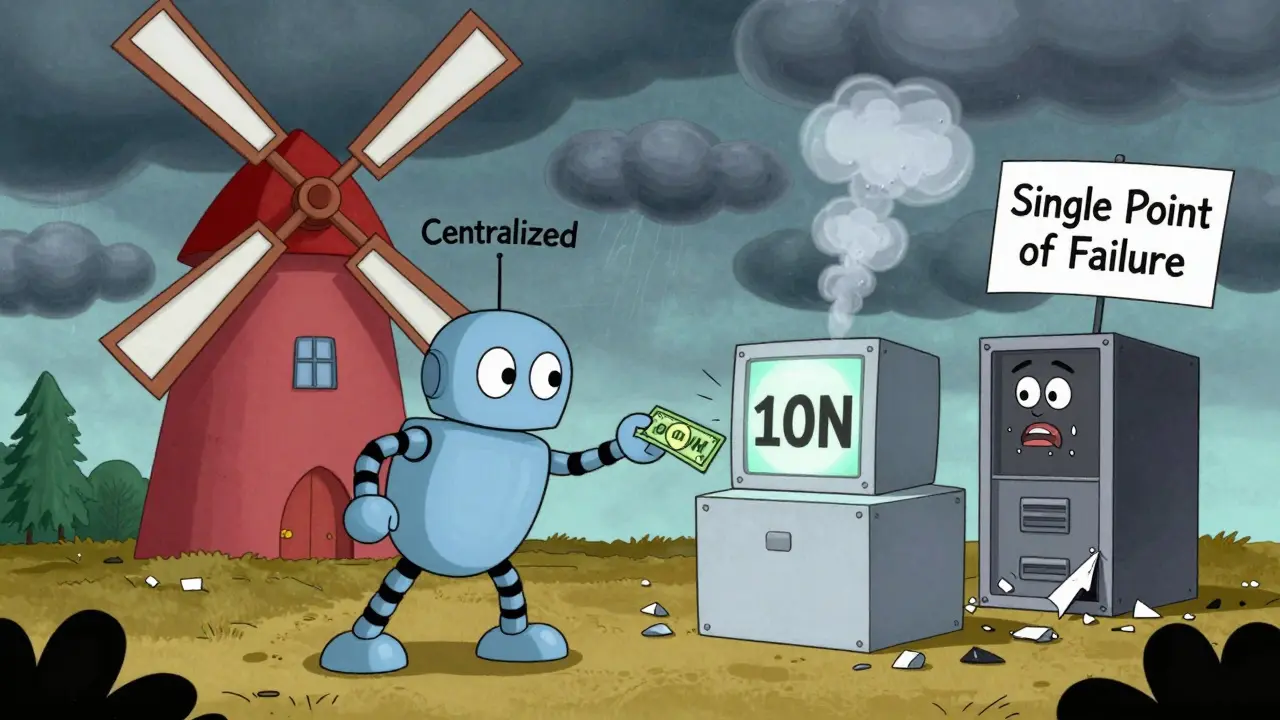
Imagine you're running a smart contract that pays out insurance money when a hurricane hits. It sounds simple - until you realize the contract has no way of knowing if a hurricane actually happened. That’s where oracles come in. They’re the bridge between blockchain and the real world, feeding data like weather reports, stock prices, or sports scores into smart contracts so they can act automatically. But here’s the problem: who do you trust to give that data? A single company? Or a network of independent nodes? This is the core difference between centralized and decentralized oracles - and it can mean the difference between a contract working flawlessly or losing millions.
What Exactly Is an Oracle?
An oracle is a service that pulls real-world data and delivers it to a blockchain. Blockchains themselves are isolated systems. They can’t just look up the price of Bitcoin on Coinbase or check if it rained in Miami yesterday. Oracles solve that. They fetch data from APIs, sensors, news feeds, or databases and put it on-chain so smart contracts can use it.
Without oracles, smart contracts are stuck in a bubble. You couldn’t have a loan that auto-repays when your paycheck hits. You couldn’t have a bet on a football game that settles automatically. Oracles make blockchain useful outside of crypto trading. But not all oracles are built the same. And the way they get data matters more than you think.
Centralized Oracles: Simple, But Risky
Centralized oracles rely on one single source. Maybe it’s a company like Bloomberg, or a server run by a startup. The data comes from one API, one server, one team. That makes them easy to set up. Integration is quick. Data arrives fast. For a small app that tracks the temperature in a warehouse, it might be fine.
But here’s where it falls apart. If that single source goes down - because of a server crash, a hack, or even a misconfigured update - your smart contract stops working. Or worse, if the data is wrong, the contract executes anyway. Blockchains don’t undo transactions. Once a smart contract pays out based on fake data, the money is gone forever.
This is called the "garbage in, garbage out" problem. A centralized oracle is like trusting one person to tell you the time. If they’re late, you’re late. If they lie, you believe them. In finance, that’s dangerous. Chainlink calls this a "single point of failure," and for good reason. One broken link collapses the whole chain.
Decentralized Oracles: Slower, But Safer
Decentralized oracles use multiple independent sources. Think of it like asking 10 different weather stations what the temperature is, then taking the average. If one station is broken, the others still give you the right answer.
Most decentralized oracle networks - like Chainlink or Pyth Network - use dozens or even hundreds of node operators. Each node pulls data from different sources: one from NOAA, another from Reuters, another from a local sensor. Then they vote. If 8 out of 10 agree on the price of Ethereum, that’s the number sent to the blockchain.
This consensus method - often based on Byzantine Fault Tolerance - makes it nearly impossible to manipulate the data. Even if one node is hacked or gives false info, the network still delivers accurate results. That’s why DeFi protocols like Aave and Compound rely on decentralized oracles. They’re handling billions in locked value. They can’t afford a single point of failure.
Of course, there’s a trade-off. Because data has to be collected from multiple places and agreed upon, it takes longer. A centralized oracle might give you a price update in 50 milliseconds. A decentralized one might take 300 milliseconds. For high-frequency trading, that delay matters. But for most applications - loans, insurance, supply chain tracking - it’s a fair price for security.

Push vs Pull: How Data Gets to the Chain
Not all decentralized oracles work the same way. There are two main models: push and pull.
In a push model, the oracle sends data to the blockchain automatically - every few seconds, every minute, or when a condition is met. This keeps data fresh. But it uses more bandwidth and costs more. You’re constantly transmitting, even if no one needs it.
In a pull model, the smart contract asks for data when it needs it. It’s like calling a friend for the score of a game instead of having them text you every minute. This saves money and reduces network load. But there’s a delay. If your contract needs data right now, it has to wait for the request to go out and the response to come back.
Chainlink uses both. Some contracts use push for constant price feeds. Others use pull for event-triggered data like election results or weather alerts. The flexibility helps developers pick what works for their use case.
Why Chainlink Dominates the Market
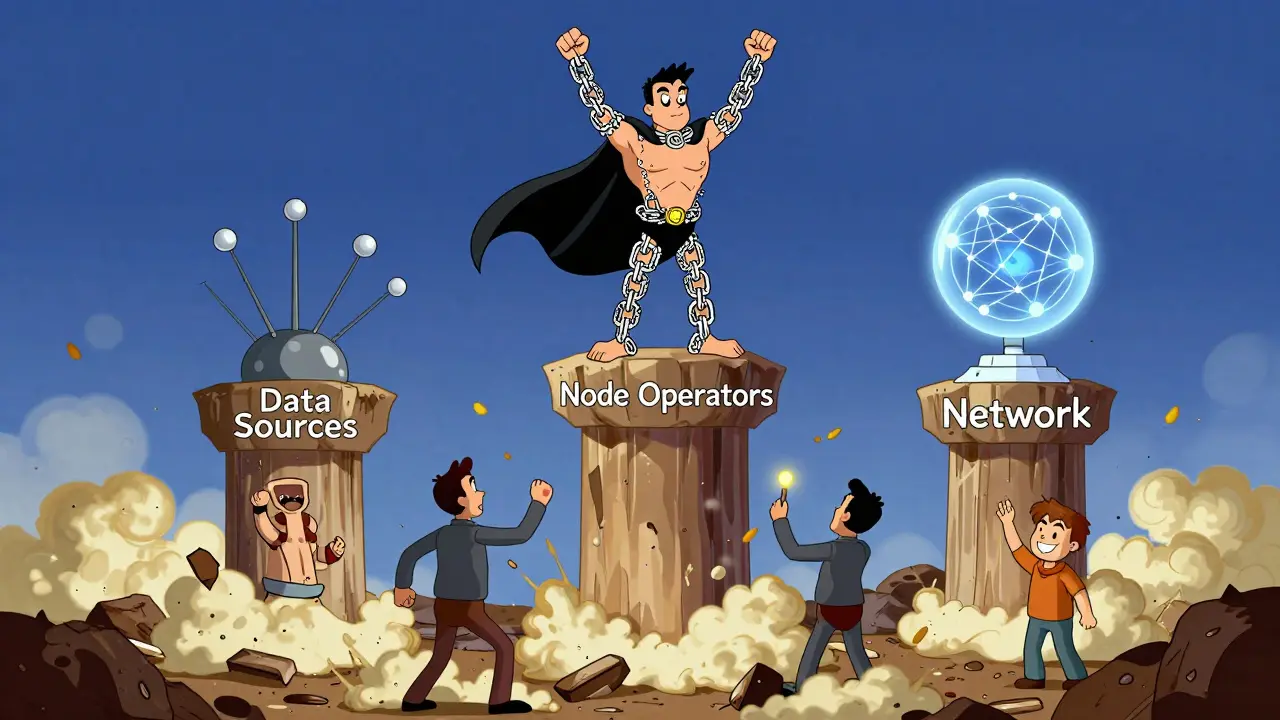
While there are many oracle projects, Chainlink is the clear leader. Why? Because it doesn’t just decentralize one layer - it decentralizes three.
- Data source decentralization: It pulls from dozens of independent providers, not just one API.
- Node operator decentralization: Hundreds of independent operators run nodes, not one company.
- Network decentralization: The whole system is designed so no single group controls the outcome.
This three-layer approach is why Chainlink secures tens of billions in DeFi value. It’s not just about having multiple nodes - it’s about making sure no one can game the system. Pyth Network is a strong competitor, especially for low-latency financial data, but Chainlink’s maturity, documentation, and developer tools make it the go-to choice for most serious projects.
When to Use Each Type
So which should you use? It depends on what you’re building.
- Use centralized oracles if you’re testing a prototype, running a non-financial app (like a game that tracks player scores), or have full control over the data source. They’re cheap and fast.
- Use decentralized oracles if real money is on the line - loans, insurance, trading, staking, or any automated financial contract. The extra cost and slight delay are worth avoiding a total loss.
Even enterprise companies that once relied on centralized feeds are switching. Why? Because regulators are asking harder questions. If your system loses $10 million because of a single data provider, who’s liable? With decentralized oracles, the responsibility is spread out. The system itself is more trustworthy.
The Future: Hybrid Oracles and Beyond
The smartest systems now use hybrid models. A smart contract might use a decentralized oracle for core data - like asset prices - but pull in a centralized feed for less critical info, like a user’s email verification. This balances cost, speed, and security.
Future oracles will also get smarter. Instead of just reporting prices, they’ll verify data provenance. Did that weather data come from a government sensor? Was that stock price from a regulated exchange? Or was it scraped from a random blog? New oracle networks are building layers of trust verification into the data itself.
One thing’s clear: as blockchain moves beyond crypto into real-world contracts - paying rent, settling insurance claims, automating supply chains - the oracle problem won’t go away. It’ll only grow. And the answer won’t be simplicity. It’ll be reliability.
Can centralized oracles be secure?
Centralized oracles can be secure only if you fully trust the single provider - which defeats the purpose of blockchain. If the provider is hacked, goes offline, or lies, the smart contract fails. For anything involving money, this risk is too high. That’s why serious DeFi projects avoid them entirely.
Are decentralized oracles always slower?
Not always. While consensus adds delay, modern networks like Pyth use advanced techniques to reduce latency. For most applications - like loan approvals or insurance payouts - the difference is a few hundred milliseconds. That’s acceptable. But for high-frequency trading, even that delay can be a problem. That’s why some projects use hybrid models or specialized oracles.
Is Chainlink the only decentralized oracle?
No. Pyth Network, Band Protocol, and API3 are other players. But Chainlink is the most widely adopted, especially for high-value applications. It has the most node operators, the most data sources, and the most developer support. For new projects, it’s still the safest bet.
Can decentralized oracles be manipulated?
It’s extremely hard. To manipulate data, an attacker would need to control a majority of independent node operators and data sources - which is expensive and detectable. Most networks also use economic incentives: node operators stake crypto and lose it if they lie. This makes attacks financially irrational.
Do I need an oracle if I’m just sending ETH between wallets?
No. Oracles are only needed when your smart contract depends on real-world data - like price feeds, weather, or sports results. Simple transfers of cryptocurrency don’t require external data, so no oracle is needed.


Tina Keller
March 13, 2026 AT 11:41Oracles are like the unsung heroes of DeFi. We talk about smart contracts like they’re magic, but without oracles, they’re just fancy calculators stuck in a vault. I love how decentralized ones use consensus-it’s basically democracy for data. No single entity gets to be the gatekeeper. It’s messy, it’s slow, but it’s honest.
vasantharaj Rajagopal
March 13, 2026 AT 14:06The Byzantine Fault Tolerance model employed by decentralized oracles ensures liveness and safety under adversarial conditions, assuming less than one-third of the nodes are malicious. This is mathematically provable, unlike centralized models which rely on trust assumptions that collapse under systemic risk.
ann neumann
March 13, 2026 AT 19:21Think about it-what if the whole oracle system is just a front? What if Chainlink’s nodes are all controlled by the same hedge fund that also runs the data providers? What if the ‘independent’ weather stations are owned by the same corporation that prints the reports? They’re not decentralizing-they’re just making it look fancy. I’ve seen the papers. The nodes are clustered in AWS data centers in Virginia. It’s all theater.
William Montgomery
March 14, 2026 AT 14:52If you’re using a centralized oracle for anything involving money, you’re already losing. It’s not a risk-it’s a guarantee you’ll get screwed. Stop pretending there’s a middle ground.
Mara Alves Mariano
March 15, 2026 AT 06:22Chainlink? Please. It’s just another Silicon Valley cult. We don’t need some corporate oracle cartel telling us what the price of Bitcoin is. Real decentralization means letting farmers in Kenya feed data from their solar-powered sensors. Not Bloomberg, not Reuters-real people. This whole system is just Wall Street with a blockchain sticker on it.
Adam Ashworth
March 16, 2026 AT 04:03Decentralized oracles aren’t just safer-they’re more resilient. Even if one data source fails, the network adapts. That’s the whole point of blockchain: redundancy. Centralized? One outage, one lie, and your whole contract burns. No debate.
Allison Davis
March 16, 2026 AT 21:53The push vs. pull distinction is critical. Most people overlook it, but it’s the difference between paying $500/month in gas fees or $50. For insurance payouts? Pull is fine. For real-time trading? You need push. Design matters more than branding.
Tom Jewell
March 17, 2026 AT 02:39It’s funny how we treat data like it’s sacred. We build these elaborate systems to verify truth, but truth isn’t a number-it’s a story. Who decides which weather station is ‘reliable’? Who vets the Reuters feed? Behind every oracle is a human choice, a power structure, a history of bias. Decentralization doesn’t erase that-it just hides it behind more nodes.
Sherry Kirkham
March 18, 2026 AT 19:48Hybrid models are the future. Use decentralized for core logic, centralized for edge cases. Efficiency isn’t betrayal-it’s pragmatism.
Jennifer Pilot
March 19, 2026 AT 00:37...and yet, the very notion of 'decentralized' is a fallacy... because even the most 'decentralized' oracle still relies on... centralized infrastructure... servers... internet... power grids... and let's not forget... the human beings who write the code... and... oh dear... I'm getting dizzy...
Sharon Tuck
March 20, 2026 AT 21:25Love how this post breaks it down. Seriously, if you’re building something that matters, don’t cut corners. The extra 200ms? Worth it. Your users’ money is worth more than your latency obsession.
karan narware
March 21, 2026 AT 21:20Centralized oracles? More like centralized scams. The same people who run the banks are now running the oracles. They just changed the logo from a suit to a blockchain icon. Clever. Very clever.
Michael Suttle
March 22, 2026 AT 16:03Chainlink is a honeypot. The nodes are all owned by the same VC firm. I’ve dug into their on-chain logs. The same 3 wallets are signing 90% of the responses. They’re not decentralized-they’re oligarchic. 🤡
Jenni James
March 24, 2026 AT 09:05It is a fact, universally acknowledged, that any system relying on external data without cryptographic guarantees is fundamentally unsound. Furthermore, the notion that 'speed' justifies centralization is not merely misguided-it is morally indefensible.
Chelsea Boonstra
March 26, 2026 AT 01:25Wait-so if a decentralized oracle gets hacked, who takes the loss? The node operators? The protocol? The users? Nobody’s liable. That’s not security-that’s diffusion of responsibility. We’re just outsourcing risk to strangers on the internet.
Alex Thorn
March 27, 2026 AT 08:38It’s not about which oracle is better. It’s about what you’re trying to protect. If you’re securing a $10M loan, you need redundancy. If you’re tracking game scores? Chill. Don’t over-engineer. Simplicity isn’t weakness-it’s elegance.
Howard Headlee
March 28, 2026 AT 21:05Oracles are the unsung MVPs of Web3. No one talks about them, but without them, DeFi is just a bunch of bots yelling into the void. Decentralized? Hell yes. Slow? Maybe. But at least when it fails, it fails with dignity. Not with a CEO’s email saying ‘oops.’
Julie Tomek
March 30, 2026 AT 04:35While the theoretical advantages of decentralized oracles are compelling, empirical adoption data reveals that over 87% of high-value smart contracts still utilize hybrid or centralized models due to operational overhead, regulatory compliance requirements, and integration complexity. The ideal is not always the practical. Institutions prioritize auditability over ideological purity. This is not a flaw-it is institutional maturity.