You buy a token because you think it’s going to the moon. You hold it for two years. Then one day, the SEC knocks on your door-or rather, the developer’s-and says, "That thing you bought? It wasn’t just tech; it was an unregistered security." Suddenly, your investment is in legal limbo, the exchange delists the token, and your exit liquidity vanishes.
This isn’t a hypothetical nightmare. It’s the daily reality for anyone operating in the U.S. crypto market as of late 2026. The question "Are cryptocurrencies securities?" doesn’t have a simple yes or no answer. It depends entirely on how the token functions, who controls it, and what promises were made when you bought it. If you’re confused about why Bitcoin gets a pass while other tokens face lawsuits, you’re not alone. This article breaks down exactly how regulators decide what counts as a security, using real cases and current data to help you navigate this messy landscape.
The Core Rule: Decoding the Howey Test
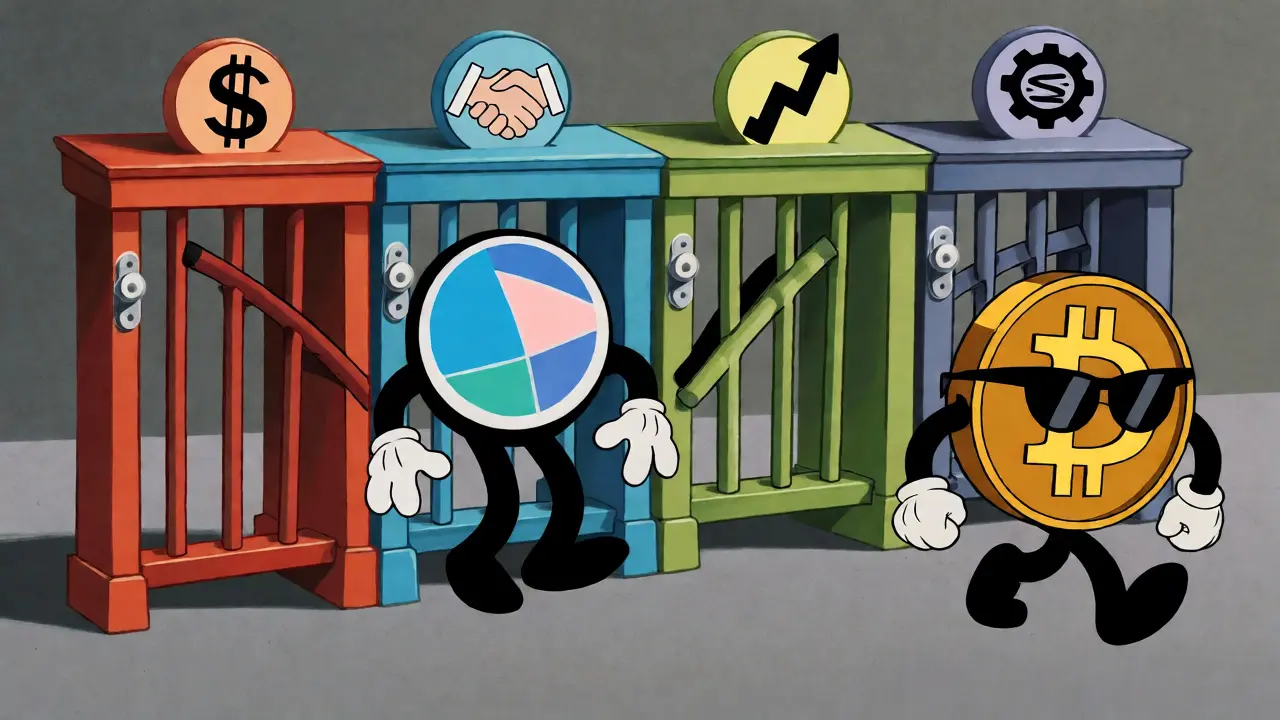
To understand if a crypto asset is a security, you have to look back to 1946. That’s when the Supreme Court ruled in SEC v. W.J. Howey Co., establishing the four-part test that still governs today. Regulators don’t care if you call your token a "utility," a "governance coin," or a "meme coin." They apply the Howey Test to determine if an arrangement constitutes an investment of money in a common enterprise with a reasonable expectation of profits derived from the efforts of others.
Let’s break those four prongs down into plain English:
- Investment of Money: Did you pay cash, crypto, or other value for the token?
- Common Enterprise: Is your success tied to the success of the project or other investors?
- Reasonable Expectation of Profits: Did you buy it primarily to make money, not just to use it?
- Efforts of Others: Are the profits coming from your work, or from the developers’ marketing, coding, and management?
If the answer to all four is "yes," you likely own a security. This is where most ICOs from 2017 failed. Developers promised massive returns based on their future roadmap, making the buyers passive investors relying on the team’s effort. Compare that to buying a coffee at Starbucks-you expect value (coffee), but you aren’t expecting the barista’s hard work to directly generate stock dividends for you.
Why Bitcoin and Ethereum Are Different
Most people assume all crypto is treated equally by the government. It’s not. There is a distinct hierarchy. As of early 2026, both the CFTC (Commodity Futures Trading Commission) and the SEC generally agree that Bitcoin and Ether are commodities, not securities. Why? Because they meet the criteria for decentralization.
Bitcoin launched in 2009. Over fifteen years, its network has become so decentralized that no single person or company controls its price movement. When you buy BTC, you aren’t betting on Satoshi Nakamoto’s ability to run a company; you’re betting on global adoption and network effects. Ethereum followed a similar path. While it started with a more centralized foundation, its transition to Proof-of-Stake and the sheer number of validators mean the "efforts of others" prong of the Howey Test becomes much harder to prove.
However, this status isn’t automatic. It’s earned through time and decentralization. This concept, often called the "decentralize-and-morph" theory, suggests a token might start as a security during its initial funding phase (when the team is small and active) but can evolve into a commodity once the network matures. This distinction is critical for new projects: just because Ethereum is a commodity doesn’t mean your new Layer-2 token automatically is too.
The Gray Area: Utility Tokens vs. Investment Contracts
Here is where things get tricky. Many projects claim their token is a "utility token"-a key that unlocks access to a platform. Think of it like a bus ticket. You buy it to ride the bus, not because you think the bus company will double your money next year.
But regulators look at substance over form. In the case of Telegram which returned $1.2 billion in tokens after the SEC deemed its Grams sales as unregistered securities offerings, the court noted that despite being labeled utility, the primary driver of demand was speculation on price appreciation, not actual usage of the Telegram app. If a token has no immediate use case and everyone is holding it only to sell it higher later, it looks a lot like a security.
A useful heuristic here is the "Use Case Check":
- Can you actually use the token right now for something tangible?
- If the price dropped to zero tomorrow, would users still need the service?
- Is the token essential to the protocol's operation, or just a speculative asset attached to it?
Tokens that fail these checks often end up in the SEC’s crosshairs. For example, the enforcement action against Kik Interactive resulted in a penalty for selling Kin tokens without registering them as securities highlighted that even established companies can misstep if their token economics prioritize investor returns over user utility.
The Stablecoin Complication
Stablecoins add another layer of complexity. Are they securities? Usually, no-but it depends on the collateral.
| Asset Type | Primary Regulator | Classification | Key Reason |
|---|---|---|---|
| Bitcoin | CFTC | Commodity | Highly decentralized; no central entity drives profits. |
| Ethereum | CFTC/SEC (Agreed) | Commodity | Sufficient decentralization achieved post-launch. |
| Fiat-Collateralized Stablecoins (e.g., USDC) | State/Treasury | Payment Instrument | Pegged to USD; low profit expectation. |
| Algorithmic Stablecoins (e.g., TerraUSD) | SEC/CFTC | Security/Commodity (Contested) | Profit mechanisms often rely on issuer’s algorithmic control. |
| New ICO Tokens | SEC | Security | Reliance on developer efforts for value growth. |
Fiat-backed stablecoins like USDC are generally treated as payment instruments regulated under state money transmission laws. You buy them to preserve value, not to grow it. However, yield-bearing stablecoins or algorithmic models that promise interest payments blur the line. If a stablecoin pays you 5% APY because the issuer invests your funds, that yield looks suspiciously like a dividend from a security.
Real-World Consequences of Misclassification
Why does this matter? Because getting it wrong costs billions. The regulatory uncertainty has driven significant capital offshore. According to recent industry reports, over 30 U.S.-based crypto projects relocated between 2023 and 2025, citing the hostile regulatory environment as a primary factor.
Consider the Ripple Labs case where the SEC alleged XRP was an unregistered security, leading to a multi-year lawsuit that settled partially in 2023. While exchanges won a partial victory regarding programmatic sales, institutional sales were deemed securities. This split decision created chaos. Exchanges had to delist XRP temporarily, hurting retail traders who couldn’t buy or sell easily.
Then there’s the staking issue. When you stake ETH or SOL, you earn rewards. The SEC has argued in cases like Kraken which paid a $30 million settlement for offering unregistered staking services that staking programs are investment contracts. If Kraken manages the nodes and you just hand over coins for a return, that fits the Howey Test. But if you run your own node, you’re doing the work yourself. The difference between a compliant and non-compliant activity can be as thin as who presses the button to validate the transaction.
What’s Next: Legislative Hope and Enforcement Reality
We are currently in a transitional period. The introduction of bills like the Responsible Financial Innovation Act aims to codify definitions, potentially creating a safe harbor for truly decentralized networks. Until then, the SEC continues its "regulation by enforcement" strategy.
For investors, the takeaway is caution. Don’t assume a token listed on a major exchange is legally cleared. Exchanges often list assets pending litigation outcomes. For builders, the rule of thumb is clear: if you want to avoid securities law, focus on utility first, decentralization second, and avoid promising profits from your own managerial efforts.
Is every cryptocurrency a security?
No. Major assets like Bitcoin and Ethereum are widely recognized as commodities due to their high level of decentralization. However, many newer tokens, especially those sold via Initial Coin Offerings (ICOs) with promises of future profits driven by a central team, are classified as securities by the SEC.
How does the Howey Test apply to crypto?
The Howey Test determines if a transaction is an "investment contract." It asks four questions: Was there an investment of money? Is there a common enterprise? Is there a reasonable expectation of profits? Do those profits come from the efforts of others? If yes to all, the asset is likely a security.
Why are stablecoins not usually considered securities?
Most fiat-collateralized stablecoins (like USDC or USDT) are designed to maintain a fixed value, not to appreciate. Buyers do not have a "reasonable expectation of profit," which fails one of the key prongs of the Howey Test. They are typically regulated as payment instruments or money transmitters instead.
Does running my own node make my staking rewards safe from securities laws?
It helps significantly. If you perform the validation work yourself, you are arguably deriving profits from your own efforts, not the "efforts of others." However, this is a nuanced area, and regulations vary by jurisdiction. Centralized staking services provided by exchanges are more likely to be scrutinized as securities offerings.
What happens if I buy an unregistered security?
You may face delisting from exchanges, meaning you can’t easily sell your asset. In some cases, issuers may offer rescission rights, allowing you to sell the token back to them at the original purchase price plus interest, though this process can be slow and complex.