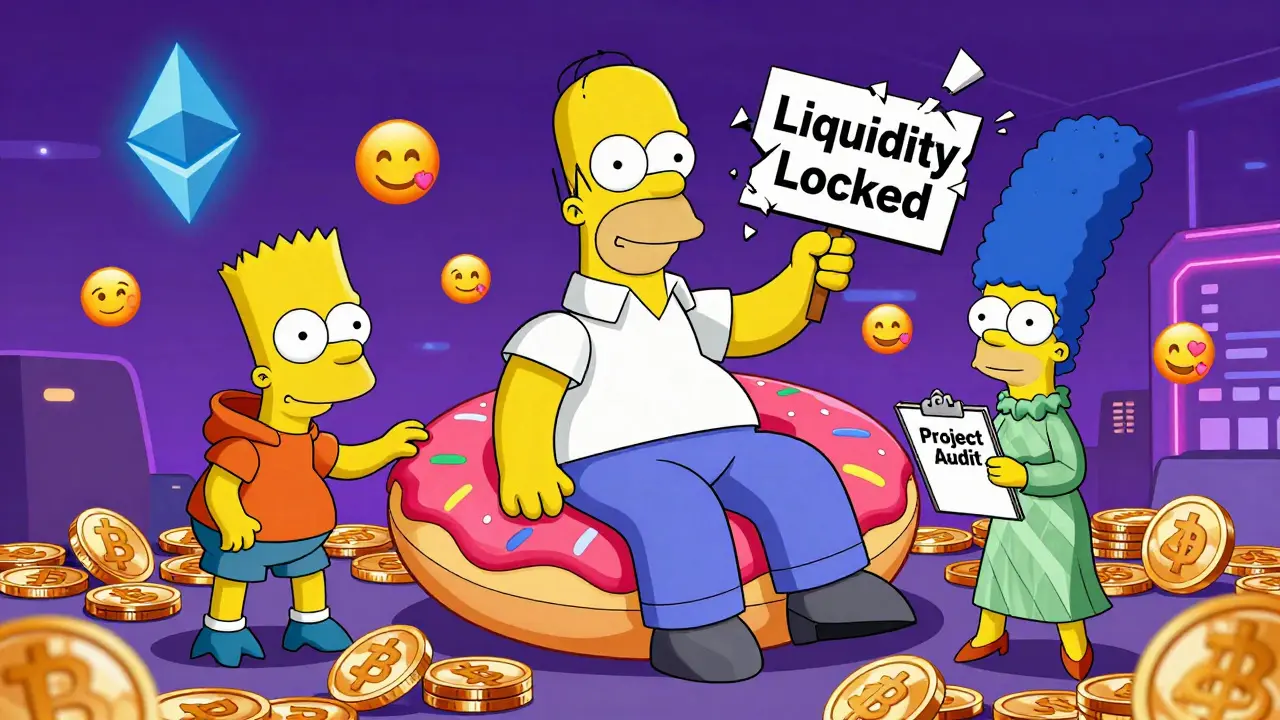
Ever seen a crypto coin named after Homer Simpson and wondered if it’s real - or just a joke with a blockchain? Meet Homer (SIMPSON 2.0), one of the weirdest, wildest, and riskiest tokens ever launched. It’s not a game. It’s not a utility coin. It’s a meme with a wallet.
Launched on the Ethereum network as an ERC20 token, Homer (SIMPSON 2.0) has a total supply of 420 trillion coins. Yes, you read that right - 420,000,000,000,000 tokens. The number isn’t random. It’s a nod to internet culture, where 420 means weed, chaos, and meme magic. And just like those memes, this coin doesn’t care about logic. It’s built for fun, hype, and the occasional wild payday.
How did Homer crypto even get started?
The team behind it? All fictional characters from The Simpsons. Bart Simpson is listed as lead developer. Marge Simpson runs the project. Ned Flanders handles community outreach. No real names. No public team. Just cartoon avatars and a website that looks like it was made in 2021 and never updated. And yet, they claimed to have done a full audit and KYC verification. That’s rare for meme coins. Most vanish after a pump. This one stuck around - barely.
Here’s the kicker: 100% of all 420 trillion tokens were released at launch. No team tokens. No private sales. No reserve. That sounds fair, right? But here’s the catch - with that many coins floating around, each one is worth almost nothing. A single Homer coin is worth about $0.00000012. To buy one dollar’s worth, you’d need over 8 million coins. That’s not a coin. It’s a digital grain of sand.
What’s the price been doing?
Homer’s price history reads like a rollercoaster with no tracks. It hit its all-time high on July 7, 2023, at $0.000000114138. Then it dropped. Hard. By October 2023, it hit $0.000000136756 - yes, higher than the peak. That’s not a typo. Meme coins flip like this all the time. Liquidity is thin. One whale moves 50 billion coins, and the price spikes or crashes.
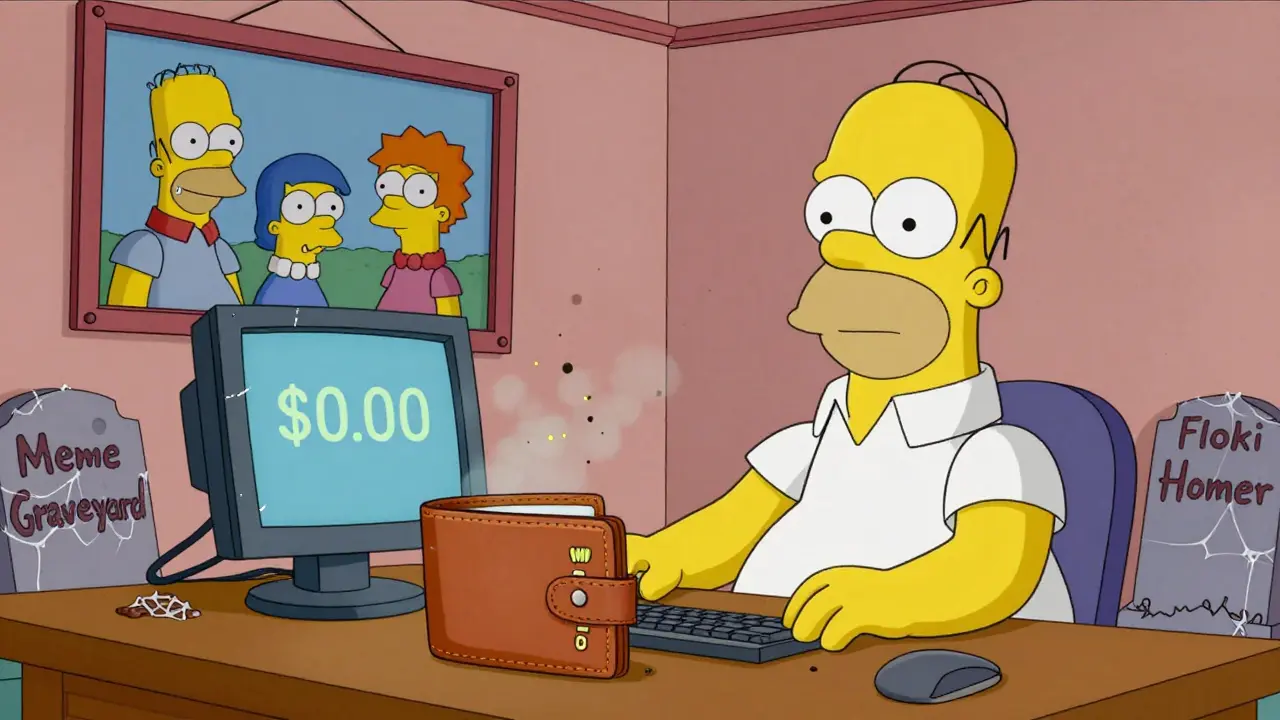
By late 2025, prices were bouncing between $0.000000121 and $0.000000125. Sounds stable? It’s not. Daily trading volume hovered around $2.00. Sometimes $0. That’s not trading. That’s someone refreshing their wallet and hoping. For comparison, Bitcoin moves over $20 billion daily. Homer moves less than your coffee.
Market cap? More like market whisper.
Market cap numbers for Homer vary wildly. One site says $42,692. Another says $121,000. A third says $1.12 million. Why? Because with near-zero volume, every trade distorts the number. A single buy order of 5 trillion coins can make the market cap jump 10x. That’s not a market. That’s a spreadsheet glitch.
Homer ranks #406 among meme coins and #1749 among all Ethereum tokens. That’s not impressive. It’s invisible. Out of over 10,000 crypto assets, it’s buried in the bottom 15%. And its market dominance? 0.00%. Nobody cares.
So what’s the point? AI bots and fake utility
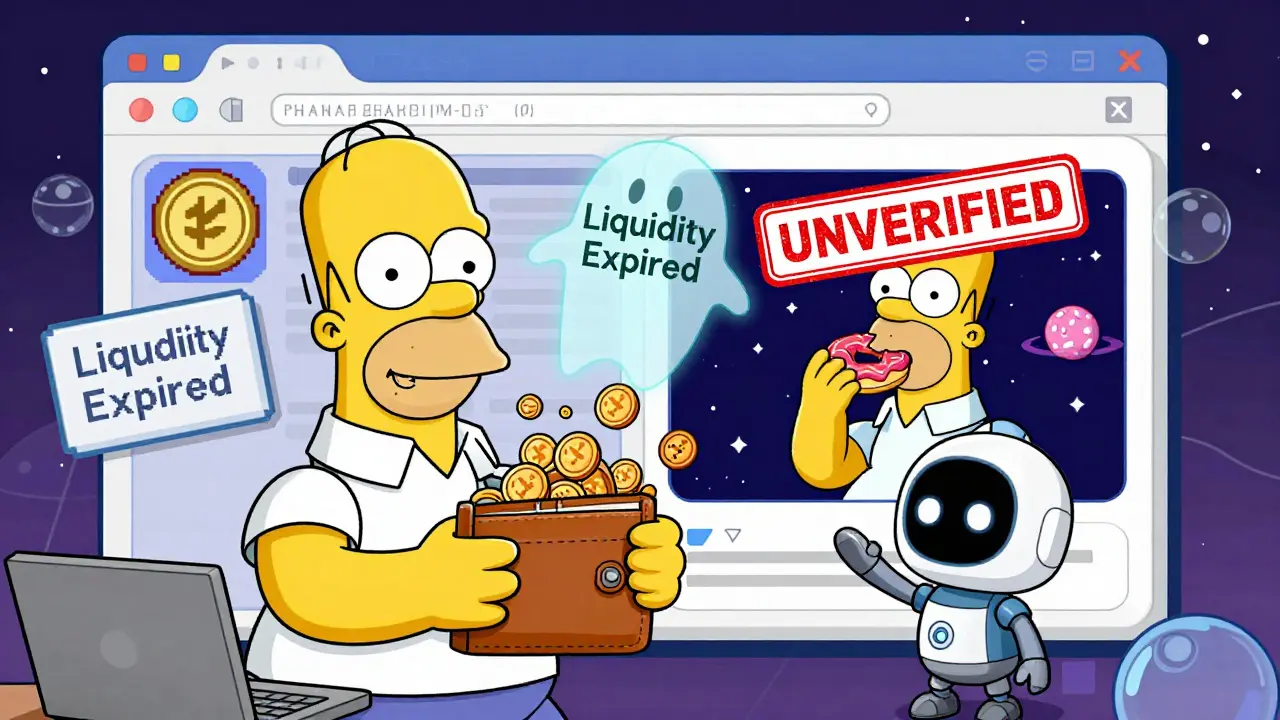
Here’s where Homer tries to sound serious. The team built two AI bots - one on Twitter, one on Telegram. The Twitter bot answers questions about the coin. The Telegram bot generates images from text. Like, if you type “Homer eating donuts in space,” it makes a picture. Cool? Maybe. But there are thousands of free AI image tools. Why pay attention to this one?
These bots aren’t utility. They’re distractions. They’re marketing tricks to make people think “this project has substance.” But there’s no revenue. No product. No service. Just bots running on free cloud servers and a Discord channel that’s mostly spam.
Is it safe? The locked liquidity myth
The project claims liquidity is locked for one year. That means no one can pull out the money backing the trading pair. Sounds safe? It was - until it expired. Liquidity locks usually last 12 months. Homer launched in early 2023. By early 2024, that lock was gone. No one announced it. No update. Just silence. And now? Nobody knows if liquidity is still there. The contract hasn’t been re-locked. That’s a red flag bigger than a giant donut.
And KYC? They said they did it. But no public proof. No name. No ID. No verification link. Just “we did it.” That’s not trust. That’s a hope.
Can you still buy it?
Yes. But not on Coinbase, Binance, or Kraken. You need a decentralized exchange like Uniswap or PancakeSwap. You connect your MetaMask or Binance Wallet. You search for SIMPSON 2.0. You swap ETH or BNB for Homer. And then? You’re stuck with it. No major exchange lists it. No ETF. No futures. Just you, a wallet, and a coin worth less than a penny.
Some wallets like Phantom list it as “unverified.” That means your wallet won’t warn you - but it also won’t protect you. If the team vanishes tomorrow, your coins turn to dust. And they can. No one’s legally responsible. No regulator watches this. It’s the wild west, with Homer Simpson as the sheriff.
Who’s buying this stuff?
People who think meme coins are “easy money.” People who saw a 100x gain on Dogecoin and thought, “I can do that.” But Dogecoin had millions of users, media coverage, and Elon Musk tweets. Homer has cartoon characters and a $2 daily trade volume.
Some claim it’s a “long-term play.” That’s nonsense. There’s no roadmap. No updates. No team. Just a static website and bots that answer the same five questions over and over.
Bottom line: Is Homer crypto worth it?
No. Not as an investment. Not as a tool. Not even as a joke.
If you want to laugh at crypto - sure, buy a few trillion coins. Spend $5. See what happens. But don’t call it investing. Don’t put in savings. Don’t believe the hype. This isn’t a coin. It’s a digital carnival ride. And the ride is already over.
There are thousands of meme coins. Most die within months. Homer is still alive - but only because no one cared enough to kill it. That’s not a sign of strength. It’s a sign of indifference.
Is Homer (SIMPSON 2.0) a real cryptocurrency?
Yes, it’s technically real - it exists on the Ethereum blockchain as an ERC20 token. But it has no intrinsic value, no team, no utility, and no long-term plan. It’s a meme coin built for fun, not finance.
Can I make money trading Homer crypto?
You might get lucky, but it’s extremely unlikely. With daily trading volume often under $5 and a market cap under $50,000, even small trades can swing the price 20-30%. That means you could lose money faster than you can click buy. Most people who trade it lose everything.
Why does Homer have 420 trillion coins?
It’s a meme reference. 420 is internet slang for cannabis culture. Meme coins often use absurd numbers to signal they’re not serious - and to make prices look “cheap.” In reality, it just makes each coin worth almost nothing.
Are the AI bots on Homer’s project actually useful?
They’re novelty features, not real utility. The bots can answer basic questions or generate silly images, but you can do the same for free with ChatGPT or Midjourney. They’re there to make the project seem more advanced than it is - which it isn’t.
Is Homer crypto listed on major exchanges like Binance or Coinbase?
No. It’s only available on decentralized exchanges like Uniswap or PancakeSwap. You need a crypto wallet to buy it. Major exchanges won’t list it because it has no volume, no credibility, and no regulatory compliance.
What happened to the one-year liquidity lock?
It expired in early 2024. There was no announcement. No update. No re-locking. The liquidity is now unsecured, meaning anyone could pull the funds and crash the price overnight. That’s why most analysts consider it a high-risk, potentially abandoned project.
Is Homer crypto a scam?
It’s not a scam in the legal sense - no one stole money. But it’s a classic pump-and-dump setup with no transparency, no team, and no future. It’s designed to attract buyers during hype, then fade away. If you’re holding it, you’re holding a gamble.
Should I invest in Homer crypto?
No. Not unless you’re willing to lose every dollar you put in. There’s no fundamental reason to believe it will grow. No revenue, no users, no innovation. It’s pure speculation on internet culture - and that’s not investing. It’s gambling with a blockchain.
rajan gupta
March 18, 2026 AT 17:55Billy Karna
March 20, 2026 AT 05:02Cheri Farnsworth
March 21, 2026 AT 08:17Gene Inoue
March 22, 2026 AT 21:06Ricky Fairlamb
March 23, 2026 AT 22:16Sahithi Reddy
March 24, 2026 AT 02:19Katrina Smith
March 24, 2026 AT 13:12Anastasia Danavath
March 26, 2026 AT 11:13anshika garg
March 27, 2026 AT 02:40Bruce Doucette
March 28, 2026 AT 05:03