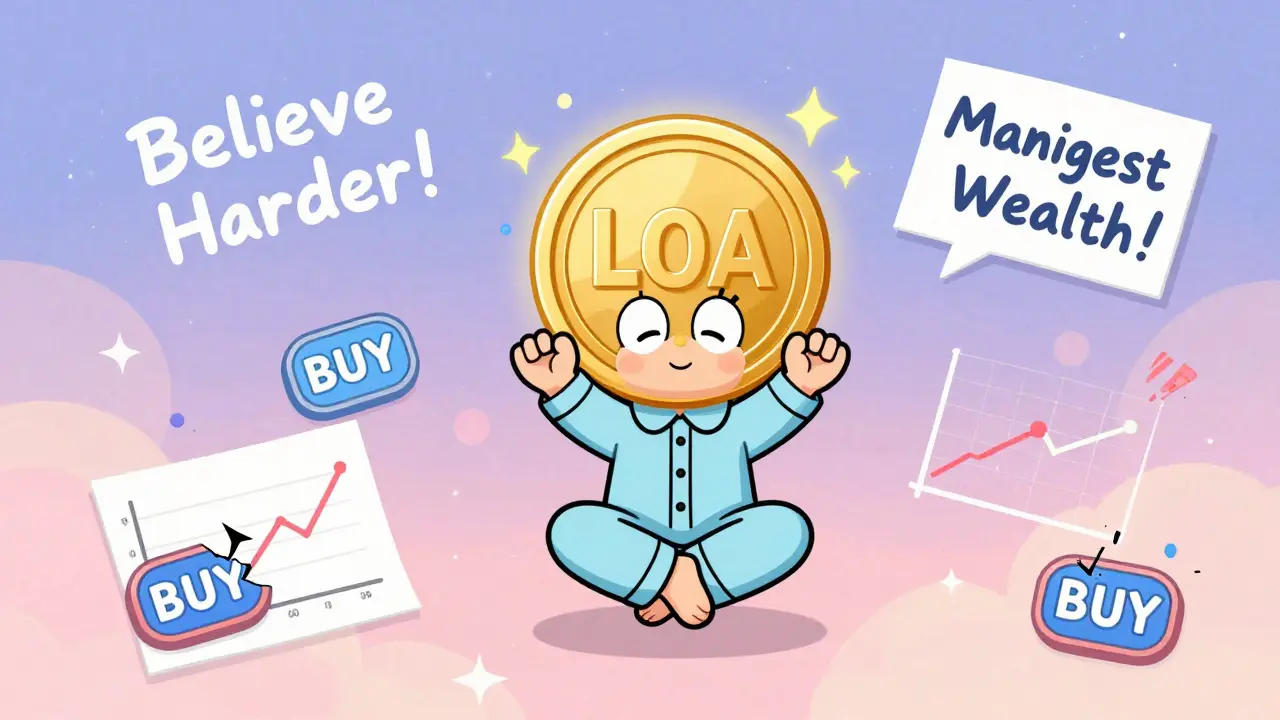
There’s a crypto coin called Law of Attraction (LOA) that claims you can manifest wealth just by believing in it. It’s not a joke. It’s real - listed on a few exchanges, with a price, a supply, and even a blockchain address. But here’s the catch: no one is buying it. No one is selling it. And if you try to trade it, you might find out you’re stuck with coins no one else wants.
What Is Law Of Attraction (LOA) Crypto?
Law of Attraction (LOA) is a cryptocurrency built on the Solana blockchain. Its official description on CoinMarketCap says it’s a "ground-breaking experiment" meant to test whether collective belief can push a token’s market cap to $1 billion. That’s it. No whitepaper. No team. No utility. Just the idea that if enough people think hard enough about making LOA valuable, it will happen.
It’s not the first time someone’s tried to merge spirituality with finance. Tokens like Karma (KARMA) and Manifest (MANI) came before it, all promising that positive energy = positive returns. But LOA takes it further - it doesn’t just claim to be spiritual. It says your mindset directly affects its price.
There are two versions floating around: LOA v1 and LOA v2. The newer one, LOA v2, is the one listed at #9149 on CoinMarketCap as of December 2025. But even that number is misleading. At this rank, LOA isn’t just low-cap - it’s invisible in the crypto world.
Why the Data Doesn’t Add Up
If you look up LOA on different platforms, you’ll get conflicting numbers. That’s not a glitch. That’s a red flag.
- CoinGecko says total supply is 100 million LOA.
- CoinMarketCap says it’s 731.1 million.
- Bitget and Binance say 100 million again.
The same confusion shows up in market cap and price. CoinMarketCap says LOA trades at $0.00004478. Crypto.com says $0.0006543. Binance says $0.00054. None of these numbers are close. And the trading volume? $0 on CoinMarketCap. $0 on Binance. $0 on Crypto.com.
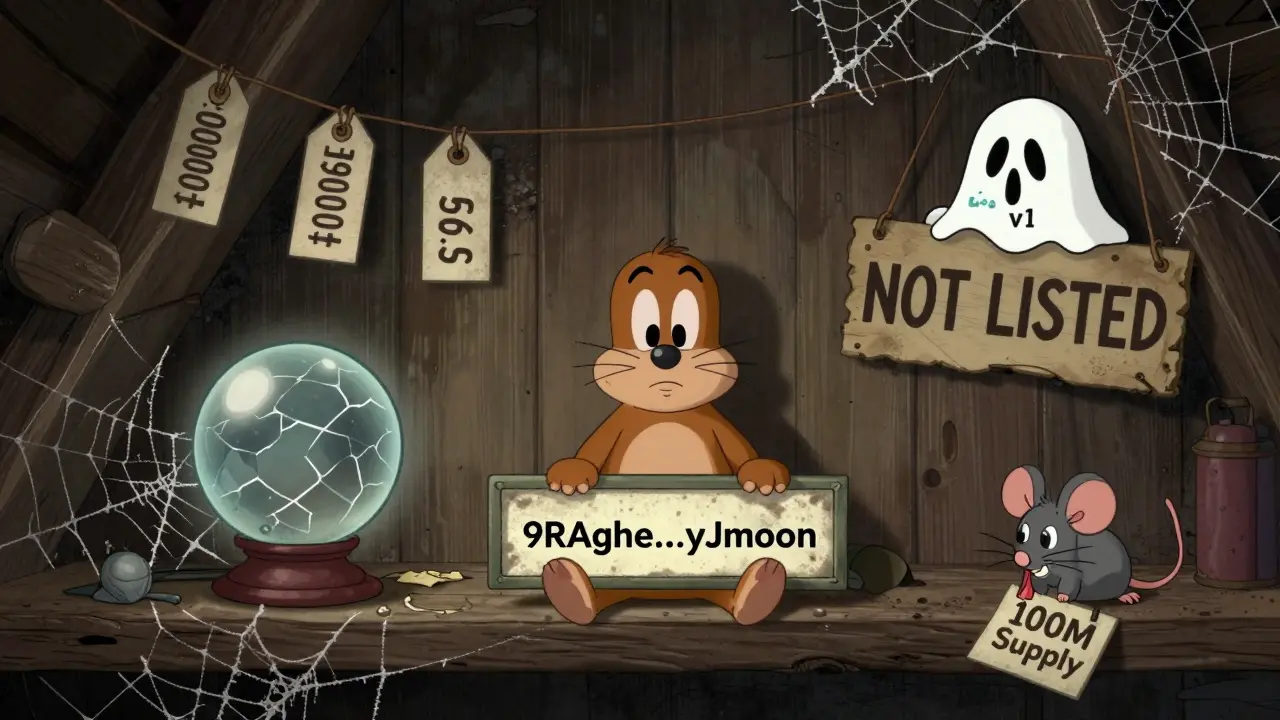
That means no one has bought or sold LOA in the last 24 hours. Not one trade. Not one transfer. Not even a bot trying to manipulate it. The token is frozen in time.
Even the all-time high is disputed. Binance says LOA once hit $3.95. CoinMarketCap says its peak was $0.001104 - over 3,500 times lower. Which one’s right? Neither, really. It’s likely both numbers come from different versions of the token, or from fake trades on low-traffic DEXs where a single wallet can move the price by buying a few coins from itself.
Who Owns LOA? (Spoiler: Almost No One)
As of December 2025, CoinMarketCap reports only 674 unique wallet addresses holding LOA. That’s fewer than the number of people who attended a small-town Bitcoin meetup in 2013. For context, Bitcoin has over 100 million wallets. Ethereum has over 200 million. LOA has less than a thousand.
There are no active Telegram groups. No Discord servers. No official Twitter/X account. No Reddit threads with more than three posts. The only discussions you’ll find are people asking, "Can I sell this?" and "Why is my wallet showing $0?"
One user on CoinCodex wrote: "Another pump and dump disguised as 'spiritual investment'." That’s the most honest review you’ll find.
Why You Can’t Trade LOA - Even If You Want To
You might think, "I’ll just buy it on a DEX and wait for it to rise." But here’s the problem: liquidity is zero.
On decentralized exchanges like Raydium or Jupiter, LOA might appear as a trading pair. But when you try to swap your SOL for LOA, you’ll see the slippage is over 90%. That means for every $10 you send, you might get $1 worth of LOA - or nothing at all. The price jumps because there’s no one on the other side of the trade.
And if you manage to buy it? Good luck selling. There’s no buyer. No market. No depth. You’re holding digital confetti.
Even platforms that list LOA - like Bitget and Crypto.com - don’t let you trade it directly. They just show the price, like a museum exhibit of a dead currency.
The Billion Dream - Is It Possible?
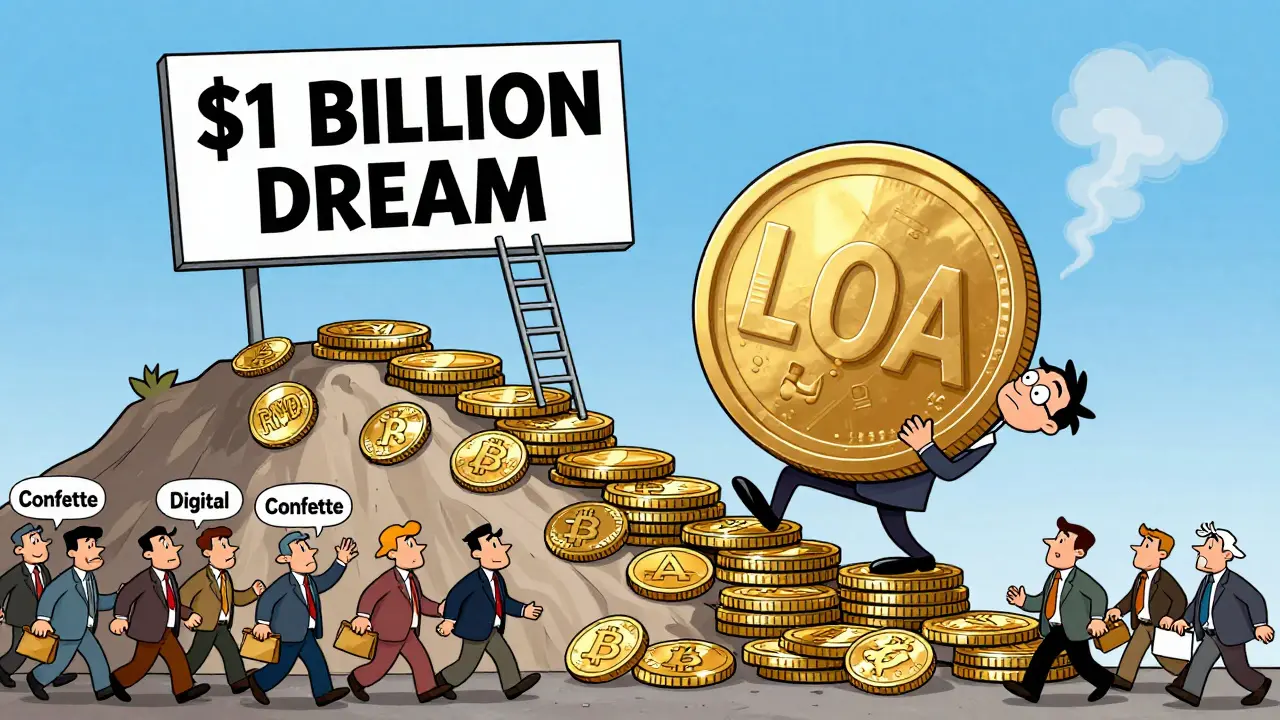
LOA’s entire premise is that if enough people believe in it, its market cap will hit $1 billion. Sounds like a motivational poster. But math doesn’t care about belief.
As of December 2025, LOA’s highest reported market cap is $76,661.22 (on CoinGecko). To reach $1 billion, it would need to grow by 13,000 times. That’s not a 10x or even a 100x. That’s a 13,000x.
Since 2013, only 0.02% of all crypto tokens have ever achieved a 10,000x return. And those were projects with real teams, products, and adoption - like Ethereum, Solana, or Shiba Inu in its early days. LOA has none of that.
Even the most optimistic meme coins - Dogecoin, Pepe, Bonk - had millions of holders, active communities, and real trading volume before they surged. LOA has none of that. It’s a ghost coin.
Experts Say It’s a High-Risk Trap
Dr. Carol Alexander, a finance professor at the University of Sussex, told CoinDesk in 2024: "Cryptocurrencies built solely on metaphysical concepts without underlying utility or technological innovation represent the highest risk category in digital assets, with historical failure rates exceeding 98%."
Bloomberg Intelligence’s Mike McGlone added in September 2025: "Tokens attempting to merge spirituality with finance typically exhibit extreme volatility followed by rapid decline, with median survival time of 18 months from launch."
LOA launched in early 2025. It’s now past the 18-month mark - and still has no volume, no community, no exchange support. It’s not just dead. It’s already been buried.
Is LOA a Scam?
It’s not a classic scam like a rug pull. There’s no evidence the creators vanished with funds. The token exists. The blockchain address is real. The supply is recorded.
But it’s a scam in spirit. It preys on hope. It uses spiritual language to make people feel like they’re part of something meaningful - when in reality, they’re holding a digital artifact with no value, no liquidity, and no future.
The U.S. Securities and Exchange Commission (SEC) warned in November 2025 that tokens marketed with "promises of financial returns based on metaphysical principles" could be classified as unregistered securities. LOA fits that description perfectly.
What Should You Do?
If you already own LOA - don’t panic. But don’t hold onto it hoping for a miracle. The chances of it ever becoming liquid are near zero. If you can find a buyer on a DEX, even at a fraction of your cost, take it. Walk away.
If you’re thinking of buying - don’t. There’s no upside. Only risk. And that risk isn’t just financial. It’s psychological. Believing in a coin that only works if you believe hard enough? That’s not investing. That’s self-deception.
There are thousands of crypto projects with real use cases - DeFi, AI, real-world asset tokenization, decentralized storage. None of them need you to manifest their success. They just need to work.
LOA doesn’t work. It never will. And the longer you wait, the more you’ll waste - not just money, but your belief in what crypto can actually do.
LOA vs Real Crypto Projects
Compare LOA to even the smallest legitimate crypto projects:
| Feature | Law of Attraction (LOA) | Render (RNDR) | Arweave (AR) |
|---|---|---|---|
| Market Cap (Dec 2025) | $76,661 | $1.2 billion | $580 million |
| 24-Hour Volume | $0 | $120 million | $45 million |
| Active Holders | 674 | 380,000+ | 210,000+ |
| Real Utility | None | GPU rendering on blockchain | Permanent data storage |
| Exchange Listings | 3 (limited) | 50+ | 40+ |
| Team & Roadmap | None | Public team, active development | Public team, active development |
LOA doesn’t just lose the comparison. It doesn’t even show up on the same field.
Is Law of Attraction (LOA) coin a good investment?
No. LOA has zero trading volume, no real utility, and no community. Its price is inconsistent across platforms, and its market cap is less than $80,000. Even if you believe in the Law of Attraction, money doesn’t manifest from belief alone - it comes from demand. There is no demand for LOA.
Can I buy LOA on Coinbase or Binance?
You can’t buy LOA on Coinbase - it only shows a description, no trading option. Binance lists it as "Not listed," meaning you can’t trade it there. You can only find it on small, obscure decentralized exchanges like Raydium or Jupiter, where liquidity is near zero.
Why does LOA have different supply numbers on different sites?
Because there are multiple versions (v1 and v2), and no official source controls the data. Some platforms track one version, others track another. This inconsistency is a classic sign of a low-quality or abandoned project. Legitimate tokens have one clear, verified supply.
Is LOA on the Solana blockchain?
Yes, the current version (LOA v2) operates on Solana. Its contract address is 9RAghe...yJmoon. But being on Solana doesn’t make it valuable. Thousands of tokens are on Solana - most have no value, no volume, and no future.
What happens if I hold LOA for years?
You’ll likely hold worthless tokens forever. Tokens with zero trading volume for more than 6 months almost always become completely illiquid. Even if someone claims "it’ll spike someday," there’s no mechanism, no team, and no market to make that happen. It’s digital dust.
Are there any real projects using the Law of Attraction concept successfully?
No. There are no successful crypto projects built on the idea that belief creates value. All attempts - including LOA, Karma, and Manifest - have failed to gain traction. Real crypto projects succeed because they solve problems, not because they ask you to visualize wealth.
Final Thought
The Law of Attraction might work for mindset, motivation, or personal growth. But it doesn’t work for crypto. Money doesn’t appear because you think about it. It appears because people trade it. And no one is trading LOA.
If you want to believe in something, believe in projects that build, ship, and serve real needs. Don’t believe in a coin that asks you to manifest its price. That’s not magic. That’s a trap dressed up as inspiration.
Florence Maail
December 16, 2025 AT 08:53Chevy Guy
December 17, 2025 AT 17:29Craig Nikonov
December 19, 2025 AT 14:23Emma Sherwood
December 20, 2025 AT 06:05Shruti Sinha
December 21, 2025 AT 21:53Cheyenne Cotter
December 23, 2025 AT 07:37Kayla Murphy
December 25, 2025 AT 03:08George Cheetham
December 25, 2025 AT 19:40Dionne Wilkinson
December 26, 2025 AT 19:19Sally Valdez
December 28, 2025 AT 08:28Sue Bumgarner
December 30, 2025 AT 05:11Terrance Alan
December 31, 2025 AT 21:11Heather Turnbow
January 1, 2026 AT 08:58Greg Knapp
January 2, 2026 AT 03:34Bradley Cassidy
January 2, 2026 AT 03:59Sean Kerr
January 2, 2026 AT 16:13Amy Copeland
January 3, 2026 AT 01:28Jack Daniels
January 3, 2026 AT 21:33Jesse Messiah
January 5, 2026 AT 09:35George Cheetham
January 5, 2026 AT 13:43