
ZKP Comparison Tool
Zero-Knowledge Proof Comparison
Compare the key characteristics of different zero-knowledge proof implementations used in cryptocurrency. Select one or more options to see side-by-side differences.
Comparison Results
| Feature | zk-SNARKs | zk-STARKs | Bulletproofs |
|---|---|---|---|
| Proof Size | ~288 bytes | ~45 KB | ~1–2 KB |
| Trusted Setup | Yes | No | No |
| Verification Speed | 3–10 ms | 10–20 ms | 15–30 ms |
| Used By | Zcash, zkSync, StarkNet | StarkNet, Polygon zkEVM | Monero |
Imagine sending money to someone without ever telling anyone who you are, who they are, or how much you sent. No public ledger showing your balance. No trail for anyone to follow. That’s not science fiction-it’s what zero-knowledge proofs make possible in cryptocurrency.
What Exactly Is a Zero-Knowledge Proof?
A zero-knowledge proof (ZKP) lets one person prove they know something-like a password or a secret-without actually saying what that thing is. Think of it like proving you’re over 21 to enter a bar without showing your ID. You just say, "I am," and the bouncer believes you because of how you answer their questions. In math terms, a ZKP must satisfy three rules:- Completeness: If you’re telling the truth, the system will confirm it.
- Soundness: If you’re lying, you can’t trick the system.
- Zero-knowledge: The verifier learns nothing except that the statement is true.
How ZKPs Work in Crypto Transactions
Most blockchains are public. Every transaction is visible. If you send 5 ETH to someone, anyone can see your address, their address, and the amount. That’s fine for some use cases-but not for people who want true financial privacy. Zcash solved this with zk-SNARKs (Zero-Knowledge Succinct Non-Interactive Arguments of Knowledge). Here’s how it works in simple terms:- You create a shielded transaction-hiding sender, receiver, and amount.
- Your wallet runs a complex math process to generate a tiny proof (about 288 bytes).
- The network checks that proof in under 10 milliseconds.
- If the proof is valid, the transaction is added to the blockchain-without ever revealing the details.
zk-SNARKs vs. zk-STARKs vs. Bulletproofs
Not all ZKPs are the same. Three main types dominate crypto today:| Type | Proof Size | Trusted Setup? | Verification Speed | Used By |
|---|---|---|---|---|
| zk-SNARKs | ~288 bytes | Yes | 3-10 ms | Zcash, zkSync, StarkNet |
| zk-STARKs | ~45 KB | No | 10-20 ms | StarkNet (future), Polygon zkEVM |
| Bulletproofs | ~1-2 KB | No | 15-30 ms | Monero |
Why ZKPs Are Changing Ethereum
Ethereum’s biggest problem isn’t security-it’s cost and speed. The base chain can only handle 15-45 transactions per second. Gas fees spike during busy times. Enter zk-Rollups. These are layer-2 solutions that bundle hundreds of transactions into one proof, then submit it to Ethereum. The network doesn’t check each transaction-it just checks the proof. That means:- 2,000+ transactions per second (vs. Ethereum’s 45)
- Gas fees drop from $1.50 to $0.02 per transaction
- Security stays the same-Ethereum still validates the proof
Real-World Use Cases Beyond Privacy
ZKPs aren’t just for hiding money. They’re being used to solve bigger problems:- Identity verification: Prove you’re a citizen without showing your passport.
- Supply chain tracking: Prove a product is ethically sourced without revealing supplier names.
- Vote verification: Prove you voted without revealing who you voted for.
- Compliance: JPMorgan’s Onyx system uses ZKPs to verify transactions for regulators while keeping client data private.
Challenges and Criticisms
ZKPs aren’t perfect. Here are the real issues:- Computational power: Generating a proof can take over a minute on a regular laptop. That’s why most users rely on cloud-based provers.
- Centralization risk: 67% of zkSync’s proving power comes from just three data centers. That’s a single point of failure.
- Metadata leaks: Even if amounts are hidden, timing, frequency, and address patterns can still be analyzed. Researchers like Dr. Sarah Jamie Lewis warn that "privacy is not guaranteed-just obfuscated."
- Developer complexity: Writing ZKP-enabled smart contracts takes 3-4 times longer than regular ones. Only about 2,147 developers worldwide are actively building with ZKPs as of 2024.
What’s Next for Zero-Knowledge Proofs?
The roadmap is aggressive:- By late 2025, ZK-EVMs will fully match Ethereum’s execution environment, removing compatibility issues.
- Quantum-resistant ZKPs are being developed for 2026-2027 to protect against future attacks.
- Specialized hardware chips for ZK proving are in early testing-this could cut proof times from minutes to seconds.
- Decentralized proving networks like Espresso Systems are launching to reduce reliance on centralized providers.
How to Get Started
If you’re curious about using ZKPs:- Try Zcash: Send a shielded transaction using the Zcash wallet. You’ll see the difference in privacy.
- Use zkSync: Send a small amount of ETH on zkSync Era. You’ll pay pennies and get instant confirmations.
- Explore open-source tools: 0xPARC offers free weekly ZK coding workshops with hundreds of participants.
Are zero-knowledge proofs completely anonymous?
No. ZKPs hide transaction details like sender, receiver, and amount, but they don’t eliminate all metadata. Timing, frequency, and address usage patterns can still be analyzed. For true anonymity, ZKPs need to be combined with other techniques like mixing or ring signatures-as Monero does.
Can I use ZKPs with Bitcoin?
Not natively. Bitcoin’s design doesn’t support complex ZKPs like zk-SNARKs. But projects like Taro and Taproot have laid groundwork for future privacy upgrades. Zcash, which started as a Bitcoin fork, is the closest real-world example of Bitcoin-style privacy using ZKPs.
Why do some ZKPs need a trusted setup?
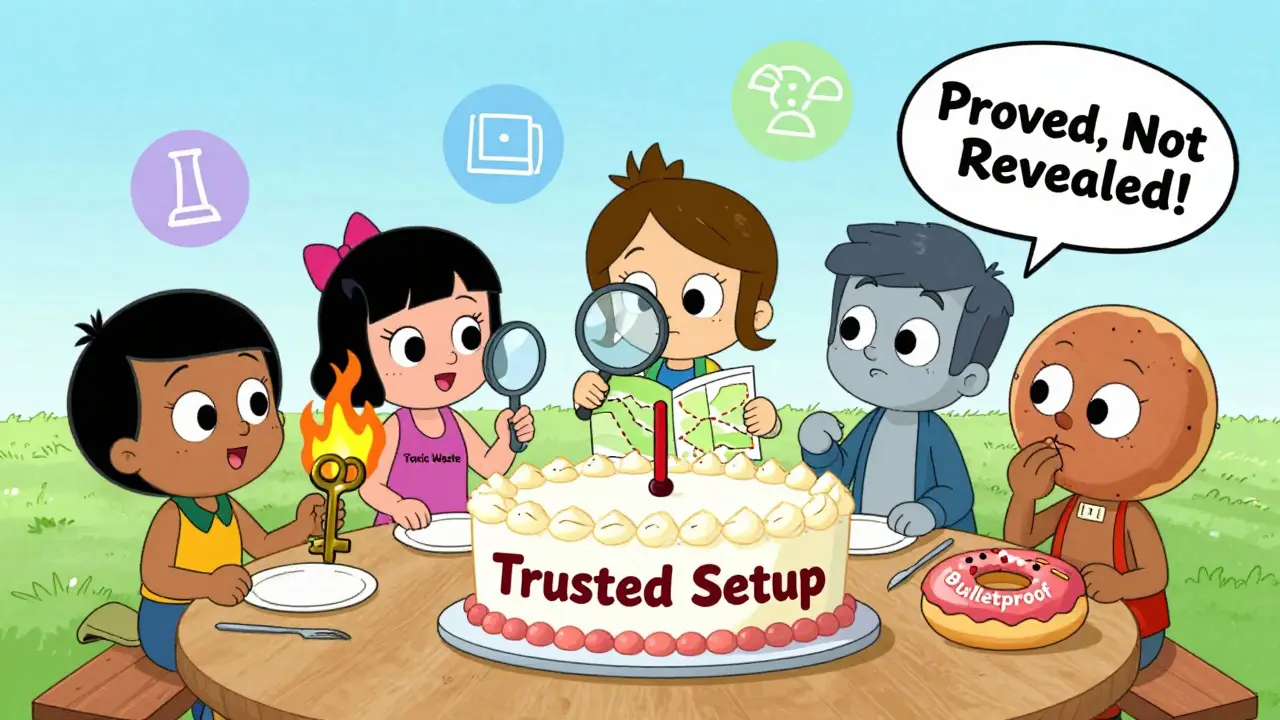
zk-SNARKs require a one-time setup to generate public parameters used in proving. If someone keeps the private part of those parameters (called "toxic waste"), they could create fake proofs. The trusted setup spreads this risk across multiple people-each destroys their part. Zcash’s 2016 ceremony involved six people from six countries, all publicly verifying each step.
Are ZKPs faster than regular blockchain transactions?
Verification is extremely fast-under 10 milliseconds. But generating the proof can be slow, especially on consumer hardware. That’s why most users rely on cloud provers. On layer-2 solutions like zkSync, the whole process is optimized so users feel near-instant results.
Do ZKPs make crypto more secure?
They don’t prevent hacks or bugs in code, but they add a layer of cryptographic integrity. A ZK proof guarantees that a transaction followed all rules without needing to reveal the data. This reduces attack surfaces and makes fraud detection more reliable, especially in complex smart contracts.
What’s the difference between ZK-Rollups and Optimistic Rollups?
ZK-Rollups use zero-knowledge proofs to prove transactions are valid before they’re added to Ethereum. Optimistic Rollups assume they’re valid and only check if someone disputes them-requiring a 7-day waiting period to withdraw funds. ZK-Rollups are faster to withdraw and more secure, but harder to build.
Jon Visotzky
December 6, 2025 AT 21:23kinda wild that this has been around since 85 but only now its actually useful
Joe West
December 8, 2025 AT 09:54Tisha Berg
December 9, 2025 AT 09:22Kenneth Ljungström
December 10, 2025 AT 03:28sonia sifflet
December 10, 2025 AT 06:28Shane Budge
December 10, 2025 AT 15:54Nicole Parker
December 10, 2025 AT 19:38Vincent Cameron
December 12, 2025 AT 13:21Brooke Schmalbach
December 12, 2025 AT 19:58michael cuevas
December 13, 2025 AT 16:08Barb Pooley
December 14, 2025 AT 17:55miriam gionfriddo
December 15, 2025 AT 06:12Richard T
December 16, 2025 AT 04:56Holly Cute
December 18, 2025 AT 02:31Nina Meretoile
December 19, 2025 AT 14:05