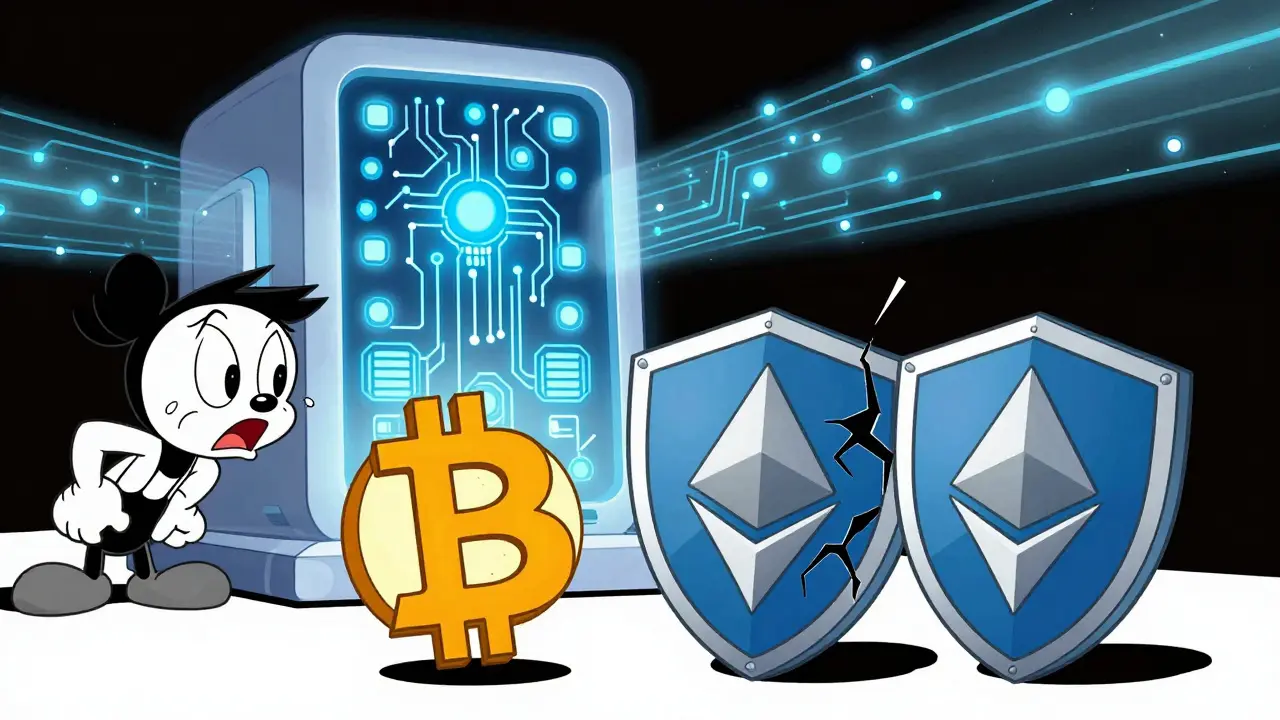
Imagine waking up tomorrow to find that every Bitcoin you’ve held for years is suddenly accessible to anyone with a powerful enough computer. It sounds like science fiction, but the clock is ticking on a very real cryptographic crisis. Quantum computing is an emerging technology that threatens to break the public-key cryptography securing most blockchain networks today. While we aren’t there yet, the risk isn’t just about the future-it’s about what attackers are doing right now.
The core issue boils down to one thing: the math behind your wallet addresses. Most cryptocurrencies rely on algorithms that classical computers can’t crack, but quantum computers might be able to solve in minutes. This isn’t a hypothetical scenario anymore; it’s a calculated timeline that experts are racing against. If you hold digital assets, understanding this threat is no longer optional-it’s essential for protecting your wealth.
The Mechanics of the Quantum Threat
To understand why quantum computing poses such a severe risk, we have to look at how blockchains secure transactions. Currently, systems like Bitcoin and Ethereum use Elliptic Curve Cryptography (ECC) to generate private keys from public keys. Think of it like a one-way street: it’s easy to go from your private key to your public address, but nearly impossible to reverse-engineer the private key from the public address using traditional computers.
Enter Shor’s algorithm, developed by mathematician Peter Shor in 1994. This algorithm allows a sufficiently powerful quantum computer to factor large integers exponentially faster than any classical supercomputer. In practical terms, this means Shor’s algorithm could derive a private key from a public key in hours or even minutes, rather than millions of years. Another algorithm, Grover’s algorithm, affects symmetric encryption like AES, cutting its effective security strength in half. While doubling the key size mitigates Grover’s impact, Shor’s threat to asymmetric cryptography is existential because it breaks the fundamental assumption of one-way functions.
However, not all crypto assets are equally vulnerable. The danger depends heavily on whether your public key has been exposed on the blockchain. When you send a transaction, your public key becomes visible. If an attacker sees that public key before they have a quantum computer, they can wait until their machine is ready to steal the funds. This leads us to the most insidious aspect of the threat: "Harvest Now, Decrypt Later" attacks.
The "Harvest Now, Decrypt Later" Strategy
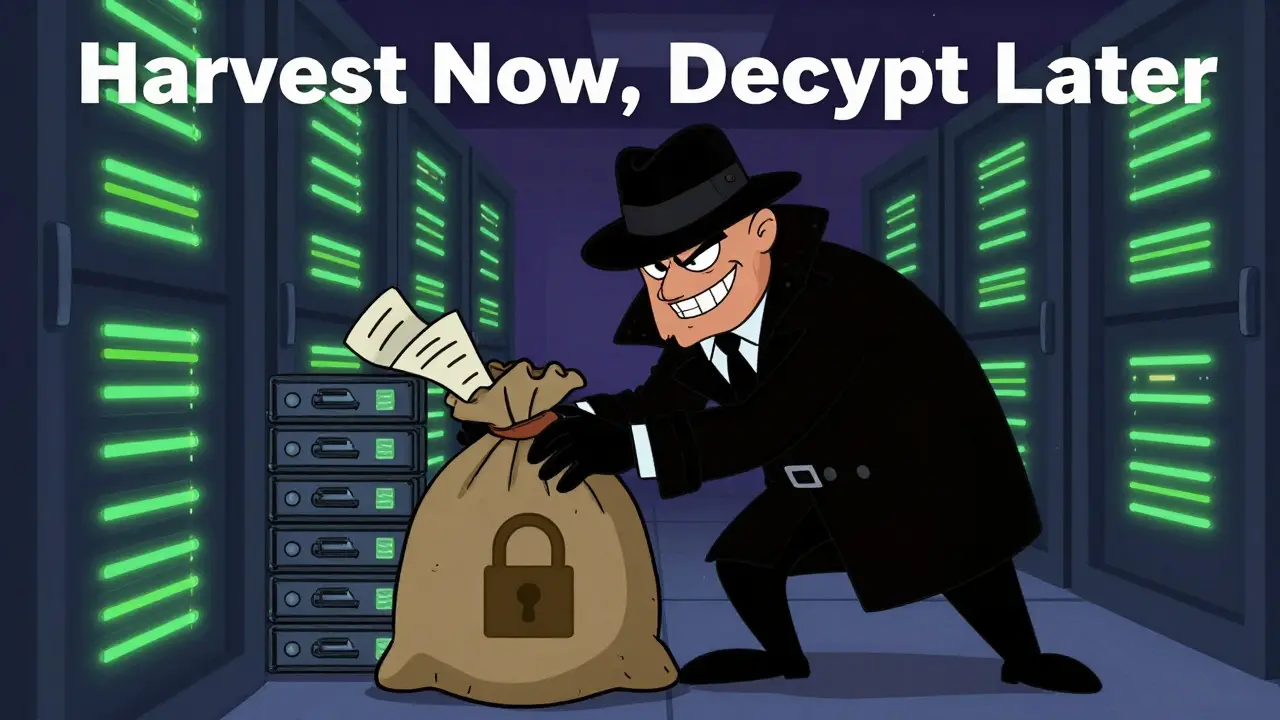
You might think, "I don’t need to worry until quantum computers actually exist." That logic is flawed. A strategy known as Harvest Now, Decrypt Later (HNDL) is already in play. Adversaries-often state-sponsored actors-are currently collecting encrypted data and public keys from the internet. They store this data securely, waiting for the day when quantum technology matures enough to unlock it.
A Federal Reserve Board study from October 2025 highlighted this active risk. Analysts Jillian Mascelli and Megan Rodden noted that HNDL represents a present and unavoidable privacy risk. By the time a quantum computer capable of breaking ECC arrives, attackers will have years of harvested blockchain data ready to exploit. This means the vulnerability window opened long before Q-Day-the theoretical date when quantum computers become powerful enough to break current encryption standards.
This strategy shifts the urgency from "when will the tech arrive?" to "what data is being stolen today?" For blockchain users, this implies that any transaction broadcasted today leaves a permanent, exploitable trail if the underlying cryptography falls. The race is not just to build better quantum computers, but to migrate to resistant standards before the harvested data becomes valuable.
Who Is Most Vulnerable Right Now?
Not all cryptocurrency holders face the same level of immediate risk. According to Deloitte’s October 2025 analysis, approximately 25% of Bitcoins in circulation are potentially vulnerable to a quantum attack. Why only 25%? It comes down to address types and user behavior.
| Address Type | Public Key Exposure | Quantum Risk Level |
|---|---|---|
| P2PK (Pay-to-Public-Key) | Exposed immediately upon creation | Critical |
| P2PKH (Reused) | Exposed after first outgoing transaction | High |
| P2PKH (Fresh) | Hidden until spending occurs | Low (until spent) |
| P2SH / SegWit | Hidden until spending occurs | Low (until spent) |
If you reuse addresses-a common habit among early adopters-you expose your public key on the ledger. Once that key is public, a future quantum computer can derive your private key. Conversely, if you always generate a new address for every deposit and never spend from an old one, your public key remains hidden, offering temporary protection. However, this is only a stopgap measure. As soon as you initiate a withdrawal, the vulnerability activates.
Ethereum faces similar risks, though its roadmap includes upgrades aimed at improving resilience. Still, both major networks remain fundamentally reliant on ECDSA signatures, which Shor’s algorithm targets directly. Stablecoins present a unique hybrid risk. With the passage of the Genius Act in July 2025, stablecoins are increasingly integrated with traditional banking systems. A quantum breach here could compromise both crypto holdings and fiat reserves simultaneously, creating systemic financial instability.
The Timeline: When Will Q-Day Arrive?
Everyone wants a specific date for Q-Day, but experts offer ranges based on hardware progress. IBM’s quantum roadmap projects scaling from today’s 433-qubit Osprey chip to systems exceeding several thousand qubits by 2035. According to BCG’s 2025 analysis, there is a "better than 50% likelihood" of breaking RSA-2048 encryption around that time. Breaking ECC, which requires fewer logical qubits but higher error correction, may happen slightly sooner or later depending on algorithmic optimizations.
State-sponsored entities likely move faster than commercial players. Edward Snowden’s 2013 disclosures revealed the NSA’s $80 million "Penetrating Hard Targets" initiative, suggesting governments prioritize cryptographic breakthroughs for espionage. BCG estimates these actors could exploit quantum capabilities for intelligence gathering sometime around 2035. For widespread financial theft, however, IBM researchers suggest error correction requirements will delay practical attacks until at least 2045.
Despite these timelines, the preparation window is closing. Migrating entire global infrastructure to new cryptographic standards takes years. NIST guidelines estimate five to ten years for full migration. If Q-Day hits in 2035, we need to start moving today. Waiting until the last minute guarantees chaos, especially for decentralized networks that require consensus to change rules.
The Solution: Post-Quantum Cryptography
The answer lies in Post-Quantum Cryptography (PQC), a field dedicated to developing algorithms resistant to both classical and quantum attacks. The National Institute of Standards and Technology (NIST) led a global standardization competition starting in 2016, culminating in the selection of four quantum-resistant algorithms in 2022. These were finalized as FIPS standards in August 2025:
- CRYSTALS-Kyber: Selected for general encryption tasks.
- CRYSTALS-Dilithium: Chosen as the primary digital signature algorithm.
- FALCON: An alternative signature scheme with smaller signature sizes.
- SPHINCS+: A stateless hash-based signature scheme for high-security applications.
These algorithms rely on mathematical problems like lattice-based cryptography, which quantum computers struggle to solve efficiently. Unlike ECC, lattice problems do not have known quantum shortcuts. Implementing PQC in blockchains requires hard forks-major protocol updates that demand community consensus. Ethereum researchers estimate an 18-24 month development cycle for integrating quantum-resistant signatures, a timeline documented in September 2025 discussions on Ethereum Magicians.
Some niche cryptocurrencies have already adopted quantum-resistant measures. Projects like QANplatform and IOTA use lattice-based or other advanced signatures, though they represent less than 0.1% of total market capitalization according to CoinGecko data from October 2025. Mainstream adoption remains slow due to complexity and the lack of immediate pressure, but the industry is waking up. The Post-Quantum Cryptography Alliance, formed in September 2025, includes Coinbase, Chainlink, and 27 other major entities committed to migration.
What Should You Do Today?
You can’t fix the blockchain yourself, but you can mitigate personal risk. Here are actionable steps based on current best practices:
- Never Reuse Addresses: Always generate a fresh address for every deposit. This keeps your public key off-chain until you decide to spend, buying you time.
- Migrate Old Funds: If you hold coins in reused P2PKH or legacy P2PK addresses, consider moving them to new, unused addresses. While this exposes the old key during the transfer, it resets the clock on the new address.
- Monitor Wallet Updates: Use wallets that support or plan to support PQC standards. Check developer roadmaps for mentions of CRYSTALS-Dilithium or similar algorithms.
- Diversify Storage: Avoid keeping life-changing amounts in a single vulnerable asset. Consider diversifying into assets with different cryptographic foundations or physical storage options.
- Stay Informed: Follow updates from NIST and major blockchain foundations. Regulatory changes like the EU’s Quantum Security Directive (requiring migration plans by Q2 2026) signal shifting priorities.
The quantum threat is real, but panic is unnecessary. The technology doesn’t exist yet to break your wallet today. However, the data harvesting does. By adopting good hygiene practices now and staying alert to protocol upgrades, you position yourself ahead of the curve. The goal isn’t to fear the future, but to prepare for it methodically.
Will quantum computers destroy Bitcoin?
Not necessarily. Bitcoin can survive if it successfully migrates to post-quantum cryptography before Q-Day. The network would need a hard fork to implement quantum-resistant signatures like CRYSTALS-Dilithium. Without this upgrade, Bitcoin’s ECDSA signatures would become vulnerable to Shor’s algorithm, allowing attackers to steal funds from exposed public keys.
What is Harvest Now, Decrypt Later?
Harvest Now, Decrypt Later (HNDL) is a strategy where adversaries collect encrypted data and public keys today, storing them for future decryption once quantum computers are powerful enough. This makes current data privacy a present risk, even if quantum technology isn’t available yet.
How soon will quantum computers break encryption?
Estimates vary. BCG suggests a better-than-50% chance of breaking RSA-2048 by 2035, while IBM researchers believe error correction issues may delay practical attacks until at least 2045. State-sponsored actors may achieve limited breakthroughs earlier for espionage purposes.
Is my Ethereum safe from quantum attacks?
Currently, Ethereum uses ECDSA signatures, which are vulnerable to Shor’s algorithm. However, Ethereum’s roadmap includes upgrades toward more resilient features. Until those upgrades are live, Ethereum faces similar risks to Bitcoin, particularly if public keys are exposed through transaction history.
What are NIST’s post-quantum cryptography standards?
NIST selected four algorithms in 2022, finalized in 2025: CRYSTALS-Kyber for encryption, and CRYSTALS-Dilithium, FALCON, and SPHINCS+ for digital signatures. These standards provide the foundation for migrating existing systems to quantum-resistant security.