
Imagine sending money where no one-not the bank, not the government, and certainly not a hacker-can see who sent it or how much. That is the promise of privacy coins, cryptocurrencies designed to ensure transaction anonymity through advanced cryptographic techniques. For years, projects like Monero (XMR) and Zcash (ZEC) have offered this shield. But in 2026, that shield has become a target. Governments worldwide are tightening their grip on anonymous digital assets, turning what was once a niche technical feature into a major regulatory battleground.
If you hold or use these coins, you need to know the rules changing under your feet. The era of unchecked anonymity is ending. By 2025, privacy coins accounted for 11.4% of all cryptocurrency transactions globally, with volumes exceeding $250 billion. Yet, alongside this growth came a dramatic 34% surge in regulatory actions since 2024. Ninety-seven countries have implemented stricter frameworks specifically targeting these assets. This article breaks down exactly how these restrictions work, why they exist, and what they mean for your ability to trade and use Monero and Zcash today.
The Core Conflict: Anonymity vs. Compliance
To understand the restrictions, you first have to understand why regulators hate privacy coins. It isn't just about technology; it's about control. Financial authorities rely on the ability to trace money flows to prevent crime. When transactions are opaque, that ability vanishes. Regulators worry about money laundering, tax evasion, and terrorism financing. Enhanced privacy features make transaction tracing extremely difficult for authorities, creating a blind spot in the global financial system.
This tension creates a fundamental clash. On one side, you have the core philosophy of cryptocurrencies: financial sovereignty and privacy. On the other, you have the established financial order, which demands transparency. The result is a regulatory environment that treats privacy coins as high-risk entities by default. Most jurisdictions now classify them under strict Anti-Money Laundering (AML) and Know Your Customer (KYC) protocols. If you cannot prove who owns the funds, you often cannot move them through traditional banking channels or regulated exchanges.
How Monero and Zcash Handle Privacy Differently
Not all privacy coins are built the same way, and this technical difference matters immensely when regulations hit. Monero and Zcash take two distinct approaches to hiding transaction details, and regulators view them differently because of it.
Monero (XMR) makes privacy mandatory. There is no option to turn it off. Every single transaction uses ring signatures to mix your signature with others, stealth addresses to hide the recipient, and RingCT (Ring Confidential Transactions) to mask the amount. You cannot accidentally send a public transaction. Because privacy is baked into the protocol's core functionality, Monero offers consistent anonymity. However, this consistency makes it harder for exchanges to justify listing it, as they cannot offer a "compliant" version of the coin.
In contrast, Zcash (ZEC) offers optional privacy. It uses groundbreaking zk-SNARKs (Zero-Knowledge Succinct Non-Interactive Arguments of Knowledge) technology. Users can choose between fully "shielded" private transactions or "transparent" public ones. This flexibility was originally seen as a bridge to regulation. If a user chooses a transparent transaction, it looks like a standard Bitcoin transfer on the blockchain, allowing for easier auditing. However, this design has a flaw: if most users choose transparency, the "anonymity set" shrinks, making those few shielded transactions stand out more. Still, from a regulatory perspective, Zcash’s architecture provides a pathway for compliance that Monero lacks.
| Feature | Monero (XMR) | Zcash (ZEC) |
|---|---|---|
| Privacy Model | Mandatory (Always Private) | Optional (Shielded or Transparent) |
| Cryptography | Ring Signatures, RingCT | zk-SNARKs |
| Regulatory View | High Risk (No compliance path) | Medium Risk (Compliance possible via transparent pool) |
| Exchange Status | Widely delisted in EU/UK | Listed on many major exchanges with restrictions |
| User Adoption Trend | Strong among privacy advocates | Declining due to preference for transparent txns |
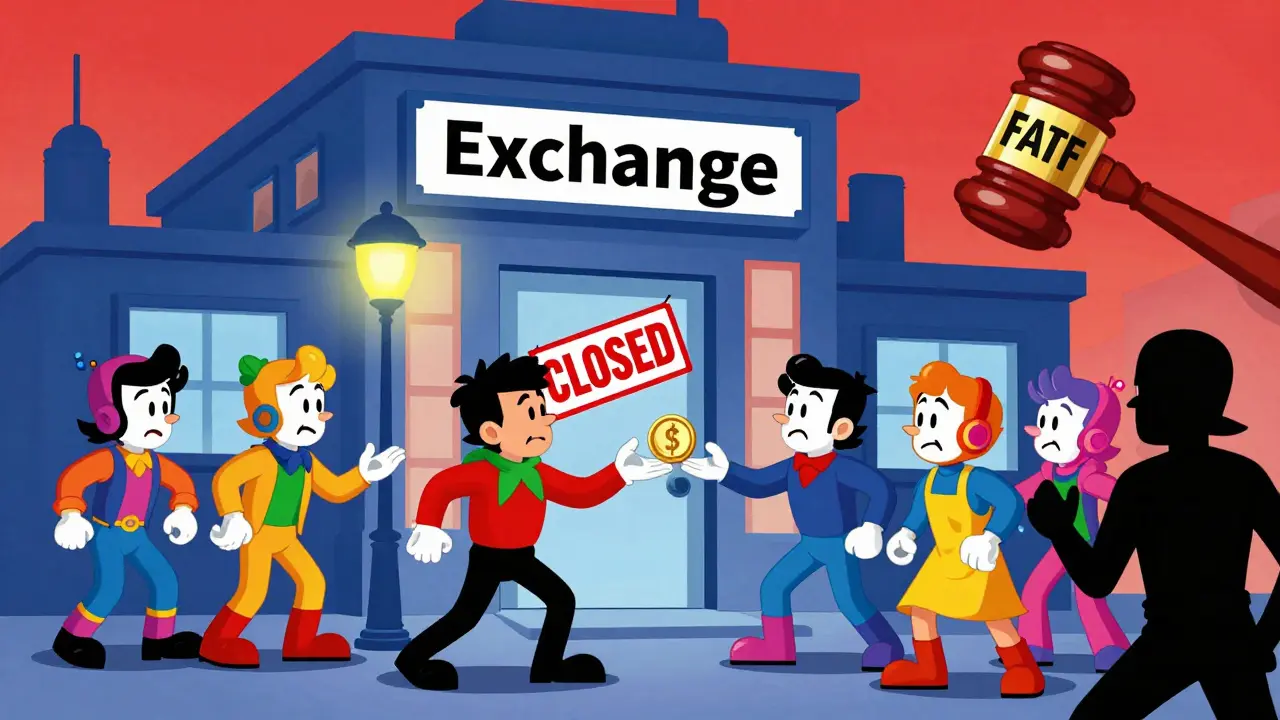
The Global Regulatory Hammer: FATF and MiCA
You might think you can avoid regulations by moving your funds around, but the net is closing globally. Two major frameworks are driving the current restrictions: the Financial Action Task Force (FATF) guidelines and the European Union's Markets in Crypto-Assets (MiCA) regulation.
The FATF Travel Rule extension in 2025 has been a game-changer. It requires virtual asset service providers (VASPs) to share sender and receiver information for transactions above certain thresholds. For privacy coins, this is technically impossible without breaking the core protocol. Consequently, the FATF rules have directly impacted 57% of privacy coin transactions. Exchanges that want to keep their banking relationships must comply. Since they cannot extract the required data from Monero transactions, they simply delist the coin. This rule effectively pushes privacy coin trading away from centralized platforms.
In Europe, MiCA has taken an even harder line. The regulation imposes strict transparency requirements that fundamentally conflict with privacy coin design principles. As a result, privacy coin offerings in the EU have dropped by 22%. Many European exchanges have removed Monero entirely and placed heavy restrictions on Zcash, requiring enhanced due diligence for any account holding significant amounts. If you are based in the EU, accessing these coins is significantly harder than it was two years ago.
Market Impact: Delistings and the Rise of P2P
When exchanges remove listings, users don't just stop using the coins; they find new ways to trade. The regulatory pressure has created a massive shift in market dynamics. Major players like Binance and Kraken executed significant privacy coin delistings in 2025 to align with international banking standards. This didn't kill demand; it just moved it underground.
The immediate result was a 19% growth in peer-to-peer (P2P) platform usage, particularly in economically unstable regions. People still value the privacy these coins offer, especially when local currencies are failing or surveillance is high. However, P2P trading comes with its own risks. Without the escrow and dispute resolution services of large exchanges, you are more exposed to scams and fraud. Furthermore, liquidity is lower, meaning you might face wider spreads or difficulty selling large amounts quickly.
This fragmentation hurts the ecosystem. Developers report that 74% cite FATF rules as their biggest challenge. Innovation slows down when you cannot easily test on mainnet or attract institutional investment. Institutional trust in regulated platforms has increased, but those institutions largely ignore privacy coins due to compliance costs. This leaves privacy coins in a paradoxical position: they are trusted by users for privacy but distrusted by the financial infrastructure needed to scale.

Real-World Risks: Why Regulators Are So Strict
It is easy to dismiss regulations as overreach, but regulators point to concrete dangers. Privacy coins have been documented on darknet markets for illegal activities. For instance, U.S.-based vendors have used Monero and Bitcoin on platforms like Abacus Market to sell fentanyl-laced products. These transactions are nearly impossible to trace, complicating law enforcement efforts significantly.
These real-world applications intensify scrutiny. When a tool is used for harm, the entire user base faces collateral damage. Regulators do not distinguish between a citizen protecting their financial privacy and a criminal evading sanctions. To them, the mechanism is the same. This leads to measures like designating privacy coins as Anonymity-Enhanced Cryptocurrencies (AECs). AECs are subject to additional reporting and monitoring protocols, making it harder for ordinary users to interact with them legally.
Future Outlook: Can Privacy and Compliance Coexist?
Is there a middle ground? Some experts believe so. Technical innovation is attempting to bridge the gap through hybrid solutions. Zero-knowledge proof implementations may enable AML compliance without completely compromising anonymity. Imagine a system where you can prove to a regulator that you did not receive dirty money, without revealing who you are or how much you have. Zcash development teams are exploring these selective disclosure mechanisms.
However, these solutions face steep hurdles. They require significantly more computational resources than traditional models, potentially slowing down networks. Moreover, regulators remain skeptical. They want full visibility, not cryptographic proofs. Until there is a legal framework that accepts zero-knowledge audits as sufficient for compliance, the tension will remain.
Looking ahead to late 2026 and beyond, expect further exchange delistings in strict jurisdictions like the EU and UK. Conversely, look for growth in "crypto-friendly" sandboxes in places like Singapore and Switzerland, which offer controlled environments for privacy coin development. The future of privacy coins likely lies in decentralization. As centralized exchanges retreat, decentralized exchanges (DEXs) and atomic swaps will become the primary method for entering and exiting these assets. This restores user sovereignty but demands higher technical literacy from everyday users.
Are privacy coins illegal in the US?
No, owning privacy coins like Monero or Zcash is not illegal in the United States. However, trading them on regulated exchanges is becoming increasingly difficult. The IRS requires reporting of all cryptocurrency transactions, and the lack of transparency in privacy coins can trigger audits or penalties if you fail to accurately report gains. While possession is legal, using them to evade taxes or sanctions is a serious federal crime.
Why did Binance and Kraken delist Monero?
Major exchanges delisted Monero primarily due to pressure from international banking partners and regulators enforcing the FATF Travel Rule. Because Monero's privacy features are mandatory, exchanges cannot provide the sender/receiver information required by law for compliance. To maintain their licenses and access to fiat banking rails, these platforms chose to remove assets that could not meet these transparency standards.
Is Zcash safer than Monero from a regulatory standpoint?
Yes, generally speaking. Zcash allows for "transparent" transactions that appear on the public ledger, similar to Bitcoin. This gives exchanges and regulators a way to audit activity if users opt-in to transparency. Monero forces privacy on every transaction, offering no such compliance pathway. As a result, Zcash remains listed on more major exchanges than Monero, though it still faces significant scrutiny and restrictions in regions like the European Union.
How does the FATF Travel Rule affect privacy coin users?
The FATF Travel Rule requires exchanges to share personal data about both the sender and receiver of crypto transactions. For privacy coins, this is technically impossible without breaking the protocol. Therefore, most compliant exchanges refuse to list privacy coins altogether. For users, this means you cannot easily buy or sell these coins on mainstream platforms like Coinbase or Binance. You are forced to use peer-to-peer networks or decentralized exchanges, which carry higher risks and complexity.