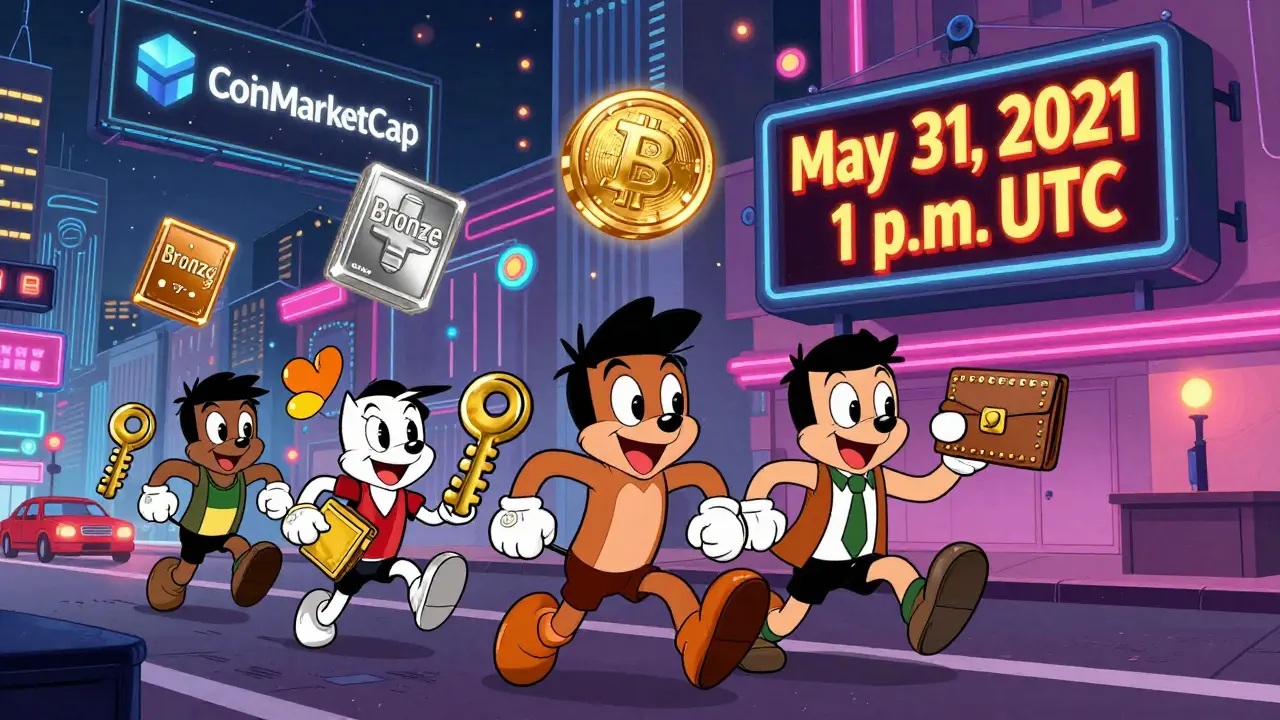
Back in May 2021, the crypto world was buzzing with NFT mania. People were rushing to claim free digital art, collectibles, and tokens-any chance to get in early on the next big thing. One of those projects was YOOSHI, a community-driven initiative tied to the Shiba Inu ecosystem. The SHIB ARMY NFT airdrop was its big launch, promising free NFTs to loyal followers. But what exactly did it offer? Who got in? And what happened after the four-day window closed?
How the YOOSHI SHIB ARMY NFT Airdrop Worked
The airdrop wasn’t just a random giveaway. It had rules. To qualify, you had to do two things: join the #YOOSHI campaign on CoinMarketCap and whitelist your Binance Smart Chain (BSC) wallet address. No Ethereum wallets. No MetaMask on the mainnet. You needed a wallet that worked on BSC-like Trust Wallet, MetaMask with BSC network switched, or Binance Chain Wallet. You couldn’t just sign up and walk away. You had to actively engage. That meant following YooShi’s official Telegram channel, retweeting their posts, and completing the CoinMarketCap NFT registration. The campaign ran from May 27 to May 31, 2021. Only those who completed all steps before May 31 at 1 p.m. UTC got a shot at claiming their NFT. Once eligible, participants logged into yooshi.io and connected their wallet. The system checked if they were whitelisted. If yes, they could claim one NFT from the SHIB ARMY collection. The NFTs came in three tiers: Bronze, Silver, and Gold. Each had different rarity levels, with Gold being the rarest. The exact number of each tier wasn’t publicly listed, but the total supply of the entire collection was tied to the YooShi token supply: 45,896,736,161,754 tokens. That’s not a typo-it’s over 45 trillion. The NFTs were meant to be digital membership cards to the SHIB ARMY, a nickname for Shiba Inu’s massive community.Why Binance Smart Chain? The Technical Choice
Why BSC and not Ethereum? Gas fees. In May 2021, Ethereum network fees were hitting $100+ per transaction. For a free NFT airdrop, that made no sense. BSC offered near-zero transaction costs and faster confirmations. It was the practical choice for mass adoption. Participants needed to have BSC-compatible wallets with enough BNB to cover tiny gas fees (usually less than $0.10) for claiming and later transferring the NFT. This wasn’t a barrier for most crypto-savvy users, but it did filter out casual newcomers. The project didn’t want to attract people who didn’t understand wallets. It wanted builders, traders, and true believers.The Shiba Inu Ecosystem Connection
YOOSHI wasn’t some random token. It was built on the momentum of Shiba Inu, which had exploded in early 2021. The term “SHIB ARMY” wasn’t just marketing-it was a real cultural force. Thousands of people had bought SHIB not because they believed in its utility, but because they believed in the community. YooShi leaned into that. The NFTs weren’t just art. They were symbols of belonging. Other Shiba-related projects followed similar patterns. For example, the Shib Army Inferno NFT project used 30% of minting proceeds to buy back and burn SHIB tokens, reducing supply and boosting scarcity. YooShi didn’t publicly confirm if it used the same burn mechanism, but the pattern was clear: NFTs were a way to deepen community loyalty and create deflationary pressure on the main token.
Marketing and Promotion
CoinMarketCap was a huge part of the campaign. Their partnership gave YooShi instant credibility. When CoinMarketCap promoted a project, it reached millions of crypto users who trusted the platform for price data and market news. The #YOOSHI and #CMC hashtags were everywhere on Twitter. Telegram channels flooded with screenshots of whitelisted addresses. People were racing to complete steps before the deadline. YooShi’s official Telegram channel posted countdowns. One message on May 18, 2021, said: “RT @CoinMarketCap: 5 Days left to join #YOOSHI's SHIB ARMY.” That wasn’t just a reminder-it was a call to arms. The community responded. The airdrop launched during one of the biggest crypto bull runs in history. Bitcoin was above $60,000. Ethereum hit $4,000. NFT sales hit $1 billion in a single week. Timing couldn’t have been better.What Happened After the Airdrop?
The claiming window closed on May 31, 2021. No extensions. No second chances. That’s how these things worked back then. You missed it? You missed it. What happened to the NFTs after that? Not much. Unlike other NFT projects that built games, metaverse worlds, or utility systems, YooShi’s SHIB ARMY NFTs never evolved. No roadmap. No staking. No exclusive access to future airdrops. The NFTs sat in wallets, mostly forgotten. There was no official secondary market. No OpenSea listing. No floor price tracking. Some collectors traded them privately on Telegram, but there was no centralized marketplace. No one published trading volumes. No one released data on how many were claimed. Estimates suggest only a fraction of eligible users actually claimed-maybe 20-30%. Why? Because claiming required gas fees. Some people didn’t have enough BNB. Others didn’t know how. Others just didn’t care. By late 2022, the project faded. The YooShi website went quiet. The Telegram channel stopped posting. The team shifted focus to Shibarium, Shiba Inu’s Layer-2 blockchain. Shibarium launched in 2023 with gaming and DeFi features. The original SHIB ARMY NFTs? They became digital relics.
Could This Happen Again?
Today, in 2026, NFT airdrops are rare. Most projects skip them. Why? Because the hype died. People got burned. They claimed free NFTs, only to watch them lose 95% of their value. Wallets filled with useless JPEGs. Trust eroded. But the model isn’t dead. It’s evolved. New projects now tie airdrops to real utility: access to games, voting rights, token unlocks, or staking rewards. The YooShi airdrop was pure loyalty reward. No strings attached. That’s why it didn’t last. If you’re looking for similar opportunities today, watch for projects that link NFTs to ongoing utility-not just a one-time collectible. Look for teams that build ecosystems, not just memes.Key Takeaways
- The YOOSHI SHIB ARMY NFT airdrop was a four-day event in May 2021, open only to those who whitelisted their BSC wallet and joined CoinMarketCap’s campaign.
- NFTs came in Bronze, Silver, and Gold editions, with rarity tied to community engagement, not random generation.
- Binance Smart Chain was chosen for low fees, making mass participation possible.
- The project was deeply tied to the SHIB ARMY community culture, using meme energy to drive adoption.
- After claiming, most NFTs had no utility, no marketplace, and no roadmap. They became digital artifacts.
- Today, successful airdrops offer ongoing value-not just collectibles.
Was the YOOSHI SHIB ARMY NFT airdrop free?
Yes, the NFTs themselves were free to claim. But you needed BNB in your wallet to pay for gas fees when claiming and later transferring the NFT. The gas cost was usually under $0.10, but if you didn’t have any BNB, you couldn’t complete the claim.
Can I still claim the YOOSHI SHIB ARMY NFT today?
No. The claiming window closed on May 31, 2021. There was no extension, and the official website no longer supports claiming. Any NFTs in circulation today were transferred privately after the original airdrop.
Did the YOOSHI NFTs have any value after the airdrop?
Very little. There was no official marketplace, no staking, and no utility tied to the NFTs. A few were traded privately on Telegram, but there was no consistent demand. Most ended up sitting idle in wallets. Unlike projects like Bored Ape or CryptoPunks, these NFTs never gained secondary market traction.
Why did YooShi use CoinMarketCap for the airdrop?
CoinMarketCap was one of the most trusted crypto data platforms at the time. Partnering with them gave YooShi instant visibility to millions of users who checked prices and market trends daily. It wasn’t just marketing-it was credibility. The #CMC hashtag was a signal: this project was legit enough for a major platform to back it.
Are there any active YooShi projects today?
The original YooShi team shifted focus to Shibarium, Shiba Inu’s Layer-2 blockchain. Current efforts are centered around gaming, DeFi apps, and new tokenomics-not NFT airdrops. The SHIB ARMY NFT collection is no longer part of active development.
Tanvi Atal
February 21, 2026 AT 15:01Free NFTs? Yeah right. Everyone thought they were getting rich. Turned out it was just another JPEG with zero utility. I didn't even bother claiming. Knew it was a gimmick from day one.
Now we're stuck with digital dust.
Sony Sebastian
February 23, 2026 AT 11:24Let’s be real-the entire YooShi airdrop was a liquidity grab disguised as community building. BSC was chosen not for scalability but because it allowed them to bypass Ethereum’s regulatory scrutiny. Gas fees were a filter, sure, but also a way to exclude retail investors who couldn’t afford even $0.08 in transaction costs. Classic rug-pull engineering.
And don’t get me started on the 45-trillion token supply. That’s not a feature-it’s an inflationary landmine. They knew no one would ever hold it. They just wanted the hype cycle to pump the price before vanishing.
Brian Lemke
February 24, 2026 AT 15:29I remember this time like it was yesterday. The energy in the crypto space was electric. People weren’t just investing-they were joining a movement. The SHIB ARMY wasn’t just a hashtag; it was a tribe. And YooShi? It gave us something to rally around, even if it was just a digital badge.
Yeah, the NFTs didn’t evolve. But that doesn’t mean they didn’t matter. For a few months, we were part of something bigger than price charts. We had memes, we had inside jokes, we had each other. That’s rare.
Maybe the utility wasn’t coded into the smart contract… but it was coded into us.
Megan Lavery
February 26, 2026 AT 14:13Honestly? I claimed mine. It’s still in my wallet. I don’t use it. I don’t sell it. I just kinda… keep it.
Like a little souvenir from when crypto felt fun instead of stressful.
Kinda nostalgic, honestly. 😊
Trenton White
February 27, 2026 AT 14:50The BSC choice made sense. Ethereum fees were insane. But I think the bigger issue was the lack of follow-through.
They built a community, then walked away.
That’s the real tragedy-not the NFTs being worthless, but the silence after the hype.
Cheryl Fenner Brown
February 28, 2026 AT 15:45omg i totally forgot about this 😭 i claimed mine and then like… never checked again. i still have it in trust wallet. it’s like a crypto ghost. also why did they use 45 TRILLION tokens??? that’s not a number, that’s a cry for help 💀
Michael Teague
March 2, 2026 AT 00:26Free NFTs? Sure. Until you realize you need BNB to claim it. Then it’s not free. It’s a trap.
And no one ever told you how to get BNB if you didn’t already have it. Classic bait-and-switch.
I didn’t claim. Smart move.
kati simpson
March 2, 2026 AT 17:22You know what I find interesting? It wasn’t the NFTs that failed. It was the lack of a story after the launch.
People don’t need utility. They need meaning.
They gave us a badge but no reason to wear it.
And once the bull run ended, no one cared anymore.
That’s how these things die.
Not with a bang.
But with silence.
Cory Derby
March 4, 2026 AT 13:37It is worth noting that the YooShi initiative, while ultimately unsuccessful in sustaining long-term engagement, did succeed in demonstrating the power of community-driven marketing during a period of unprecedented market enthusiasm. The integration with CoinMarketCap provided a legitimate channel for mass participation, and the technical decision to utilize Binance Smart Chain reflected a pragmatic understanding of transactional economics.
Although the NFTs themselves lacked subsequent utility, the underlying model-linking digital identity to community participation-remains a viable framework for future projects that prioritize sustained interaction over speculative value.
Colin Lethem
March 6, 2026 AT 13:19Bro I still have my Bronze NFT. I didn’t even know it was still there until I opened my wallet last week. Looked at it, laughed, then sent it to my friend who’s into crypto nostalgia. He’s got a whole folder of dead NFTs. We call it ‘The Crypt Graveyard.’
It’s not valuable. But it’s funny. And honestly? That’s worth something too.
Also, 45 trillion tokens?? Who designed that? A math wizard or a drunk guy with a calculator?