Stablecoins are supposed to be boring. They’re meant to sit there, holding their value at $1.00, while the rest of the crypto market goes crazy around them. But lately, "boring" has become complicated again. After high-profile collapses in the past, you might be asking: can I actually trust these digital dollars? Enter Usual USD, a newer player trying to fix the trust issues that plague older coins like USDT or USDC.
If you’ve heard the ticker symbol USD0 is a fully collateralized stablecoin backed by short-term US Treasury Bills, you’re looking at a different kind of money. It’s not just a promise from a company; it’s a direct link to government debt, wrapped in blockchain technology. Let’s break down what this means for your wallet and why people are paying attention.
The Core Idea: Real-World Assets Backing Digital Cash
Most stablecoins work on a fractional reserve model. That sounds fancy, but it basically means the company behind the coin holds some cash and some risky investments, hoping they always have enough to cover withdrawals. With Usual USD (USD0) is a non-fractional stablecoin where every single token is backed 1:1 by low-risk, liquid assets, the math is simpler. Specifically, those assets are short-term US Treasury Bills.
Why does this matter? Because T-Bills are considered one of the safest investments in the world. When you hold USD0, you aren’t relying on the goodwill of a private firm. You’re relying on the US government’s ability to pay its bills, which is then verified on-chain. This creates a layer of security that traditional fiat-backed stablecoins struggle to match without heavy regulatory overhead.
This approach falls under the broader trend of Real-World Assets (RWA) refers to tokenizing physical or traditional financial assets like bonds, real estate, or commodities for use on blockchains. By bringing Treasuries on-chain, Usual bridges the gap between Wall Street safety and Main Street accessibility.
How the Three-Token Ecosystem Works
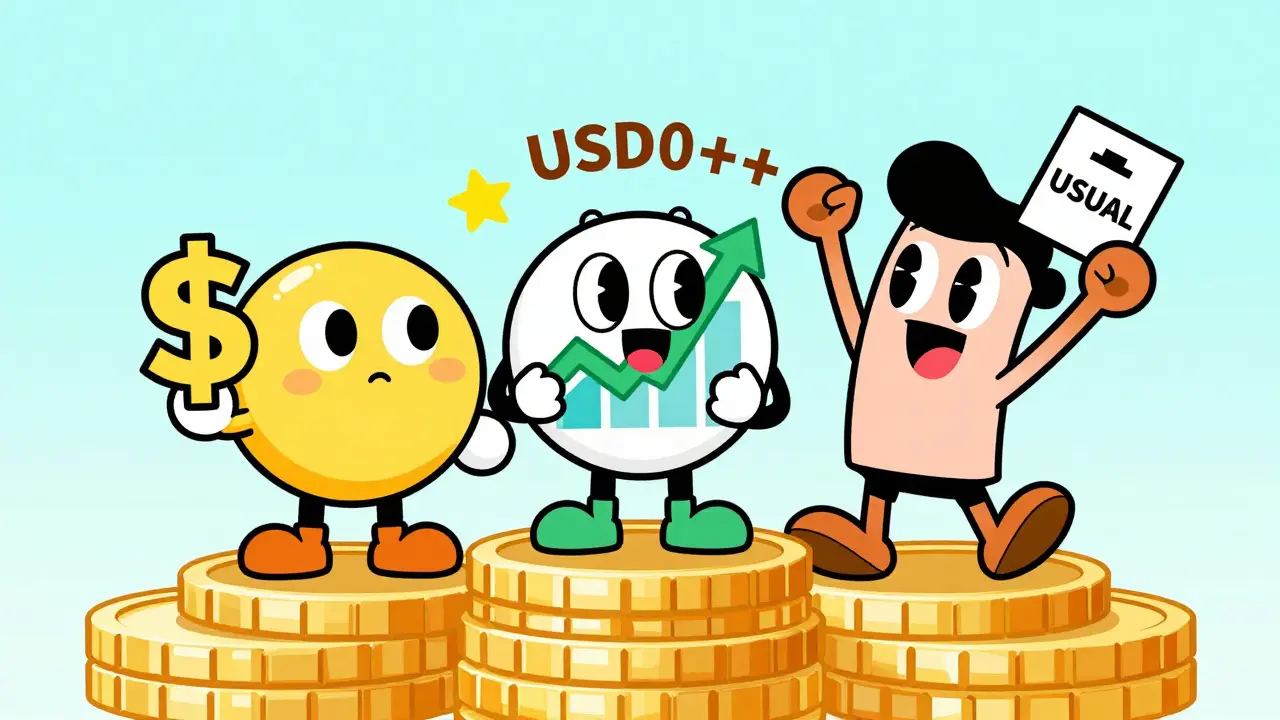
You won’t just see USD0 floating around. The Usual protocol actually runs on three distinct tokens, each with a specific job. Understanding the difference between them is crucial so you don’t accidentally stake the wrong thing.
- USD0: This is your everyday spending money. It’s the stablecoin itself. You use it to trade, pay for goods, or move value across borders instantly. It aims to stay pegged tightly to the US Dollar.
- USD0++: Think of this as "staking mode." When you lock up your USD0 in the protocol’s smart contracts, it converts to USD0++. You keep your principal value, but now you’re earning rewards. It’s a liquid staking derivative, meaning you can still move it around within the ecosystem while it works for you.
- USUAL: This is the governance and utility token. It’s not a stablecoin. Its value fluctuates based on market demand and protocol performance. Holders of USUAL get a say in how the protocol evolves, and importantly, they receive a share of the revenue generated by the system.
The relationship here is tight. The more USD0 people stake into USD0++, the more demand there is for the USUAL token, because USUAL is used to distribute the yields earned from the underlying T-Bills. It’s a flywheel designed to reward users who provide liquidity and stability to the network.
Earning Yield: Staking and Rewards
In traditional banking, if you want interest on your savings, you open an account and wait. In DeFi, you can earn yield actively. With Usual, the mechanism is straightforward. You deposit USD0, and it becomes part of the pooled reserves backing the protocol.
Where does the profit come from? Remember those US Treasury Bills? They pay interest. The Usual protocol collects that interest from the underlying assets and redistributes it to holders of USD0++ is the staked version of USD0 that accrues rewards in the form of USUAL tokens. The Annual Percentage Yield (APY) isn’t fixed; it changes based on current Treasury rates and the total amount of capital locked in the system.
This is a key shift from earlier DeFi models where yields were often inflated by unsustainable incentives. Here, the yield is "real"-it comes from actual financial instruments. As of early 2026, this model has attracted significant Total Value Locked (TVL), proving that investors prefer predictable, asset-backed returns over speculative gambling.
Safety First: Insurance and Transparency
We’ve all seen headlines about exchanges going bankrupt or stablecoins de-pegging. Usual addresses these fears head-on with two main features: transparency and insurance.
First, everything is on-chain. You can verify the reserves yourself. There’s no need to wait for a quarterly audit report from a third-party accountant. The connection between the USD0 supply and the T-Bill holdings is visible in real-time. This eliminates the "black box" problem where you hope the company is telling the truth about their balance sheet.
Second, there’s an insurance fund. Protocol revenue flows into this pot. If something catastrophic happens-a bug in the smart contract, a hack, or a systemic failure-this fund acts as a backstop to protect holders. It’s not a guarantee against all risks, but it adds a layer of defense that most decentralized protocols lack.
| Feature | Usual USD (USD0) | Traditional Fiat-Backed (e.g., USDT/USDC) |
|---|---|---|
| Backing Asset | Short-term US Treasury Bills (RWA) | Cash equivalents, commercial paper, corporate bonds |
| Transparency | Real-time on-chain verification | Periodic attestations/audits (days/weeks delay) |
| Yield Source | Treasury interest passed to stakers | Usually none for holders (issuer keeps profit) |
| Governance | Decentralized via USUAL token | Centralized company decisions |
| Risk Profile | Low (Govt-backed assets + Insurance Fund) | Medium (Counterparty risk of issuer) |
Current Market Status and Pricing
As we move through 2026, USD0 has established itself as a reliable tool for traders and institutions. It maintains its peg remarkably well. On typical trading days, you’ll see it hovering right around $1.00, perhaps dipping to $0.998 or spiking to $1.002 due to minor arbitrage opportunities.
For example, recent data shows USD0 trading at approximately $0.9988 with healthy daily volumes exceeding $150,000. This volume indicates active usage rather than dormant holdings. Meanwhile, the governance token USUAL is the volatile governance token of the Usual protocol, valued separately from the stablecoin trades independently. Its price reflects sentiment about the protocol’s growth. If more people stake USD0, the demand for USUAL rises, potentially increasing its market cap, which sat near $25 million in early reports.
The conversion rate remains nearly 1:1 with the US Dollar. If you exchange 1,000 USD0, you should expect to receive roughly $998.29 to $1,000 USD, depending on transaction fees and slippage on the specific exchange platform you use. These tiny variances are normal in crypto markets and reflect operational costs, not instability.

Who Should Use Usual USD?
Not every crypto project is for everyone. So, who benefits most from USD0?
- DeFi Savvy Investors: If you already use platforms like Uniswap or Aave, USD0 offers a safer place to park funds when you’re not actively trading volatile assets.
- Yield Seekers: People who want exposure to US Treasury yields without dealing with brokerage accounts or minimum investment thresholds.
- Global Users: Individuals in countries with unstable local currencies can hold USD0 to preserve purchasing power, knowing it’s backed by hard assets rather than a fragile local bank.
However, if you’re looking for high-risk, high-reward meme coins or speculative tech bets, USD0 isn’t it. It’s infrastructure. It’s the digital equivalent of a savings bond, not a lottery ticket.
Getting Started with USD0
Using USD0 requires a few basic steps. First, you need a self-custody wallet that supports the blockchain networks where Usual operates (typically Ethereum-compatible chains). Next, you’ll need to acquire USD0. You can usually swap other cryptocurrencies for USD0 on major decentralized exchanges (DEXs) or centralized exchanges that list the pair.
Once you have USD0, decide if you want to spend it or stake it. To stake, you interact with the Usual protocol interface, approve the transaction, and convert your USD0 to USD0++. From there, you start accruing USUAL rewards automatically. Always double-check the contract addresses on official channels to avoid phishing scams-a common risk in DeFi.
Is Usual USD (USD0) safe?
USD0 is considered highly secure because it is fully collateralized by short-term US Treasury Bills, which are low-risk government assets. Additionally, the protocol includes an insurance fund backed by revenue to protect against smart contract failures or hacks. However, as with any crypto asset, users should manage their own private keys and be aware of general blockchain risks.
What is the difference between USD0 and USDC?
While both are stablecoins pegged to the dollar, USDC is issued by a centralized company and backed by a mix of cash and securities. USD0 is decentralized and backed specifically by on-chain verifiable US Treasury Bills. USD0 also allows holders to earn yield directly through staking, whereas USDC holders typically do not earn interest unless they lend it out elsewhere.
Can I lose money holding USD0?
The value of USD0 is designed to stay at $1.00. You wouldn't lose value from price volatility like you would with Bitcoin. However, you could face losses if the underlying US Treasury market crashes (extremely unlikely), if the smart contracts are hacked (mitigated by insurance), or if you lose access to your private wallet keys.
What is the USUAL token used for?
USUAL is the governance token of the Usual protocol. It allows holders to vote on protocol upgrades and changes. More importantly, it captures the value of the protocol's revenue. When you stake USD0 into USD0++, you earn rewards in USUAL, making it essential for participating in the ecosystem's yield generation.
Does USD0 require KYC (Know Your Customer) verification?
No, USD0 is a permissionless cryptocurrency. You do not need to provide personal identification to buy, hold, or stake it on decentralized platforms. You only need a compatible crypto wallet. This contrasts with traditional banking products or regulated centralized exchanges which often require strict identity checks.