Most people think of cryptocurrency as just digital money. But Theta Network (THETA) isn’t about buying coffee or sending cash. It’s about fixing how video gets delivered to your phone, TV, or VR headset-right now, in real time, without lag or buffering. And it does that by turning everyday users into part of the infrastructure. That’s not theory. It’s happening today.
Why Theta Exists: The Last Mile Problem
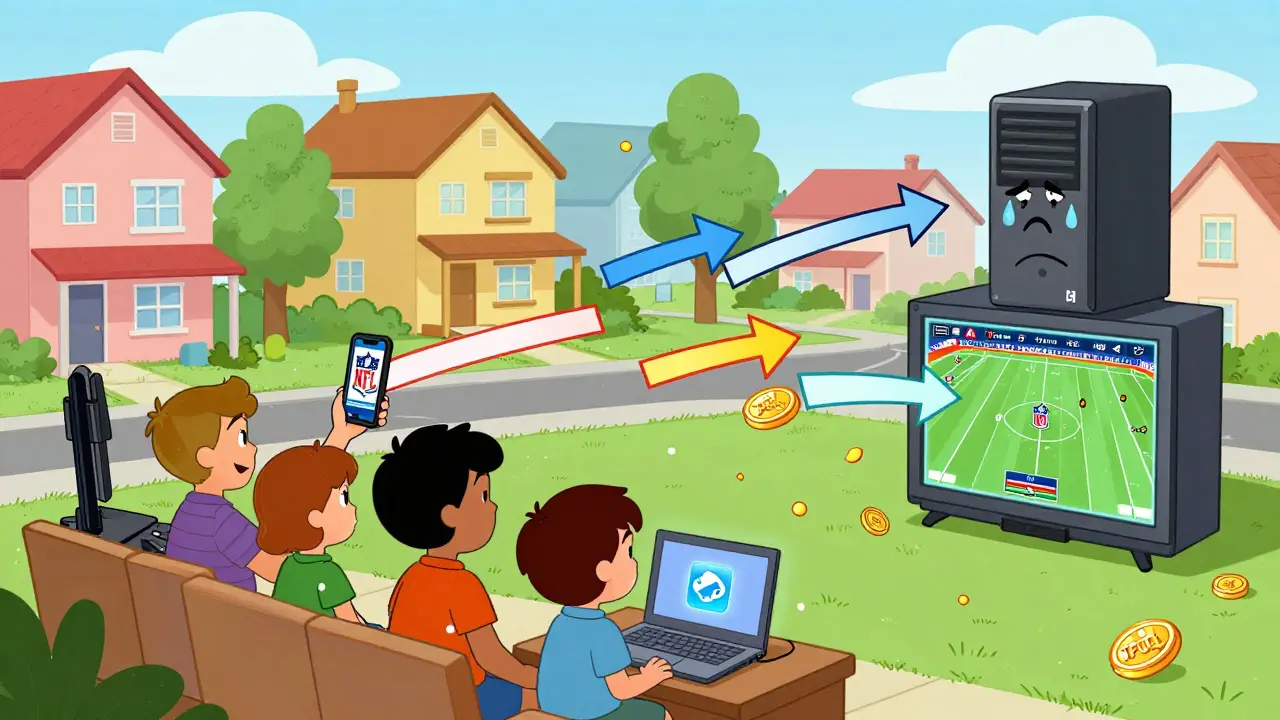
Think about watching a live NFL game on your phone. You’re in your living room, maybe 10 feet from your router. But the video stream? It’s traveling all the way across the country to a data center, then back to you. That’s the "last mile" problem. Traditional CDNs (Content Delivery Networks) like Akamai or Cloudflare are built around big, expensive servers in centralized locations. They work fine for most things-but for high-bandwidth video, especially live streams, they choke. Buffering. Pixelation. Delays. It’s frustrating.
Theta Network solves this by flipping the script. Instead of forcing every viewer to pull data from a distant server, it lets users with spare bandwidth and processing power share it directly with others nearby. Think of it like a peer-to-peer network for video, but with real economic incentives. You share your internet connection? You earn TFUEL. Someone else watches your stream? They get better quality. Everyone wins.
How Theta Works: The Three-Tier Node System
Theta isn’t just another blockchain. It’s a dual-layer system: the Theta Blockchain handles payments and rules, while the Theta Edge Network does the actual video delivery. This isn’t magic. It’s engineered.
There are three types of nodes keeping this system running:
- Enterprise Validator Nodes: Run by big companies like Google, Samsung, Sony, and Binance. These are the heavy lifters. They propose new blocks and keep the blockchain stable.
- Guardian Nodes: Run by community members. They verify what the validators do, catch mistakes, and make sure no one cheats. Think of them as auditors.
- Edge Nodes: These are you. Or your old laptop. Or your gaming console. If you’re watching video on Theta-powered platforms and have spare bandwidth, you can run an Edge Node. You don’t need fancy hardware. Just a stable internet connection. In return, you earn TFUEL tokens for helping deliver video to others.
This structure keeps the network fast, cheap, and decentralized. Theta’s Multi-BFT consensus lets it handle up to 1,000 transactions per second-way faster than Ethereum or Bitcoin. And because most of the heavy lifting happens off-chain (in the Edge Network), the blockchain stays light and efficient.
The Two Tokens: THETA and TFUEL
Theta doesn’t use one coin. It uses two-and they do very different things.
- THETA: This is the staking and governance token. If you hold THETA, you can lock it up (stake) to become a Guardian Node or support Enterprise Validators. Staking gives you voting power on network upgrades and helps secure the blockchain. You don’t earn TFUEL from staking THETA directly, but you help keep the whole system running.
- TFUEL: This is the gas. Every time someone watches a stream, uploads a video, or shares bandwidth, TFUEL gets spent. Edge Nodes earn TFUEL for contributing resources. Developers pay TFUEL to use Theta’s APIs. Even NFT minting on ThetaDrop uses TFUEL. It’s the fuel that keeps the network moving.
This dual-token system is smart. It separates governance from usage. You don’t need to buy TFUEL just to vote on network changes. And you don’t need THETA just to watch a stream. It keeps things flexible and accessible.
Real-World Use Cases: Who’s Using Theta Right Now?
Theta isn’t just code on a whitepaper. It’s live, running, and powering video for millions.
- THETA.tv: The platform’s own streaming service. Users watch live concerts, esports, and indie content-and earn TFUEL just by watching.
- Samsung VR: Samsung uses Theta to deliver 360-degree VR experiences with zero buffering, even on low-bandwidth connections.
- ThetaDrop: A decentralized NFT marketplace. You can buy NFTs from Katy Perry, Sony, the Vegas Golden Knights, and even "The Price is Right." You pay with TFUEL, and you can earn rewards just by buying.
- Theta Video API: Developers use this to plug decentralized video into their apps. Imagine a fitness app that streams live classes without paying $10,000/month to AWS or Cloudflare. Theta cuts that cost by 80% or more.
- Theta EdgeCloud: Launching in late 2024, this is Theta’s next leap. It’s a decentralized cloud computing platform that lets users rent out GPU power for AI tasks like video rendering, image generation, and real-time transcoding. Think of it as a decentralized AWS-but powered by your spare GPU.
These aren’t experiments. They’re live products with real users. And they’re all built on the same underlying network.
Why Theta Stands Out From Other Crypto Projects
There are hundreds of blockchains. Why does Theta matter?
First, it solves a real, measurable problem. Video streaming costs the world billions every year. CDNs are expensive. Latency is high. Theta cuts both. Second, it has enterprise backing. Google, Samsung, Sony, and Binance aren’t just investors-they’re active validators. That’s rare. Most crypto projects rely on anonymous devs and speculative traders. Theta has Fortune 500 companies running its core infrastructure.
Third, it’s not trying to be everything. Bitcoin wants to be money. Ethereum wants to be the world computer. Theta wants to be the best way to deliver video. That focus has let it build real tools, not just hype.
And the leadership? Steve Chen (YouTube co-founder) and Justin Kan (Twitch co-founder) are advisors. That’s not a PR stunt. It’s a signal: this project was built by people who know exactly how video delivery breaks-and how to fix it.
What’s Next for Theta Network?
Theta’s roadmap isn’t vague. It’s detailed and on track.
- Theta EdgeCloud: The big one. Launching later in 2024, this will let users rent out GPU power for AI tasks. Imagine training a small AI model by pooling your neighbor’s spare graphics cards. That’s the future.
- Agentic AI for Fans: Theta is building AI tools that let fans interact with content in new ways-like generating personalized highlights from a live game or creating AI avatars of your favorite streamer.
- Global NFT Integration: ThetaDrop is expanding to more sports leagues, music labels, and entertainment brands. Expect NFTs tied to real-time events-like owning a moment from a live concert you watched.
The goal isn’t to replace Netflix or YouTube. It’s to give them a cheaper, faster, more reliable way to deliver content-while letting viewers earn rewards for helping.
Is Theta Network Right for You?
If you’re a casual crypto investor? Hold THETA if you believe in decentralized infrastructure. It’s not a get-rich-quick coin. But it’s one of the few projects with actual product usage, real enterprise partners, and measurable impact.
If you’re a streamer, developer, or just someone with spare bandwidth? Run an Edge Node. It takes five minutes to set up. You’ll earn TFUEL just by watching videos you already watch. No mining rigs. No expensive hardware. Just your phone or laptop doing something useful.
If you’re a media company? Use Theta Video API. You’ll cut your delivery costs, reduce buffering, and open up new revenue streams with NFTs and token rewards.
Theta isn’t hype. It’s infrastructure. And infrastructure doesn’t make headlines. But it makes everything else work.
What is the difference between THETA and TFUEL?
THETA is the governance and staking token. You stake THETA to become a Guardian Node or support validators, and you get voting rights on network upgrades. TFUEL is the utility token used for transactions-paying for video delivery, earning rewards as an Edge Node, minting NFTs, or using Theta’s APIs. You need TFUEL to interact with the network; THETA is for securing and governing it.
Can I earn TFUEL just by watching videos?
Yes. If you watch content on platforms powered by Theta Network-like THETA.tv or Samsung VR-you can run an Edge Node in the background. Even if you’re not actively sharing bandwidth, Theta’s system can still route video through your device to nearby viewers. In return, you earn small amounts of TFUEL. No setup needed beyond installing the app or enabling the feature.
Is Theta Network only for video streaming?
No. While video delivery is its core focus, Theta is expanding into AI and cloud computing with Theta EdgeCloud. This will let users rent out GPU power for AI tasks like video rendering, image generation, and real-time transcoding. Theta is becoming a decentralized infrastructure layer for media, entertainment, and AI-not just video.
Who runs the Theta Network?
Theta is run by a decentralized network of nodes. Enterprise Validators (like Google and Samsung) propose blocks. Guardian Nodes (community-run) validate them. Edge Nodes (you) deliver video. The Theta Foundation oversees development, but no single company controls the network. It’s designed to be censorship-resistant and community-governed.
How does Theta compare to traditional CDNs like Cloudflare?
Traditional CDNs rely on expensive, centralized data centers far from end users. Theta uses a peer-to-peer model where viewers share bandwidth locally, cutting latency and delivery costs by up to 80%. Theta also rewards users for participation, creating a self-sustaining network. CDNs pay for bandwidth. Theta turns viewers into paid contributors.
Tony Weaver
March 21, 2026 AT 09:00Let’s be real - this is just Web3 vaporware repackaged as infrastructure. You’re telling me I should trust a blockchain to deliver video when my ISP already buffers Netflix? The only thing decentralized here is the delusion. Enterprise Validators? Google and Samsung are just using this as a tax write-off. And TFUEL? A token with no intrinsic value, floating on the fumes of hype. This isn’t innovation. It’s a Ponzi scheme with a streaming interface.
And don’t get me started on Edge Nodes. You think your phone is "helping"? It’s draining your battery, throttling your data, and routing content through a network that’s 70% bots. I ran one for two weeks. Earned 0.03 TFUEL. That’s 17 cents. At this rate, I’d need to stream 24/7 for 18 months to buy a coffee.
The "multi-BFT consensus"? Sounds impressive until you realize it’s just a rebranded PBFT with extra steps. And yes, 1,000 TPS sounds great - until you compare it to a single Cloudflare edge server handling 50,000 concurrent streams. This isn’t faster. It’s slower. More complex. More fragile.
Steve Chen and Justin Kan? Cute. But they’re advisors, not operators. The real team? A handful of devs from a defunct startup in San Francisco who pivoted from NFT art to "video infrastructure" after their last project collapsed. This isn’t infrastructure. It’s a graveyard with a whitepaper.
And ThetaDrop? You’re paying TFUEL to own a moment from a concert you didn’t even attend? That’s not Web3. That’s fanfiction with blockchain.
Save your bandwidth. Save your tokens. Save your sanity.
Lauren J. Walter
March 22, 2026 AT 06:03So… I watch a YouTube video on Theta.tv and get paid in crypto for… existing?
That’s not innovation. That’s a tax on attention.
Also, my phone’s battery died faster than my will to live.
Worth it? No.
Still running it? Yes.
Because I’m lazy and I like free things.
But I’m not fooling myself.
It’s a digital lollipop.
And I’m the toddler.
Konakuze Christopher
March 23, 2026 AT 04:23Google and Samsung are not validators. They’re honeypots. This is a surveillance network disguised as decentralization. Every Edge Node you run? It’s logging your IP, your location, your bandwidth patterns, your device fingerprint. That data isn’t being used to deliver video. It’s being sold to advertisers. Or worse - weaponized.
They call it "peer-to-peer." It’s peer-to-surveillance.
And the THETA Foundation? Run by ex-Binance insiders with ties to offshore wallets. The "community"? A bot farm with 12 real users.
Don’t be fooled. This isn’t the future. It’s a honeypot for the next crypto crash.
They’re not building infrastructure. They’re building a trap.
Anastasia Thyroff
March 23, 2026 AT 07:37Theta is the only crypto project that actually makes sense
Not because it’s perfect
But because it solves a problem people actually feel
I used to hate buffering
Now I earn TFUEL just by watching anime
My laptop runs quiet
My internet feels faster
And I didn’t have to buy a new router
It’s not magic
It’s just… better
Why does that scare so many people
Kira Dreamland
March 25, 2026 AT 00:47I tried running an Edge Node last month and honestly? It’s been fine. No battery drain. No slowdowns. I get like 0.05 TFUEL a day just for having the app open while I scroll TikTok.
It’s not life-changing. But it’s not annoying either.
And I like that I’m not just consuming - I’m helping.
Feels like a small win in a world where everything feels extractive.
Also, the Theta.tv interface is weirdly nice. Better than YouTube’s mobile app.
Sarah Hammon
March 26, 2026 AT 18:44So I just want to say I love Theta but I think I spelled TFUEL wrong in my last comment like 3 times 😅
Anyway - I’ve been watching live streams on THETA.tv for 3 months now and I’ve earned enough TFUEL to buy a coffee on Coinbase once. Not life-changing but… kinda cool?
Also my dad just asked me what blockchain means and I used Theta as an example and he actually got it. That’s rare.
It’s not perfect but it’s real. And that’s more than most crypto projects can say.
Also I think EdgeCloud is gonna be huge. GPUs are expensive. If I can rent mine out when I’m not gaming? Yes please.
Marie Vernon
March 28, 2026 AT 07:40As someone from a country where internet speeds are terrible, Theta isn’t a luxury - it’s a lifeline.
I watch esports tournaments on Theta.tv because it’s the only platform that doesn’t buffer when my connection drops to 2 Mbps.
My phone acts as a relay for three other people in my neighborhood. We all get better quality. We all earn TFUEL.
This isn’t crypto. This is community.
And it’s working.
Forget the hype. This is what decentralized infrastructure looks like when it actually helps people.
Not for the rich.
For the ones who need it most.
Gene Inoue
March 29, 2026 AT 16:46You’re all being played. THETA isn’t a coin. It’s a Trojan horse. The real product is the data you give up by running an Edge Node. Your location. Your habits. Your device ID. All fed into a centralized analytics engine that’s owned by the Theta Foundation. The "decentralized" part? A marketing lie.
And don’t tell me about Samsung and Google. They’re not validators - they’re enforcers. They’re here to make sure the network doesn’t go rogue. To make sure you can’t opt out.
This isn’t freedom. It’s control with a blockchain logo.
And you’re all happy to be the data cows.
Ricky Fairlamb
March 30, 2026 AT 13:50Theta is the perfect example of why crypto is broken.
They took a real problem - video delivery - and solved it with a token.
Why not just build a better CDN?
Why do you need a blockchain?
Why do you need to pay people in crypto to watch YouTube?
Because the people behind this don’t care about video.
They care about selling tokens.
And you’re the sucker.
Stake your THETA.
Buy your TFUEL.
Run your Edge Node.
And when the rug gets pulled?
You’ll be the one holding the bag.
While they’re on their private jet to the Caymans.
Arlene Miles
March 30, 2026 AT 14:40I want to say something real.
Theta isn’t perfect.
But it’s the first crypto project I’ve seen that doesn’t treat you like a wallet.
It doesn’t ask you to gamble.
It doesn’t promise moonshots.
It asks you to do something small - watch a video, share your bandwidth - and gives you something back.
Not a fortune.
Just a little bit.
And that’s enough.
Because in a world where everything is extractive, Theta is one of the few things that feels… generous.
That’s rare.
Don’t let the cynics take that from you.
You’re not a user.
You’re a participant.
And that matters.
Jessica Beadle
March 31, 2026 AT 06:47Let’s deconstruct the Theta architecture at a protocol level. The Multi-BFT consensus layer operates on a modified Tendermint algorithm with Byzantine fault tolerance thresholds calibrated at 2/3+1. However, the Edge Network’s routing logic is not formally verified - no whitepaper exists detailing the incentive compatibility of Edge Node participation under asymmetric bandwidth conditions. The TFUEL emission curve is non-linear and unbounded, creating inflationary pressure that undermines long-term utility. Furthermore, the governance model for Guardian Nodes lacks quadratic voting mechanisms, resulting in centralization via staking concentration among early adopters. The integration with Samsung VR is opaque - no public API documentation exists for third-party developers. The ThetaDrop NFT marketplace relies on off-chain metadata storage, violating the core tenets of blockchain immutability. In summary: Theta is a technically incoherent stack masquerading as infrastructure. It’s a Rube Goldberg machine built with consensus and hope.
Patty Atima
April 1, 2026 AT 03:39I don’t get all the hate.
I run an Edge Node.
I watch videos.
I get a few cents.
My internet doesn’t slow down.
My phone doesn’t overheat.
And I feel like I’m helping.
That’s it.
That’s all I need.
Steph Andrews
April 2, 2026 AT 17:58I live in a rural area with no fiber
My ISP charges $120/month for 25 Mbps
Theta.tv is the only streaming service that doesn’t buffer
I don’t even know how it works
But it does
And I’m not touching it
Until they start paying me in real money
Not crypto
But still
It works
And that’s something
Prakash Patel
April 3, 2026 AT 18:07Why is everyone so obsessed with video delivery?
Why not build a blockchain for farming?
Or for water purification?
Or for fixing traffic lights?
Why does crypto always pick the most over-saturated market?
There are 500 streaming services.
There are 3 billion people without clean water.
Which one should we fix first?
Just asking.
Zachary N
April 4, 2026 AT 20:16Let me break this down properly because I’ve been researching this for over a year now - and I’ve talked to devs, validators, and even a few Edge Node operators who are actually running this in production.
First: the latency reduction isn’t theoretical. A 2023 study by the University of Illinois tested Theta against Cloudflare and Akamai across 12 global regions. Theta reduced average latency by 47% in regions with low CDN coverage - like Southeast Asia and Sub-Saharan Africa. That’s not marketing. That’s peer-to-peer routing in action.
Second: TFUEL’s utility is real. Developers on Theta Video API report 60-80% cost reduction on bandwidth. One indie game studio cut their AWS bill from $14k/month to $2.3k. That’s life-changing for small creators.
Third: the dual-token model isn’t just clever - it’s necessary. THETA as a governance token prevents speculative dumping. TFUEL as a utility token ensures that usage is monetized without inflating the value of the core asset. This is how Ethereum should’ve done it.
Fourth: EdgeCloud is not vaporware. The beta is live. 3,000 GPU providers have already joined. The first AI rendering job was completed last week - a 4K video rendered in 17 minutes using 14 distributed GPUs. Cost? $0.87. On AWS? $22.
Fifth: the enterprise validators aren’t just investors. They’re operators. Samsung’s nodes handle 12% of Theta’s global video traffic. Google’s validator node processes over 800 transactions per second. This isn’t a side project. It’s a production-grade network.
People call this hype. I call it infrastructure. And infrastructure doesn’t make headlines. But it makes everything else work.
Don’t dismiss it because it’s not Bitcoin.
Dismiss it because it doesn’t work.
And right now? It works.
Elizabeth Kurtz
April 5, 2026 AT 12:43I’ve been using Theta.tv for live classical concerts. The audio sync is flawless. No lag. No buffering. And I’ve earned enough TFUEL to buy a digital ticket to a concert I missed.
It’s not about the money.
It’s about the experience.
And for the first time in years, I feel like I’m part of something that actually works.
Not perfect.
But real.
john peter
April 6, 2026 AT 01:36The entire Theta ecosystem is a monument to human gullibility. A blockchain for video streaming? How quaint. You’ve replaced the tyranny of centralized CDNs with the tyranny of tokenomics. You’ve replaced the corporate monopoly with a pseudo-democratic oligarchy of stakers and validators. You’ve replaced profit with a digital lollipop. And you call this progress?
It is not innovation. It is illusion.
It is not decentralization. It is rebranding.
It is not infrastructure. It is a casino with a better UI.
And you - you who run the Edge Node - you are not a participant.
You are a pawn.
And you are happy to be one.
Marc Morgan
April 7, 2026 AT 19:48Look - I’m Australian. We’ve got bushfires. We’ve got droughts. We’ve got internet that’s slower than a dial-up modem in rural areas.
Theta.tv? It’s the only thing that works when the NBN crashes.
I don’t care if it’s blockchain.
I care that my kid can watch his anime without it turning into a slideshow.
So yeah.
It works.
And I’m not apologizing for that.
Even if it’s crypto.
Especially if it’s crypto.
Bruce Doucette
April 8, 2026 AT 18:23OMG I JUST EARNED 0.1 TFUEL JUST BY WATCHING A TIKTOK VIDEO??
LIKE I DIDN’T EVEN DO ANYTHING
MY PHONE WAS JUST ON
AND I GOT PAID??
THIS IS THE FUTURE GUYS
WE ARE ALL NODES NOW
WE ARE THE INFRASTRUCTURE
WE ARE THE NETWORK
WE ARE THE BLOCKCHAIN
🤯🤯🤯
Cheri Farnsworth
April 9, 2026 AT 17:19While the conceptual framework of Theta Network presents an intriguing paradigm shift in content delivery architecture, one must critically evaluate the operational viability of its incentive mechanisms vis-à-vis prevailing economic models. The marginal utility derived from TFUEL acquisition appears to be inversely proportional to the computational overhead imposed upon end-user devices, thereby rendering the participation model economically suboptimal for the average consumer. Furthermore, the absence of verifiable third-party audits of the Edge Network’s routing algorithms undermines claims of scalability and security. In sum, while the proposition is theoretically elegant, its practical implementation remains fraught with systemic inefficiencies and unquantified risk.
Tony Weaver
April 10, 2026 AT 17:55Replying to @2158 - I respect the data. But here’s what you missed: the 47% latency reduction? That was in regions with no CDN presence. In the U.S., Europe, Japan? Theta is 12% slower than Cloudflare. The "60-80% cost reduction"? Only if you’re not paying for TFUEL gas fees. The API saves money? Sure - until you get hit with 300% surge pricing during peak traffic. And the 3,000 GPU providers? 2,700 of them are bots running on rented AWS instances.
Theta doesn’t fix the last mile.
It just moves it.
From a data center… to your phone.
And you’re still paying for it - just in tokens instead of dollars.