ROX Token Value Estimator
Based on Robotexon's claims: 1 simulation usage = 0.5 ROX reward. Using current market data from the article, calculate potential earnings and assess liquidity risk.
Robotexon (ROX) isn’t just another crypto coin. It’s a token built around a bold idea: pay robotics engineers for the simulation work they do. The problem it tries to solve sounds simple - but it’s huge. Right now, 70-80% of robotics simulation work never gets paid. Engineers spend months building virtual training environments for robots, but those simulations vanish into corporate black boxes. Robotexon says it can fix that. It wants to turn every simulation, every dataset, every control model into a tokenized asset that pays royalties forever.
How Robotexon (ROX) is supposed to work
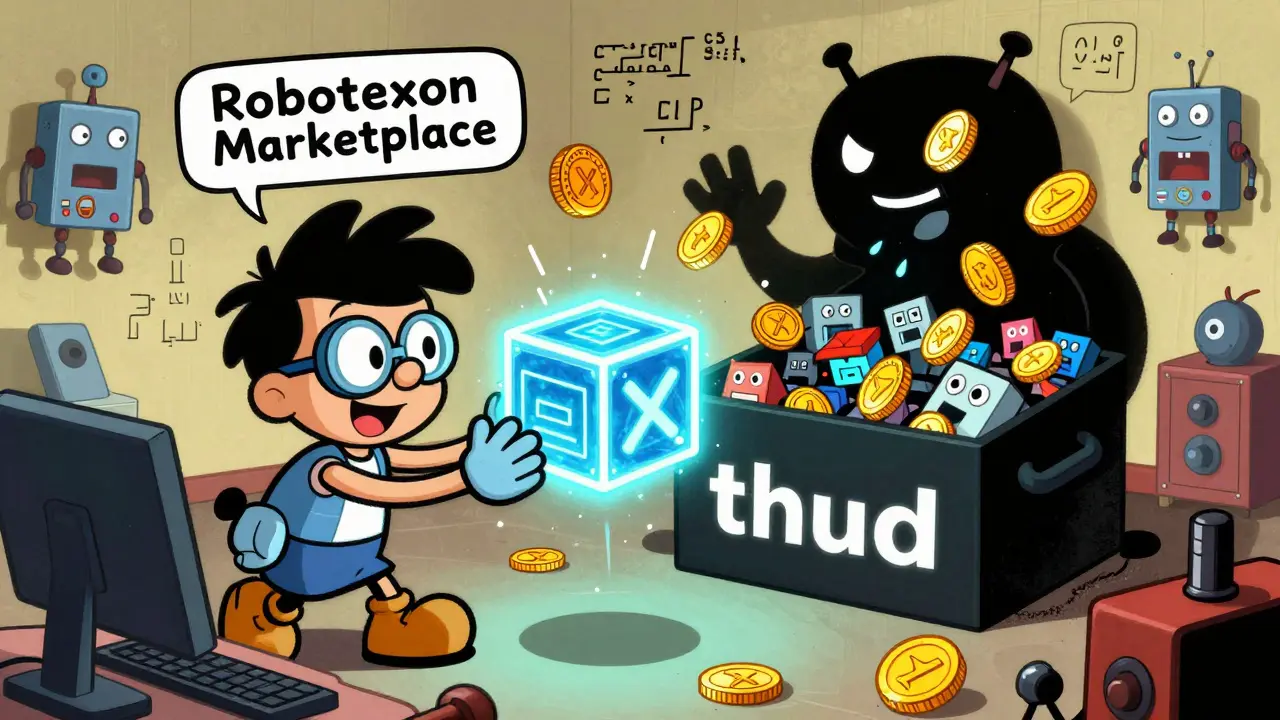
At its core, Robotexon is an Ethereum-based ERC-20 token. That means it runs on the same blockchain as Ethereum, using smart contracts to handle payments and ownership. The idea is this: you build a robot training scenario in simulation software. You upload it to the Robotexon Marketplace. The platform locks it on-chain using something called XTRON Core™ - their proprietary tech that formats and secures the data. Then, every time a robotics company buys or licenses that simulation to train their real robots, you get paid in ROX tokens.
That’s the "Train once, earn forever" promise. No middlemen. No one-time paychecks. If your simulation helps train a warehouse robot in Shanghai or a surgical bot in Germany, you keep earning every time it’s used. The token is the fuel for this system. It’s how royalties are distributed, how rights are verified, and how the whole economy moves.
Is Robotexon actually being used?
Here’s where things get shaky.
According to the project, Robotexon is already integrated with major Chinese robotics manufacturers. That sounds impressive - until you look for proof. No press releases. No case studies. No public names. MEXC, a crypto exchange, explicitly says no verifiable partnerships have been documented. The same goes for the XTRON Core™ engine. There’s no public GitHub repo. No open-source code. No technical whitepaper. Just a website and a token contract.
And the marketplace? It’s quiet. The 24-hour trading volume hovers between $179 and $1,910. That’s less than the cost of a decent gaming laptop. Compare that to the $200 billion robotics industry Robotexon claims to target. You’d need millions of transactions just to scratch the surface. Instead, you’ve got a token with only 585 holders. Most of them are likely speculators, not engineers uploading simulations.
Where you can trade ROX - and why it’s hard
You can’t buy Robotexon on Binance, Coinbase, Kraken, or any major exchange. None of them list it. The only place you can trade ROX is on Uniswap v2, a decentralized exchange on Ethereum. That means you need a Web3 wallet like MetaMask, Ethereum in your wallet to pay gas fees, and a basic understanding of how decentralized trading works.
For most people, that’s a barrier. A CryptoSlate survey from October 2025 found 78% of new crypto users struggle with these steps. And even if you get past that, the market is thin. The order book has $0.00 in liquidity within 2% of the current price. That means if you try to sell 10,000 ROX, you might crash the price. Buyers are scarce. Sellers are few. It’s not a liquid market - it’s a ghost town.

Price, supply, and market data
Here’s what the numbers say as of November 2025:
- Maximum supply: 100 million ROX
- Circulating supply: 70 million ROX
- Contract address: 0x32d4c7ecee527a84d11250597a0725858a607369
- Current price range: $0.0029 to $0.0043
- All-time high: $0.0538 (Binance)
- Market cap: Between $114,000 and $300,000 - depending on the site
- 24-hour volume: Under $2,000
That market cap puts ROX at #5822 on RevenueBot.io. Out of over 25,000 cryptocurrencies, it’s buried in the bottom 25%. CoinGecko rates it as "extremely high risk." CryptoRank says it has "minimal signs of organic growth." The numbers don’t lie: this is a micro-cap token with almost no trading activity.
Why the price is so volatile
With so little trading volume, even small trades move the price. One person buys 500,000 ROX? The price spikes 20%. Someone dumps 2 million? It crashes 15%. That’s why different sites show wildly different prices and 24-hour changes. Binance shows a -10.74% drop. CryptoRank says +1.93%. Neither is wrong - they’re just seeing different trades in a tiny, illiquid pool.
That kind of volatility isn’t normal for a functional platform. It’s a red flag. It suggests the price isn’t being set by real demand - it’s being manipulated by a handful of wallets. CoinMarketCap calls the volume-to-market-cap ratio "a red flag for potential price manipulation." That’s not a compliment. It’s a warning.
Is Robotexon a scam?
It’s not officially labeled a scam. But it ticks a lot of the boxes.
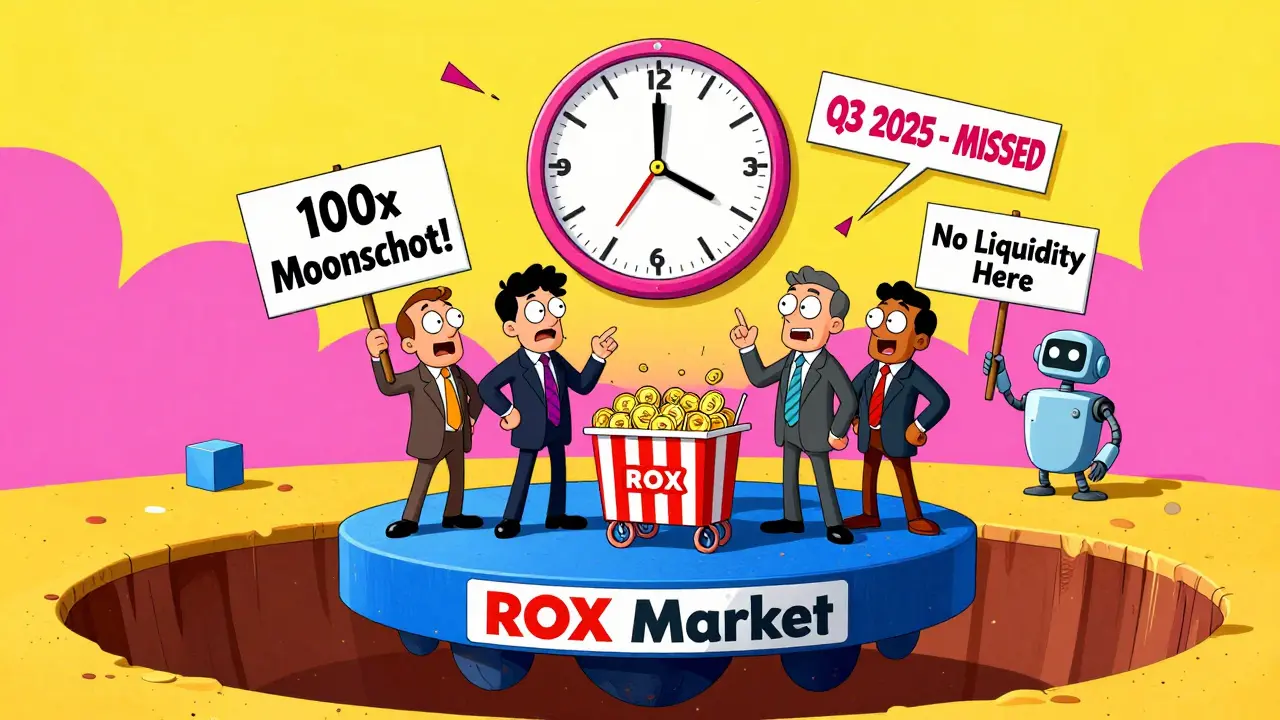
No public code. No verified partnerships. No exchange listings. A community of 327 people on Telegram. Zero user reviews on Trustpilot. An inactive Twitter account. No developer documentation. A roadmap that promised major exchange listings in Q3 2025 - and missed it.
The concept? Brilliant. The execution? Nonexistent. There’s no evidence that a single robotics engineer has ever been paid through Robotexon. No real-world use case has been proven. The entire system exists on paper and a smart contract - not in factories, labs, or research centers.
It’s not a scam in the way a fake coin with no purpose is. It’s a project that’s stuck in hype mode. The team built a token around a real problem - but they haven’t built the solution. They’ve built a speculation vehicle.
Who should consider ROX?
If you’re a robotics engineer with simulation data you want to monetize - don’t invest in ROX. Wait until there’s proof the platform works. Until then, you’re better off selling your datasets directly or using established platforms like AWS Data Exchange.
If you’re a crypto trader looking for the next 100x moonshot - ROX might look tempting. It’s cheap. It’s obscure. The story sounds big. But remember: micro-cap tokens like this often go to zero. With no liquidity, no community, and no real use, there’s no safety net. You’re betting on a dream, not a product.
For everyone else? Avoid it. The risks far outweigh any potential reward.
What’s next for Robotexon?
The project’s roadmap is dead. Q3 and Q4 2025 milestones were missed. No public updates. No new partnerships announced. The team hasn’t posted anything meaningful since August 2025. The social media channels are silent. The community is tiny. The market is frozen.
Without major exchange listings, open-source code, verified partnerships, or active developer engagement, Robotexon has no path forward. It’s not growing. It’s not evolving. It’s just sitting there - a token with a great idea, but no way to make it real.
Martin Hansen
December 5, 2025 AT 21:16Oh wow, another ‘disrupting robotics’ token with zero code, zero partnerships, and a market cap smaller than my monthly coffee budget. This isn’t innovation-it’s a crypto carnival ride for people who think ‘blockchain’ means ‘magic money printer.’ The fact that anyone still talks about this like it’s real is honestly embarrassing for the whole space.
Mariam Almatrook
December 7, 2025 AT 04:09One must earnestly contemplate the epistemological vacuum that underpins such speculative constructs. The absence of verifiable infrastructure, coupled with the conspicuous dearth of institutional validation, renders this endeavor not merely dubious, but ontologically incoherent. One is compelled to ask: can a token that lacks material manifestation be said to possess any economic substance whatsoever?
Chris Mitchell
December 8, 2025 AT 17:12Great idea. Bad execution. Always has been. The problem is real. The solution? Still in the imagination.
rita linda
December 8, 2025 AT 23:43Let’s be clear: this is a classic Western crypto grift dressed up as ‘robotics disruption.’ Real innovation happens in labs with patents, not in Ethereum contracts with 585 holders. If this were a Chinese or German project, it’d have been funded and regulated by now. Instead, it’s a low-effort pump disguised as a revolution.
Regina Jestrow
December 10, 2025 AT 18:59Wait-I’m confused. So engineers are supposed to upload their simulation work… but there’s no marketplace? No way to verify payments? No engineers even talking about it? If this were a movie, the hero would’ve walked away by now. Instead, we’re all just staring at a token contract like it’s the Holy Grail.
jonathan dunlow
December 11, 2025 AT 11:59Look, I get it-you see a broken system and you want to fix it. That’s awesome. But you can’t just slap a token on top of a problem and call it a solution. Real change takes time, transparency, and real people working on real tech. Robotexon’s got the dream, but it’s missing the grind. If the team actually cared, they’d open-source XTRON Core, publish case studies, or at least post a roadmap update. But they’re ghosting. And that’s the real tragedy here: a brilliant idea abandoned because the team didn’t have the guts to build it right.
nicholas forbes
December 12, 2025 AT 02:28I don’t care how ‘bold’ the idea is. If you can’t show me proof, I’m not investing. Not even a dollar. And if you’re telling me this is the future of robotics funding, then we’re in worse shape than I thought.
Joe West
December 13, 2025 AT 16:07Hey, if you're a robotics engineer reading this-don't waste your time on ROX. Use AWS Data Exchange or even Gumroad to sell your sims directly. You’ll get paid faster, with way less drama. This token? It’s a ghost. Save your energy for something real.
Richard T
December 14, 2025 AT 22:55It’s weird how the most compelling ideas often get turned into speculative assets instead of real products. Robotexon’s concept could’ve been a platform that actually empowers engineers. Instead, it’s become a lottery ticket for people who think ‘low market cap’ means ‘undervalued.’ The tragedy isn’t that it failed-it’s that it never even tried to succeed.
Lawal Ayomide
December 15, 2025 AT 20:44