
Imagine you have a massive dataset-maybe it’s medical records, satellite imagery, or customer behavior logs. You want to sell it to train an AI model, but you’re terrified of losing control. If you hand over the files, who knows where they’ll end up? Will they be copied? Sold again? Used without your permission?
This is the exact problem Ocean Protocol was built to solve. It is not just another cryptocurrency; it is a decentralized infrastructure that lets people monetize their data while keeping it private and secure. At the heart of this system is the OCEAN token, which acts as the fuel for transactions, governance, and staking within the ecosystem.
If you’ve heard whispers about "data tokens" or "compute-to-data" in crypto circles, you’ve likely stumbled upon Ocean Protocol. But what does it actually do, and why should you care? Let’s break down how this protocol works, how the OCEAN token functions, and whether it holds real value in today’s AI-driven world.
The Core Problem: Data Hoarding vs. Data Sharing
In the traditional web, big tech companies hoard user data. They collect it, analyze it, and profit from it, while users get nothing in return. For researchers and AI developers, this creates a bottleneck. High-quality data is locked behind paywalls or proprietary APIs.
Ocean Protocol flips this script. Founded in 2017, it aims to create a decentralized data exchange. Think of it as a marketplace where data providers and consumers meet directly. There are no middlemen taking huge cuts. Instead, blockchain technology ensures transparency, security, and fair compensation for everyone involved.
The key innovation here is that data doesn’t have to leave its owner’s possession to be useful. This addresses two major fears: privacy breaches and loss of intellectual property rights. By using cryptographic proofs and smart contracts, Ocean Protocol allows data to be shared securely.
How Datatokens Work: The Currency of Data
To understand Ocean Protocol, you need to understand datatokens. These are not the same as the OCEAN token. While OCEAN is the native utility coin of the network, datatokens are specific ERC-20 tokens created by data providers for each dataset or service they offer.
Here is how the process works:
- Publishing: A data provider uploads metadata about their dataset to the Ocean Market. They don’t necessarily upload the raw data itself if it’s sensitive. Instead, they deploy a smart contract that mints datatokens.
- Pricing: The provider sets the price for access. This can be a fixed price or determined dynamically through liquidity pools.
- Purchasing: A consumer wants to use the data. They buy the datatokens using OCEAN or other cryptocurrencies.
- Access: Once the consumer holds the datatokens, they gain access to the data or the compute services associated with it.
This tokenization model makes data tradeable like any other asset. You can hold datatokens, transfer them to friends, or even trade them on secondary markets. It turns static information into liquid financial assets.
The Role of the OCEAN Token
So, if datatokens handle individual datasets, what is the OCEAN token used for? It serves three primary functions that keep the ecosystem running smoothly.
| Function | Description | Benefit |
|---|---|---|
| Medium of Exchange | Used to purchase datatokens on the Ocean Market. | Provides a standardized currency for trading diverse datasets. |
| Governance | d>Holders vote on protocol upgrades and treasury spending via OceanDAO. | Ensures decentralized decision-making and community control. |
| Staking & Curation | Users stake OCEAN in liquidity pools to earn fees and curate high-quality data. | Incentivizes quality control and provides passive income opportunities. |
As of March 2026, the OCEAN token has a fixed total supply of 1.41 billion tokens. This scarcity model means there is no inflationary pressure from new minting, which theoretically supports long-term value retention as demand grows. However, like all cryptocurrencies, its price is volatile. In early 2026, OCEAN traded around $0.12, reflecting broader market trends rather than isolated project news.
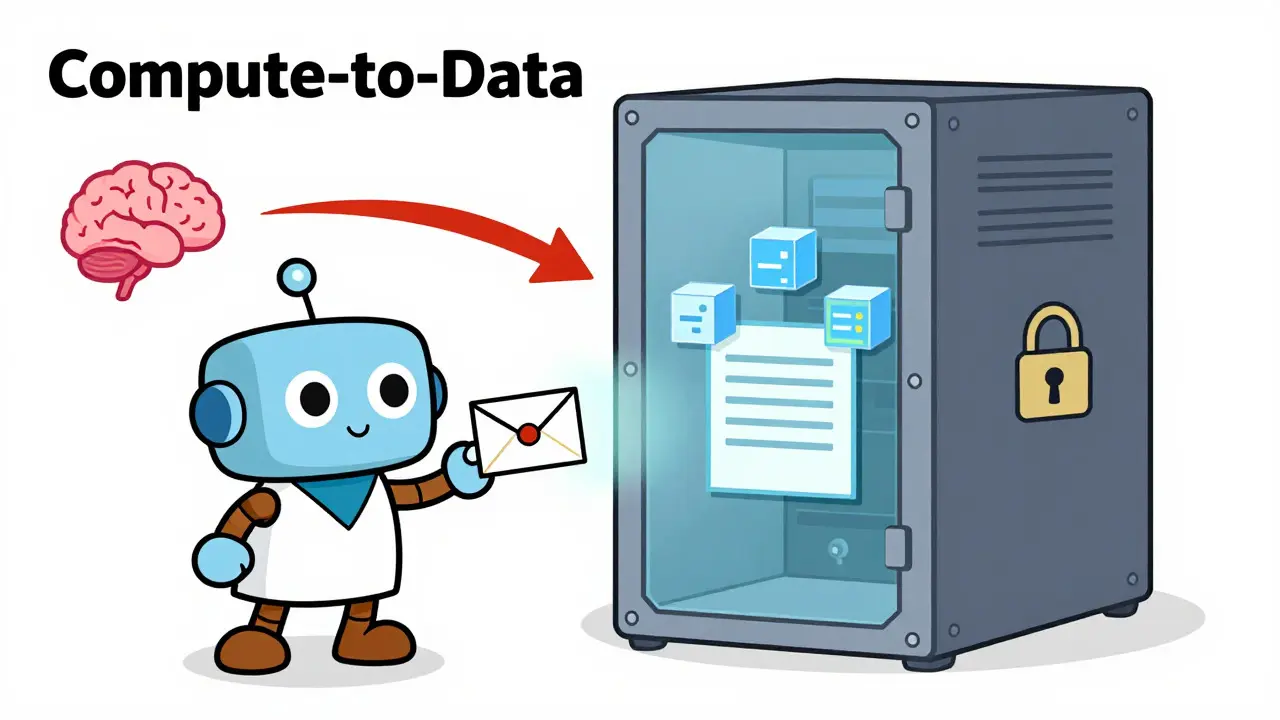
Compute-to-Data: Privacy Meets AI
One of the most compelling features of Ocean Protocol is Compute-to-Data. This feature solves a critical issue in artificial intelligence development: training models on sensitive data without exposing that data.
Traditionally, if a hospital wanted to help a researcher train an AI for disease detection, they’d have to send anonymized patient records. Even anonymized data can sometimes be reverse-engineered. With Compute-to-Data, the algorithm goes to the data, not the other way around.
Here’s the workflow:
- A researcher writes a machine learning script.
- They send this script to a secure compute environment hosted by the data provider.
- The script runs on the private data inside that secure environment.
- Only the results (the trained model parameters) are sent back to the researcher.
The raw data never leaves the provider’s server. This enables collaboration across industries that were previously too siloed due to privacy laws like GDPR or HIPAA. For AI practitioners, this opens up a treasure trove of high-quality, previously inaccessible datasets.
Staking and Curation: Earning While You Protect Quality
Not all data is created equal. Some datasets are accurate and well-labeled; others are noisy or outdated. How does Ocean Protocol ensure quality? Through a mechanism called curation staking.
OCEAN holders can stake their tokens in liquidity pools alongside datatokens. When someone buys access to a dataset, a portion of the fee goes to the stakers. This creates a financial incentive for users to stake on high-quality, popular datasets. If a dataset is bad, fewer people will buy access, and stakers earn less. Over time, the best data rises to the top because it attracts more staking capital.
However, staking isn’t risk-free. Users face impermanent loss, a common concept in decentralized finance (DeFi). If the price of the datatoken drops significantly compared to OCEAN, stakers might lose value relative to simply holding the tokens. Additionally, there is counterparty risk-if a data provider abandons their pool, stakers could lose their OCEAN stake. Always research before staking.
OceanDAO: Community Governance
Ocean Protocol is not controlled by a single company. It is governed by OceanDAO, a decentralized autonomous organization. OCEAN token holders have voting rights on key decisions, such as:
- Protocol upgrades and technical changes.
- Treasury management and grant funding for developers.
- Parameter adjustments for staking rewards.
This structure aligns the interests of developers, users, and investors. Since the future of the protocol depends on community consensus, it reduces the risk of centralized corruption or mismanagement. If you hold OCEAN, you effectively own a piece of the governance structure.

Who Should Use Ocean Protocol?
Ocean Protocol isn’t for everyone. It’s particularly valuable for specific groups:
- Data Scientists & AI Researchers: Access to diverse, high-quality datasets without navigating complex legal agreements.
- Healthcare Providers: Monetizing patient data insights while maintaining strict privacy compliance.
- IoT Companies: Selling sensor data streams from connected devices in real-time.
- DeFi Developers: Building applications that require external data feeds (oracles) in a trustless manner.
If you are a casual investor looking for quick gains, OCEAN might appeal to you as a speculative asset tied to the AI narrative. But if you are a developer or data owner, the utility lies in the tools and infrastructure provided by the protocol.
Risks and Challenges
No technology is perfect. Ocean Protocol faces several hurdles:
Adoption Barrier: The crypto space is still niche for many enterprises. Convincing large corporations to integrate blockchain-based data exchanges requires significant education and infrastructure changes.
Technical Complexity: Using datatokens, managing liquidity pools, and understanding smart contract risks requires technical know-how. The barrier to entry is higher than using a traditional cloud storage service.
Market Volatility: The value of OCEAN and datatokens fluctuates with the broader crypto market. A bear market can reduce liquidity and discourage participation, regardless of the underlying technology’s merit.
Future Outlook
As artificial intelligence becomes more central to our economy, the demand for clean, verifiable, and private data will explode. Ocean Protocol positions itself at the intersection of these two massive trends: Web3 and AI.
The protocol continues to evolve, focusing on better developer tools, improved user interfaces, and deeper integration with Ethereum Layer 2 solutions to reduce transaction costs. If the vision of a decentralized data economy takes hold, OCEAN could become a foundational asset in that landscape.
Whether you are looking to monetize your own data, find rare datasets for your next big project, or simply diversify your crypto portfolio with exposure to the AI sector, Ocean Protocol offers a unique proposition. It’s not just about buying a coin; it’s about participating in a new way of valuing information.
What is the main purpose of Ocean Protocol?
Ocean Protocol enables individuals and organizations to share, monetize, and utilize data in a decentralized, secure, and privacy-preserving manner. It connects data providers with consumers without relying on central intermediaries.
How is OCEAN different from other cryptocurrencies?
Unlike general-purpose coins like Bitcoin or Ethereum, OCEAN is specifically designed for the data economy. It facilitates the trading of datatokens, governs the Ocean Protocol, and incentivizes data curation through staking mechanisms.
What are datatokens?
Datatokens are ERC-20 tokens issued by data providers to represent access rights to specific datasets or services. Consumers purchase these tokens to gain access to the data, allowing for transparent and automated data trading.
Is Ocean Protocol safe for sensitive data?
Yes, especially with its Compute-to-Data feature. This allows algorithms to run on private data without the data ever leaving the owner's secure environment, ensuring privacy while enabling analysis.
Can I earn passive income with OCEAN?
Yes, by staking OCEAN in liquidity pools on the Ocean Market. Stakers earn a portion of the transaction fees generated when users buy datatokens. However, this comes with risks like impermanent loss.
What is the total supply of OCEAN tokens?
The total supply of OCEAN tokens is fixed at 1.41 billion. This capped supply prevents inflation and helps maintain scarcity as adoption grows.
How does Ocean Protocol benefit AI developers?
AI developers often struggle to find high-quality, labeled training data. Ocean Protocol provides access to diverse datasets from various sources, including private ones, via Compute-to-Data, accelerating model development.