You see the name Coupon Assets and assume it’s a discount voucher or a bond that pays interest. That’s the first trap. It’s not. Coupon Assets (CA) is an Ethereum-based ERC-20 platform token created by RADAR LAB, designed to act as a settlement medium for digital financial assets like bonds and insurance. But here’s the kicker: as of November 2026, it trades at roughly $0.22, down nearly 87% from its all-time high. Only about 6.8% of its total supply is actually in circulation. So, is this a hidden gem or a liquidity trap waiting to spring shut?
| Metric | Value | Implication |
|---|---|---|
| Current Price | ~$0.22 USD | High volatility; 87% drop from ATH |
| Market Cap | ~$4.1 Million | Micro-cap asset; high risk of manipulation |
| Circulating Supply | ~18.4 Million CA | Only ~6.8% of max supply is live |
| Total Max Supply | 270 Million CA | Significant dilution potential remains |
| Holder Count | ~1,600 | Very small community base |
The Name Game: Why "Coupon" Is Misleading
Let’s clear up the confusion right away. When you hear "coupon," you think of a clip from a newspaper or a fixed-income security that pays regular dividends. RADAR LAB uses the term loosely to describe their vision of a global circulation system for financial assets. They claim CA connects digital tokens with instruments like promissory notes, equity-like assets, and ESG investments. But does holding CA entitle you to a coupon? No. Does it give you ownership of a bond? Also no.
The project describes itself as infrastructure. Think of it less like a bank account and more like a specialized currency meant to move value between different types of financial products on the blockchain. The official site mentions features like "intelligent digital currency" and a "magnetic algorithm," but these are marketing terms, not technical specifications you can verify on GitHub. There is no public audit report confirming how these algorithms work, nor is there evidence that CA has been registered as a security with regulators like the SEC. If you buy CA expecting guaranteed interest payments, you’re likely misunderstanding the product.
Tokenomics: The Supply Overhang Problem
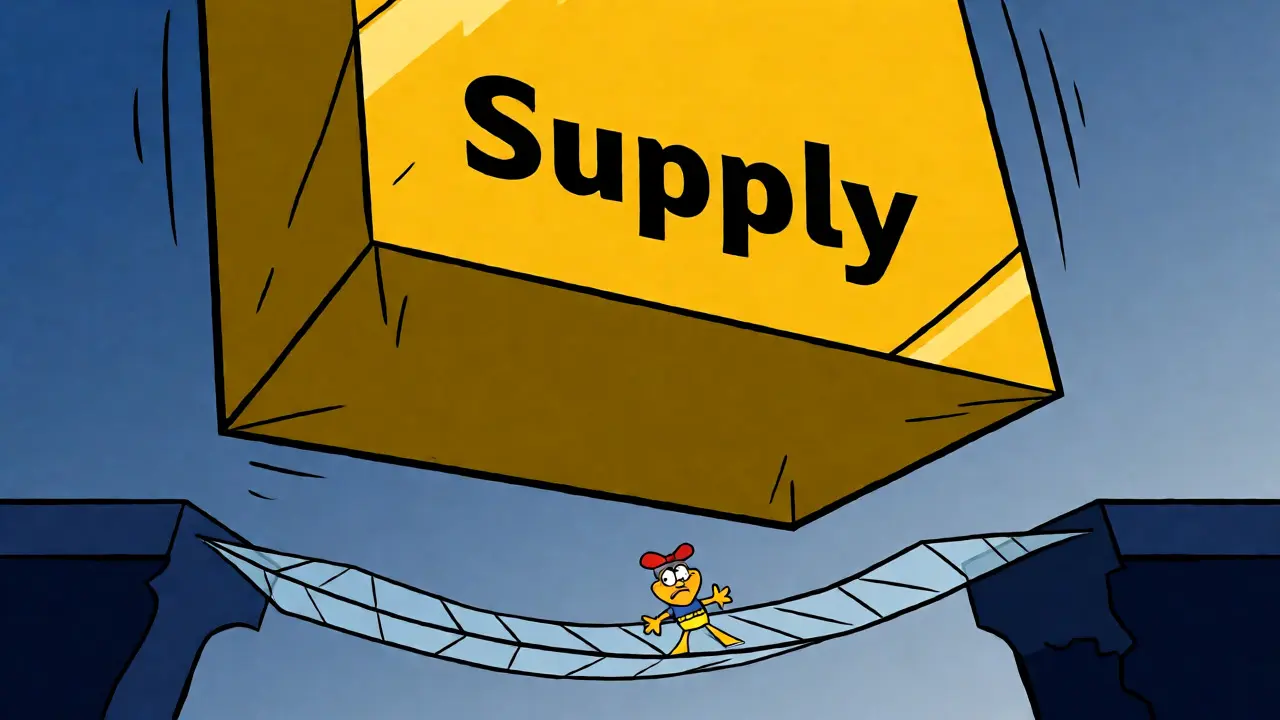
Here is where the math gets scary for new investors. The maximum supply of CA is capped at 270 million tokens. However, data from CoinGecko and Etherscan shows only about 18.39 million tokens were circulating as of mid-November 2026. That means over 93% of the total possible supply is still locked, held by the team, or waiting to be released into the market.
Why does this matter? Simple supply and demand. If the price spikes due to hype, those locked tokens could flood the market, crushing the price for everyone else. This is known as a "supply overhang." FraudCoins, a risk-analysis platform, flagged this exact issue, assigning CA a medium-risk score partly because of this low free float. If you’re looking for stability, a micro-cap coin with such a large gap between circulating and total supply is rarely a safe bet. You aren’t just betting on the technology; you’re betting against massive future dilution.
Liquidity and Trading Venues: A Concentrated Risk
You might wonder where you can actually trade this thing. Unlike Bitcoin or Ethereum, which are available everywhere, CA lives in a tiny ecosystem. Most of its trading volume happens on centralized exchanges like HTX and MEXC. On November 14, 2026, HTX accounted for nearly 80% of all reported daily volume. This concentration is dangerous.
If HTX goes down, delists CA, or experiences a withdrawal freeze, your ability to exit the position vanishes instantly. Furthermore, the order book depth is shallow. We’re talking about thousands of dollars, not millions. Trying to sell a large amount of CA quickly will result in significant slippage-you’ll get a worse price than what you see on the chart. Decentralized exchanges like Uniswap do list CA, but liquidity there is often too thin for any serious trade size without moving the market against you.
Technology and Transparency Gaps
RADAR LAB claims to support real-time consumer payments and collection of virtual assets. They mention integrations with mainstream fiat financial-settlement institutions. But where is the proof? In the world of crypto, trust is earned through code and audits. For CA, the transparency is lacking.
- No Public Audit: While CertiK has a page for the project, there is no widely accessible, detailed smart-contract audit report that validates the security of the token logic.
- Vague Whitepaper: The documentation focuses heavily on vision and buzzwords like "global business network" rather than technical architecture details like throughput or consensus mechanisms.
- Team Opacity: Market directories name William Shihara as CEO, but independent verification of his background or the corporate registration of RADAR LAB is difficult to find in primary sources.
Without a robust GitHub repository showing active development, or case studies proving merchants are actually using CA for payments, the technology remains theoretical. It’s a solution looking for a problem, rather than a tool solving a verified pain point.

Market Performance: Highs and Lows
History teaches us caution. CA hit an all-time high of approximately $1.70 in late 2024. Today, it sits around $0.22. That’s an 87% drawdown. If you bought at the peak, you’ve lost nearly nine-tenths of your investment. This isn’t unusual for altcoins, but it highlights the extreme volatility inherent in projects with small holder bases.
With only about 1,600 holders, the community is incredibly small. Compare this to major projects with hundreds of thousands of holders. A small community means less organic demand and higher susceptibility to pump-and-dump schemes. There are no major analyst forecasts or academic models supporting CA’s growth. It flies under the radar of most institutional investors.
Who Should Consider Buying CA?
Should you buy? Probably not if you want safety. CA is best suited for speculative traders who understand the risks of micro-cap assets. It’s not a "set and forget" investment. It requires active monitoring of exchange listings and token unlock schedules.
Consider CA only if:
- You are comfortable losing 100% of your capital.
- You believe in RADAR LAB’s specific vision for tokenizing traditional finance assets.
- You have verified the current contract address (
0x9ee8c380e1926730ad89e91665ff27063b13c90a) to avoid scams.
For everyone else, the lack of verifiable adoption and the looming supply dilution make it a tough sell. It’s a high-risk gamble, not a diversified portfolio component.
Is Coupon Assets (CA) a stablecoin?
No, CA is not a stablecoin. Stablecoins are pegged to a fiat currency like the US Dollar. CA is a volatile cryptocurrency whose price fluctuates based on market supply and demand. As of November 2026, it traded around $0.22, far below its historical highs, demonstrating significant price instability.
Does holding CA pay interest or dividends?
Despite the name "Coupon Assets," there is no public evidence that holding CA automatically generates interest payments or dividends. The token is described as a utility token for a settlement network, not a security with contractual yield rights. Investors should not expect passive income from simply holding the token.
Where can I buy Coupon Assets (CA)?
CA is primarily traded on centralized exchanges such as HTX, MEXC, DigiFinex, and Hotcoin. Liquidity is concentrated on HTX, which handles the majority of daily volume. Always verify the token contract address before depositing to ensure you are interacting with the correct ERC-20 token.
What is the total supply of Coupon Assets?
The maximum supply of Coupon Assets is capped at 270 million tokens. However, only approximately 18.4 million tokens were in circulation as of November 2026. This low circulating supply relative to the max supply indicates potential future dilution if remaining tokens are released into the market.
Is Coupon Assets audited?
While third-party platforms like CertiK track the project, there is no widely published, comprehensive smart-contract audit report available to the general public that details security vulnerabilities or confirms code integrity. This lack of transparent auditing adds to the risk profile of the token.