
You’ve probably heard of buying a VPN subscription with credit cards or PayPal. But what if you could pay for internet privacy using cryptocurrency, and even earn crypto by sharing your own home Wi-Fi? That’s the core idea behind MYST, the native utility token of the Mysterium Network, a decentralized virtual-private-network (dVPN) marketplace.
If you are searching for "what is MYST," you likely want to know three things: Does it have real use cases beyond speculation? How does the technology actually work? And is it worth your attention in 2026? This guide cuts through the hype to explain exactly how this small-cap asset functions, where it trades, and what risks you need to watch out for.
The Core Concept: Decentralized Privacy Marketplace
Traditional VPNs like NordVPN or ExpressVPN run on centralized servers owned by one company. If that company gets hacked, goes down, or changes its privacy policy, you’re affected. Mysterium Network flips this model on its head. It connects users directly to independent node operators-regular people running software on their computers, Raspberry Pis, or servers.
Here is the basic economic loop:
- Users buy secure internet access by paying fees in MYST tokens.
- Node Operators provide bandwidth and IP addresses from their residential connections. They get paid in MYST.
- Token Holders can stake MYST in the Delegation Pool to help secure the network and earn a share of the transaction fees.
This isn’t just theoretical. The project was founded in 2017 by BlockDev AG, a Swiss company based in Zug. After raising roughly $13-14 million in its initial token sale, it launched the MYST token in June 2017. Today, it remains an active project with public code repositories and live consumer products.
How MYST Tokenomics Actually Work
Understanding the supply side is critical because discrepancies between data aggregators often confuse new investors. As of November 2026, estimates vary significantly depending on which blockchain explorer you trust.
| Metric | CoinMarketCap Data | CoinGecko Data | Notes |
|---|---|---|---|
| Circulating Supply | ~20.03 Million | ~32.00 Million | Discrepancy likely due to bridged/migrated tokens accounting. |
| Max Supply | 32.43 Million | N/A (often listed as fixed cap) | Fixed cap prevents infinite inflation. |
| Price (Approx.) | $0.1117 | $0.1090 | Highly volatile; check live charts. |
| Market Cap | ~$2.24 Million | ~$3.49 Million | Micro-cap asset status. |
| Primary Chains | Ethereum, Polygon | Ethereum, BSC, Polygon | Polygon is preferred for low-fee transactions. |
Why do these numbers differ? Because MYST exists across multiple chains. Originally an Ethereum ERC-20 token, it migrated to support Polygon and Binance Smart Chain (BSC) to reduce gas fees. Some aggregators count only Ethereum holdings; others include bridged assets. Always verify the contract address before sending funds.
Technology Behind the Scenes
The magic happens in the background via smart contracts. When you connect to a Mysterium node, the app negotiates a price. You deposit a small amount of MYST into a payment channel. As you browse, micro-payments flow to the node operator. If the connection drops or speeds slow down, you stop paying immediately. This is vastly different from monthly subscriptions where you pay upfront whether you use the service or not.
The node software itself is written in Go and is open-source. This transparency allows developers to audit the code, though it doesn’t guarantee security against all vulnerabilities. The network uses a mechanism called the Hermes smart contract to handle fee distribution. If you delegate your MYST to a node operator, you aren’t locking up your coins forever; you’re essentially vouching for that node’s reliability. If the node misbehaves, both the operator and delegator can be penalized (slashed).

Real-World Use Cases: Who Is This For?
MYST isn’t designed to replace Bitcoin as digital gold. It has specific utility:
- Residential IP Access: Traditional VPNs use data center IPs, which websites like Netflix or Amazon often block. Mysterium nodes use residential IPs, making them harder to detect. This is crucial for web scraping, ad verification, or accessing geo-restricted content without triggering CAPTCHAs.
- Pay-As-You-Go Privacy: Instead of committing to a $10/month plan, you can top up with $5 worth of MYST and use it until it runs out. Great for occasional travelers or light users.
- Passive Income Experiment: Can you earn money running a node? Yes, but don’t quit your day job. Community reports from Reddit suggest earnings vary wildly. One user reported earning less than $12 total over three months. Another claimed $50/month from a high-demand location. Most fall somewhere in between, often struggling to cover electricity costs unless they have very cheap bandwidth.
Risks and Red Flags You Must Know
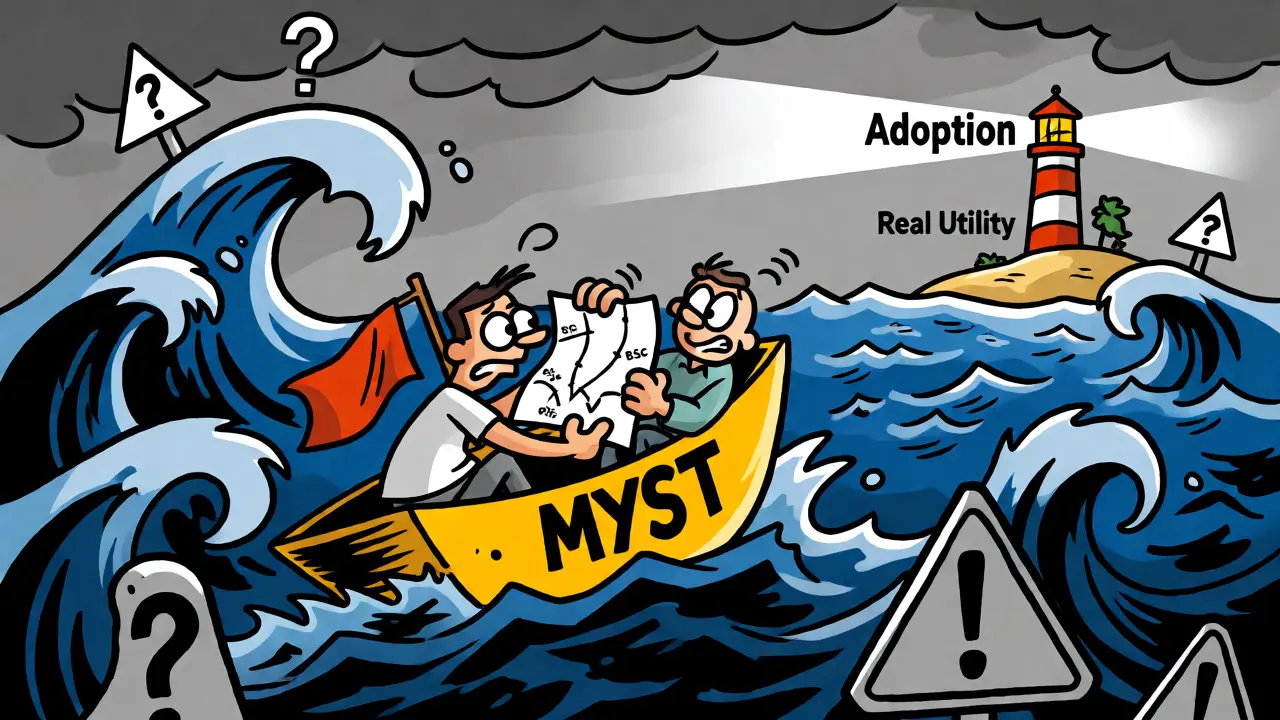
Before you buy, consider the downsides. This is a micro-cap asset with significant hurdles.
Liquidity Issues: With a market cap under $4 million and daily volumes sometimes dipping below $25,000, selling large amounts of MYST can crash the price. Slippage on decentralized exchanges (DEXs) like Uniswap or QuickSwap can be severe.
Audit Gaps: While Mysterium claims a no-logs policy, independent third-party audits of their privacy practices have been limited compared to giants like ProtonMail or Mullvad. A 2026 review noted that while the tech stack looks solid, the lack of a verified "warrant canary" or recent external security audit means you are trusting the team’s word more than verifiable proof.
Node Saturation: Early adopters earned well because there were few nodes and many users. Now, thousands of nodes compete for a smaller pool of paying customers. If demand doesn’t grow faster than supply, rewards for node operators will continue to shrink.
Where to Buy and Trade MYST
You won’t find MYST on Coinbase or Kraken. Its trading venues are more niche:
- Centralized Exchanges: MEXC and HitBTC offer decent liquidity. MEXC is currently the most active venue for MYST/USDT pairs.
- Decentralized Exchanges (DEXs):
- Ethereum: Uniswap V3 (Higher gas fees, good for larger trades).
- Polygon: QuickSwap (Low fees, ideal for frequent small swaps).
- BSC: PancakeSwap (Alternative option, check bridge compatibility).
Pro Tip: Always send a test transaction first. Sending unmigrated MYST to an exchange that only accepts Polygon MYST (or vice versa) can result in lost funds. Verify the chain selection on the deposit screen carefully.
Final Verdict: Is MYST Worth Watching?
MYST is a legitimate project solving a real problem: centralized VPN bottlenecks. However, it remains a speculative micro-cap play. If you believe in the future of decentralized infrastructure and want exposure to the dVPN sector, it’s a valid candidate for a small portion of a diversified portfolio. But if you’re looking for stable returns or guaranteed passive income from node operation, temper your expectations. The network needs more paying users to sustain healthy rewards for providers.
Is MYST coin a good investment?
MYST is a high-risk, high-reward micro-cap asset. It has real utility within the Mysterium Network, but its value depends heavily on the adoption of decentralized VPN services. Investors should expect high volatility and low liquidity compared to major cryptocurrencies like Bitcoin or Ethereum.
Can I mine MYST like Bitcoin?
No, you cannot mine MYST in the traditional sense. Instead, you can run a Mysterium Node. By providing bandwidth and IP connectivity to the network, you earn MYST as compensation. This is more akin to renting out computing resources than performing proof-of-work calculations.
Which blockchain is MYST on?
MYST originally launched as an ERC-20 token on Ethereum. It has since expanded to Polygon and Binance Smart Chain (BSC) to lower transaction costs. Always ensure you are interacting with the correct contract address for the specific network you intend to use.
Does Mysterium Network keep logs?
Mysterium claims a strict no-logs policy, stating they do not record visited websites or traffic content. However, unlike some competitors, they have not consistently published recent independent third-party audits verifying this claim. Users should rely on the technical architecture (decentralized routing) rather than solely on marketing promises.
How much can I earn running a Mysterium node?
Earnings vary drastically based on location, bandwidth speed, latency, and current network demand. Reports range from a few dollars per month to potentially higher amounts in high-demand regions with residential IPs. It is generally considered a supplementary income source rather than a primary revenue stream.