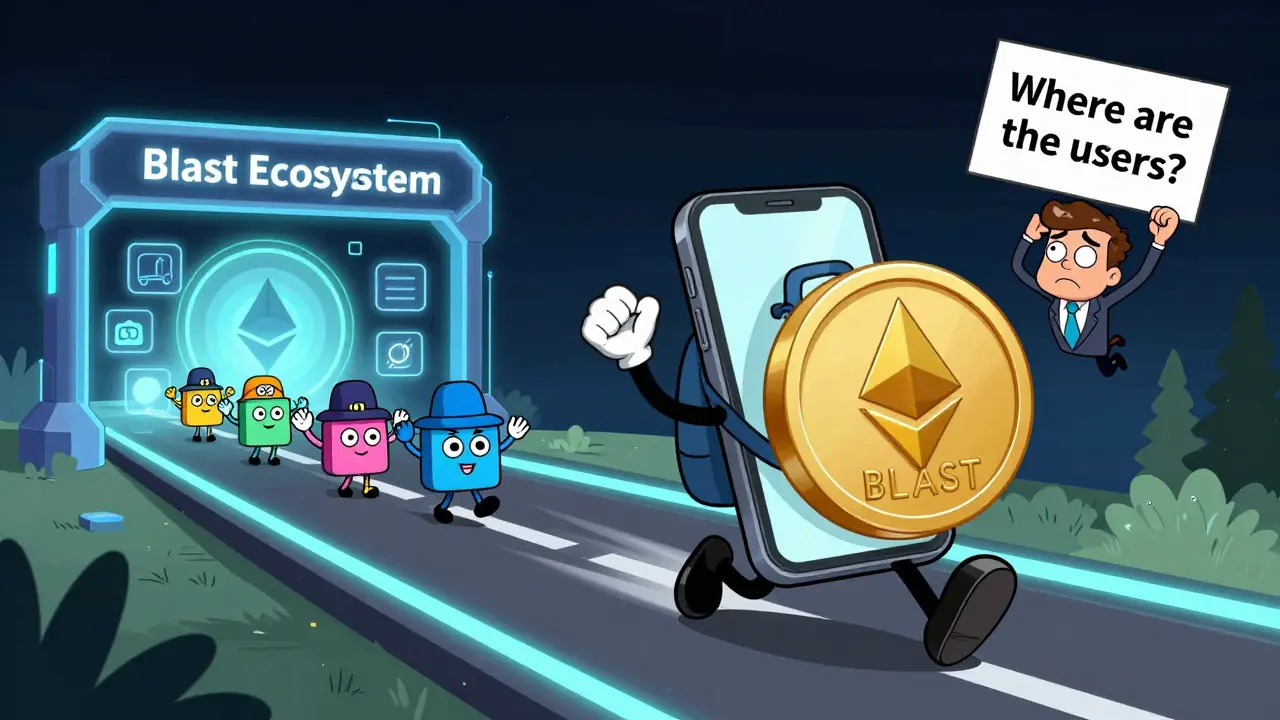
Blast (BLAST) is a cryptocurrency token built as a layer 2 scaling solution on Ethereum. Unlike many other tokens that simply ride on Ethereum’s network, Blast is designed to improve how decentralized apps (dApps) work-especially on mobile devices-by making transactions faster and cheaper while still using Ethereum’s security. It’s not just another altcoin; it’s a project trying to solve real problems in blockchain usability, though its market performance tells a different story.
What Blast Actually Does
Blast doesn’t create a new blockchain. Instead, it sits on top of Ethereum as a layer 2 network. This means it takes transactions from users, bundles them up, and processes them off the main Ethereum chain. Then it submits a single proof back to Ethereum to confirm everything was done correctly. This cuts down on fees and speeds things up. But what makes Blast different is its focus on mobile dApps.
Most blockchain apps today are built for desktop or web browsers. Blast is one of the few trying to make blockchain work smoothly on smartphones. The project promotes a "Blast App" ecosystem that rewards users for interacting with dApps-like earning crypto just for using a decentralized wallet or playing a blockchain game on your phone. This kind of incentive model is rare and could matter if it gains traction.
It also supports staking. Users can lock up their BLAST tokens to help secure the network and earn rewards in return. But unlike major staking platforms, Blast doesn’t publish exact APY rates or minimum stake amounts. That lack of transparency is a red flag for many investors.
Token Supply and Distribution
The total supply of BLAST is fixed at 100 billion tokens. That’s a huge number, but it’s not unusual for newer tokens to have high supplies to allow for wider distribution. The real issue is how much of that supply is actually in circulation.
There’s a major discrepancy between platforms. CoinLore says only about 2.87 billion BLAST (2.87%) are circulating as of late 2025. But CoinMarketCap’s AI analysis reports 48.56 billion (48.56%) are already out. Why the difference? It comes down to how each platform defines "circulating supply." Some include locked or vested tokens. Others don’t. This confusion makes it hard to judge how much pressure there is on the market from new tokens being released.
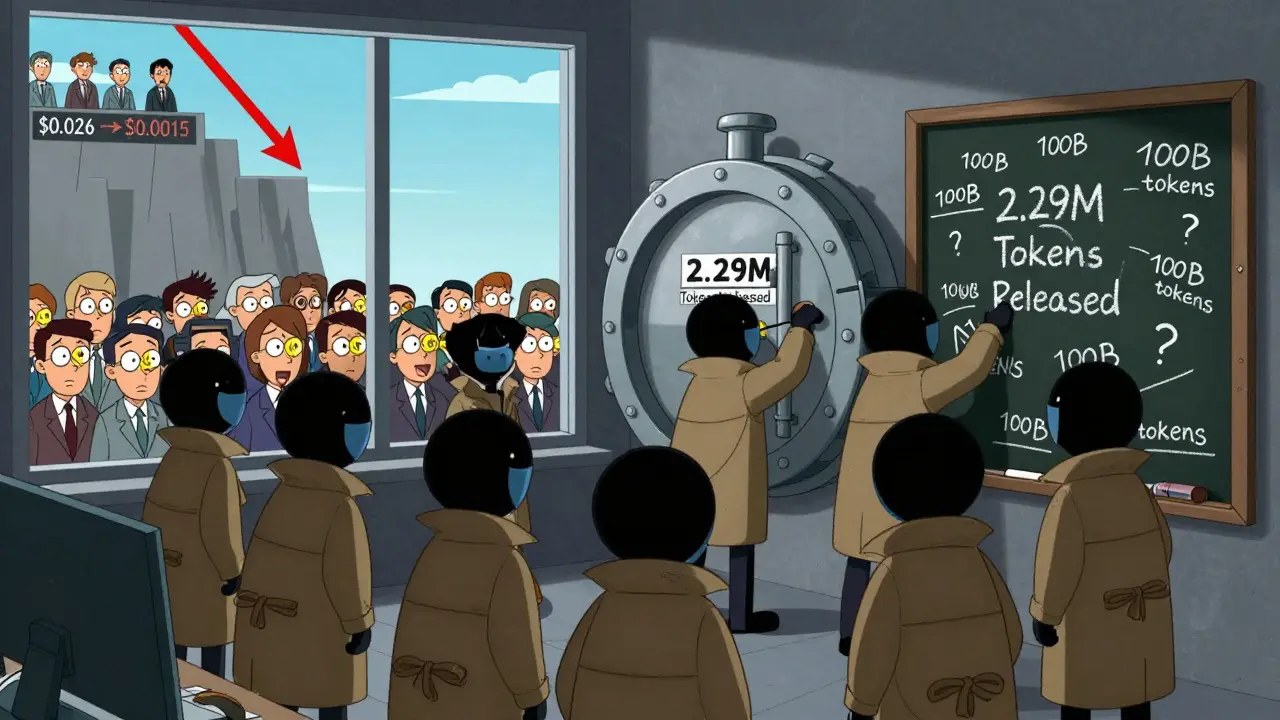
One major event happened on August 25, 2025: 2.29 million BLAST tokens (worth around $3,500 at the time) were unlocked. That’s a tiny amount relative to the total supply, but it’s a sign that more tokens could be released gradually over time. If large holders start selling, the price could drop further.
Price History and Current Performance
Blast hit its all-time high of $0.0260 in early 2024. Since then, it’s lost over 94% of that value. As of early 2026, the price hovers around $0.0015. That’s not a minor dip-it’s a collapse.
Here’s how different platforms are reporting the price as of late 2025:
- Gate.io: $0.001545
- CoinCheckup: $0.001550
- CoinLore: $0.001530
- TradingBeasts: $0.001476 (average)
The 24-hour trading range is tight-between $0.00149 and $0.00159-meaning there’s very little buying or selling pressure. That’s usually a sign of low interest or lack of confidence.
Market capitalization is around $4.4 million according to CoinLore, putting Blast at #373 on CoinMarketCap’s list of cryptocurrencies. For context, Bitcoin’s market cap is over $1 trillion. Blast is in the bottom 1% of all crypto assets by value.
Why the Price Is Dropping
There’s no single reason Blast’s price crashed, but several factors line up:
- No real adoption: There’s no public data showing how many people are using Blast’s dApps or how many transactions happen daily. Without users, a token has no utility.
- Weak team visibility: The developers behind Blast are anonymous. No LinkedIn profiles, no public interviews, no GitHub activity. That makes it hard to trust the project.
- High supply + no demand: With 100 billion tokens and only a small fraction circulating, the math doesn’t favor price growth. If even 10% of the total supply enters circulation, the price could drop below $0.0005.
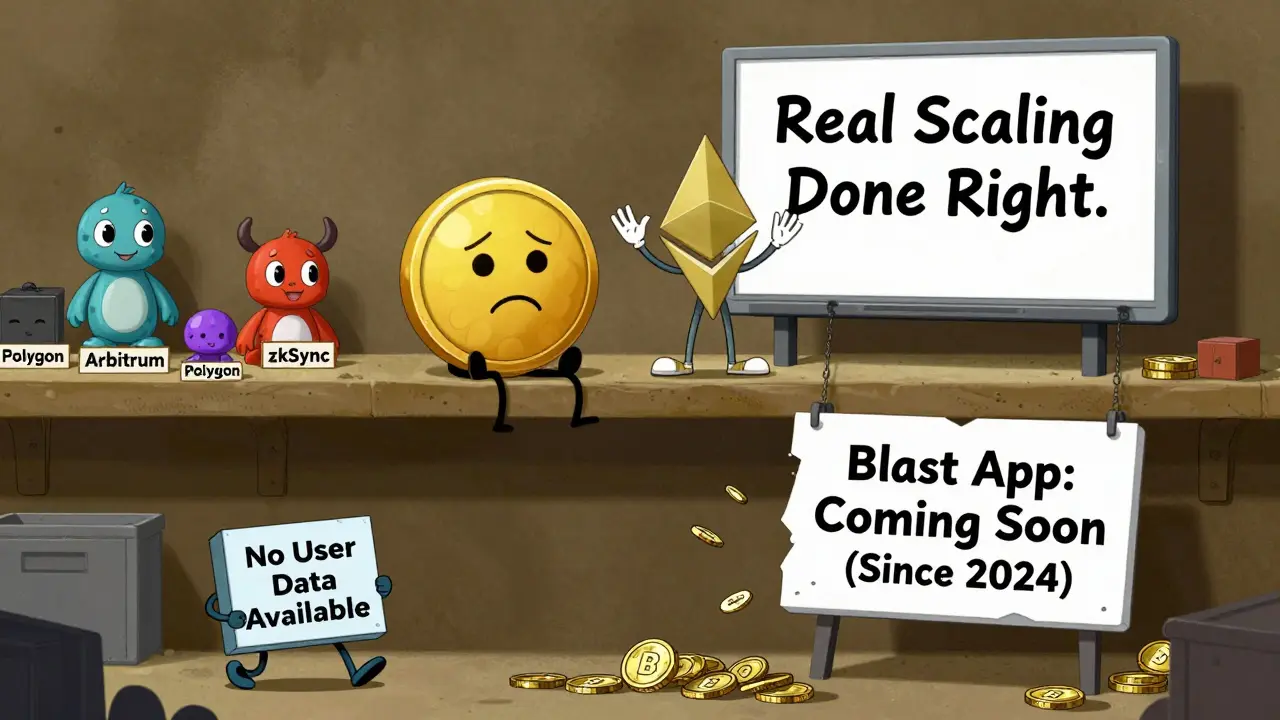
- Competition: Layer 2 solutions like Arbitrum, Optimism, and Polygon already dominate Ethereum scaling. Blast offers no clear advantage over them.
Some analysts blame the bearish crypto market overall. But even during downturns, projects with strong fundamentals hold up better. Blast hasn’t shown any.
Price Predictions: Who’s Right?
Forecasting Blast’s price is like guessing the weather in a hurricane. The predictions vary wildly.
Here’s what major platforms say for 2025-2026:
| Source | 2025 Forecast | 2026 Forecast |
|---|---|---|
| Gate.io | $0.0035-$0.050 (avg. $0.010) | $0.02817 |
| CoinLore | $0.0149-$0.0238 | Not available |
| CoinCodex | $0.001092 (by Nov 2025) | $0.001799-$0.003120 (2030) |
| TradingBeasts / WalletInvestor | $0.00144-$0.00151 | Same range |
| Swapspace.co | $0.000785 | $0.000785 (2030) |
Gate.io is the only one with a bullish outlook, betting on mobile dApp adoption and ecosystem growth. But even they admit it’s speculative. CoinCodex, CoinLore, and others see continued decline. Swapspace.co’s prediction of $0.000785 for both 2025 and 2030 suggests they think Blast will never recover.
The truth? No one knows. But if you look at the data-low trading volume, no user metrics, no developer updates-it’s hard to justify optimism.
Should You Buy Blast?
If you’re looking for a long-term investment, Blast is a risky bet. The project lacks transparency, adoption, and clear progress. It’s not listed on major exchanges like Coinbase or Binance, which limits accessibility and trust.
Some traders might see it as a speculative play. The price is so low that a 10x move would still keep it under $0.015. But that’s gambling, not investing.
Here’s what to consider:
- Don’t invest money you can’t afford to lose. Blast’s price could go to zero.
- Don’t trust hype. Social media posts claiming "Blast will moon" are not based on facts.
- Watch for real activity. If Blast starts publishing monthly dApp usage stats, or if major wallets integrate it, that’s a sign to pay attention.
- Compare it to alternatives. Arbitrum, Polygon, and zkSync already have working ecosystems. Blast has promises.
Right now, Blast is a project that sounds promising on paper but has failed to deliver anything tangible. Unless something changes, it’s likely to remain a footnote in crypto history.
Is Blast (BLAST) a good investment?
Blast is not a good investment for most people. Its price has dropped over 94% from its all-time high, it has no clear user base, and its development team is anonymous. While some analysts predict price recovery, the lack of real-world adoption and transparency makes it a high-risk speculative asset. Only risk-tolerant traders should consider it, and even then, with very small amounts.
How many Blast tokens are there?
The total supply of BLAST is fixed at 100 billion tokens. However, there’s disagreement on how many are in circulation. CoinLore reports around 2.87 billion (2.87%), while CoinMarketCap says 48.56 billion (48.56%). This discrepancy comes from different methods of counting locked, vested, or reserved tokens. Until the project clarifies its token distribution, investors can’t be sure of the true supply pressure.
Can I stake Blast tokens?
Yes, Blast supports staking. Users can lock up their BLAST tokens to earn rewards, likely as a way to incentivize holding and support network security. However, the exact reward rate (APY), minimum stake amount, and unstaking period are not publicly disclosed by the Blast team. This lack of detail makes it difficult to evaluate staking as a reliable income source.
Why is Blast’s price so low?
Blast’s price is low because it lacks real adoption. There’s no public data showing how many people use its apps, how many transactions occur daily, or which dApps are built on its network. It also competes with established layer 2 solutions like Arbitrum and Polygon that have millions of users. Combined with a massive total supply and no clear roadmap, investor confidence has collapsed.
Is Blast listed on major exchanges?
Blast is not listed on major exchanges like Coinbase, Binance, or Kraken. It’s only available on smaller platforms like Gate.io, MEXC, and Bitrue. This limits liquidity and makes it harder to buy or sell large amounts without affecting the price. Lack of listing on top exchanges is often a sign of lower trust and regulatory scrutiny.
What’s the future outlook for Blast?
The future of Blast is uncertain. Some analysts believe its mobile dApp focus could pay off if developers start building on it. But without public updates, user metrics, or partnerships, there’s no evidence this is happening. Most forecasts predict continued decline or stagnant prices. Unless the team releases a clear development roadmap and proves real usage, Blast is unlikely to recover its value.
What Comes Next for Blast?
The next big milestone is the next token unlock event. While the August 2025 release was small, more are expected. If large holders start selling-especially if the price dips below $0.001-the downward pressure could accelerate.
For Blast to survive, it needs one of two things: either a major partnership with a mobile app platform (like Google Play or Apple’s App Store) to integrate its tech, or a surge in developer activity with real dApps launching on its network. Neither has happened.
For now, Blast remains a cautionary tale. It’s a crypto project that looked promising on paper but failed to move beyond the whitepaper stage. Investors should treat it not as a coin to buy, but as a lesson in how not to build a blockchain project.
Don B.
March 2, 2026 AT 17:35Arya Dev
March 4, 2026 AT 11:42Leslie Cox
March 5, 2026 AT 16:16Andrew Hadder
March 7, 2026 AT 10:25Derek Sasser
March 8, 2026 AT 23:16Neeti Sharma
March 9, 2026 AT 09:38Nadia Shalaby
March 9, 2026 AT 20:12Fiona Monroe
March 11, 2026 AT 17:50Molley Spencer
March 13, 2026 AT 12:35Daisy Boliaan
March 14, 2026 AT 06:51Vishakha Singh
March 16, 2026 AT 05:58