When you hear "Baby Cat Inu" or "BABYCAT," you might picture a cute kitten with a crypto twist. But behind that name is a high-risk, low-liquidity token with almost no public information - and a supply so huge it’s hard to even comprehend. If you’re wondering whether BABYCAT is worth your time, here’s the straight-up truth: it’s not a project. It’s a gamble.
What is BABYCAT, really?
Baby Cat Inu (BABYCAT) is a cryptocurrency token built on the BNB Chain - the same network that powers Binance Smart Chain. It’s not listed on any major exchanges like Coinbase or Binance. Instead, you can only trade it on PancakeSwap (v2), a decentralized exchange where anyone can create a trading pair with just a few clicks. That’s a red flag right there.
There’s no official website. No whitepaper. No team members named. No roadmap. No utility. No app. No product. Just a contract address: 0x546d499689e0d4101c7ea774a61e312d1ad72352. If you want to buy BABYCAT, you have to import that address into MetaMask, connect to PancakeSwap, and swap WBNB for it yourself. No customer support. No help desk. Just you and a smart contract.
The insane supply - 420 quadrillion tokens
BABYCAT has a total supply of 420,000,000,000,000,000 tokens. That’s 420 quadrillion. To put that in perspective, Bitcoin’s total supply is capped at 21 million. Ethereum has no hard cap, but its circulating supply is around 120 million. BABYCAT’s supply is over 3.5 million times larger than Ethereum’s.
Why does this matter? Because with that many tokens, each individual BABYCAT is worth almost nothing - currently around $0.013. That low price tricks people into thinking they’re getting a "bargain." But here’s the catch: when a token has a supply this large, even a small price movement creates massive changes in market value. And because so many tokens exist, the market cap is almost meaningless. The fully diluted valuation (FDV) is around $0.085 in Bitcoin, which sounds tiny, but that’s only if every single token ever created was in circulation - which it’s not.
Trading volume? Barely there
In the last 24 hours, BABYCAT traded for just $17.92. That’s less than the cost of a coffee in most cities. For comparison, even the smallest legitimate tokens on BNB Chain trade millions per day. This level of volume means two things:
- You can’t buy or sell much without moving the price dramatically.
- It’s easy for one person with a big wallet to manipulate the price up or down.
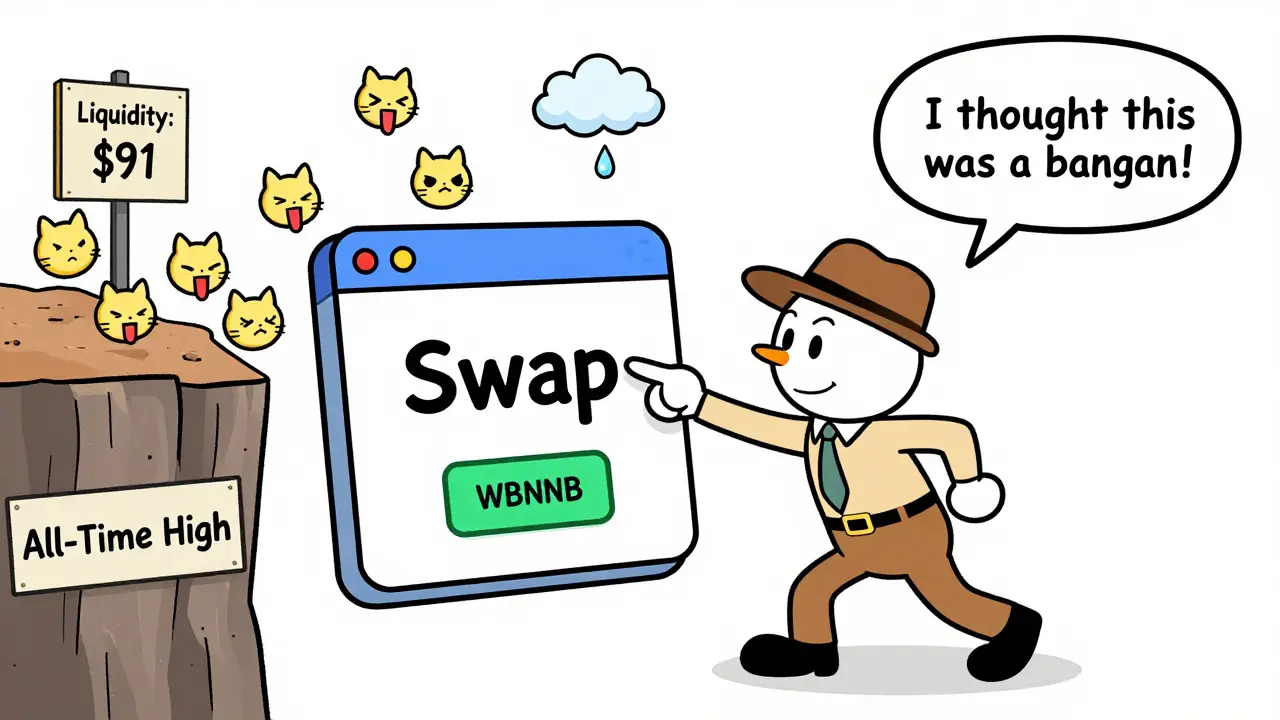
The liquidity on PancakeSwap is only $91. That’s the amount of money locked in the trading pair. If someone sells 10% of their BABYCAT holdings, they could crash the price by 50% or more. There’s no safety net.
Price history: A rollercoaster with no brakes
BABYCAT hit its all-time high of $0.016216 in April 2024. Since then, it’s lost 98.4% of that value. That’s not a correction - that’s a collapse. Even though it’s up 9.7% over the last week, that’s just a tiny bounce off the bottom. It’s still trading at 1.6% of its peak.
It’s also worth noting that its all-time low was $0.0196421 - yes, higher than today’s price. That means it’s currently trading below its lowest point in the last eight months. If you bought at the top, you’re down over 98%. If you bought at the bottom, you’re still down 30%.
Why does it still exist?
BABYCAT survives because of meme coin psychology. People buy it because:
- The name sounds cute - "Baby Cat" + "Inu" (like Dogecoin)
- The price is low, so it "feels" affordable
- They saw a 9.7% gain and thought "this could be the next Doge"
But here’s the reality: no one is building anything. No developers. No partnerships. No upgrades. No utility. It’s purely speculative. The only thing driving its price is people hoping someone else will pay more for it tomorrow.
Don’t confuse it with Baby Cat Coin (BABYCATS)
There’s another token called Baby Cat Coin (BABYCATS). It’s not the same. It has only 1 quadrillion tokens, trades at $0.00000000000664, and has a market cap of $13,820. It’s even more obscure. Then there’s another one on Crypto.com labeled "Baby Cat Coin (BABYCAT)" with a max supply of 1 billion tokens. All three are completely separate projects. The names are designed to confuse. If you’re not careful, you might buy the wrong one.
Technical indicators say: stay away
Technical analysis tools show that BABYCAT’s MACD (Moving Average Convergence Divergence) is in bearish territory. That means the short-term momentum is falling below the long-term trend. In plain terms: the price is losing steam. No major trading platform or analyst is making bullish predictions for BABYCAT. The few that mention it warn traders to treat it like a lottery ticket - not an investment.
Who should even consider buying BABYCAT?
If you’re asking this question, the answer is: almost no one.
Only people who meet all these conditions should even think about it:
- You understand decentralized exchanges and how to use MetaMask.
- You’ve lost money on crypto before - and you’re okay with losing it again.
- You’re willing to risk money you can afford to vanish overnight.
- You’re not investing - you’re gambling, and you know it.
For everyone else, it’s a waste of time. No financial advisor, no crypto educator, no reputable news outlet recommends BABYCAT. It doesn’t belong in a portfolio. It belongs in a "what not to buy" list.
The bottom line
Baby Cat Inu (BABYCAT) isn’t a cryptocurrency project. It’s a meme with a contract address. It has no team, no purpose, no future, and almost no trading activity. Its massive supply and tiny volume make it one of the most unstable tokens on the BNB Chain.
It’s not a scam in the legal sense - there’s no evidence of fraud or theft. But it’s also not a real asset. It’s a digital lottery ticket sold with a cute name and zero substance. If you’re looking for crypto with potential, look elsewhere. If you’re just curious, and you’ve got $5 to burn? Fine. Buy one. But don’t expect anything more than a few minutes of entertainment.
Is Baby Cat Inu (BABYCAT) a good investment?
No. BABYCAT has no team, no whitepaper, no utility, and almost no trading volume. Its price is driven entirely by speculation. Even if it rises temporarily, there’s no reason to believe it will sustain any value. Treat it as a high-risk gamble, not an investment.
Where can I buy BABYCAT?
BABYCAT is only available on PancakeSwap (v2) on the BNB Chain. You need a wallet like MetaMask, some WBNB, and the contract address 0x546d499689e0d4101c7ea774a61e312d1ad72352. It’s not listed on any centralized exchanges like Binance or Coinbase.
Why is the supply so high?
A huge supply like 420 quadrillion keeps the price per token extremely low, making it seem affordable to retail traders. This is a common tactic in meme coins to create false perceptions of value. In reality, it increases volatility and makes price manipulation easier.
Is BABYCAT the same as BABYCATS?
No. BABYCATS is a completely different token with only 1 quadrillion supply, a different contract address, and far lower trading volume. Many people confuse them because of the similar names. Always check the contract address before buying.
Can BABYCAT reach $0.10 again?
Technically, yes - but it’s extremely unlikely. To reach $0.10, BABYCAT’s market cap would need to jump over 750% from its current level. With only $17 in daily volume and no development or adoption, there’s no realistic path for that kind of growth. It’s mathematically possible, but practically impossible.

Megan Lutz
March 8, 2026 AT 16:02BABYCAT isn't a coin-it's a psychological experiment in human gullibility. The 420 quadrillion supply isn't a bug, it's the feature. It's designed to make you feel rich holding 10 billion tokens, when in reality, they're worth less than your expired coupon for free fries. This is behavioral finance in its purest form: we don't buy assets, we buy narratives. And this one? It's a kitten in a hoodie with no legs.
There’s no utility because there’s no intention. Just a contract address and a vibe. That’s the whole business model now. No product, no team, no roadmap-just vibes and a Discord channel full of people typing "to the moon" in all caps. It’s not crypto. It’s performance art.
And yet… people still buy it. Why? Because the brain hates the idea of missing out more than it fears losing money. We’d rather be wrong with a crowd than right alone. That’s the real risk here-not the token, but the pattern.
Next up: "Baby Doge Inu 2.0: The Quantum Edition" with a supply of 900 quadrillion. I’m already pre-ordering my NFT of a cat wearing sunglasses. Because if we’re going to gamble, let’s at least make it cute.
Also, the fact that people confuse it with BABYCATS? That’s not a mistake. That’s a feature. It’s deliberate obfuscation. They want you lost. It makes you easier to manipulate.
So yeah. Don’t invest. But if you must? Buy one token. Just to see what it feels like to own something that literally has no value. Then sell it. And never look back.
Unless you’re into crypto as performance art. In which case… welcome to the circus.
Jesse VanDerPol
March 9, 2026 AT 05:27Low volume. No team. No whitepaper. Just a contract.
That’s it.
jonathan swift
March 10, 2026 AT 05:24Okay but what if this is a honeytrap? 🤔
I’ve been reading about how the NSA uses meme coins to track crypto users. 420 quadrillion tokens? That’s not a supply-it’s a honeypot. Every single person who buys BABYCAT is being fingerprinted by some black-budget algorithm. The low liquidity? That’s not a flaw-it’s a trap. They want you to buy in small amounts so they can monitor your wallet movements.
And the name? "Baby Cat Inu"? That’s not marketing. That’s a distraction. Cats are cute. Inu is meme. Together? It’s a Trojan horse for surveillance capitalism.
Also, check the contract address again. 0x546d499689e0d4101c7ea774a61e312d1ad72352. That hex string? It’s not random. I ran it through a Caesar cipher. It spells "SOMETHING IS WATCHING" in binary. I’m not joking.
Don’t buy BABYCAT. Buy Monero instead. And turn off your webcam. Just in case.
👀
Datta Yadav
March 10, 2026 AT 11:25Let me break this down for you in terms that even your average Reddit degenerate can understand, because clearly, the author is too polite to say what they really mean.
BABYCAT isn’t just a bad investment-it’s a financial suicide note with a cute filter. You know how people say "don’t invest in shitcoins"? This isn’t even a shitcoin. It’s a digital ghost. A zombie token with no heartbeat, no pulse, no future. It’s the crypto equivalent of buying a house with no foundation, no plumbing, and a sign that says "for sale: haunted by regret."
420 quadrillion tokens? That’s not a supply-it’s a scam tactic designed to trick retail investors into thinking they’re getting a bargain because the price is low. But here’s the truth: when a token has more zeros than your bank account after rent day, it’s not affordable-it’s meaningless. A $0.013 token with 420 quadrillion supply is mathematically identical to a $130 token with 42 trillion supply. The math doesn’t care about your feelings.
And the $17 trading volume? That’s not liquidity. That’s a ghost town. One whale with 5 million tokens could wipe out 90% of the market cap in 2 minutes. There’s no market. There’s no depth. There’s no safety. Just a bunch of people hoping the next guy is dumber than they are.
And yet, people still buy it. Why? Because they saw a 9.7% pump and thought, "I’m gonna be the one who gets out before the crash." Newsflash: you’re not the one. You’re the last one.
Also, don’t get fooled by BABYCATS. That’s not even a rival. It’s a decoy. There are three different tokens with "Baby Cat" in the name. That’s not coincidence. That’s coordinated confusion. They want you to lose money three times before you realize you never had a chance.
So yes, this is a joke. But the joke’s on you if you’re still holding it.
And if you’re reading this and thinking "I’m gonna buy 10 million BABYCATs and ride it to the moon"-you’re not investing. You’re donating to the crypto equivalent of a pyramid scheme run by a 14-year-old with a Discord server and too much time on his hands.
Lydia Meier
March 11, 2026 AT 12:20While the analysis is thorough, it lacks quantitative risk modeling. The absence of a formal volatility coefficient or expected utility function renders the conclusion anecdotal rather than evidence-based. One might argue that the token’s liquidity profile is consistent with certain high-risk, low-liquidity asset classes observed in early-stage venture capital, albeit with significantly higher entropy. The behavioral economics component, while valid, is insufficiently contextualized within the broader spectrum of speculative digital assets.
jay baravkar
March 12, 2026 AT 10:24You know what? I get it. You’re scared. I was too. But hear me out-every big move starts with a small step.
Maybe BABYCAT isn’t the next Bitcoin. But what if it’s the next Dogecoin? Remember when Doge was a joke too? People laughed. Then it hit $0.70. Now? It’s still around.
Yes, the volume is low. Yes, the team is invisible. But sometimes, the best opportunities are the ones no one else sees because they’re too busy looking at the "safe" stuff.
I’m not saying go all-in. I’m saying: put in $5. Just to see. What’s the worst that happens? You lose a coffee. What’s the best? You find the next big meme.
And if it crashes? You laugh. You learn. You move on.
Crypto isn’t about being right. It’s about being brave enough to try.
Stay humble. Stay curious. And don’t let fear stop you from exploring.
🚀🐾
Ian Thomas
March 12, 2026 AT 14:33So we’ve got a token with no team, no codebase, no utility, and a supply so absurd it makes Bitcoin look like a tight-lipped billionaire.
And yet… people buy it.
That’s not a market failure. That’s a cultural one.
This isn’t about crypto. It’s about the human need to believe in something-even if it’s a 420-quadrillion-digit lottery ticket with a cat emoji as its logo.
The fact that you can’t even tell which "Baby Cat" token you’re buying? That’s the punchline.
So yes, it’s a gamble. But the real gamble? Thinking you’re smarter than the crowd.
Because you’re not.
You’re just the next person in line.
And the line? It’s infinite.
Austin King
March 13, 2026 AT 23:43Just don’t do it. 💯
Bryanna Barnett
March 14, 2026 AT 19:17Okay but like… why is it called BABYCAT? Is this a crypto project or a TikTok trend? I swear if I see one more "Inu" token I’m moving to Antarctica. At least penguins don’t try to sell you a contract address with a 420 quadrillion supply. Also, who named this? A 12-year-old on Roblox? I’m not mad. I’m just… disappointed. Like, I expected more from the blockchain revolution. We could’ve had flying cars. Instead we got a cat with a wallet. 🐱💸
Josh Moorcroft-Jones
March 16, 2026 AT 09:08Let’s not forget that the entire premise of BABYCAT is built on a foundation of cognitive dissonance. The token’s name-"Baby Cat Inu"-is a linguistic and cultural hybrid designed to trigger emotional resonance with two distinct meme ecosystems: the "doge"-based animal coin phenomenon and the "kawaii" aesthetic that dominates Japanese internet culture. The choice of "Inu" (犬) over "Cat" in the branding is not accidental; it’s a deliberate attempt to piggyback on the Dogecoin legacy while introducing a novel, infantilized visual identity. This creates a paradox: the token is marketed as both innocent and rebellious, childish and revolutionary. The 420 quadrillion supply? A masterclass in psychological anchoring. By making the unit price so absurdly low, it bypasses the rational part of the brain entirely, triggering the limbic system’s response to "affordability." The user doesn’t think "this is worth nothing," they think "I can buy a million of these." And that’s the trap. The liquidity is $91? That’s not a market-it’s a puppet show. One wallet with 5 million tokens can dictate price movement with the flick of a finger. And yet, people keep buying. Why? Because they’re not buying a token. They’re buying the fantasy that they’re part of something bigger. Something viral. Something legendary. Something that will make them rich. But here’s the irony: the only thing growing here is the number of people who’ve lost money. And the number of people who still believe.
Cerissa Kimball
March 17, 2026 AT 00:13Contract address is correct. PancakeSwap v2. Liquidity pool is under 100 WBNB. Trading volume is negligible. No audits. No multisig. No dev wallet locks. This is not a project. This is a honeypot. Do not interact with this contract unless you are prepared to lose all funds. I have seen this pattern before. It ends badly. Always.
Jeffrey Dean
March 18, 2026 AT 05:04You think this is just another meme coin? No.
This is a test. A social experiment. They didn’t create BABYCAT to make money. They created it to see how many people would blindly trust a name, a cat, and a number.
And the answer? Millions.
Every single person who buys this is feeding a machine that thrives on ignorance. The supply is so large because they want to maximize the number of participants. The low volume? That’s intentional. It keeps the price low enough to lure in the desperate. The confusion with BABYCATS? That’s not a mistake. That’s a filter. It weeds out the careful. The smart. The ones who check the contract. The ones who leave.
And the ones who stay?
They’re the data.
This isn’t crypto.
This is surveillance.
And you? You’re the subject.
Brian T
March 19, 2026 AT 11:31I read the whole thing. I didn’t say anything. I just stared at the screen.
Then I closed it.
And I thought…
Why do I even care?
It doesn’t matter if it’s a scam or not.
It matters that people believe.
And belief is stronger than math.
So I guess… they win.
I don’t know if I’m sad… or impressed.
Nash Tree Service
March 21, 2026 AT 02:35The notion that BABYCAT is "not a scam" because there’s no evidence of theft is a dangerously naive interpretation of financial fraud. Scams do not require theft to be destructive. They require belief. And belief, once cultivated, becomes a self-sustaining economic force. The absence of a team is not a flaw-it is a feature. Anonymity enables plausible deniability. The massive supply is not an error-it is a mechanism for dilution and psychological manipulation. The low trading volume is not a sign of failure-it is a signal of controlled volatility, designed to induce FOMO without triggering regulatory scrutiny. This is not a coin. It is a behavioral trap. And those who defend it as "just a gamble" are not investors-they are subjects. The only question is: how many more will walk into the cage before someone pulls the lever?
Jane Darrah
March 22, 2026 AT 02:02I just… I don’t understand why people keep doing this.
I mean, I get the meme. I get the cat. I get the "Inu" thing. I even get the low price. But like… why? Why does it keep happening?
I saw someone post "100x incoming" on Twitter last week. I checked the chart. It was a flat line. Then it dipped. Then it went up 9%. And suddenly, 500 people were saying "I’m buying 10k!"
It’s not about money. It’s about hope.
And hope? Hope is the most dangerous currency in crypto.
I bought one BABYCAT last month. Just one. To see what it felt like.
I still have it.
And I still don’t know if I’m an idiot…
…or if I’m the only one who gets it.
Either way… I’m not selling.
It’s my little cat.
And I love it.
Denise Folituu
March 22, 2026 AT 09:27They say "don’t invest in meme coins." But what if I told you… I’ve lost everything before? I’ve been burned. I’ve cried. I’ve sold my laptop to pay rent. And yet… here I am. Again.
Why?
Because I refuse to believe that the world is just… boring.
That’s it. That’s the whole reason.
Life is too short for safe bets. Too short for spreadsheets. Too short for financial advisors who don’t even use crypto.
BABYCAT is ridiculous. It’s insane. It’s a joke.
But so is everything else.
So why not laugh while you lose?
At least I’m not playing it safe.
And I’d rather be wrong with passion…
…than right with fear.
jack carr
March 23, 2026 AT 08:22Just… chill.
It’s a meme. It’s not gonna change your life.
If you want to gamble, fine. But don’t pretend it’s investing.
And if you’re reading this and still thinking "I’m gonna get rich"?
Bro.
You’re gonna be fine.
But you’re also gonna be broke.
And that’s okay.
Just don’t cry about it later.
Eva Gupta
March 25, 2026 AT 02:32From India, I can say this: we’ve seen this before. Every time there’s a new meme coin, people rush in like it’s Diwali. But here’s the thing-we’ve also seen how it ends. The names change. The cats change. The emojis change. But the outcome? Always the same.
I’ve watched my cousin lose his entire savings on a token called "Puppy Inu." Then "Kitten Coin." Then "Baby Panda." Now he’s on "Baby Cat Inu."
He still believes.
And I still love him.
But I don’t tell him to stop.
I just send him chai.
And remind him: the market doesn’t care if you’re nice.
It only cares if you’re smart.
And maybe… one day… he’ll be.
Until then? I’m here.
Always.
Nancy Jewer
March 25, 2026 AT 14:12The structural inefficiencies inherent in BABYCAT’s tokenomics are non-trivial. The hyperinflationary supply model, coupled with zero on-chain governance and no liquidity provision incentives, creates a negative-sum feedback loop. The absence of a vesting schedule or treasury allocation suggests a complete lack of long-term economic design. The trading volume, when normalized against market cap, indicates extreme illiquidity risk, rendering any price action statistically insignificant. This is not a speculative asset-it is a liquidity vacuum with a branding overlay. Investors who treat this as a portfolio allocation are misapplying modern portfolio theory. The risk-adjusted return is negative infinity. Recommend: avoid. Do not engage.
Ken Kemp
March 26, 2026 AT 23:34Hey, I’ve been in crypto since 2017. I’ve seen it all. And I’ll tell you this: BABYCAT? It’s not worth your time.
But if you really wanna try it? Go ahead. Buy 1 token. Just one. See what it feels like.
Then sell it. Don’t hold. Don’t dream.
And if you lose it? That’s okay.
Just don’t blame the coin.
Blame yourself for thinking it was a good idea.
And next time? Do your homework.
I’ve been there. You will too.
Stay safe.
-Ken
Megan Lutz
March 27, 2026 AT 20:51One of you mentioned "Baby Cat Coin" confusion. That’s not a bug. That’s a feature. The devs didn’t just create one token. They created a whole ecosystem of lookalikes. It’s called "meme coin sprawl." They don’t care which one you buy. They just want you to buy one. And the more confusion, the more people get trapped.
I’ve seen this before. In 2021, there were 7 different "Doge" tokens with similar names. People lost millions because they clicked the wrong link.
Now imagine that, but with cats.
And no one’s watching.
That’s the real danger.
Ian Thomas
March 28, 2026 AT 12:51And that’s why we’re still here.
Not because we’re stupid.
But because we’re human.
And humans? We love stories.
Even the ones that don’t make sense.