Vietnam Crypto Tax Calculator
How the Tax Works
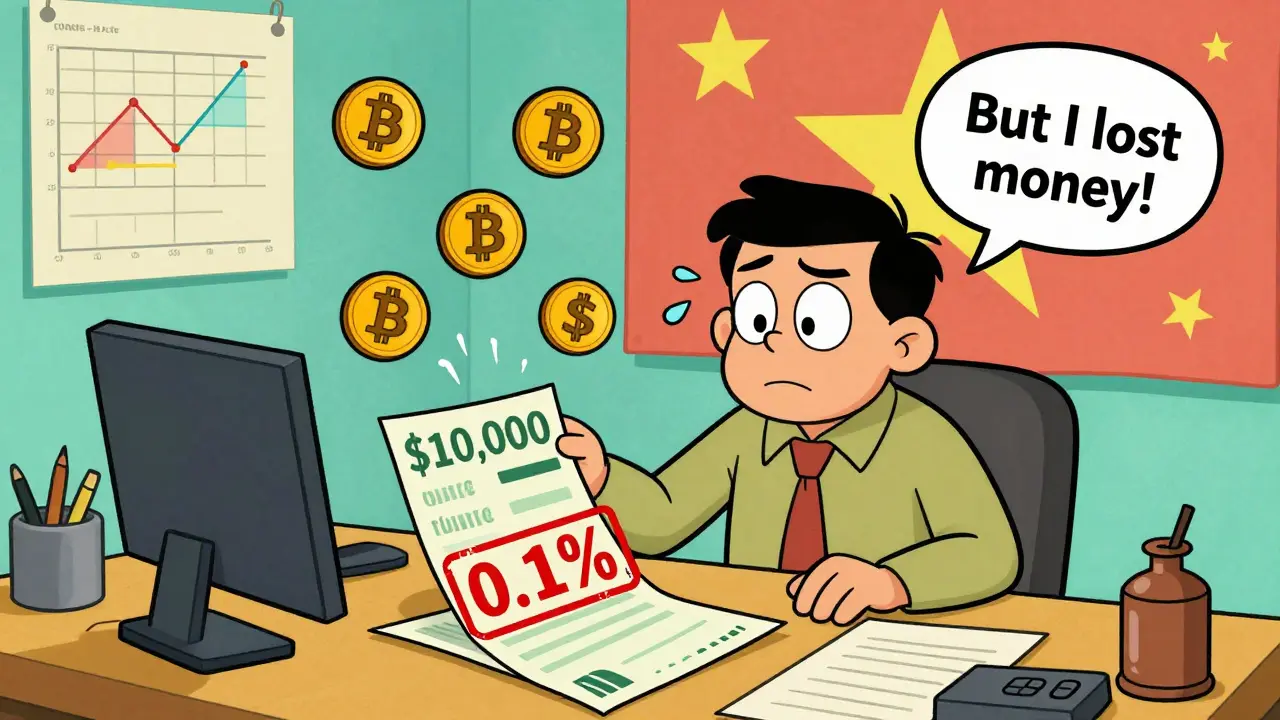
Vietnam taxes every crypto trade at 0.1% - regardless of profit or loss. The tax applies to both buying and selling transactions.
Note The first 10 million VND ($400) in annual crypto gains is tax-free for individuals.
On January 1, 2026, Vietnam will begin taxing every crypto trade at 0.1%-no exceptions. It doesn’t matter if you made a profit or lost money. If you bought, sold, or swapped Bitcoin, Ethereum, or any other token, the government takes 0.1% of the total value. That’s not a tax on gains. That’s a tax on the trade itself.
Why Vietnam Is Doing This
Vietnam isn’t trying to punish crypto traders. It’s trying to collect money from a market it can no longer ignore. About 17 million people in Vietnam own cryptocurrency. That’s nearly one in five adults. The total value of crypto held by Vietnamese citizens exceeds $100 billion. Chainalysis ranks Vietnam third in global usage of international crypto exchanges. The government sees this as a revenue opportunity-and it’s acting fast. The new tax is part of a broader update to Vietnam’s Personal Income Tax Law. For the first time, digital asset transfers are officially classified as "other income." This means crypto trades are now treated like stock trades under tax law. The 0.1% rate matches the existing fee for securities trading, showing the government wants consistency across financial markets. This isn’t just about taxes. It’s about control. Vietnam’s Digital Technology Industry Law, passed in June 2025, gives the state its first legal definition of "crypto assets." It also sets the stage for regulation, compliance, and enforcement. The Ministry of Finance isn’t just writing rules-it’s building a system to track every transaction.How the Tax Works in Practice
Let’s say you buy $10,000 worth of Bitcoin. Then you sell it for $12,000. You made $2,000 profit. Under the new rules:- You pay 0.1% on the $10,000 purchase = $10
- You pay 0.1% on the $12,000 sale = $12
- Total tax: $22
Who Pays and Who Doesn’t
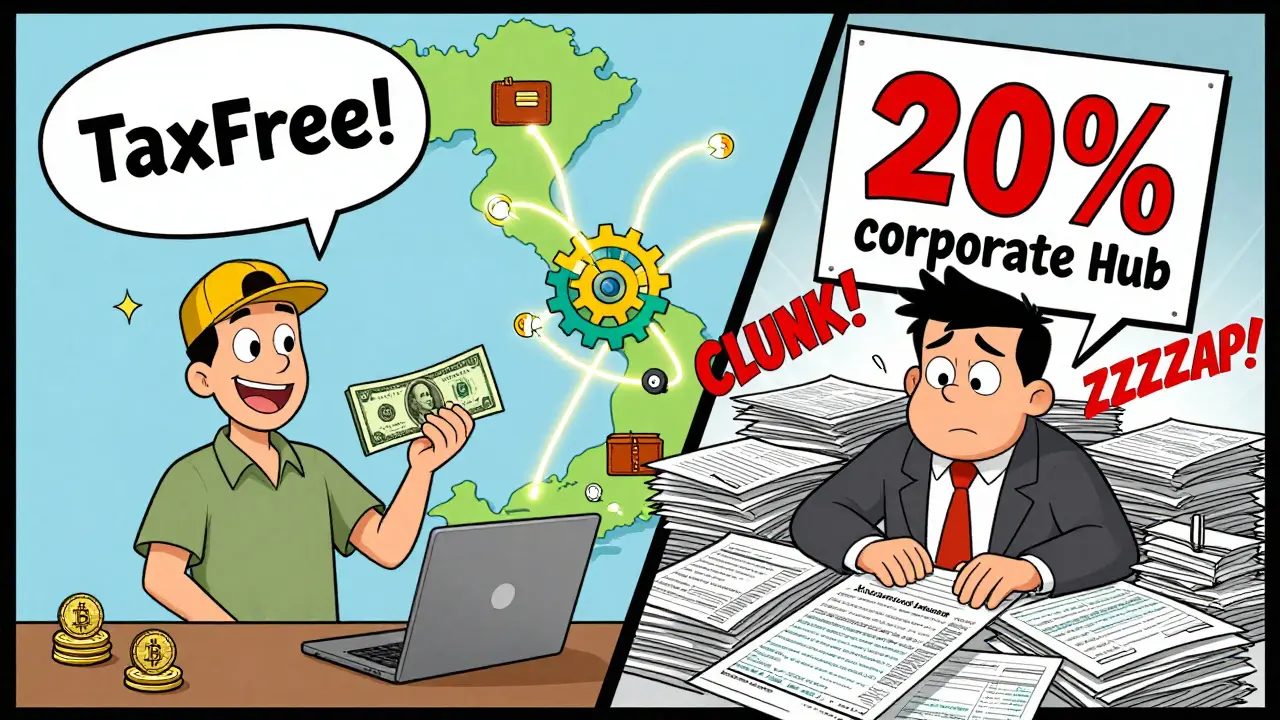
The tax applies to individuals and businesses alike. But there’s a small break for small investors. The first 10 million Vietnamese dong ($400) in annual crypto gains are tax-free. That helps casual traders who buy a little Bitcoin on weekends and don’t trade often. But if you’re active? You’re in the crosshairs. Every swap, every transfer, every trade on Binance, Bybit, or any other platform counts. Even peer-to-peer trades between friends are subject to reporting. Businesses face even more. Crypto exchanges must pay 10% VAT on service fees. Mining and staking income is taxed at 5% to 35%, depending on your total earnings. Corporate income tax for crypto companies is 20%. And all of it is tracked through mandatory reporting. Individuals must file an annual report to the General Department of Taxation by March 31. Businesses file quarterly. If you don’t report, penalties start at 2 million VND ($80) or 2% of unpaid tax-whichever is higher. Repeat offenders face higher fines and possible account freezes.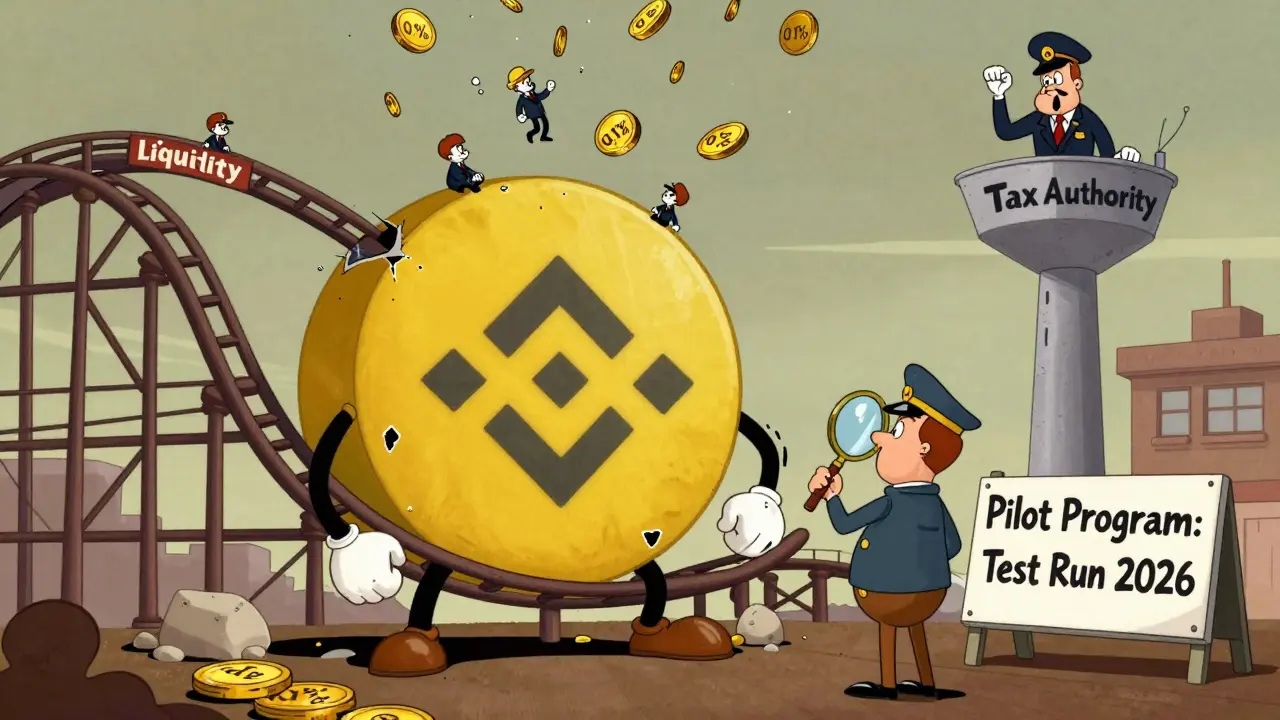
Why Exchanges Are Worried
Binance didn’t stay silent. On October 1, 2025, they sent a formal letter to Vietnam’s Ministry of Finance warning that the 0.1% tax could break market liquidity. Here’s why: Market makers-traders who provide buy and sell orders to keep prices stable-make profits of about 0.01% per trade. That’s already thin. Add a 0.1% tax, and they’re losing money on every trade. They can’t absorb that cost. So they’ll pull back. Or raise spreads. Or leave Vietnam entirely. That’s bad for regular users. Less liquidity means wider spreads. You’ll pay more to buy Bitcoin. You’ll get less when you sell. The tax meant to generate revenue could end up hurting the very people it targets. This isn’t theoretical. When other countries introduced similar gross-value taxes-like India’s 1% TDS on crypto trades-market volume dropped sharply. High-frequency traders vanished. Order books thinned. Retail traders paid more. Vietnam’s government knows this. That’s why they’re running a pilot program. The goal? Test the tax on a small scale, watch what happens, and adjust before rolling it out nationwide.What’s Next for Vietnam’s Crypto Market
The government isn’t just taxing. It’s trying to build a crypto hub. Under discussion are incentives to attract businesses:- 10% corporate income tax rate for crypto exchanges during their first five years
- VAT exemptions on crypto transactions to boost liquidity
- 5-10% tax on NFT sales
- 1-5% withdrawal fees for foreign investors
What Traders Should Do Now
If you’re a crypto user in Vietnam, here’s what you need to do:- Track every trade. Use a crypto tax tool like Koinly or CoinTracker. Record date, amount, asset, and value in VND at time of trade.
- Save transaction IDs. Exchanges may not provide tax reports. You’ll need proof of each trade.
- Don’t ignore the $400 exemption. If your total annual gains are under 10 million VND, you’re exempt. But you still need to report if you traded.
- Watch for updates. The pilot program starts in January. Rules may change based on feedback.
- Don’t assume anonymity. Vietnam’s tax authority is linked to banking systems and exchange compliance teams. Offshore wallets won’t help.
The Bigger Picture
Vietnam’s 0.1% tax isn’t about fairness. It’s about catching up. For years, the country turned a blind eye to crypto. Now, with $100 billion in assets moving through its borders, it can’t afford to anymore. The tax is blunt. It doesn’t care if you won or lost. It just takes its cut. That’s why many traders will feel it as a burden. But the government sees it as a necessary step toward legitimacy. The real question isn’t whether the tax will work. It’s whether Vietnam can balance revenue with growth. If the tax kills liquidity, no one wins. If it’s adjusted early, Vietnam could become the most regulated-and most transparent-crypto market in Southeast Asia. Right now, it’s a gamble. And every trader is a player.Is the 0.1% crypto tax in Vietnam based on profit or trade value?
It’s based on trade value-not profit. Every time you buy or sell crypto, you pay 0.1% of the total transaction amount. Even if you lose money on the trade, you still pay the tax. This is different from countries like the U.S., where you only pay tax when you make a profit.
Do I have to report crypto trades if I didn’t make a profit?
Yes. Vietnam requires all individuals to report annual crypto activity, regardless of profit or loss. The tax is applied per transaction, so even trades that result in losses must be recorded. You’ll need to file a report with the General Department of Taxation by March 31 each year.
Are there any exemptions from the crypto tax in Vietnam?
Yes. The first 10 million Vietnamese dong (about $400) in annual crypto gains are tax-free. This applies to individuals only. It doesn’t exempt you from paying the 0.1% transaction tax on each trade, but it means you won’t owe additional capital gains tax if your total yearly profit stays under that threshold.
Will this tax make crypto trading less profitable in Vietnam?
It already has. Many market makers and high-frequency traders are pulling back because the 0.1% tax eats into their tiny profit margins-often 10 times more than their earnings per trade. This reduces liquidity, widens spreads, and makes it harder for regular users to buy and sell at good prices. Retail traders are paying more without realizing it.
Can I avoid the tax by using offshore exchanges?
No. Vietnam’s tax authority works directly with major exchanges operating in the country, including Binance and Bybit. Even if you use an offshore platform, your bank account and identity are linked to your trades. The government can track deposits, withdrawals, and transaction patterns. Avoiding reporting risks penalties of up to 2% of unpaid tax or a minimum of 2 million VND.
When does the crypto tax officially start in Vietnam?
The 0.1% transaction tax officially takes effect on January 1, 2026, alongside the new Digital Technology Industry Law. However, the government is running a pilot program first to test compliance, reporting systems, and market impact before full enforcement.
How does Vietnam’s crypto tax compare to other countries?
Vietnam’s model is unusual. Most countries tax crypto gains (like the U.S. or Germany), not every trade. India also taxes at 1% per trade, but Vietnam’s 0.1% rate is lower. However, Vietnam adds capital gains tax on top-up to 35%-making it one of the most comprehensive systems in Asia. The key difference is Vietnam’s focus on gross transaction value, not net profit.
Sharmishtha Sohoni
December 3, 2025 AT 11:40This tax is brutal for small traders. I trade $500 every weekend and now I’m paying $1 per trade. That’s 0.2% of my capital gone before I even break even.
samuel goodge
December 3, 2025 AT 22:01It’s not just about revenue-it’s about normalization. Vietnam is treating crypto like stocks, not some rogue asset. That’s actually smart. The U.S. still treats it like a wild west, and look where that’s gotten us: chaos, scams, and regulatory uncertainty. At least here, you know the rules.
Yes, it’s a transaction tax, not a gain tax-but that’s the point. It removes the incentive to game the system with wash trades or layered arbitrage. Everyone pays the same. No loopholes. No tax evasion via ‘loss harvesting.’ It’s clean.
And yes, market makers will suffer. But that’s not a bug-it’s a feature. High-frequency trading doesn’t serve retail. It extracts value. If liquidity tightens, it forces the market to become more human, less algorithmic. Maybe that’s what crypto needs.
Compare this to India’s 1% TDS. Vietnam’s 0.1% is practically a discount. And they’re offering tax holidays for exchanges? That’s not hypocrisy-it’s strategy. You tax the散户, you incentivize the infrastructure. That’s how you build a financial ecosystem.
People scream ‘unfair’-but fairness isn’t about protecting losses. It’s about equal application. If you trade, you pay. If you don’t, you don’t. Simple. Elegant. And frankly, overdue.
Althea Gwen
December 5, 2025 AT 01:56so like... we're paying tax just for moving money?? 😩💸
Sarah Roberge
December 5, 2025 AT 11:40Ok but let’s be real-this is just the government trying to monetize the fact that 1 in 5 Vietnamese people are into crypto. They didn’t build this market. The people did. Now they want their cut? Classic. And don’t even get me started on how they’re gonna track every P2P trade… lol. You think someone’s gonna report their friend who sent them 0.1 BTC for lunch? 😂
Also, why is everyone acting like this is new? The U.S. has been taxing crypto gains for years and nobody complains. It’s only when it’s a flat tax on EVERYTHING that people lose their minds. Hypocrites.
And the ‘$400 exemption’? That’s a joke. You think someone who trades $50k/year cares about $400? That’s just a PR stunt to make it seem ‘fair.’
Meanwhile, Binance’s letter is just them panicking because their volume’s gonna tank. They don’t care about traders-they care about their 0.1% fee revenue. The tax is just another layer on top of their cut. So who’s really getting screwed? The little guy.
And don’t even get me started on the ‘AML systems’-they’re not doing this for safety. They’re doing it so they can freeze your account if you buy too much Dogecoin. 🤡
Durgesh Mehta
December 7, 2025 AT 07:52I live in India and we have a 1% tax on every trade. It’s annoying but we adapted. Vietnam’s 0.1% is way lighter. The real issue isn’t the tax-it’s whether people can track their trades. Most don’t even know what a transaction ID is. The government should offer free tools, not just penalties.
Also, the $400 exemption is actually thoughtful. It shows they’re not trying to crush casual users. That’s more than most governments do.
justin allen
December 9, 2025 AT 05:45Oh wow, Vietnam’s finally doing something right for once. Who knew a communist country could outsmart the U.S. on crypto regulation? The Americans are still arguing whether Bitcoin is a currency or a commodity while Vietnam’s already building tax infrastructure. I’m not even mad. They’re winning.
And you know what? If you’re complaining about paying 0.1% on a trade, maybe you shouldn’t be trading. Maybe you should be saving. Or working. Or doing something that doesn’t involve gambling on memes.
Also, ‘offshore wallets won’t help’? Finally, someone says it. The U.S. government can’t track your crypto? Please. Your bank knows. Your phone knows. Your ISP knows. You think Vietnam’s any dumber? They’ve got more data on their citizens than the FBI has on you.
And don’t act like this is ‘oppression.’ This is maturity. When your economy hits $100B in unregulated crypto activity, you don’t ignore it. You tax it. And you regulate it. And you make sure the money stays in your country.
Meanwhile, Americans are still trying to get crypto classified as a commodity so they can avoid taxes. Pathetic.
Steve Savage
December 9, 2025 AT 21:05Look, I get why people are mad. Paying tax on every trade feels like being charged just for breathing. But here’s the thing-this isn’t about punishment. It’s about inclusion. For years, crypto was the wild west. Now Vietnam’s bringing it into the light. That’s a good thing.
Yes, market makers will leave. But that’s okay. The market will stabilize. Prices won’t be manipulated by bots anymore. You’ll actually get fair prices. That’s a win for regular people.
And the $400 exemption? That’s not a loophole-it’s a lifeline. It means your weekend $200 Bitcoin buy doesn’t turn into a tax nightmare. That’s thoughtful policy.
Yes, it’s blunt. But blunt can be better than complex. The U.S. tax code on crypto is a 500-page nightmare. Vietnam’s is one sentence: pay 0.1% per trade. Simple. Clear. Fair.
And if you’re worried about liquidity? Give it time. Markets adapt. Remember when PayPal first started charging fees? Everyone screamed. Now it’s normal.
This isn’t the end of crypto in Vietnam. It’s the beginning of its adulthood.
Joe B.
December 11, 2025 AT 08:08Let’s run the numbers. 17 million people. Average trade size: $1,500. 2 trades per month per active user. That’s 408 million trades per year. At 0.1%, that’s $61.2 billion in annual trade volume taxed → $61.2 million in revenue. That’s it? That’s the whole point? $61 million? That’s less than what Apple makes in 3 hours.
Meanwhile, the real money is in the 10% VAT on exchange fees and the 5-35% tax on mining/staking. That’s where the real juice is. This 0.1%? It’s a smokescreen. A decoy. A way to make retail traders feel like they’re being targeted so the real tax collectors can swoop in on the big players.
And the pilot program? It’s not to test compliance-it’s to test how much pain the market can take before it collapses. They’re doing a stress test on their own economy. And if liquidity dries up? They’ll just raise the exemption to $1,000 and call it a ‘compromise.’
Also, the fact that they’re forcing exchanges to report everything means they’re building a real-time surveillance network. This isn’t taxation. It’s financial control. Welcome to China 2.0.
And don’t get me started on NFTs. 5-10% tax? That’s a death sentence. NFTs are already dead. They’re just burying the body with a tax receipt.
So yeah. $61 million. That’s the entire goal. All this regulation, all this infrastructure, all this fear-mongering… for less than the cost of one SpaceX launch. Pathetic.
Jess Bothun-Berg
December 11, 2025 AT 17:55Wow. So Vietnam’s solution to crypto chaos is… more chaos? Taxing every single trade? That’s not regulation-that’s extortion. You’re punishing people for using a financial tool. You’re not taxing profit-you’re taxing existence.
And let’s be honest: this isn’t about revenue. It’s about control. They want to know who owns what, when they bought it, and whether they’re ‘worthy’ of holding it. This is the beginning of a financial caste system.
And you think the $400 exemption helps? It doesn’t. It just makes the rest of us feel like we’re being punished for being ‘too active.’ That’s psychological warfare.
Also, the fact that they’re forcing banks and exchanges to share data? That’s not compliance. That’s betrayal. You’re turning every platform into a state informant.
And the ‘pilot program’? It’s a trap. They’re not testing the tax-they’re testing how many people will comply before they revolt.
This isn’t progress. It’s authoritarianism with a spreadsheet.
alex bolduin
December 12, 2025 AT 20:06Steve Savage
December 13, 2025 AT 23:08Actually, I think Alex is right. Simplicity wins. The U.S. tax code on crypto is a nightmare. You need to track cost basis, holding periods, wash sales, and then file Form 8949. And half the time, exchanges don’t even give you the right data.
Vietnam’s system? You log your buys and sells. You multiply by 0.1%. You pay. Done. No math. No guesswork. No IRS audits.
Yeah, it feels unfair when you lose money. But guess what? So does getting fined for speeding when you were in a hurry. The law doesn’t care about your excuse. It just enforces the rule.
And honestly? I’d rather live in a country that taxes me clearly than one that pretends it’s fair but actually screws you in the details.