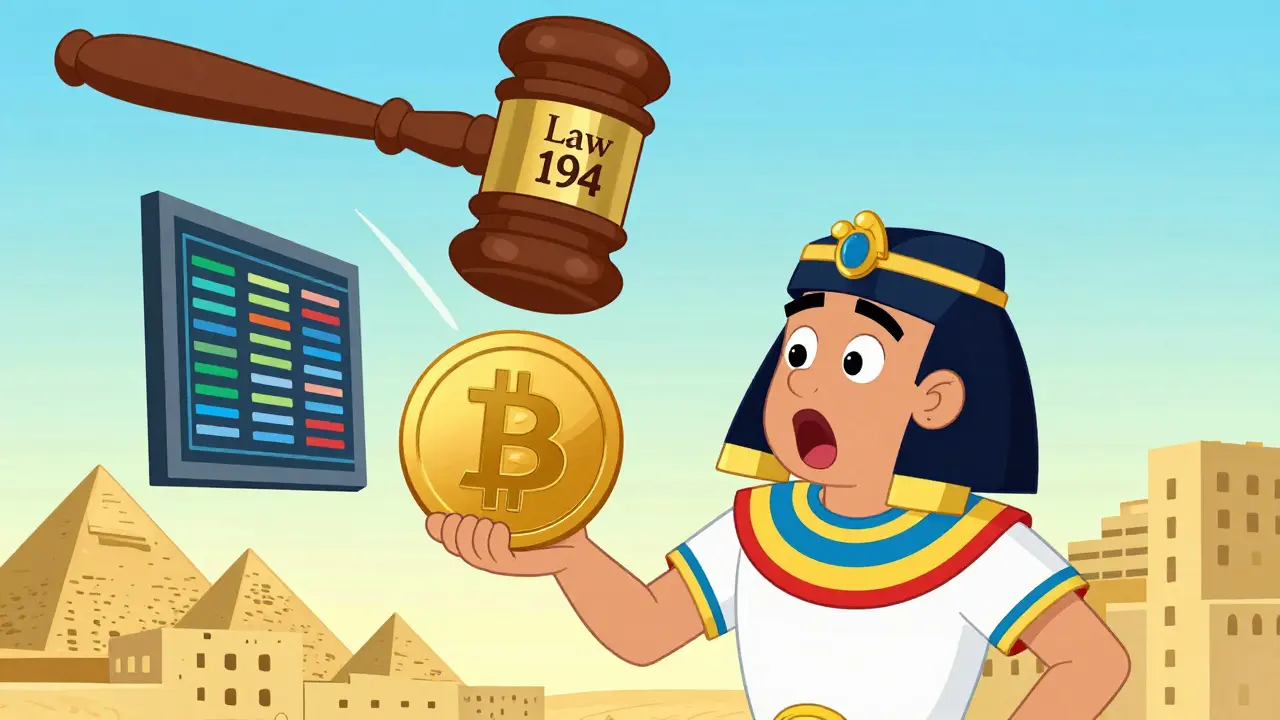
Imagine waking up to find your exchange account frozen or discovering that your favorite digital asset is now legally classified as a prohibited item in your own country. For millions of people in Egypt, this isn't a hypothetical scenario-it's the reality of Law 194 of 2020 is the comprehensive Central Bank and Banking Sector Law that effectively banned the issuance, trading, and promotion of cryptocurrencies across Egypt. Since its implementation, the legal landscape for digital assets in the region has shifted from a "grey area" to a strict "no-go zone." If you're trying to navigate the risks of holding crypto in Egypt or wondering why the government took such a hard line, you need to understand exactly what the law says and how it's being enforced.
The Core of the Ban: What Exactly is Law 194?
Passed by the Egyptian Parliament on September 15, 2020, Law 194 of 2020 isn't just a small amendment; it's a massive overhaul of the banking sector. It expanded the previous regulatory framework from 135 articles to 241. While most of the law deals with standard banking operations, Article 204 is the part that keeps crypto enthusiasts awake at night. This specific article strictly prohibits the issuance, trading, and promotion of cryptocurrencies unless you have prior approval from the Central Bank of Egypt (CBE), which is the independent regulatory body responsible for monetary policy and financial stability in Egypt.
Here is the catch: while the law technically allows for "prior approval," there is no record of the CBE ever granting such a permit to any individual or company. In practice, this means a total ban. It doesn't just stop you from starting your own coin (ICOs); it targets the very act of trading on platforms like Binance or Coinbase, and even the act of promoting these assets to others.
How the Government Enforces the Ban
The CBE hasn't just relied on the law; they've used a series of aggressive warnings and circulars to shut down the ecosystem. Since 2020, the bank has issued four separate warning statements. The most recent one, from March 8, 2023, closed any remaining loopholes by expanding the ban to include "all types of cryptocurrencies" and related financial instruments, like security tokens.
The enforcement isn't just on paper. The CBE issued Circular 4/2022, which explicitly tells banks to block any transactions headed toward known crypto platforms. This move effectively crippled the local peer-to-peer (P2P) market. According to data from Chainalysis, these banking restrictions led to a 92% drop in P2P trading volumes by the end of 2022. If you try to send money from an Egyptian bank account to a global exchange, the transaction is likely to be flagged and frozen immediately.
Comparing Egypt's Approach to the Rest of the Region
Egypt's stance is an extreme outlier in the Middle East. While countries like the UAE have embraced digital assets through frameworks like VARA (Virtual Assets Regulatory Authority), Egypt has chosen a path similar to Algeria. This creates a strange paradox: the Egyptian government is pushing a national blockchain strategy for government services, yet they are criminalizing the currency that powers that very technology.
| Feature | Egypt (Law 194) | UAE (VARA Framework) | Algeria |
|---|---|---|---|
| Legal Status | Prohibited without CBE approval | Regulated & Legal | Outright Ban |
| Exchange Access | Blocked by banks | Licensed & Available | Illegal |
| Institutional Trading | Illegal | Encouraged | Illegal |
| Gov. Stance | Restrictive / Prohibitive | Innovation-focused | Prohibitive |

The Real-World Impact: Frozen Funds and Brain Drain
For the average person, the ban manifests as a loss of access to their own money. Community forums like r/CryptoEgypt have seen hundreds of reports of blocked accounts. In some cases, users have lost millions of dollars because they can no longer verify their identities or withdraw funds through local banks. A dedicated Facebook group for "Egypt Crypto Victims" has documented nearly $8.7 million in inaccessible funds.
Beyond individual losses, there's a massive "brain drain" happening. Many blockchain developers and fintech entrepreneurs have packed their bags and moved to Dubai or Singapore. The Egyptian Fintech Startup Association reported that nearly 80% of their surveyed blockchain entrepreneurs relocated after the law passed. This isn't just a loss of people; it's an estimated $150 million in lost investment that could have built a local tech hub.
Why is the Ban So Strict?
You might wonder why the government is so scared of a digital coin. According to legal experts like Dr. Ahmed Kandil, the ban is about two things: monetary sovereignty and capital flight. When a country's currency is volatile, people naturally look for "safe havens." The government fears that if millions of Egyptians move their wealth into stablecoins or Bitcoin, the CBE loses its ability to control the money supply and stabilize the Egyptian Pound.
The CBE also points to the high volatility of the market and the risk of scams. However, critics argue that this is an outdated way of thinking. By banning the asset, the government isn't stopping the demand-they're just pushing it underground. Roughly 3.2 million Egyptians still use VPNs and P2P networks to trade, moving over $1 billion annually despite the risks.

What's Next: Will the Law Change?
There are signs of a potential shift, though nothing is official. Egypt is currently negotiating a massive $8 billion bailout package with the International Monetary Fund (IMF), which is a major global organization that provides financial assistance and policy advice to member countries. The IMF has explicitly mentioned that regulatory barriers to fintech innovation need to be addressed. This puts the Egyptian government in a tough spot: keep the ban to protect the pound, or lift it to attract the investment the IMF wants to see.
Some analysts, including those from Fitch Ratings, suggest we might see a "regulatory sandbox" by 2026. This would allow a small number of companies to test crypto products under strict supervision without fully legalizing the market for everyone. Until then, the law remains one of the most restrictive in the world, placing Egypt in the same "prohibitive" category as China.
Is it illegal to own Bitcoin in Egypt?
While the law focuses heavily on "issuing, trading, and promoting," the overall spirit and enforcement of Law 194 of 2020 make any interaction with cryptocurrency a legal risk. The Central Bank of Egypt (CBE) has warned against "dealing with all types of cryptocurrencies," which can be interpreted to include simple ownership and holding.
Can I use a VPN to access crypto exchanges in Egypt?
Many users do use VPNs to bypass regional blocks on websites like Binance. However, while a VPN hides your location, it does not protect you from the banking system. If you attempt to fund an account using an Egyptian bank card or bank transfer, the transaction will likely be blocked under Circular 4/2022, and your bank may report the activity to the CBE.
What are the penalties for violating Law 194 of 2020?
Article 205 allows the CBE to refer violations to judicial authorities. While specific fines are not always publicized, violators can face criminal charges. Because cryptocurrency activity often overlaps with the 2018 Anti-Money Laundering Law, some users have faced dual prosecutions, making the legal stakes significantly higher than a simple fine.
Does the ban apply to blockchain technology for businesses?
There is a distinction between blockchain (the technology) and cryptocurrency (the asset). The Egyptian Ministry of Communications has actually launched a national blockchain strategy. This means using a distributed ledger for logistics, healthcare, or government records is generally permitted, as long as it doesn't involve the trading or issuance of banned digital tokens.
Will the IMF force Egypt to legalize crypto?
The IMF hasn't explicitly demanded the legalization of cryptocurrency, but they have flagged "regulatory barriers to fintech innovation" as a problem. This could lead to a compromise where Egypt allows institutional trading or creates a controlled environment (sandbox) for fintech companies, even if retail trading remains restricted.
Next Steps and Troubleshooting
If you are currently holding digital assets in Egypt, you are in a high-risk position. The first step is to avoid using local bank accounts for direct transfers to exchanges. Most users who have avoided detection rely entirely on P2P networks, although even this is becoming harder as banks implement better monitoring systems.
For entrepreneurs, the current climate suggests that launching a crypto-based product within Egypt is nearly impossible without high-level government connections. Most are choosing to incorporate in the UAE (Dubai) or Singapore to ensure their intellectual property and funds are legally protected. If you have frozen funds, your best bet is to seek legal counsel specializing in the 2018 Anti-Money Laundering Law, as the intersection of that law and Law 194 is where most legal battles are fought.
Omotola Balogun
April 11, 2026 AT 16:06Law 194 is just a classic move by a state trying to keep its monopoly on money. Most people dont realize that the CBE is basically terrified of the EGP collapsing further if everyone jumps ship to USDT. Its a textbook case of capital control gone wild but they think they can stop the internet with a piece of paper lol
Adam Auksel
April 13, 2026 AT 09:08It is so heartbreaking to see people losing access to their own hard-earned funds 😔. I really hope those seeking a regulatory sandbox get a win soon! Innovation should be welcomed, not feared 🚀✨
Samson Selleck
April 14, 2026 AT 13:36The macroeconomic divergence here is quite transparent. The CBE is attempting to mitigate systemic liquidity risks and prevent the exacerbation of inflationary pressures through unauthorized capital outflows. By criminalizing the on-ramp and off-ramp mechanisms, they aren't addressing the fundamental fiscal instability of the Egyptian Pound, but rather implementing a superficial layer of prohibition that ignores the inherent decentralization of the protocol. It is a futile attempt to apply legacy regulatory frameworks to an asymmetric financial revolution, effectively creating a black market that will inevitably undermine the very monetary sovereignty they claim to protect through these draconian measures. This is precisely why the brain drain to the UAE is happening; the intellectual capital is simply migrating to jurisdictions with a more sophisticated understanding of programmable money and digital asset custody. The irony of promoting a national blockchain strategy while banning the tokenomics that facilitate it is almost comical in its cognitive dissonance. We are seeing a total failure in policy orchestration where the left hand is building the infrastructure and the right hand is handcuffing the users. This lack of coherence will only lead to increased volatility in the shadow economy. Eventually, the pressure from the IMF will force a pivot, but by then, the local ecosystem will have been completely hollowed out. It's a masterclass in how to kill a burgeoning tech sector in record time.
Surender Kumar
April 14, 2026 AT 16:55man this is wild.. hope things get better for the peepels there soon
Lela Singh
April 16, 2026 AT 06:02Total chaos! 💥 Use P2P with caution folks!
EDOZIEM MICHAEL
April 17, 2026 AT 13:40money is just a collective dream anyway and the government is just the loudest dreamer
Prasanna Shembekar
April 18, 2026 AT 18:12this is so sad i cant even imagine losing millions of dollars just like that
Emily H
April 19, 2026 AT 05:19The correlation between currency volatility and the adoption of stablecoins is well-documented. It is logical that the government views this as a threat to their monetary control.
Mikayla Murphy
April 19, 2026 AT 08:39It must be incredibly stressful to feel like your financial security is at the mercy of a sudden law change. Sending strength to everyone dealing with frozen accounts.
Lane Montgomery
April 20, 2026 AT 15:08Who cares? Get a real job.
Alan Seiden
April 21, 2026 AT 19:05Typical nonsense. Why is everyone obsessed with this digital gambling? If they want a stable economy, they should stop chasing magic internet money and focus on actual industry.
jennelle williams
April 22, 2026 AT 14:07just want people to be safe
James Bone
April 22, 2026 AT 17:11The 'safety' argument is a joke. They just want to stop you from escaping a sinking ship. Imagine thinking the CBE has your best interests at heart while they inflate your currency into oblivion.
Rob Mitchell
April 23, 2026 AT 01:01Dubai is definitely the better bet right now for anyone in fintech.
william manes
April 23, 2026 AT 05:04Silly people thinking they can hide from the government 🤡. Just follow the rules or lose it all! 📉
Tyler Webb
April 23, 2026 AT 05:57That sounds like a nightmare for the average person : //
Aaliyah BROTHERS
April 24, 2026 AT 18:58WAKE UP!!! This isn't just about 'money'!! It's a total control grid!!!! They want us all on CBDCs so they can track every single penny we spend!!!! Law 194 is just the beginning of the Great Reset in Africa!!!! 👁️🚫💰
Heather Warren
April 25, 2026 AT 03:11I agree that the IMF might push for a change. It would be great to see some legal paths open up for small investors.
Akshay Gorad
April 25, 2026 AT 03:16The mention of the Anti-Money Laundering Law is very important here. It adds a layer of risk that goes beyond just losing money.