You hold Bitcoin. You want to use it on Ethereum to lend money or trade on a decentralized exchange. But Bitcoin doesn't speak Ethereum's language. It lives on its own chain. So how do you get that value over there without selling your coins? The answer is the wrapping and unwrapping process.
This isn't just technical jargon for computer scientists. It’s the plumbing of the modern crypto economy. Every time you move assets between different blockchains-like taking Bitcoin to Solana or Ethereum to Polygon-you are relying on this mechanism. Without it, each blockchain would be an isolated island, unable to share value with the others.
What Is Token Wrapping?
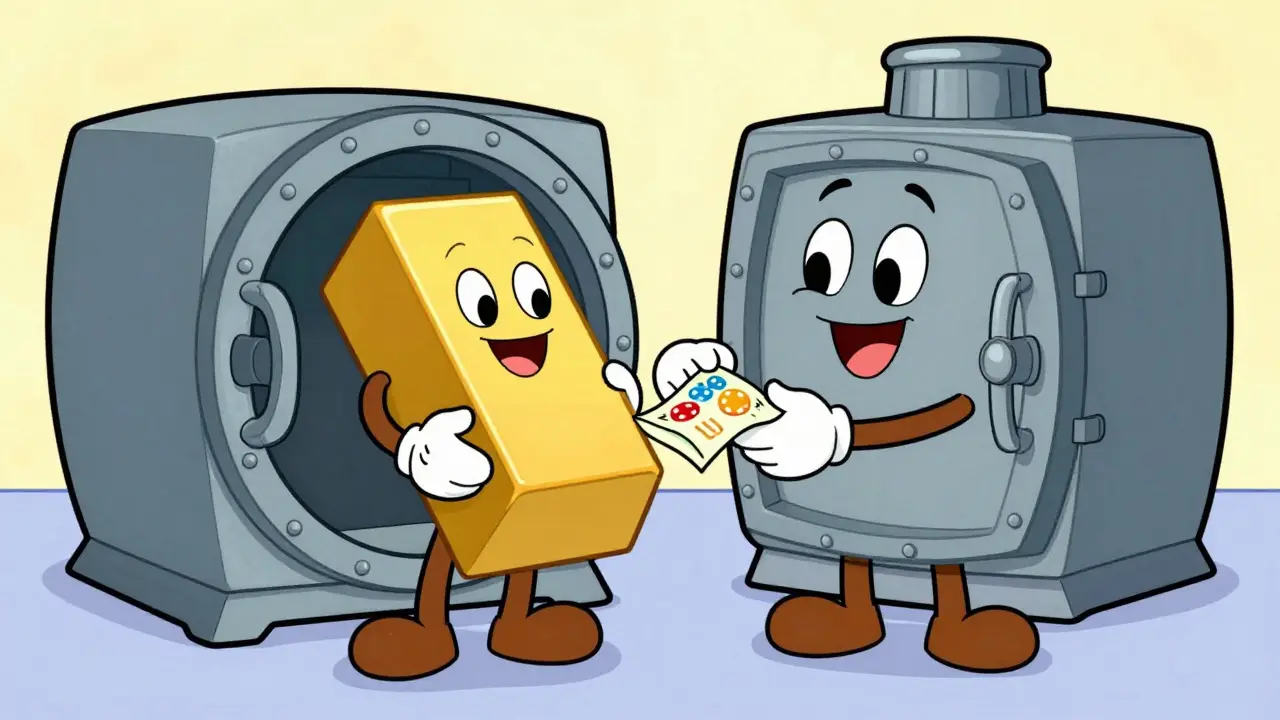
Imagine you have a gold bar. You can’t take it directly into a casino that only accepts chips. So, you go to a bank (a trusted vault), hand them the gold, and they give you a receipt. That receipt says, "I own one gold bar." You can now use that receipt inside the casino as if it were cash. When you’re done, you take the receipt back to the bank, and they give you your gold bar back.
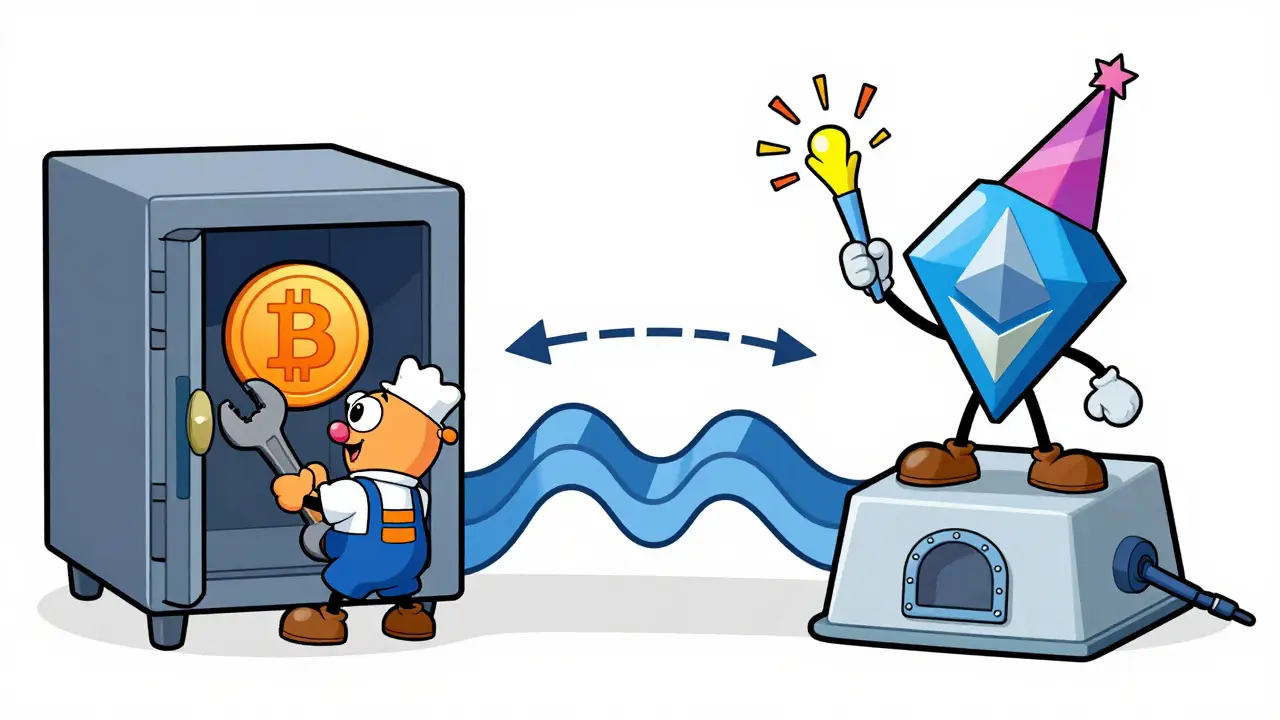
In blockchain terms, this is exactly what happens. Wrapped tokens are digital assets that represent a 1:1 pegged value of another cryptocurrency on a different blockchain. When you wrap Bitcoin, you don’t actually move the Bitcoin itself to Ethereum. Instead, you lock the original Bitcoin in a secure smart contract or custodial wallet. In return, you receive a new token on Ethereum called Wrapped Bitcoin (WBTC). This WBTC behaves like any other ERC-20 token. It can be traded, lent, or used in DeFi protocols, but it always mirrors the price and value of the underlying Bitcoin.
The key here is the 1:1 ratio. One WBTC must always equal one BTC. If that trust breaks, the whole system collapses. That’s why the security of the locking mechanism is the most critical part of the entire process.
The Step-by-Step Wrapping Process
Let’s look at how this actually works under the hood. The process involves three main players: the user (you), the bridge protocol (the middleman), and the smart contracts (the automated vaults).
- Initiation: You send your native asset (e.g., BTC) to a designated address controlled by the bridging service. This could be a multisig wallet managed by a consortium of companies or a fully decentralized smart contract, depending on the bridge.
- Locking: Once the network confirms your transaction, the bridge locks those funds. They are frozen. They cannot be spent or moved until the process is reversed. Think of this as putting your car in a secure parking garage.
- Minting: The bridge notifies the target blockchain (e.g., Ethereum). A smart contract on Ethereum verifies that the lock happened. Then, it mints new wrapped tokens (WBTC) and sends them to your Ethereum wallet. These are newly created tokens backed by your locked Bitcoin.
- Usage: You now hold WBTC on Ethereum. You can swap it, lend it, or provide liquidity. To the Ethereum network, this looks like any other standard token.
This flow seems simple, but it introduces significant complexity regarding trust. Are you trusting a single company to hold your keys? Or are you trusting a mathematical proof? This distinction defines the safety of your assets.
How Unwrapping Works
Unwrapping is simply the reverse operation. Let’s say you want your Bitcoin back. You don’t sell the WBTC; you redeem it.
- Burning: You send your WBTC back to the bridge’s smart contract on Ethereum. The contract doesn’t send it anywhere; it destroys it. This is called "burning." The supply of WBTC decreases by one unit.
- Verification: The bridge protocol detects that the wrapped token has been burned. It checks its records to ensure the burn was legitimate and not a hack or error.
- Unlocking: The bridge releases the equivalent amount of native Bitcoin from its vault. It sends the BTC to your specified Bitcoin wallet address.
- Receipt: You now have your original Bitcoin back on the Bitcoin network. The cycle is complete.
If you skip the burning step and just try to withdraw, the bridge won’t release the funds. The integrity of the system relies on the fact that every wrapped token in circulation corresponds to a locked native asset. No double-spending allowed.
Custodial vs. Non-Custodial Bridges
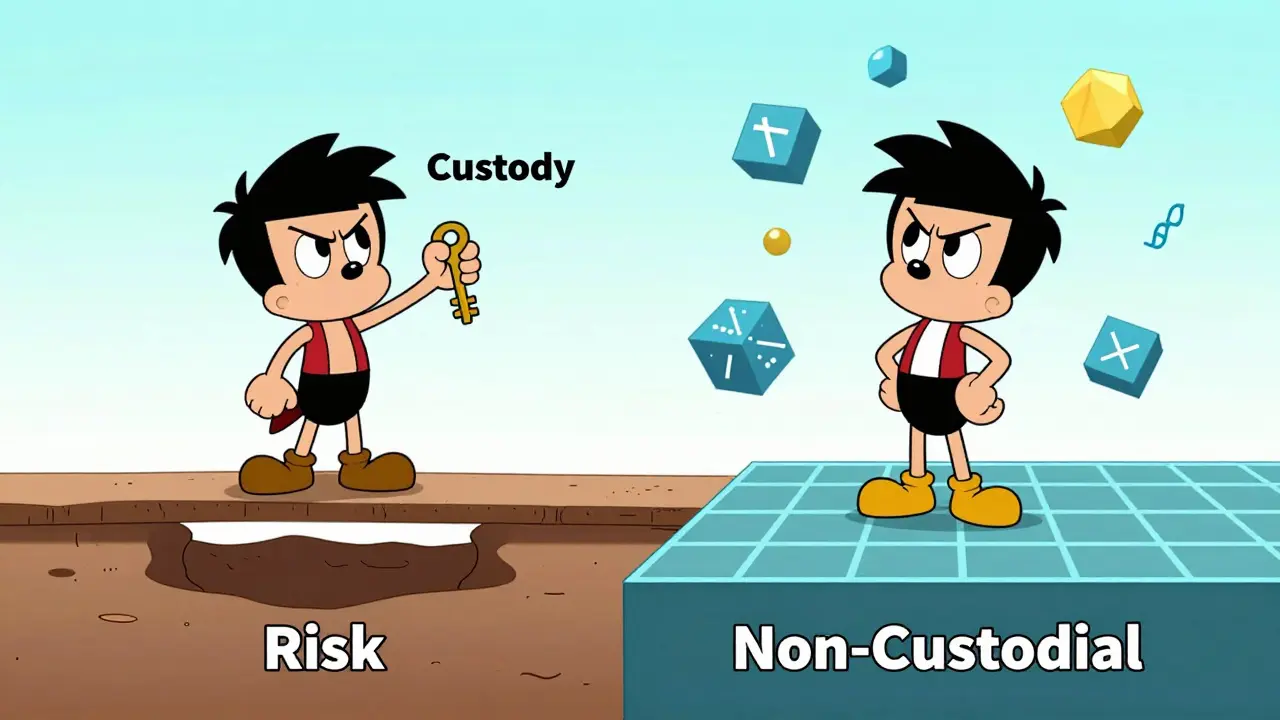
Not all wrapping processes are built the same. The biggest risk factor is who holds the keys to the vault. There are two main models: custodial and non-custodial (or decentralized).
| Feature | Custodial (Centralized) | Non-Custodial (Decentralized) |
|---|---|---|
| Control | Third-party company holds private keys | Smart contracts control funds via code |
| Trust Required | High (Trust the operator) | Low (Trust the math/code) |
| Speed | Fast (Manual approval possible) | Slower (Requires consensus/proofs) |
| Security Risk | Hacking of central server or insider theft | Smart contract bugs or oracle manipulation |
| Example | Early WBTC implementation | LayerZero, Wormhole, Synapse |
Custodial bridges, like the original setup for WBTC, rely on a group of trusted entities (merchants and custodians) to manage the Bitcoin vault. If these entities collude or get hacked, your wrapped tokens become worthless paper. On the other hand, non-custodial bridges use cryptographic proofs to verify transactions. For example, some bridges use light clients that run on both chains to prove that a transaction occurred without needing a middleman. This is safer in theory, but smart contracts are still prone to coding errors, which hackers love to exploit.
Why Do We Need Wrapped Tokens?
You might wonder, why not just use Bitcoin on Bitcoin? The reason is utility. Different blockchains excel at different things. Bitcoin is incredibly secure but slow and expensive for complex operations. Ethereum is flexible and hosts thousands of decentralized applications (DeFi), but it can also be congested.
By wrapping Bitcoin, you bring its store-of-value properties into Ethereum’s vibrant ecosystem. You can lend your WBTC on Aave to earn interest. You can use it as collateral to borrow stablecoins. You can trade it against ETH on Uniswap. Without wrapping, Bitcoin holders would be excluded from the majority of the DeFi yield opportunities available today.
Similarly, wrapped versions of Ethereum (WETH) allow ETH to function as an ERC-20 token, making it compatible with smart contracts that require standard token interfaces. This interoperability is the backbone of the multi-chain future.
Risks and Pitfalls to Avoid
While the concept is elegant, the execution has failed spectacularly more than once. History is littered with hacked bridges. Here is what you need to watch out for:
- Smart Contract Vulnerabilities: Even if the idea is sound, bad code leads to losses. Audits help, but they aren’t foolproof. Always check if a bridge has undergone multiple independent audits.
- Oracle Manipulation: Some bridges rely on external data feeds (oracles) to confirm prices or transaction statuses. If a hacker manipulates the oracle, they can trick the bridge into minting free wrapped tokens.
- Liquidity Mismatches: In extreme market crashes, the demand to unwrap might exceed the available liquidity on the receiving end. You might find yourself holding wrapped tokens that you can’t easily convert back to native assets quickly.
- Counterparty Risk: With custodial bridges, you are trusting humans. Remember the FTX collapse? Centralized points of failure are dangerous in a decentralized world.
To mitigate these risks, never keep large amounts of wrapped tokens in a hot wallet for long periods. Use reputable bridges with transparent governance. And always understand where your funds are actually sitting. Are they in a multisig wallet? Are they secured by a decentralized network of validators?
The Future of Interoperability
The industry is moving away from heavy reliance on third-party custodians. New technologies like Intent-Based Routing and Universal Messaging Layers are emerging. Protocols like LayerZero and Chainlink CCIP aim to create standardized ways for blockchains to talk to each other without needing separate wrapped tokens for every pair of chains.
Imagine a world where you don’t need WBTC, wBTC, or tBTC. Instead, your Bitcoin stays on Bitcoin, but a universal layer allows Ethereum apps to interact with it directly through atomic swaps. This reduces the attack surface and eliminates the need for complex minting and burning mechanisms.
Until then, wrapping and unwrapping remain essential tools. They are imperfect, risky, but necessary bridges connecting our fragmented digital financial system. Understanding how they work is not just for developers-it’s vital for anyone looking to protect their assets while navigating the multi-chain landscape.
Is wrapped Bitcoin safe?
Wrapped Bitcoin (WBTC) is generally considered safe if you use established bridges with strong auditing and decentralized custody models. However, it carries counterparty risk because your actual Bitcoin is held by a third party. If that custodian is hacked or acts maliciously, your WBTC could lose its backing. Always research the specific bridge protocol before using it.
What is the difference between WETH and ETH?
ETH is the native currency of the Ethereum network, used for gas fees and transfers. WETH (Wrapped Ether) is an ERC-20 token version of ETH. Smart contracts often require tokens to follow the ERC-20 standard to function properly. WETH allows ETH to be used in decentralized exchanges and lending protocols that don't support native ETH directly.
Can I unwrap my tokens instantly?
It depends on the bridge. Some centralized bridges offer near-instant unwrapping because they have pre-funded liquidity pools on the destination chain. Decentralized bridges may take longer as they require cryptographic proofs to be verified across networks, which can take several minutes to hours depending on network congestion.
Do wrapped tokens affect the total supply of the original coin?
No. Wrapping does not change the total supply of the underlying asset. When you wrap Bitcoin, the original BTC is locked, not destroyed. The wrapped token is a new asset issued on a different chain. The sum of native BTC plus wrapped WBTC represents the total accessible value, but the Bitcoin blockchain itself remains unchanged.
What happens if a bridge gets hacked?
If a bridge is hacked, the attacker may drain the locked funds or mint unauthorized wrapped tokens. This can cause the price of the wrapped token to crash as users rush to sell, fearing it no longer has backing. In severe cases, the wrapped token becomes worthless. This is why choosing audited, decentralized bridges is crucial for risk management.
Tobias Gjerlufsen
May 24, 2026 AT 11:25you think this is new? its just digital fiat backed by nothing but code and hope. the whole premise of wrapping is a trust fall with your life savings. you lock btc in a multisig that could be compromised or coerced and get back a token that is only as good as the custodian's integrity. it is not interoperability it is centralized risk disguised as decentralization. people who use these bridges are either ignorant or greedy. there is no middle ground. the gold bar analogy fails because the bank can just print more receipts if they want to. why do we keep pretending this is secure?
Samara McCallum
May 25, 2026 AT 15:35i feel like everyone here is so angry about the mechanics when the real issue is that we are trying to force square pegs into round holes. maybe bitcoin should stay on bitcoin and ethereum should stay on ethereum. why do we need to mix them? it feels like creating problems to solve. i just want my money to sit quietly without me having to worry about smart contract audits or oracle manipulation. isn't that what crypto was supposed to be? peace of mind?
Sheldon Friesen
May 26, 2026 AT 17:50Oh, look at us! Trying to play god with cross-chain protocols! 🙄 It is absolutely fascinating how people ignore the fundamental security flaws in favor of yield farming opportunities. You see, the problem isn't the technology; it is the human element. We are building castles on sand and calling it DeFi. The article mentions LayerZero and Chainlink CCIP as the future, but let us be honest: until we have atomic swaps that do not require wrapped tokens, we are all just gambling on which bridge gets hacked next. Do yourself a favor and read the whitepapers instead of just clicking buttons.
Caique Muniz
May 27, 2026 AT 01:26honestly this post is basic stuff for anyone who has been in crypto since 2017. u guys act like wrapping is some new invention. its been around forever and yet bridges still get drained every week. the writing style is too academic for reddit. nobody reads tables. just tell us which bridge is safe. oh wait none of them are. lol. also ur grammar is kinda stiff. chill out.
Gavin Wonnacott
May 28, 2026 AT 06:42I find it deeply amusing that you would publish such a sanitized view of the ecosystem. You speak of 'trust' as if it is a virtue rather than a vulnerability. In reality, every time you wrap an asset, you are surrendering sovereignty to a third party. This is not innovation; it is regression. The elitist nature of understanding these risks means most users are already victims waiting to happen. I pity those who cannot grasp that their 'yield' is merely compensation for holding the bag on someone else's negligence.
Jan Gilmore
May 29, 2026 AT 09:09Let me break it down for the folks who missed the memo. Wrapping is essential for liquidity fragmentation. Without it, each chain is a silo. Yes, there are risks, but the benefits of accessing DeFi yields on BTC outweigh the counterparty risk if you use reputable bridges. WBTC is the standard for a reason. It has survived multiple market cycles. If you are worried about hacks, you should not be using crypto at all. Go buy stocks. But for those of us who understand the trade-off, this is how we maximize our holdings. Stop fear-mongering and start participating.
robert Whitehead
May 31, 2026 AT 03:03The moral hazard here is staggering. Developers build complex systems with known vulnerabilities and then blame users for falling victim to exploits. It is irresponsible to promote wrapped tokens without emphasizing the catastrophic failure modes. Every bridge hack is a testament to the greed and incompetence of the industry leaders. They prioritize speed and convenience over security. We are essentially handing our private keys to strangers and hoping for the best. This is not freedom; it is servitude to centralized entities masquerading as decentralized protocols. Wake up!
Mike S
June 1, 2026 AT 21:08Drama alert! Everyone is panicking about bridge hacks like it is 2022 again. Look, yes, bridges are risky. But do you know what is riskier? Holding everything in one place. Diversification across chains is key. The article correctly points out that non-custodial bridges are safer in theory, but let us be real-smart contracts have bugs. Always. So what do we do? We audit, we diversify, and we move on. Complaining about the existence of wrapped tokens is like complaining about cars because they can crash. Use seatbelts (audits) and drive carefully.
H F
June 3, 2026 AT 21:03I actually found this explanation quite helpful! It is easy to get bogged down in the technical jargon, but breaking it down into locking, minting, and burning makes it much clearer. I have used WBTC before and always wondered exactly where my Bitcoin went during the process. Knowing that it is locked in a multisig wallet gives me a bit more confidence, even if I am still cautious. Thanks for shedding light on this topic. It is definitely something every crypto user should understand.
Michael Berggren
June 4, 2026 AT 16:07This is a great overview! 👍 I think the comparison between custodial and non-custodial bridges is spot on. Many people don't realize that WBTC is custodial by design, which introduces significant counterparty risk. However, newer protocols like tBTC aim to solve this with decentralized custody. It is exciting to see the evolution towards trustless bridging. Until then, I stick to small amounts on well-audited bridges. Stay safe out there! 🛡️💎
Kiran CS
June 5, 2026 AT 06:19One must appreciate the sheer audacity of suggesting that a receipt for a gold bar is equivalent to the gold bar itself. It is a philosophical absurdity. The wrapped token is a derivative, a shadow of the original asset. To treat them as interchangeable is to misunderstand the very nature of value. Furthermore, the reliance on oracles introduces a layer of opacity that is antithetical to the transparent ideals of blockchain technology. It is a sophisticated illusion, nothing more.
Bradley Geldenhuys
June 6, 2026 AT 11:21look man i get the hype but lets keep it real. the whole point of crypto was to remove middlemen right? so why are we adding them back in with bridges? its ironic af. sure you can earn yield but you are taking on massive risk. i mean come on. if your bridge gets hacked you lose everything. its not worth it for most people. just hold your btc and let it ride. simple is better. dont overcomplicate your life with wrapped tokens unless you really know what you are doing. which most people dont.