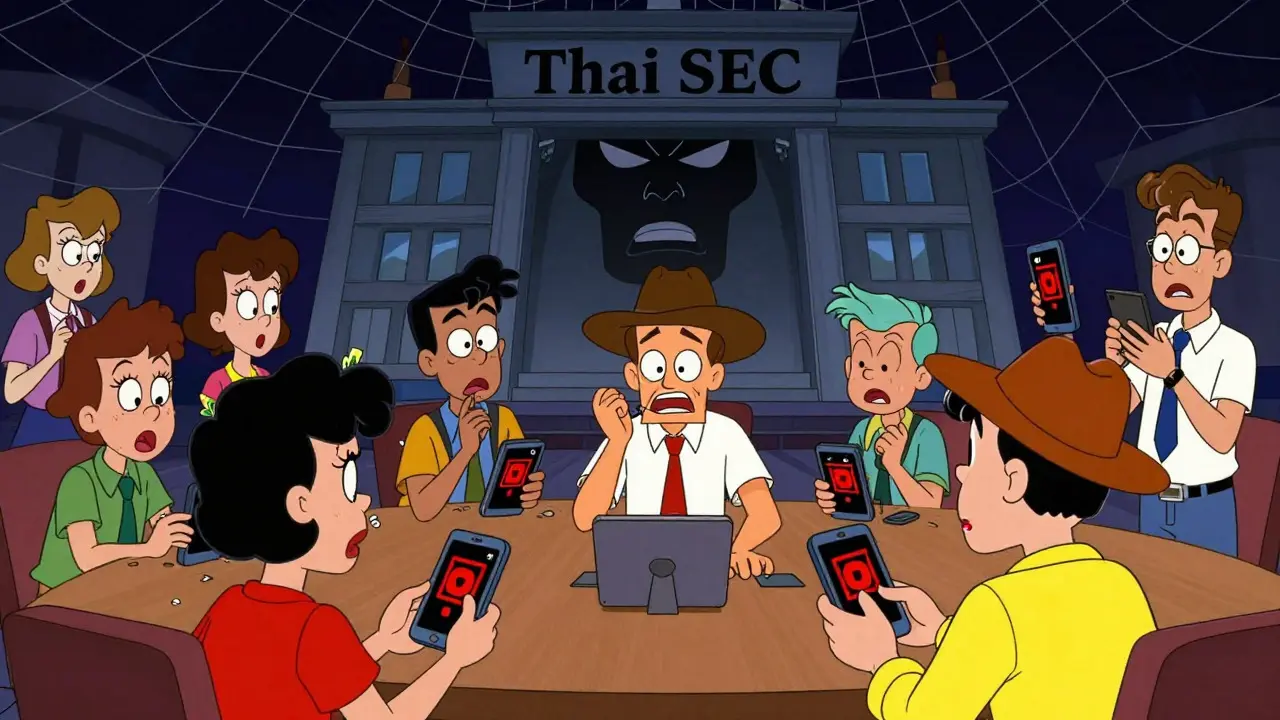
Remember when you could log into any global crypto exchange from your phone in Bangkok without a second thought? Those days are over. If you are an exchange operator or a serious trader looking at the Thai market today, the rules have changed drastically. The Thailand Securities and Exchange Commission (SEC) is the regulatory body overseeing digital assets in Thailand has pulled the rug out from under unlicensed foreign platforms. Since the major amendments to the Digital Asset Business Act took effect in April 2025, the landscape for cryptocurrency exchanges in Thailand has shifted from a wild west of accessibility to a tightly controlled environment focused on consumer protection.
This isn't just about filling out a few forms. It is about survival. Major players like Bybit and OKX were forced to shut down their services for Thai users because they failed to meet the new strict criteria. For anyone operating in or targeting this market, understanding these restrictions is no longer optional-it is the difference between a thriving business and a massive fine.
The Core Framework: Digital Asset Business Act
To understand where things stand in 2026, you have to look at the foundation. The primary law governing this space is the Digital Asset Business Act, originally enacted as the Royal Decree on Digital Asset Businesses B.E. 2561/2018. This was updated significantly by two emergency decrees in early 2025: the Emergency Decree on Digital Asset Businesses (No. 2) and the Emergency Decree on Measures for the Prevention and Suppression of Cybercrimes (No. 2).
Why did the government move so fast? Fraud. In early 2025, reports of crypto scams targeting Thai citizens spiked. The Ministry of Finance, working with the Office of the SEC under Secretary-General Pornanong Budsaratragoon, decided that protecting investors had to come before open access. Their goal wasn't to kill innovation, but to close the loopholes scammers were exploiting. The result is a framework that requires every digital asset business operator serving Thai customers to hold a specific license issued by the Thai SEC.
If you don't have that license, you are illegal. And the penalties for non-compliance are severe, including heavy fines and prison terms for executives. As of February 2025, only nine entities had successfully navigated this process to become licensed digital asset portals. You can verify who these are on the official SEC licensing database, which remains the single source of truth for compliance.
How the SEC Defines "Serving Thai Users"
Here is where many international exchanges got tripped up. They assumed that if they didn't physically locate their servers in Thailand, they were safe. The Thai SEC disagreed. The 2025 amendments introduced a seven-point test to determine if a foreign platform is effectively providing services to persons in Thailand. If you hit even one of these points, you need a license.
- Language: Your digital platform is displayed in whole or in part in the Thai language.
- Domain Name: You use a domain extension like ".th" or ".ไทย" or other names clearly associated with Thailand.
- Currency: You accept payments in Thai baht (THB) or through Thai deposit/electronic money accounts.
- Governing Law: You specify Thai law as the governing law or Thai courts for dispute resolution in your terms of service.
- Marketing: You pay search engines to facilitate access specifically for Thai users.
- Local Presence: You establish offices or hire personnel to support Thai users.
- Other Characteristics: Any other traits prescribed by future SEC Notifications.
This extraterritorial application is unique compared to neighbors like Singapore. While the Monetary Authority of Singapore (MAS) allows more foreign participation, Thailand draws a hard line. If you target Thai users, you play by Thai rules. This approach mirrors Japan's Financial Services Agency requirements for local licensing but goes further in its ability to block access instantly.
Operational Restrictions for Licensed Exchanges
Getting the license is just step one. Once you are in, the operational constraints are tight. The Thai SEC does not want crypto replacing the baht, nor do they want anonymous transactions fueling crime. Licensed operators face several specific prohibitions:
- No Privacy Coins: You cannot provide services for coins designed to hide transaction details, such as Monero or Zcash.
- No Payment Promotions: You are prohibited from promoting digital assets as a payment method for goods and services. Crypto is treated as an investment asset, not currency.
- No Lending with Promised Returns: Offering deposit-taking or lending services that guarantee returns is banned to prevent Ponzi-like schemes.
- Limited Token Selection: As of mid-2025, only about 35 tokens were approved for trading on local exchanges. Meme tokens, fan tokens, and NFTs are explicitly prohibited on licensed platforms.
These restrictions explain why user sentiment is mixed. On forums like Pantip.com, some users praise the increased security, noting an 87% reduction in scam attempts mentioned in positive reviews. However, others complain bitterly about the limited selection. Compare the 35 approved tokens on local exchanges to the 350+ available on former foreign platforms like Bybit. For traders seeking diversification, the local market feels cramped.
The Licensing Process: Costs and Timelines
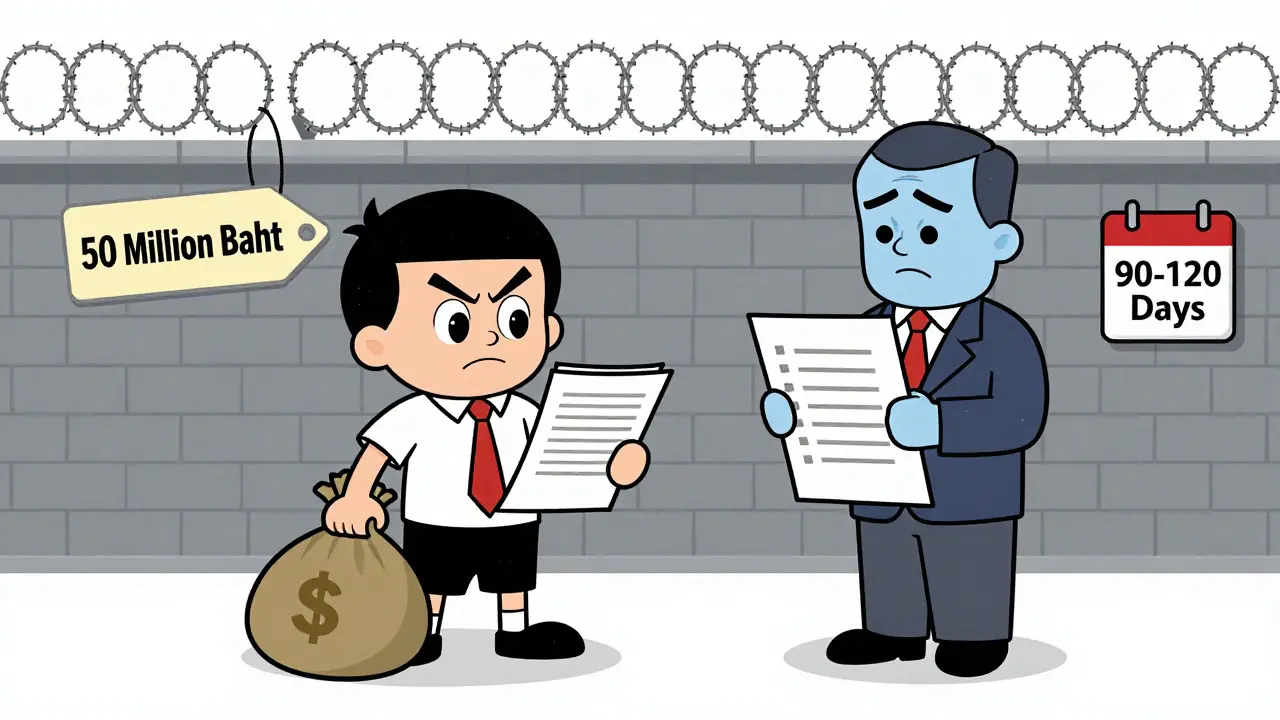
If you are an exchange deciding whether to enter the Thai market, the barrier to entry is high. The implementation process is rigorous. You must submit documentation to the SEC within 30 days of starting operations that target Thai users. The financial commitment alone filters out many smaller players.
| Requirement | Details | Estimated Cost / Value |
|---|---|---|
| Application Fee | One-time fee submitted with initial documents | ฿1,000,000 (~$27,400) |
| Annual License Fee | Recurring yearly cost to maintain status | ฿500,000 (~$13,700) |
| Minimum Operational Capital | Proof of funds required to show stability | ฿50 million (~$1.37 million) |
| Approval Timeline | Average time from application to license issuance | 90-120 days |
| Compliance Audit | Source code audits and AML/CFT system verification | Variable (requires SEC-approved firms) |
Beyond the money, you need proof of robust Anti-Money Laundering (AML) and Counter-Financing of Terrorism (CFT) systems that meet FATF standards. You also need source code audits from SEC-approved firms. Bitkub, Thailand's largest licensed exchange, reported taking six months to fully implement all compliance measures after applying. The average approval timeline for the nine currently licensed entities sits between 90 and 120 days.
Market Impact and User Behavior in 2026
The impact of these regulations has been profound. In Q4 2024, foreign platforms held 85% of the market share. By Q2 2025, domestic licensed platforms captured 78% of the market. The total digital asset market value reached $1.2 billion in Q1 2025, with 4.7 million active users-representing 23% of Thailand's adult population.
However, the crackdown has created a shadow market. Estimates suggest that 35% of Thai crypto activity has migrated offshore since April 2025, with users relying on VPN services to access foreign platforms. This regulatory arbitrage is a concern for the SEC. While the number of fraud reports dropped by 37% in Q2 2025 compared to Q1, the liquidity issues remain. Traders report wider spreads and higher fees on local exchanges, averaging 0.25% compared to 0.1% on international competitors.
Looking ahead, the regulatory roadmap includes planned amendments in Q4 2025 to address decentralized finance (DeFi) platforms. There is also a pilot project for central bank digital currency (CBDC) integration expected in Q2 2026. The National Blockchain Policy Office has allocated ฿2.1 billion for blockchain development projects through 2027, signaling that while the gatekeepers are strict, the government still believes in the technology's long-term potential.

Comparison with Regional Frameworks
How does Thailand stack up against its neighbors? It is stricter than Singapore but less restrictive than China's complete ban. Compared to the EU's MiCA framework, Thailand lacks clarity on stablecoin regulations and offers no cross-border passporting for licenses. This means an exchange licensed in Germany cannot simply operate in Thailand; it must apply separately.
Industry analysts at CryptoCompare ranked Thailand's framework as 'moderately favorable' (6.2/10) in their 2025 Global Crypto Regulatory Index. They cited strong consumer protection as a pro, but limited innovation incentives as a con. Dr. Veerathai Santiprabhob, former Governor of the Bank of Thailand, supported the move, arguing it creates a safer environment for institutional investors. Conversely, Dr. Pimkamol Chaisri of the Thai Blockchain Association criticized the short compliance windows given to existing platforms.
FAQ
Are Bybit and OKX banned in Thailand?
Yes, effectively. Following the April 2025 regulatory changes, these platforms were deemed to be serving Thai users without proper licensing. The Ministry of Digital Economy and Society (MDES) blocked access to their domains, forcing them to shut down services for Thai residents unless they obtain a full Thai SEC license.
What cryptocurrencies are allowed on Thai exchanges?
Licensed exchanges can only trade tokens approved by the SEC. As of mid-2025, this list included approximately 35 major tokens like Bitcoin and Ethereum. Privacy coins, meme tokens, fan tokens, and NFTs are currently prohibited on local licensed platforms.
How much does it cost to get a crypto exchange license in Thailand?
The direct costs include a ฿1,000,000 application fee and a ฿500,000 annual license fee. However, you must also prove minimum operational capital of ฿50 million and cover costs for source code audits and AML system implementation, which can run into hundreds of thousands of dollars.
Can I use a VPN to trade on foreign exchanges in Thailand?
Technically, yes, though it carries risk. About 35% of Thai crypto activity has moved offshore using VPNs. However, the SEC defines "serving Thai users" broadly, and using Thai baht or Thai banks to fund these accounts may still violate local banking regulations or attract scrutiny.
When will DeFi platforms be regulated in Thailand?
The SEC has announced plans to amend the Digital Asset Business Act in Q4 2025 to specifically address decentralized finance (DeFi) platforms. Until then, the current licensing requirements for centralized exchanges serve as the baseline expectation for compliance.
Subhash Kashyap Dm
August 10, 2026 AT 13:06the seven point test is basically a fishing expedition for jurisdiction. they want your data and your baht regardless of where the server sits. its classic regulatory overreach disguised as consumer protection. look at the language clause alone if you have one thai word on your site you are liable. it is absurd but that is how authoritarian financial control works. they are building a panopticon for digital assets.
Kat Bennett
August 12, 2026 AT 08:55i really think this shift towards tighter regulation is going to help stabilize the market in the long run even if it feels restrictive right now. when i look at the drop in scam reports by thirty seven percent it makes me feel much safer about putting my savings into crypto without worrying about losing everything to a rug pull or a fake platform. it takes time for these systems to mature and i am willing to wait for the benefits of having a secure environment where institutions can actually participate without fear of fraud. maybe we will see more innovation emerge from this structured approach rather than the wild west era we had before.
Candice Cornett
August 12, 2026 AT 15:42you people are so naive thinking government oversight equals safety. it just means more fees and less freedom. the fact that only thirty five tokens are allowed is an insult to intelligence. they are curating what you can buy like it is a kindergarten snack list. byebye innovation hello stagnation.
Jack Delasquez
August 12, 2026 AT 16:27bro this is huge news for us traders who were using bybit. i heard the fees are way higher on bitkub now like double or triple. does anyone know if they are gonna lower them soon? i am tired of paying so much just to swap eth for btc. also the vpn thing seems risky af. i dont wanna get banned from my bank account just for trading.
Harman Singh
August 13, 2026 AT 09:44why does everyone care about this so much. its just money. if you lost money on scams then maybe you should have been smarter. now they are taking away our options because some people cant read terms of service. it is pathetic honestly. i miss the days when we could trade whatever we wanted without asking permission from some bureaucrat in bangkok.
Qolbina Islami
August 14, 2026 AT 23:09This! Finally! The Thai SEC is doing exactly what needs to be done to protect our national sovereignty!!! Foreign exchanges were stealing our liquidity and exposing our citizens to global risks!!! We need strict controls!!! No privacy coins!!! No meme coins!!! Only serious investment assets approved by the state!!! Long live the Thai Baht!!!
SUBHAM CHOUDHURY
August 15, 2026 AT 08:58hey guys let's stay positive about this change. sure the transition is tough but imagine the security we will have. if you are planning to start an exchange business here remember the capital requirement is fifty million baht so make sure you have strong partners. let's support local licensed platforms like bitkub and build a better ecosystem together. you got this!
Joy Kwant
August 16, 2026 AT 11:53it is disgusting how they treat investors like children. banning privacy coins is just an excuse to spy on every transaction. who cares if monero hides details if you are not committing a crime why do they need to know. this moral panic is manufactured to justify their power grab. typical.
amy miranda
August 18, 2026 AT 05:54The sheer arrogance of assuming that a centralized body can effectively manage a decentralized technology is laughable, yet here we are. The prohibition on NFTs and fan tokens is particularly egregious, signaling a complete misunderstanding of cultural value versus speculative asset. It is a bureaucratic nightmare wrapped in red tape.
Pernelia Wahkan
August 20, 2026 AT 05:43what fascinates me is the extraterritorial reach of these laws. most countries struggle with cross border enforcement but thailand is blocking domains and pressuring banks. it reminds me of how china handled it but with a veneer of legitimacy. the source code audit requirement is a brilliant move for security though. forcing exchanges to open their books to auditors ensures there are no backdoors. it is a high bar but necessary for institutional trust.
Billy Cunningham
August 20, 2026 AT 15:56only 35 tokens 📉 boring 😴
Ed Wallace
August 20, 2026 AT 17:25one must consider the philosophical implications of defining currency through legal fiat rather than consensus. by restricting the token selection they are essentially saying that value is determined by permission not utility. it is a fascinating experiment in controlled scarcity. perhaps this will lead to a new model where compliance becomes the primary feature of digital assets. i wonder if this will inspire other nations to follow suit or if it will remain an isolated case.
Joshua Hofford
August 21, 2026 AT 02:31man i love how different cultures handle tech. in the us we are all about deregulation and letting the market sort itself out. here in thailand they are stepping in hard. i respect the effort to protect people though. maybe we can learn from each other. the cbdc pilot sounds cool too. curious to see how that integrates with existing exchanges.
Marcia Albert
August 22, 2026 AT 03:17it is quite the spectacle watching foreign giants like okx retreat from the market. the shadow market growing by thirty five percent is a testament to human ingenuity finding loopholes. vpn usage is skyrocketing which creates a cat and mouse game between regulators and users. it is almost poetic how technology always finds a way around restrictions.
Emma Smith
August 24, 2026 AT 03:15the paradigm shift here is ontological. they are redefining the nature of ownership by tying it to identity verification. kyckyc is not just a process it is a philosophical statement about trust. i find it intrusive that they demand such transparency but perhaps in a post truth era verified reality is the only commodity left. jargon aside it is scary.
Ed Mitchell
August 25, 2026 AT 12:39The globalist agenda is clear: control the flow of information and wealth through centralized choke points. The Thai SEC is merely a pawn in a larger chess game orchestrated by central banks worldwide. They claim to fight scams but they are really fighting decentralization. Wake up sheeple. The next step is the digital id linked to your wallet. It is already happening.
Michael Mostyn
August 26, 2026 AT 10:54It is worth noting that the comparison with Singapore highlights the divergent approaches to financial innovation within the region. While Singapore embraces a sandbox approach Thailand opts for a fortress model. This dichotomy may influence future arbitrage opportunities for sophisticated investors who can navigate both jurisdictions. The clarity provided by the seven point test reduces ambiguity which is beneficial for legal certainty despite the restrictive nature of the rules.