Plasma blockchain: What it is and why it matters for scaling crypto
When you hear Plasma blockchain, a layer-2 scaling framework built on Ethereum to handle more transactions without slowing down the main chain. Also known as the Plasma framework, it was once one of the most talked-about ways to fix Ethereum’s high fees and slow speed. Back in 2017 and 2018, developers were excited because Plasma promised to let users send thousands of transactions per second—without needing to wait for Ethereum to confirm each one. Instead, transactions happened on a child chain, or sidechain, a separate blockchain connected to Ethereum that handles its own operations while anchoring security back to the main network, and only the final results got recorded on Ethereum. That meant lower costs, faster swaps, and less network congestion.
But here’s the catch: Plasma wasn’t as simple as it sounded. To keep things secure, users had to actively monitor their sidechain transactions and challenge any fraud within a strict time window. If you didn’t, your funds could be stolen. Most users weren’t technical enough to do that, and building apps on Plasma turned out to be harder than expected. Meanwhile, other scaling tools like ZK-Rollups, a more efficient way to bundle transactions and prove their validity using zero-knowledge proofs started catching up. ZK-Rollups didn’t need users to watch for fraud—they just worked. And they were easier for developers to use. So Plasma slowly lost steam.
That doesn’t mean Plasma is dead. Some projects still use its core ideas, especially in niche areas like gaming and private payments where speed matters more than broad adoption. But today, when people talk about Ethereum scaling, they’re more likely to mention Optimism, Arbitrum, or zkSync—not Plasma. The lessons from Plasma? Scaling isn’t just about speed. It’s about usability, security, and real-world simplicity. If users can’t safely use it, even the smartest tech won’t stick.
Below, you’ll find real reviews and deep dives into crypto platforms that either tried to use Plasma-like structures or got caught up in the same scaling hype. Some worked. Most didn’t. All of them teach you what to look for—and what to avoid—when a new blockchain promise sounds too good to be true.
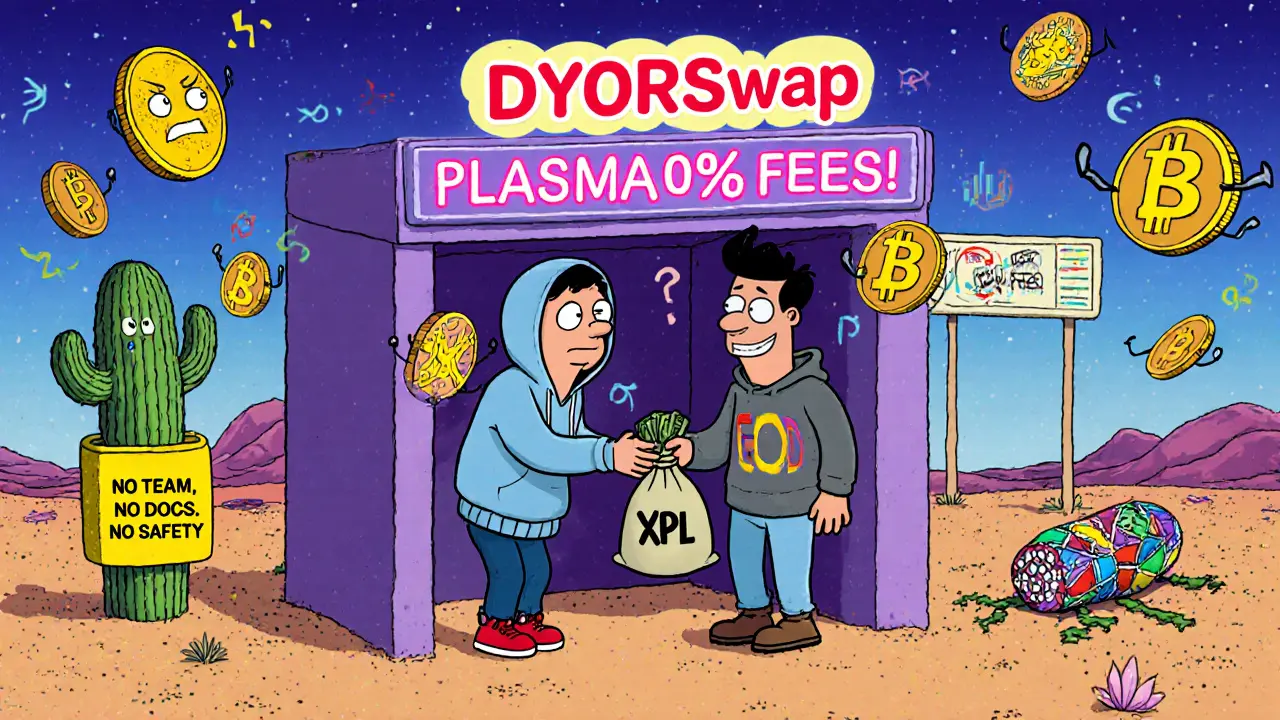
DYORSwap (Plasma) offers 0% trading fees but lacks liquidity, security, and transparency. This review exposes its risks as a niche DEX for obscure meme coins with minimal adoption and high scam potential.
View More