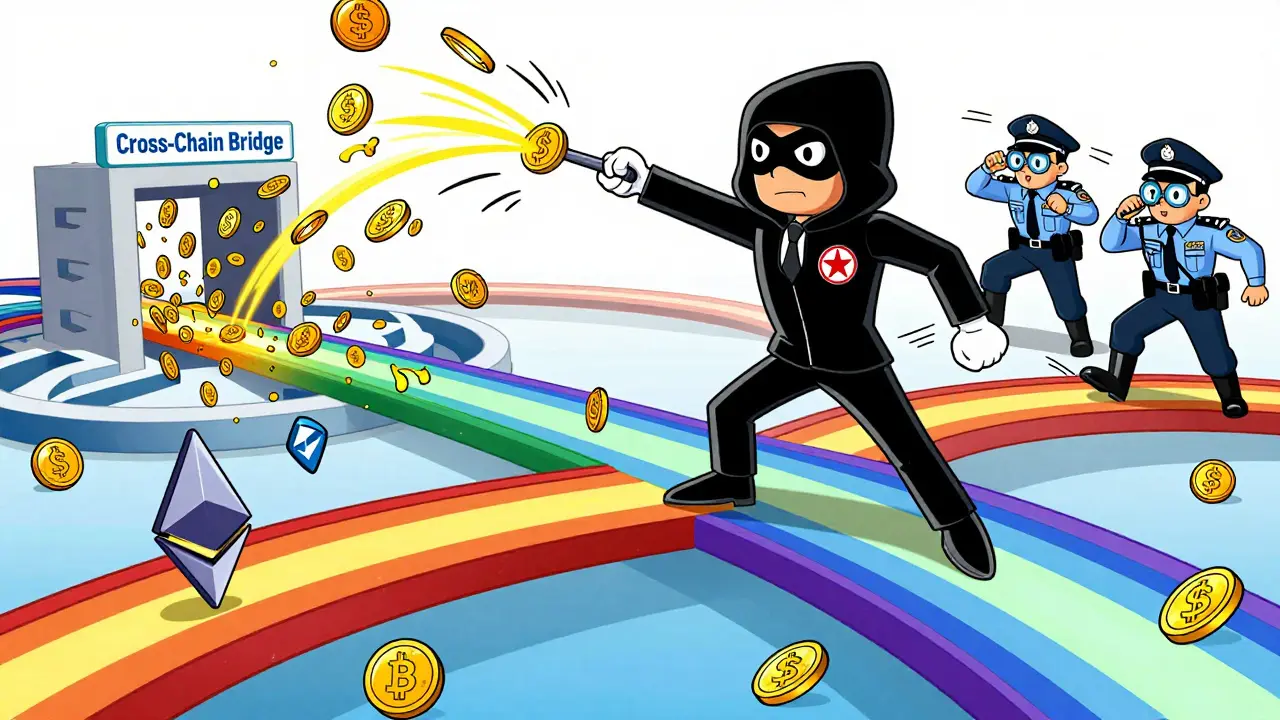
Cross-Chain Crypto Laundering: How It Works and Why It’s a Red Flag
When you hear cross-chain crypto laundering, the process of moving stolen or illicit cryptocurrency across different blockchains to hide its origin. Also known as crypto obfuscation, it’s not a feature of blockchain—it’s an abuse of its design. Blockchains were built to be transparent, yet criminals use bridges, mixers, and decentralized exchanges to shuffle coins from Ethereum to Solana, then to Polygon, then to a privacy chain—all to break the trail. This isn’t theoretical. In 2023, the FBI traced over $300 million in stolen crypto that had been laundered across at least seven chains before disappearing.
How does it actually work? A thief steals ETH from a DeFi protocol, swaps it for USDT on a DEX, sends that USDT through a cross-chain bridge to Binance Smart Chain, then swaps it again into a privacy coin like Zcash. From there, it’s moved to a wallet with no KYC, then cashed out via peer-to-peer platforms. Each step adds layers of confusion. And because most blockchains don’t talk to each other by default, tracking becomes a nightmare. This is why tools like blockchain analytics, software used by regulators and exchanges to trace suspicious crypto flows are growing fast. Companies like Chainalysis and Elliptic now track over 90% of known laundering routes—but they’re always playing catch-up.
What makes this worse is that many DeFi platforms don’t require KYC. You can swap tokens, move them across chains, and never prove who you are. That’s why platforms like MakiSwap, a now-dead DEX on HECO with zero volume and flagged as a scam, or LocalTrade, an unregulated exchange linked to scam recovery schemes, become hotspots for dirty money. They’re not just risky—they’re designed to avoid scrutiny. Even airdrops like the one for BUNI, Bunicorn’s community token or HERO, Metahero’s token with recent exchange drops can be exploited. Scammers create fake airdrop claims to lure victims into sending crypto to wallets that then funnel funds into laundering pipelines.
Regulators are starting to respond. Argentina banned bank-crypto transfers in 2025 to stop capital flight. Nigeria only allows licensed VASPs to handle crypto. Vietnam slapped a 0.1% tax on every trade to force reporting. These aren’t just about taxes—they’re about visibility. If every move leaves a paper trail, laundering becomes harder. But until every chain enforces basic checks, the gaps will stay open.
What you’ll find below isn’t a guide to laundering—it’s a warning list. These posts expose the platforms, tokens, and schemes that are either used for laundering, built on it, or collapsed because of it. From dead DEXes to meme coins with zero supply, each one shows how anonymity gets weaponized. You won’t learn how to hide money here. You’ll learn how to spot it—and avoid it.
North Korean hackers are stealing billions in crypto by hopping across blockchains to hide their tracks. This is how they do it-and why it’s a global security threat.
View More