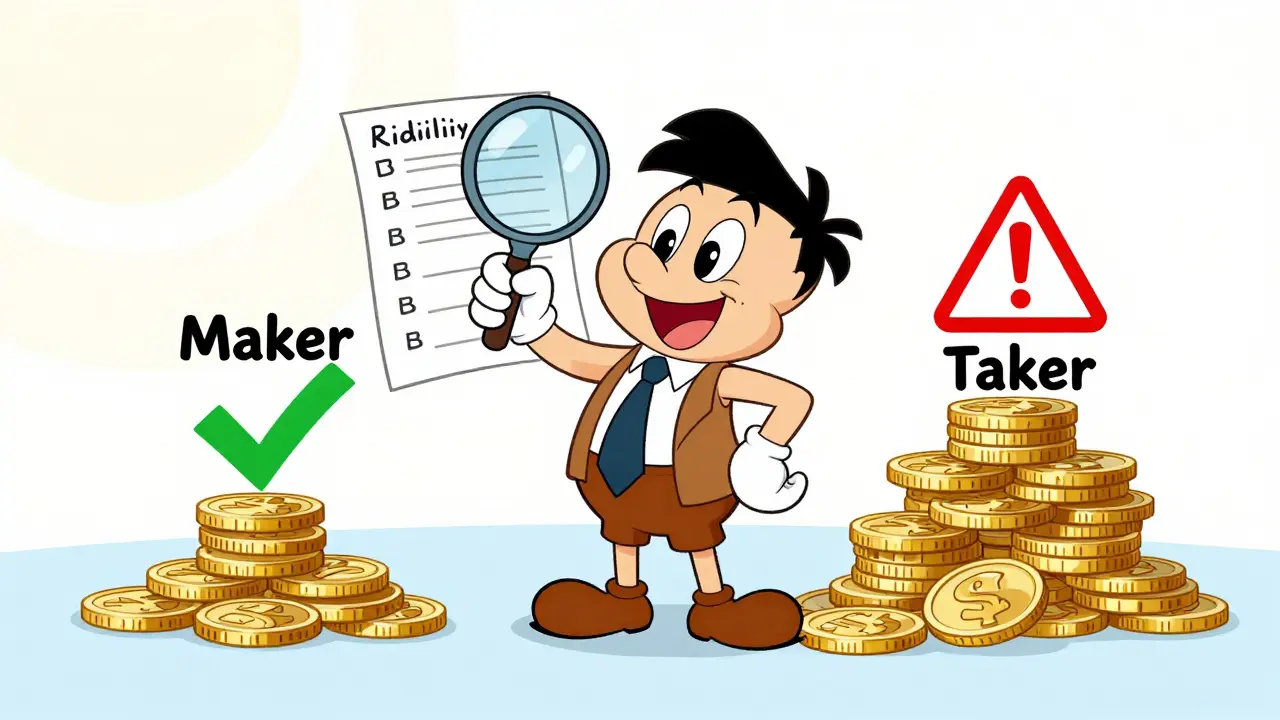
You are leaving money on the table if you do not understand spot trading fees. It is not just about finding the cheapest rate; it is about understanding how exchanges charge for liquidity. Every time you buy or sell Bitcoin, Ethereum, or any other digital asset, a percentage of your trade goes to the platform. For casual investors, this might seem negligible. For active traders, these small percentages compound into massive losses over time.
The landscape has shifted dramatically in late 2025 and early 2026. Competition among centralized exchanges has driven average fees down by nearly 18% year-over-year. However, the "lowest fee" headline often hides complex structures involving native tokens, volume tiers, and hidden withdrawal costs. This guide breaks down exactly what you pay, who pays the least, and how to structure your trades to keep more profit in your pocket.
Understanding the Maker-Taker Model
Before comparing specific platforms, you need to grasp the fundamental pricing model used by almost every major cryptocurrency exchange: the Maker-Taker Model. This system rewards users who add liquidity to the market and charges those who remove it.
- Makers: These are traders who place limit orders that do not execute immediately. You set a price you are willing to buy or sell at, and your order sits on the order book until someone else matches it. Because you provide depth to the market, exchanges charge you lower fees-or sometimes no fee at all.
- Takers: These are traders who execute market orders or limit orders that match an existing order immediately. You are taking liquidity away from the book. Exchanges charge higher fees for this convenience because it requires immediate matching infrastructure.
As of mid-2026, high-frequency trading algorithms account for roughly 68% of spot volume. This means the majority of professional activity relies on maker strategies to minimize costs. If you are buying Bitcoin instantly via a market order, you are a taker. If you set a limit order to buy when the price drops to a specific level, you are a maker. Understanding this distinction is the single most important step in reducing your trading costs.
Major Exchange Fee Structures Compared
Fee structures vary significantly between platforms. Some prioritize aggressive low rates to capture market share, while others charge premiums for regulatory compliance and security features. Here is how the major players stack up based on current data from late 2025 and early 2026.
| Exchange | Standard Maker Fee | Standard Taker Fee | Native Token Discount | Key Characteristic |
|---|---|---|---|---|
| MEXC Global | 0.00% | 0.05% | MX Token Holders | Lowest standard maker fee in the industry |
| Binance | 0.08% | 0.10% | BNB (up to 25%) | Highest market share, deep liquidity |
| Kraken | 0.25% | 0.40% | None (Volume-based only) | Strong US regulatory compliance, high security |
| KuCoin | 0.10% | 0.10% | KCS (up to 20%) | Wide variety of altcoins |
| Bybit | 0.10% | 0.10% | None | User-friendly interface, strong derivatives focus |
| OKX | 0.14% | 0.23% | OKB | Advanced trading tools |
MEXC Global currently offers the most aggressive pricing for spot traders, with a 0.00% maker fee. This represents a significant advantage for limit-order traders compared to Kraken, which charges 0.25% for makers. For a trader executing $1 million in monthly volume, the difference between MEXC and Kraken can amount to $2,500 saved per month on maker trades alone.
Binance remains the dominant player with approximately 37% market share. Its standard fees of 0.08% for makers and 0.10% for takers are competitive, but the real savings come from holding BNB tokens. Users who hold BNB and use it to pay for fees can reduce their costs by up to 25%. In November 2025, Binance further reduced maker fees to 0.075% for VIP 0 users, tightening the gap with ultra-low-fee competitors.
Kraken, established in 2011, operates differently. It does not offer native token discounts for fees. Instead, it relies on a reputation for security and U.S. regulatory adherence. Its higher base fees (0.25% maker / 0.40% taker) reflect the cost of maintaining SOC 2 Type 2 compliance and navigating strict financial regulations. For many U.S.-based traders, this premium is worth paying for peace of mind and legal protection.
Hidden Costs: Withdrawals and Fiat Deposits
Trading fees are only part of the equation. Many traders focus so heavily on the 0.05% vs 0.10% debate that they overlook transactional costs that can dwarf trading fees.
Fiat-to-Crypto Conversion Fees: When you deposit USD, EUR, or GBP to buy crypto, exchanges typically charge between 0.5% and 3.5%. This is significantly higher than crypto-to-crypto trading fees. If you are converting fiat directly within the app, you are likely paying a spread plus a processing fee. To minimize this, consider using bank transfers (SEPA, ACH, SWIFT) where possible, as these often have lower or zero fees depending on the exchange.
Withdrawal Fees: Every exchange charges network fees when you move crypto off-platform. These are not profits for the exchange; they are passed-through costs to blockchain miners or validators. However, some platforms inflate these fees. For example, Bitcoin withdrawal fees generally range from 0.0005 to 0.001 BTC per transaction. On Trustpilot, 29% of negative reviews for MEXC cited "hidden withdrawal fees" as a concern. Always check the withdrawal schedule before moving large amounts. Frequent small withdrawals will eat into your profits faster than high trading fees.
Strategies to Minimize Your Fees
You do not need to be a high-volume institutional trader to save money. Here are practical steps to reduce your cost basis immediately.
- Use Limit Orders Exclusively: Unless you are entering a position during extreme volatility, always use limit orders. By becoming a maker, you avoid the higher taker fee. On MEXC, this means paying nothing. On Binance, it cuts your fee in half compared to market orders.
- Leverage Native Tokens: If you plan to trade long-term on Binance or KuCoin, allocate a portion of your portfolio to BNB or KCS. The discount applies automatically. For instance, holding BNB reduces Binance's 0.10% taker fee to 0.075%, saving you 25% on every trade.
- Consolidate Trades: Instead of making ten $1,000 trades, make one $10,000 trade. While the percentage fee remains the same, you save on potential withdrawal fees if you are moving funds in and out. Additionally, larger single trades may help you reach higher volume tiers faster, unlocking VIP rates.
- Check Referral Links: Most exchanges offer a 10% lifetime discount on trading fees for new users who sign up via a referral link. This is free money that requires zero effort. Never create an account without applying a valid referral code.
David Shim, CEO of Lukka, noted in October 2025 that a 0.05% fee difference compounded over 100 trades equals a 5% reduction in potential profits. This makes fee optimization non-negotiable for anyone serious about trading.
Security vs. Cost: The Trade-Off
Chasing the absolute lowest fee carries risks. As cryptocurrency analyst Wendy O warned in her CryptoSlate column, platforms offering 0.00% maker fees often rely on other revenue streams, such as wider spreads or listing fees for low-quality projects. There is also the risk of insolvency. The BitKRX hack, where 3,200 BTC was stolen from a platform offering zero maker fees, serves as a stark reminder.
Kraken and Coinbase charge 15-25% higher fees than global giants like Binance or MEXC. This premium covers the cost of rigorous audits, insurance funds, and legal teams ensuring compliance with U.S. securities laws. For conservative investors, this extra cost is an insurance policy against exchange failure or regulatory seizure.
If you are storing large amounts of capital on an exchange, prioritize security certifications like SOC 2 Type 2 and proof-of-reserves audits. If you are actively day trading smaller amounts, minimizing fees through platforms like MEXC or Binance may take precedence.

Decentralized Alternatives: DEXs vs. CEXs
Decentralized exchanges (DEXs) like Uniswap and PancakeSwap offer an alternative to centralized platforms. They typically charge a flat protocol fee of 0.25% to 0.30%.
However, you must factor in gas fees. On the Ethereum network, gas fees can range from $1.50 to $5.00 or more during peak times. If you are trading $100, a $5 gas fee is a 5% cost-far higher than any centralized exchange fee. DEXs become cost-effective primarily for larger trades or when using Layer 2 solutions like Arbitrum or Optimism, where gas fees are fractions of a cent. Despite the growth of DeFi, centralized exchanges still handle 92% of spot trading volume due to superior liquidity and ease of use.
Future Trends in 2026
The trend toward lower fees is expected to continue. Delphi Digital predicts that average maker fees across major exchanges will decline to 0.05% by Q2 2026. MEXC has already announced plans to introduce a fee-free tier for users staking 1,000+ MX tokens starting December 2025.
However, regulatory pressures may counteract this in certain regions. The SEC's proposed Digital Asset Market Structure rule could increase operational costs for U.S. exchanges by 15-20%. This may lead to fee increases of 3-5% for compliant platforms in 2026. Traders should monitor regulatory news closely, as changes in law can quickly alter the cost-benefit analysis of choosing one exchange over another.
What is the difference between maker and taker fees?
Maker fees are charged to traders who add liquidity to the market by placing limit orders that do not execute immediately. Taker fees are charged to traders who remove liquidity by executing market orders or immediate limit orders. Maker fees are always lower than taker fees, often significantly so.
Which exchange has the lowest spot trading fees in 2026?
MEXC Global currently offers the lowest standard maker fee at 0.00% and a taker fee of 0.05%. Binance follows closely with 0.08% maker and 0.10% taker fees, with additional discounts available for BNB holders.
Why are Kraken's fees higher than Binance or MEXC?
Kraken charges higher fees to cover the costs of strict U.S. regulatory compliance, SOC 2 Type 2 security certifications, and robust customer support. It prioritizes security and legal adherence over aggressive price competition.
How can I reduce my trading fees on Binance?
You can reduce fees on Binance by holding BNB tokens and enabling the option to pay fees with BNB, which grants up to a 25% discount. Additionally, increasing your 30-day trading volume can unlock VIP tiers with lower rates, and using a referral link provides a 10% discount.
Are decentralized exchanges (DEXs) cheaper than centralized ones?
Not necessarily. While DEX protocol fees are around 0.30%, you must add blockchain gas fees. On Ethereum, high gas costs can make small trades very expensive. DEXs are generally more cost-effective for large trades or when using Layer 2 networks with low gas fees.