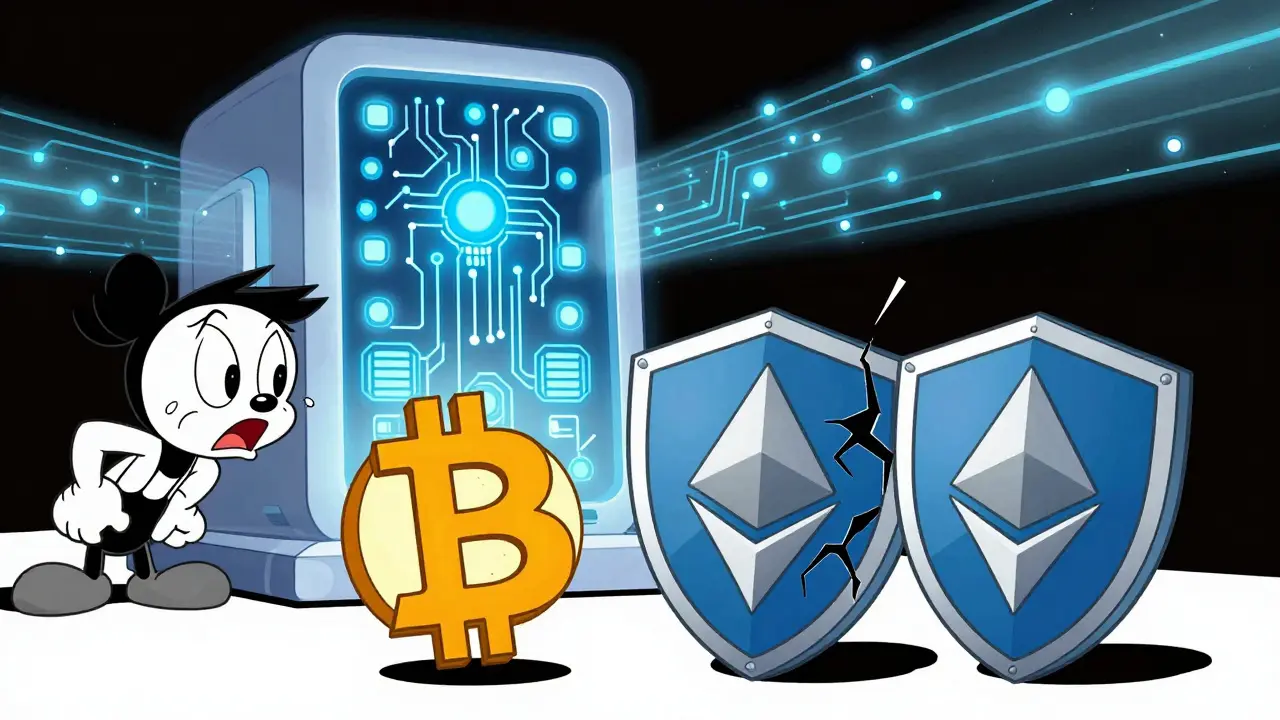
Imagine waking up one day to find your Bitcoin wallet drained. Not because you clicked a phishing link or forgot your password, but because a machine in a lab somewhere solved the math problem that protects your private key. This isn't science fiction; it's the looming reality of quantum computing and its potential to break current cryptographic standards. For years, experts dismissed this as a distant concern, something for our grandchildren to worry about. But with major tech companies racing to build stable quantum processors, the timeline has shifted dramatically. The threat is no longer "if" but "when," and the industry calls this the "harvest now, decrypt later" scenario. Adversaries are already recording encrypted blockchain data today, waiting for the day when quantum computers can unlock it retroactively.
Why Current Crypto Security Is Vulnerable
Most cryptocurrencies, including Bitcoin and Ethereum, rely on Elliptic Curve Digital Signature Algorithm (ECDSA). ECDSA works by making it incredibly difficult for classical computers to derive a private key from a public key. It’s like mixing two colors of paint; easy to mix, nearly impossible to unmix. However, quantum computers operate on different physical principles. Using Shor’s algorithm, a sufficiently powerful quantum computer could reverse this process efficiently. If this happens, anyone with access to such a machine could forge signatures, effectively stealing funds from any address that has ever broadcast a transaction on-chain.
The danger isn't uniform across all holdings. Approximately 4 million BTC, worth over $100 billion, sits in older, vulnerable address formats like P2PKH. These addresses expose their public keys once a transaction is made, leaving them open to attack. Newer formats like SegWit hide the public key until spending, offering slight protection, but they aren't immune forever. Once a quantum computer breaks ECDSA, even hidden keys become fair game if the attacker waits long enough or uses advanced techniques. This creates an urgent need for post-quantum cryptography (PQC), which uses mathematical problems that remain hard for both classical and quantum computers.
The Leading Post-Quantum Solutions
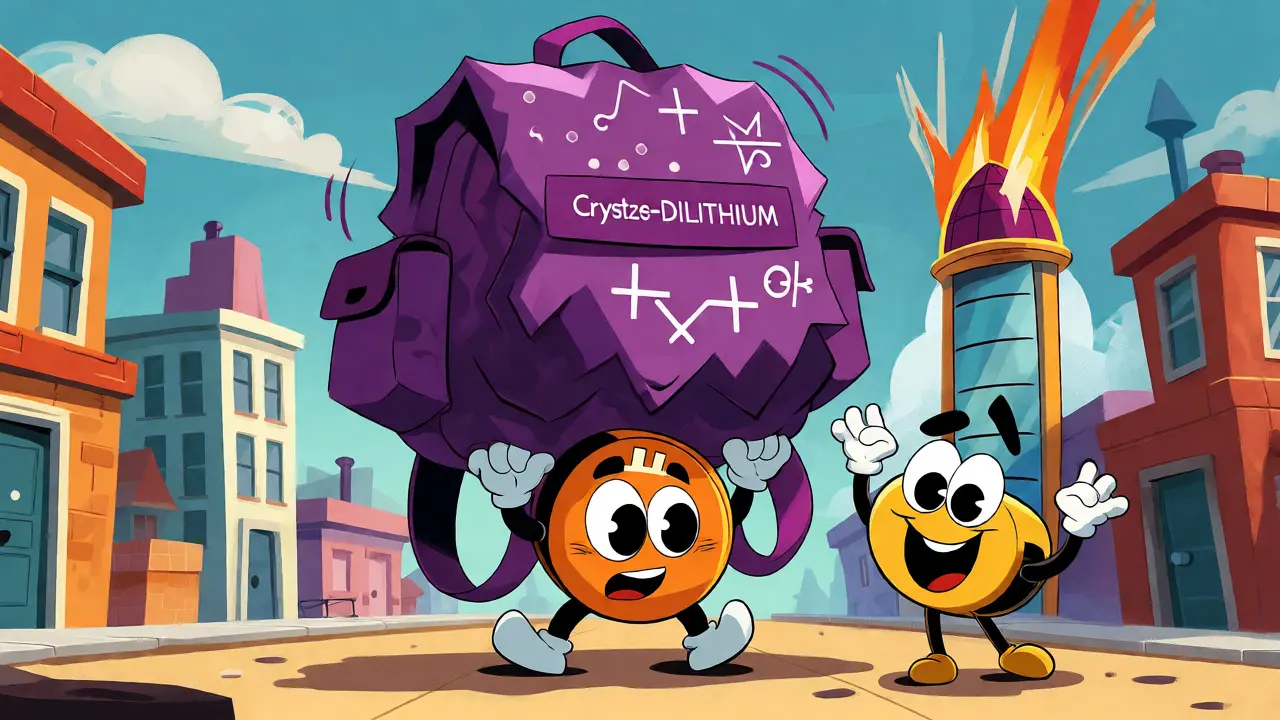
So, what replaces ECDSA? There isn't one single winner yet, but three main approaches have emerged, each with distinct trade-offs. The most prominent category involves lattice-based cryptography. Algorithms like Crystals-DILITHIUM were recently standardized by NIST (National Institute of Standards and Technology). They offer strong security against quantum attacks but come with a significant cost: size. While an ECDSA signature is tiny-about 72 bytes-a Crystals-DILITHIUM signature is roughly 2,420 bytes. That’s a 33x increase.
| Algorithm Type | Example | Signature Size | Quantum Resistance | Blockchain Impact |
|---|---|---|---|---|
| Classical (Current) | ECDSA | ~72 bytes | None | High throughput, low fees |
| Lattice-Based | Crystals-DILITHIUM | ~2,420 bytes | High | Lower throughput, higher fees |
| Hash-Based | SPHINCS+ | ~8,000 bytes | Proven | Very low throughput |
| Multivariate | Rainbow | Small | Low (Broken variants) | Unstable security model |
Another approach uses hash-based signatures, such as SPHINCS+. Projects like Quantum Resistant Ledger (QRL) use these because they rely on basic hashing functions, which we know are resistant to quantum attacks. The downside? They are massive. An SPHINCS+ signature can be 8,000 bytes. On a network like Bitcoin, where block space is precious, this would crush transaction capacity. You’d go from fitting 3,000 transactions per block to perhaps only 50. Finally, multivariate schemes exist, but some, like Rainbow, have faced cryptanalytic setbacks, proving that not all new math holds up under scrutiny.
The Scalability Trade-Off
Here is the uncomfortable truth: security comes at a price. If Bitcoin implemented Crystals-DILITHIUM tomorrow without changing anything else, transaction fees would skyrocket. Currently, Ethereum averages about $1.50 per transaction. With PQC signatures 33 times larger, that fee could jump to $50 or more, assuming demand stays constant. This makes small payments impractical. We’re talking about buying a coffee costing more than the coffee itself. To mitigate this, developers are looking at Layer-2 solutions. Networks like Lightning Network or various rollups could absorb the bulk of transactions off-chain, using PQC only for final settlement on the main chain. This hybrid approach allows the base layer to remain efficient while securing the ultimate source of truth. Another strategy is increasing block sizes, but this centralizes mining power, as only large nodes can handle the data load. It’s a classic dilemma: do we prioritize decentralization or security?
Who Is Actually Doing Something?
You might wonder, "Is anyone actually moving?" Yes, but slowly. Ethereum researchers proposed EIP-3037, exploring quantum-resistant signatures, though it remains in the research phase. JPMorgan Chase filed patents for quantum-resistant distributed ledgers, signaling that traditional finance sees the risk too. Meanwhile, niche projects like QRL have been running on hash-based crypto since 2018. Their market cap is small compared to Bitcoin, but they serve as a living testbed. They prove that PQC works, albeit with slower speeds and higher fees. Major exchanges are also waking up. Some are beginning to segregate cold storage, keeping coins in offline addresses that never broadcast a public key. This buys time. If a quantum computer arrives in five years, those coins remain safe as long as they haven't been spent. But eventually, to spend them, you must reveal the key. This forces a migration event where users move funds to new, quantum-safe addresses. Coordinating this migration across millions of wallets is a logistical nightmare, akin to upgrading the internet protocol overnight.

Practical Steps for Users Today
You don’t need to panic, but you should prepare. First, audit your holdings. If you hold Bitcoin in legacy addresses (starting with '1'), consider moving them to native SegWit addresses (starting with 'bc1'). This doesn't make you quantum-proof, but it hides your public key until you spend, reducing immediate exposure. Second, avoid reusing addresses. Each time you reuse an address, you expose your public key again, giving attackers more data points. Third, keep an eye on software updates. Wallets and exchanges will eventually introduce PQC support. When they do, migrate promptly. For developers, the learning curve is steep. Understanding lattice-based mathematics requires more than just coding skills; it demands a grasp of abstract algebra. Tools like Open Quantum Safe provide libraries to help integrate these algorithms into existing stacks. Start experimenting with hybrid systems that use both ECDSA and PQC. This ensures compatibility during the transition period. Remember, there is no switch to flip. The migration will take years, possibly decades. Starting now gives you the best chance of staying secure.
Frequently Asked Questions
When will quantum computers break Bitcoin?
Estimates vary widely. Dr. Michele Mosca suggests a 50% chance by 2031, while others argue it could take decades. The uncertainty stems from the difficulty of building stable, error-corrected qubits. Regardless of the exact date, the "harvest now, decrypt later" threat means data collected today is at risk if broken within the next 10-15 years.
Do I need to move my Bitcoin to a quantum-resistant coin?
Not necessarily. Major networks like Bitcoin and Ethereum are actively researching upgrades. Moving to a smaller, less liquid project like QRL carries its own risks, such as lower adoption and liquidity. For most users, sticking with established chains and following best practices (like using SegWit) is safer than speculative migration.
What is the biggest hurdle to adopting post-quantum cryptography?
Size and speed. PQC signatures are significantly larger than current ones, which bloats blockchains and slows down transaction processing. Implementing these changes often requires a hard fork, which needs community consensus and can split the network, creating political and technical challenges.
Are hardware wallets safe from quantum attacks?
Hardware wallets protect your private key from being stolen by malware, but they do not protect against quantum attacks on the underlying math. If the algorithm (ECDSA) is broken, the hardware wallet still generates keys based on that flawed math. Security depends on the algorithm, not the device form factor.
Will my exchange automatically update to quantum-safe crypto?
Exchanges will likely implement backend changes to support new address types. However, you may need to manually withdraw and redeposit funds to generate new, quantum-resistant addresses. Always check your exchange's announcements regarding protocol upgrades and address format changes.