
For years, Portugal was the undisputed king of European crypto havens. Traders flocked to Lisbon and Porto for one simple reason: long-term crypto gains were tax-free. But if you are planning to move your trading operations to Portugal in 2026, the landscape has shifted. The golden era of total ambiguity is over, replaced by a complex mix of strict EU regulations and specific local tax codes.
You need to know exactly where you stand before you buy a property or register a company. The old rules still apply to your taxes, but the regulatory environment is now governed by the Markets in Crypto-Assets (MiCA) regulation, which demands rigorous compliance from anyone offering services. This guide breaks down what this means for individual traders, digital nomads, and business owners looking to set up shop in Portugal today.
The Current Tax Reality for Crypto Traders
Taxation remains the primary draw for most traders considering Portugal. The system is straightforward once you understand the holding period distinction. Under the current rules enforced by the Autoridade Tributária e Aduaneira (AT), your tax liability depends entirely on how long you hold your assets.
- Short-term holdings: If you sell a cryptocurrency held for less than 365 days, the profit is taxed at a flat rate of 28%. This applies to capital gains.
- Long-term holdings: If you hold the asset for more than one year, the capital gain is completely tax-exempt.
This structure rewards patience. It pushes traders toward a "buy and hold" strategy rather than high-frequency day trading. However, there is a catch. The tax authorities scrutinize frequent transactions. If you trade daily, even if you technically hold some positions for over a year, the AT may classify your activity as professional income rather than capital gains. Professional income is taxed progressively, potentially reaching rates much higher than 28%.
For those who qualify as non-residents or new residents under the evolving Non-Habitual Residence (NHR) regime, the benefits can be even more pronounced. While the classic NHR scheme has undergone significant changes in recent years, specific versions for qualified professionals and certain income types still offer reduced flat rates or exemptions on foreign-sourced income. You must consult with a specialized tax advisor to see if your specific profile fits the updated criteria, as the rules tightened considerably after 2024.
Navigating the MiCA Regulatory Framework
The biggest change in 2026 is not about your personal wallet; it is about the platforms you use and any business you might run. Portugal is fully implementing the EU's MiCA regulation. This regulation standardizes crypto rules across Europe, replacing the patchwork of national laws that previously existed.
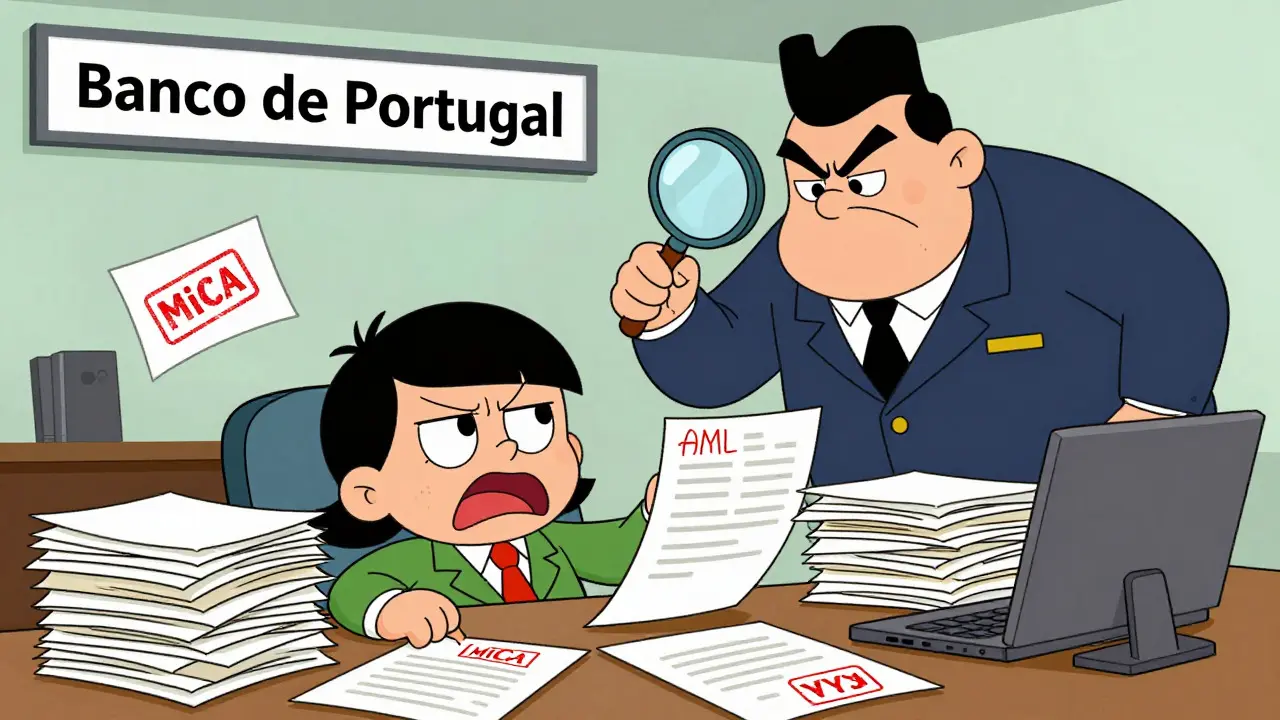
For an individual trader, MiCA means greater consumer protection. The exchanges and custodians you use must be licensed and compliant. For businesses, it means a heavy administrative burden. The Banco de Portugal acts as the competent authority for supervising virtual asset service providers (VASPs). They ensure that entities comply with Anti-Money Laundering (AML) and Countering the Financing of Terrorism (CFT) rules.
Here is what you need to know about the regulatory gap that recently closed:
- Transitional Period: Between January 2025 and mid-2026, there was a period where new licenses were paused while domestic legislation caught up with MiCA. Existing registered companies could operate, but new entrants faced barriers.
- Current Status: As of late 2025 and into 2026, the legislative framework is being finalized. The goal is full alignment with MiCA by the July 1, 2026 deadline.
- Supervision: The Comissão do Mercado de Valores Mobiliários (CMVM) works alongside the central bank to determine if specific tokens qualify as financial instruments, adding another layer of scrutiny.
If you are launching a crypto business in Portugal, expect to spend 40-60 hours just understanding the compliance requirements. You will need to appoint AML officers, conduct due diligence for transactions over €1,000, and maintain strict KYC (Know Your Customer) records. There is no minimum share capital required for a license, which lowers the entry barrier, but the operational costs for compliance are high.
Is Portugal Still Worth It? A Comparative Look
To decide if Portugal is the right move for you, you have to compare it against other popular crypto hubs. Each jurisdiction offers different trade-offs between tax benefits, lifestyle, and regulatory stability.
| Feature | Portugal | Switzerland | Germany |
|---|---|---|---|
| Long-Term Capital Gains Tax | 0% (after 1 year) | Varies by canton (often low) | 0% (after 1 year) |
| Short-Term Capital Gains Tax | 28% | Included in progressive income tax | Included in progressive income tax (up to ~45%) |
| Regulatory Clarity | High (MiCA aligned) | Very High (Established) | High (Strict) |
| Cost of Living | Moderate | Very High | High |
| Business Setup Complexity | Moderate (AML heavy) | Low (Efficient) | Moderate |
Portugal’s main advantage is the combination of zero tax on long-term gains and a significantly lower cost of living compared to Switzerland or major German cities. Germany also offers tax-free long-term gains, but the short-term tax hit can be brutal for active traders, pushing effective rates well above 40%. Portugal’s flat 28% is predictable and manageable.
However, Switzerland remains the gold standard for regulatory certainty and banking infrastructure. If you are running a large-scale institutional fund, Zurich might still be preferable despite the costs. For individual traders and small startups seeking lifestyle and tax efficiency, Portugal holds its ground firmly.
Practical Steps for Relocating Traders
Deciding to move is only the first step. The execution requires careful planning to avoid common pitfalls. Here is a realistic roadmap for a trader moving to Portugal in 2026.
1. Secure Your Residency Status
Before you touch your crypto portfolio, sort out your legal status. The D7 visa (for passive income retirees) and the Digital Nomad visa are the most common routes. Ensure your proof of income meets the current thresholds. Remember, crypto income counts, but you must provide clear documentation of your holdings and transaction history. Banks and immigration officials prefer paper trails over blockchain explorers.
2. Choose the Right Banking Partner
This is often the hardest part. Traditional Portuguese banks can be hesitant to open accounts for crypto traders due to AML concerns. You may need to approach neobanks or international banks with a strong crypto policy. Be prepared to explain your source of funds in detail. Having a local accountant who specializes in crypto can smooth this process significantly.
3. Set Up Your Tax Compliance System
Do not rely on memory. Use software that integrates with your exchanges to track cost basis and holding periods. You need to prove exactly when you bought each asset to claim the 0% tax on long-term gains. The AT will ask for evidence. Keep records of all wallets, exchange accounts, and staking rewards. Staking income is generally treated as miscellaneous income and taxed at 28%, so keep it separate from your capital gains calculations.
4. Monitor MiCA Updates
As MiCA implementation reaches its final stages in 2026, stay informed about any changes to VASP licensing. If you plan to launch a service, engage with a law firm experienced in MiCA compliance early. The transition period created confusion, but the post-2026 landscape should be clearer. Ignorance of the new reporting requirements is not a valid defense.

Common Pitfalls to Avoid
Even with good intentions, many traders stumble. Here are the most frequent mistakes:
- Mixing Personal and Business Income: If you trade frequently, the tax office may deem you a professional trader. This changes your tax bracket and reporting obligations. Keep personal investing separate from any business entity you create.
- Ignoring Staking and DeFi Rewards: These are taxable events. Every time you receive staking rewards or yield farming profits, it is considered income. Failure to report these can lead to audits.
- Underestimating Bureaucracy: Portugal is known for its slow administrative processes. Getting a NIF (tax number), opening a bank account, and registering a company can take months. Start the process early.
- Assuming All Tokens Are Equal: Under MiCA, different tokens have different rules. Utility tokens, Asset-Referenced Tokens (ARTs), and Electronic Money Tokens (EMTs) face varying levels of regulation. Understand what you are holding and issuing.
The Future Outlook for Crypto in Portugal
Despite the regulatory tightening, the sentiment in Portugal remains positive. The blockchain sector continues to attract significant venture capital, accounting for 36% of all VC funding in the country during the 2024-2025 period. This indicates that investors believe in the long-term potential of the ecosystem.
The government’s stance is clear: they want to regulate, not ban. Secretary of State João Silva Lopes emphasized that the new rules aim to strengthen supervision and protect consumers. For legitimate traders, this brings stability. The era of wild west crypto is ending globally, and Portugal is positioning itself as a safe, compliant, and tax-efficient harbor within the EU.
If you are willing to navigate the initial bureaucratic hurdles and adhere to strict compliance standards, Portugal offers one of the best combinations of quality of life and financial efficiency for crypto traders in Europe. Just remember: the tax break is real, but the paperwork is mandatory.
Is crypto trading still tax-free in Portugal?
Only for long-term holdings. If you hold a cryptocurrency for more than 365 days, the capital gain is tax-exempt. Short-term gains (less than one year) are taxed at a flat rate of 28%. Frequent trading may be classified as professional income, subject to higher progressive tax rates.
What is MiCA and how does it affect me?
MiCA (Markets in Crypto-Assets) is an EU regulation fully implemented in Portugal by 2026. For individual traders, it ensures that the exchanges you use are regulated and secure. For businesses, it imposes strict licensing, AML, and reporting requirements overseen by the Banco de Portugal.
Can I use the NHR program for crypto income?
The Non-Habitual Residence (NHR) program has been revised. While it still offers benefits for certain qualified professions and foreign-sourced income, the specific advantages for crypto traders depend on your exact residency status and income type. Consult a tax specialist to determine if you qualify for the reduced 20% flat rate or other exemptions.
How do I prove my holding period for tax exemption?
You need detailed records of your purchase dates. Use crypto tax software that integrates with your exchanges to generate reports showing the acquisition date and sale date for each asset. The Autoridade Tributária (AT) may request this documentation during an audit to verify that the asset was held for over 365 days.
Are staking rewards taxable in Portugal?
Yes. Staking rewards, yield farming income, and airdrops are generally treated as miscellaneous income and taxed at a flat rate of 28%. They are not considered capital gains, so the one-year holding period rule does not apply to them.
Is it difficult to open a bank account in Portugal as a crypto trader?
It can be challenging. Traditional banks are cautious due to AML regulations. You may need to provide extensive documentation proving the source of your crypto funds. Neobanks or international banks with crypto-friendly policies are often easier options for new residents.