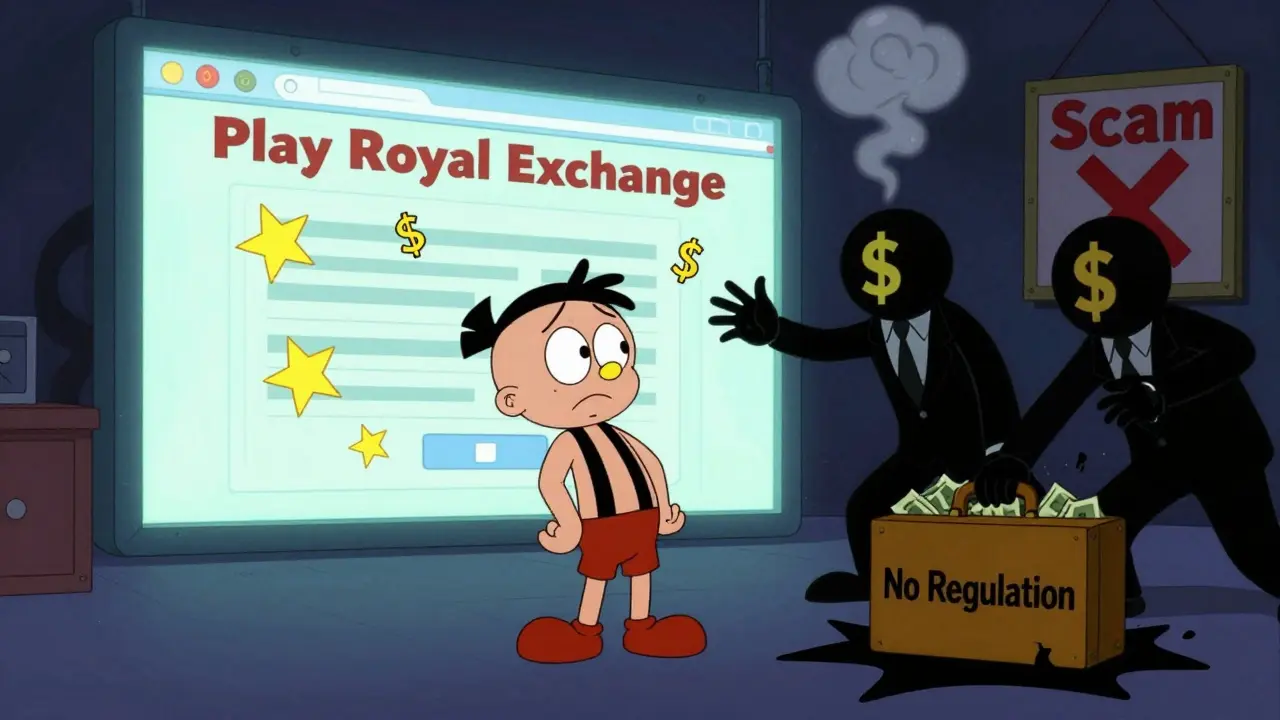
There’s no such thing as a legitimate crypto exchange called Play Royal Exchange. If you’ve come across this name while searching for a place to trade Bitcoin, Ethereum, or other cryptocurrencies, you’re being led into a dangerous trap. Multiple websites, ads, and social media posts use variations of "Royal Exchange" to trick people into depositing money - but none of them are real, licensed, or safe. This isn’t a case of poor service or bad UX. This is a known scam operation hiding behind a confusing name.
What Exactly Is Play Royal Exchange?
Play Royal Exchange doesn’t exist as a standalone company. It’s a fake brand name being used to mimic legitimate platforms like Royal Exchange (a forex broker) or Crypto Royal (a crypto casino). These names sound similar enough to fool someone who’s new to crypto. But here’s the truth: none of these entities are registered as cryptocurrency exchanges in any major jurisdiction. No U.S. SEC, no UK FCA, no Australian ASIC approval. Nothing.According to Forex Wikibit’s November 2025 analysis, the real "Royal Exchange" operates as TRD Group Ltd. - a company with no valid license, no transparent ownership, and a regulatory score of 0 out of 10. The Dutch financial authority AFM has publicly warned users against it for "potentially fraudulent activities." Traders Union, a watchdog group that tracks scam brokers, listed Royal Trading Center (a near-identical name) as a confirmed scam in July 2025. Their report says these platforms "entice investors with promises of substantial returns," then vanish with deposits.
How Do These Scams Work?
The pattern is always the same:
- You find a flashy website with fake testimonials and "limited-time bonuses."
- You sign up with just an email - no ID, no proof of address. That’s a red flag. Real exchanges require strict KYC.
- You’re encouraged to deposit as little as $50 to "test" the platform.
- At first, small withdrawals work. You even see fake profits on your dashboard.
- Then you deposit more - $500, $2,000, $10,000.
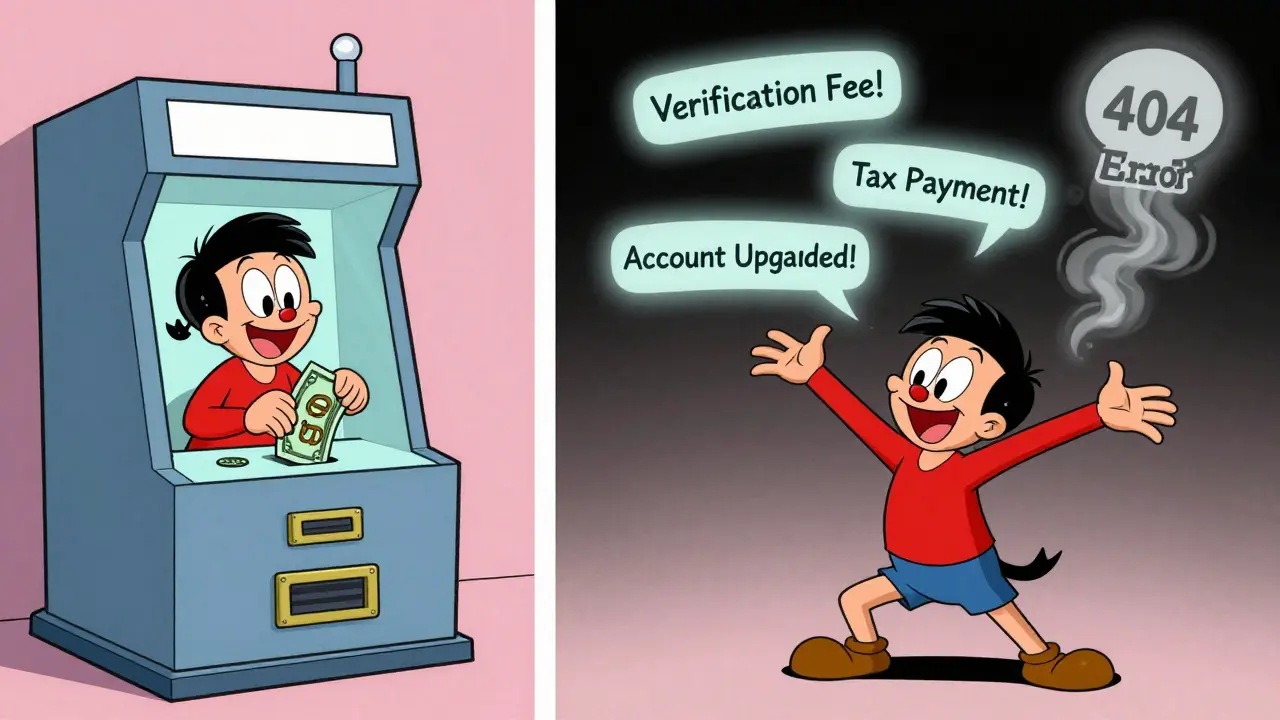
- When you try to withdraw, they demand "verification fees," "tax payments," or "account upgrades."
- Eventually, the site disappears. The customer service emails bounce. Your money is gone.
This isn’t speculation. Traders Union has collected dozens of victim reports where users lost entire life savings after falling for this exact sequence. Reddit threads from June 2025 show users in the U.S., Canada, and Europe sharing how they were tricked by "Play Royal Exchange"-style sites. One user from Texas reported losing $8,300 after being told his account was "flagged for suspicious activity" - a classic scam tactic.
Why You Can’t Trust Their Platform
Even if you ignore the scam angle and just look at the platform itself, it’s built to fail.
Legitimate crypto exchanges - like Binance, OKX, or Coinbase - use industry-standard tools: MetaTrader 4/5, API access, real-time order books, cold storage for funds, and clear fee schedules. Play Royal Exchange? It runs on a custom, closed system with no public documentation. No API. No charting tools. No way to verify trades. You’re essentially trading on a black box.
They claim to offer "cryptocurrency trading," but they don’t actually let you own or withdraw coins. Instead, you’re trading CFDs (Contracts for Difference) - a high-risk financial product tied to crypto prices. This means you never hold Bitcoin. You’re betting on its price movement. And with leverage up to 1:200, you can lose more than you deposited. That’s not trading. That’s gambling.
Security? There’s none. No two-factor authentication. No MPC wallets. No insurance for user funds. No public audit reports. Real exchanges publish these details. Play Royal Exchange hides everything.
Comparison: Play Royal Exchange vs. Real Crypto Exchanges
| Feature | Play Royal Exchange | Legitimate Exchanges (e.g., Binance, OKX) |
|---|---|---|
| Regulatory Status | None. Not registered anywhere. | Licensed in multiple jurisdictions (e.g., FCA, ASIC, NYDFS). |
| Fee Structure | Hidden. No public schedule. | Transparent (0.08%-0.1% trading fees). |
| KYC Requirements | Minimal or none. | Strict ID, address, and source of funds verification. |
| Fund Storage | No evidence of cold storage or insurance. | 95%+ of funds in offline cold wallets. |
| Withdrawal Reliability | Delays, fees, or outright refusal. | Fast, reliable, no hidden charges. |
| Platform Tools | Proprietary, limited charting, no API. | Advanced charting, API access, mobile apps. |
| User Reviews | Below 1.5 stars on Trustpilot; reviews removed. | 4.5+ stars across multiple platforms. |
What Happens If You Deposit Money?
If you’ve already deposited funds into Play Royal Exchange or a similar platform, here’s what you’re facing:
- Your money is likely in an offshore account with no legal protection.
- There’s no regulator to file a complaint with - no FCA, no SEC, no FINRA.
- Customer service is a bot or a fake email address.
- Withdrawal requests are delayed indefinitely - often under fake reasons like "compliance review" or "fraud detection."
- Once they have your funds, they’ll ask for more money to "unlock" your balance - a classic advance-fee scam.
Recovery is nearly impossible. The FBI’s Internet Crime Complaint Center (IC3) reports that over 90% of victims of these types of scams never get their money back. Even law enforcement struggles because these operations are based in countries with no extradition treaties or weak cybercrime laws.
What Should You Do Instead?
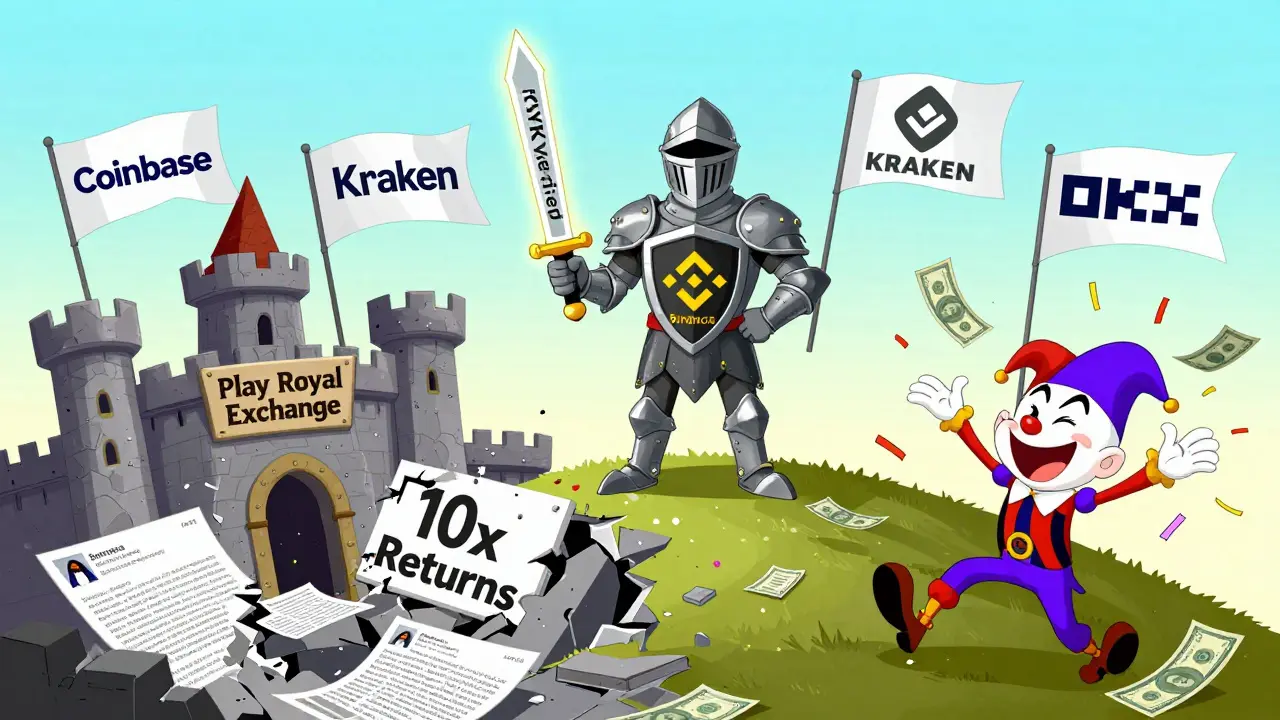
If you want to trade crypto safely, stick to platforms that are regulated, transparent, and widely used:
- Binance - Largest global exchange, supports 500+ coins, low fees.
- OKX - Strong security, high liquidity, good for advanced traders.
- Coinbase - U.S.-based, regulated, beginner-friendly.
- Kraken - Transparent audits, strong privacy controls.
All of these require KYC, publish security reports, and have been around for years. They don’t promise 10x returns overnight. They don’t need to. Their reputation is their business.
Final Warning
The crypto market is full of opportunity - but also full of predators. Scammers know newcomers are looking for easy profits. They use names like "Play Royal Exchange" to sound official. They copy real logos. They hire actors to film fake "user success" videos.
If it sounds too good to be true - "earn $500 in 24 hours," "no KYC needed," "exclusive access" - it is. The absence of regulation isn’t a feature. It’s the biggest red flag of all. There’s no such thing as a "hidden gem" crypto exchange that’s not on any official list. If you can’t find it on CoinMarketCap or CoinGecko, it’s not real.
Don’t risk your savings. Walk away from anything with "Royal" in the name. Your future self will thank you.
Is Play Royal Exchange a real crypto exchange?
No. Play Royal Exchange does not exist as a legitimate crypto exchange. It is a scam operation using a confusing name to mimic real platforms. No regulatory body recognizes it, and multiple financial watchdogs have flagged it as fraudulent.
Can I withdraw my money from Play Royal Exchange?
If you’ve already deposited, withdrawing is extremely unlikely. Scam platforms often allow small initial withdrawals to build trust, then block larger requests. They’ll demand extra fees, "verification payments," or "tax deposits" before releasing funds - all of which are tricks to steal more money. Once you’ve sent funds, recovery is nearly impossible.
Why do people still use Play Royal Exchange?
People are misled by fake testimonials, aggressive ads promising quick profits, and the use of names that sound similar to real exchanges. Many users are new to crypto and don’t know how to verify legitimacy. Scammers target this lack of knowledge with polished websites and fake customer support.
What’s the difference between Play Royal Exchange and Royal Exchange?
"Royal Exchange" is a forex broker with no crypto exchange license, while "Play Royal Exchange" is a fake brand created to confuse users. Neither is a legitimate crypto platform. Both operate without regulation and have been flagged by financial authorities. The addition of "Play" is just a tactic to make the scam appear new or different.
Are there any safe alternatives to Play Royal Exchange?
Yes. Use regulated exchanges like Binance, OKX, Coinbase, or Kraken. These platforms require identity verification, publish security audits, and are licensed in multiple countries. They don’t promise unrealistic returns, but they protect your funds and give you real control over your crypto.
How can I spot a crypto scam like Play Royal Exchange?
Look for these signs: no regulatory license, no public company details, promises of high returns with little risk, no API or advanced trading tools, pressure to deposit quickly, and difficulty withdrawing funds. Always check if the platform is listed on CoinMarketCap or CoinGecko. If it’s not, avoid it.

Sarah Terry
March 24, 2026 AT 08:03Stop chasing 'easy money' and start learning the basics. The real crypto community doesn't promise 10x returns - it teaches you how to manage risk.
Shayne Cokerdem
March 26, 2026 AT 03:40aravindsai pandla
March 27, 2026 AT 18:04namrata singh
March 27, 2026 AT 23:36Zion Banks
March 28, 2026 AT 07:38Annette Gilbert
March 30, 2026 AT 07:03John Alde
March 31, 2026 AT 20:36manoj kumar
April 2, 2026 AT 05:35Alicia Speas
April 3, 2026 AT 06:18Kevion Daley
April 3, 2026 AT 20:23Tammy Stevens
April 4, 2026 AT 12:16Justin Credible
April 6, 2026 AT 01:11Sam Harajly
April 7, 2026 AT 23:53Leona Fowler
April 9, 2026 AT 15:24Neil MacLeod
April 10, 2026 AT 15:36Misty Williams
April 10, 2026 AT 17:54Anand Makawana
April 12, 2026 AT 06:40Mohammed Tahseen Shaikh
April 13, 2026 AT 17:37Jeannie LaCroix
April 14, 2026 AT 00:56