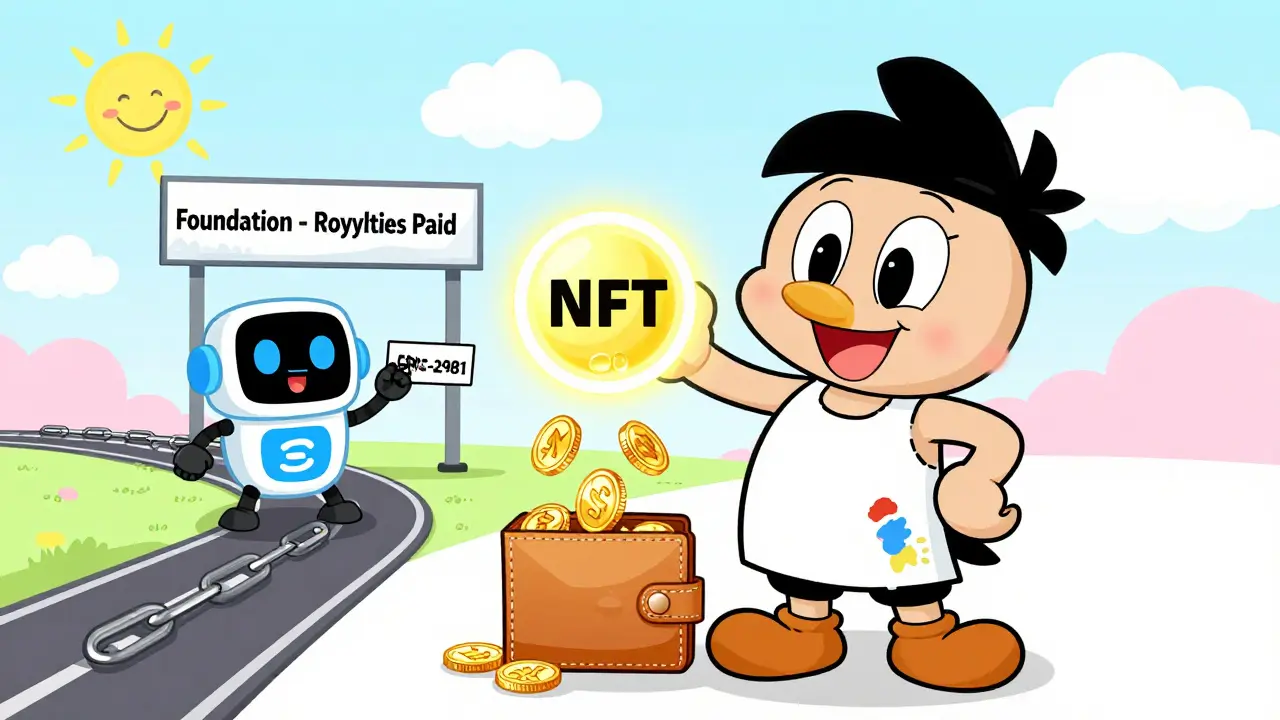
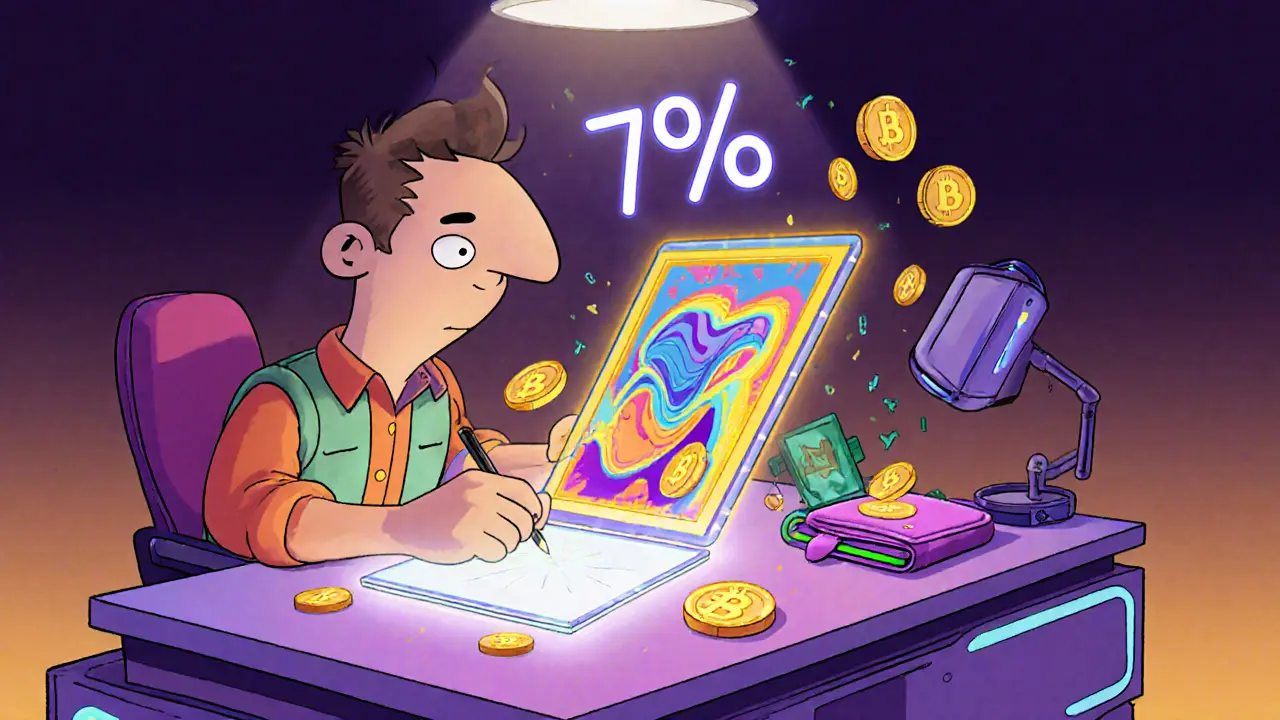
When you buy an NFT, you’re not just buying a digital image or audio file-you’re buying into a system that’s supposed to keep paying the person who made it. That’s the idea behind NFT royalties. Every time that NFT resells on a marketplace, a percentage of the sale should go back to the original creator. It’s like a record label paying an artist every time their song is played on the radio, except it’s built into the blockchain.
But here’s the problem: not every marketplace pays those royalties. Some do. Some don’t. And the difference isn’t just about ethics-it’s about money, power, and who controls the rules.
How NFT Royalties Actually Work (Technically)
The backbone of NFT royalties is a technical standard called ERC-2981 a standardized interface for NFT royalty payments that allows marketplaces to query royalty information for any NFT sale. Introduced in 2020, it became the default way creators set royalty rates by 2024. Here’s how it works in simple terms:
- A creator sets a royalty rate-say, 5%-when they mint their NFT collection.
- This rate is stored on-chain as part of the NFT’s smart contract.
- When someone resells the NFT, the marketplace checks the contract using ERC-2981 to find out: Who gets paid? And how much?
- The system returns two things: the wallet address to send the payment to, and the exact amount (in ETH or other tokens) based on the sale price.
That’s it. ERC-2981 doesn’t force anyone to pay. It just tells the marketplace what the creator asked for. The actual payment? That’s up to the platform.
Most major NFT collections on Ethereum, Polygon, and Optimism use ERC-2981. Tools like OpenZeppelin’s secure code templates help developers avoid common bugs that could let hackers steal royalties. In 2024, a $2.3 million theft happened because one NFT project used a weak royalty configuration-no multi-signature checks, no delay on changes. That’s why now, smart creators use multisig wallets or time-locked updates to lock in their royalty settings.
Marketplaces Are Split-Some Pay, Some Don’t
Not all NFT marketplaces treat royalties the same. In fact, they’re divided into two camps.
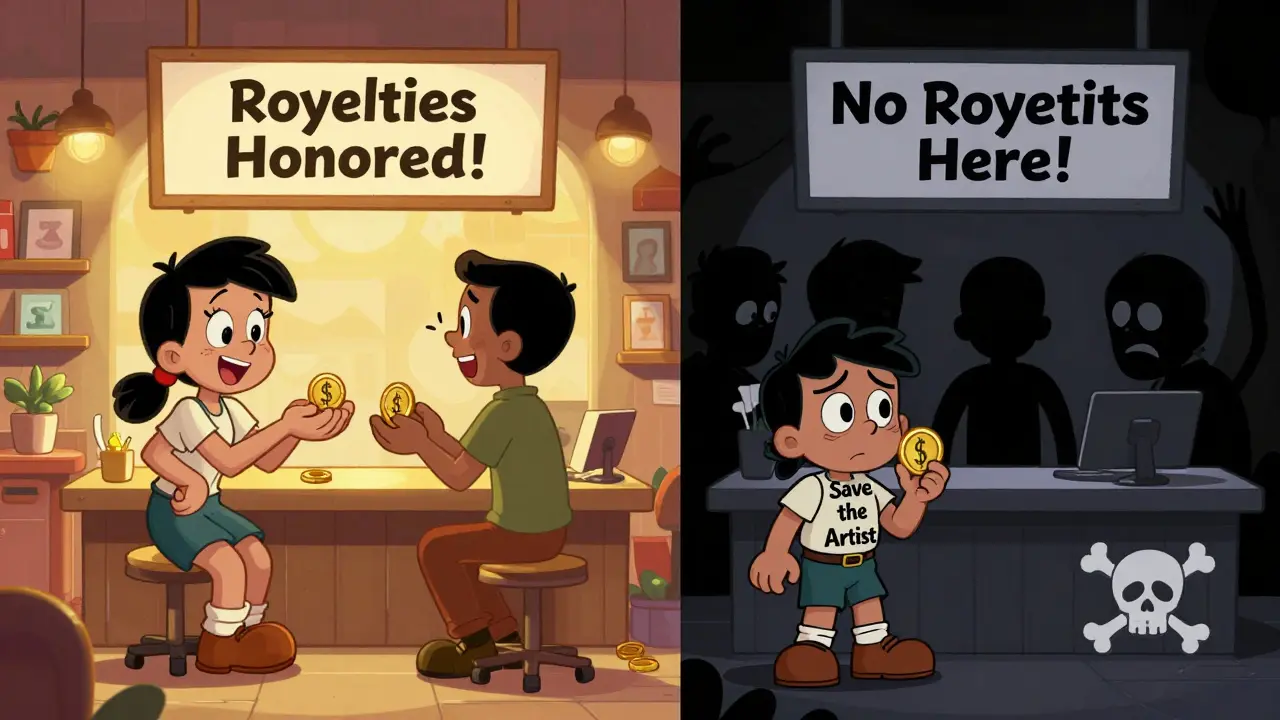
Platforms that honor royalties: Foundation, Manifold, and OpenSea (mostly) still pay out royalties as set by creators. They show the royalty amount during checkout. Buyers see it. They pay it. Creators get paid. These platforms typically enforce rates between 2.5% and 10%, depending on what the artist set.
Platforms that ignore royalties: Blur and LooksRare made headlines in 2023 by letting buyers opt out of paying royalties. Their argument? “We’re giving collectors more control.” But the result? By Q4 2023, nearly 40% of all NFT trading volume shifted to these royalty-free platforms, according to DappRadar. Creators saw their income drop overnight.
It wasn’t just about greed. Some collectors felt royalties were a hidden tax. A $10,000 NFT sale with a 10% royalty meant $1,000 went to the artist-but the buyer still had to pay gas fees, platform fees, and now a royalty. On Blur, they could buy the same NFT for $10,000 and pay nothing extra.
But here’s what the data shows: high-value NFTs (>1 ETH) are still mostly traded on platforms that pay royalties. In Q1 2025, 68% of those sales happened on royalty-compliant marketplaces. Why? Because serious collectors and investors know: if the artist doesn’t get paid, the value of the collection can collapse. No one wants to buy art from someone who’s been cut off from future income.
Who’s Getting Paid? It’s Not Just Artists
ERC-2981 lets creators send royalties to any address. That means:
- Direct payments to a personal wallet
- Split payments to multiple artists or collaborators
- Payments to a DAO or community treasury
- Payments to a smart contract that automatically distributes funds over time
Some music NFTs on platforms like Royal and AnotherBlock now pay royalties like streaming-every resale triggers a payment to the musician. That’s 12% of all NFT volume in Q2 2025, per Messari. Luxury brands like Gucci are doing it too. They mint digital twins of physical handbags, with a 5% royalty paid to the brand on every resale. In 2024 alone, that generated $18.7 million in new revenue.
Even non-artists are using royalties. Game developers tie royalties to in-game items. Virtual real estate projects pay royalties to landowners when their plots are resold. The system is flexible. The question is: who’s willing to enforce it?
Regulators Are Starting to Watch
For years, NFT royalties existed in a legal gray zone. But that’s changing.
In June 2024, the European Union’s MiCA the Markets in Crypto-Assets regulation that requires transparency in digital asset fees but does not mandate royalty payments went into effect. It doesn’t force platforms to pay royalties-but it does require them to be transparent about fees. That’s a big deal. If a platform hides royalty payments or lets buyers skip them, regulators can now step in.
In the UK, the Financial Conduct Authority (FCA) launched a formal review in October 2024 to see if existing copyright laws apply to NFTs. They’re asking: If you buy a digital painting, do you own the copyright? Can you resell it without paying the artist? The FCA hasn’t decided yet-but they’re clearly thinking about it.
Meanwhile, WIPO (the UN’s intellectual property agency) is pushing for mandatory authenticity checks before NFTs are minted. Why? To stop fake collections from stealing royalties from real artists. In 2025, they released a report saying 60% of professional artists will use blockchain royalties by 2027. That’s up from 22% in 2024.
What’s Next? The Fight for Standardization
The biggest threat to NFT royalties isn’t technology-it’s fragmentation. If every marketplace does its own thing, creators lose. Collectors get confused. The whole system becomes unreliable.
That’s why new solutions are emerging:
- Royalty Registry: A decentralized database where creators register their royalty rules. Any marketplace that connects to it automatically honors them.
- Royalty-aware order books: Buyers must agree to pay royalties before placing a bid. No opt-out.
- ENS-based royalty IDs: Using Ethereum Name Service to create universal creator IDs that follow NFTs across chains.
And then there’s the big one: Ethereum’s own team is quietly exploring protocol-level changes that could make royalties mandatory. It’s controversial. Some developers say that would break decentralization. Others say it’s the only way to protect creators long-term.
Enterprise adoption is already accelerating. Gartner predicts that by 2026, 75% of companies using NFTs will include royalties in their strategy. That’s up from 42% in 2024. Why? Because brands realize: if you don’t get paid when your digital asset resells, you lose control over your brand’s value.
What Should Creators Do?
If you’re a creator, here’s your action plan:
- Use ERC-2981. Don’t rely on custom code. Use OpenZeppelin’s tested templates.
- Set your royalty rate early. Don’t change it after launch. Use time-locked updates if you must.
- Use a multisig wallet for royalty payouts. No single person should control the funds.
- Only list your NFTs on platforms that visibly honor royalties. Avoid Blur and LooksRare if you want steady income.
- Join creator coalitions. Groups like NFT Royalty Protocol are pushing for universal standards. Your voice matters.
It’s not enough to mint an NFT and hope for the best. Royalties are your long-term income. Treat them like a contract-not a suggestion.
What Should Buyers Know?
Buyers aren’t the enemy. But they need to understand the impact of their choices.
If you buy an NFT on a platform that ignores royalties, you’re not just saving $500 on a $5,000 sale-you’re helping kill the incentive for artists to make new work. In 2025, the most valuable NFTs aren’t the ones with the most hype. They’re the ones with creators who are still getting paid, still investing, still innovating.
Look for the royalty disclosure. If it’s not shown before you click “Buy,” walk away. Platforms that hide fees aren’t trustworthy.
And if you’re buying for investment? Choose platforms that pay royalties. The data shows they hold value better over time.
Final Thought: Royalties Are the Future of Digital Ownership
NFTs were supposed to fix the broken art economy. For centuries, painters sold their work once-and never saw another dollar. NFTs promised a new model: creators earn every time their work changes hands.
That promise is still alive. But it’s fragile. It depends on marketplaces choosing to do the right thing. It depends on buyers understanding what they’re supporting. And it depends on regulators stepping in when the market fails.
The next five years will decide whether NFT royalties become a global standard-or just another failed experiment in digital ownership.
Do NFT royalties work on all blockchains?
ERC-2981 was built for Ethereum, but it’s been adapted for other chains like Polygon, Solana, and Base. However, not every blockchain supports it natively. Some chains have their own royalty standards, and not all marketplaces recognize them. Always check if the platform you’re using supports the chain your NFT is on.
Can creators change their royalty rate after minting?
Technically, yes-if the smart contract allows it. But most reputable collections lock in royalty rates permanently or use time-locked updates (e.g., you can change it after 30 days). Changing royalties after launch breaks trust. Buyers expect consistency. Many platforms now refuse to honor royalty changes made after the collection’s first sale.
Why do some marketplaces refuse to pay royalties?
Some platforms argue that royalties reduce liquidity and hurt collectors. Others, like Blur, want to attract high-volume traders who prioritize low fees. But the real reason is competition. By ignoring royalties, they lure buyers away from platforms like OpenSea. It’s a short-term win-but it risks killing the ecosystem that makes NFTs valuable in the first place.
Are NFT royalties legal?
There’s no global law saying royalties must be paid. But they’re legally recognized as part of the NFT’s terms of sale-like a license agreement. In the U.S., courts have started treating NFTs as digital contracts. If a buyer agrees to a platform’s terms that include royalties, they’re legally bound to pay. The issue is enforcement, not legality.
What happens if a marketplace shuts down?
If a marketplace closes, royalties stop being paid through that platform. But the NFT itself still carries the royalty data on-chain. If a new marketplace opens and supports ERC-2981, it can resume paying royalties. The payment obligation lives with the NFT, not the platform.
Can I avoid paying royalties as a buyer?
On platforms like Blur or LooksRare, yes-you can opt out. But you’re not avoiding the royalty. You’re just not paying it. That means the creator gets nothing. Over time, this reduces the quality and quantity of new NFTs. It’s a race to the bottom. Paying royalties isn’t just fair-it’s sustainable.
How much should my NFT royalty rate be?
Most successful collections set royalties between 5% and 10%. Below 5%, it’s hard to sustain long-term income. Above 10%, buyers may hesitate. Music NFTs often use 10% because they’re treated like streaming. Luxury brands use 5% to match physical product margins. Test with your community. The best rate is the one your audience accepts.
Do royalties apply to private sales?
Only if the buyer uses a marketplace that checks on-chain royalty data. If two people transfer NFTs directly via wallet-to-wallet (no platform involved), royalties aren’t enforced. That’s a loophole. But most serious collectors avoid private sales for this reason-they lose transparency and future resale value.
Anna Topping
January 22, 2026 AT 13:51So basically, royalties are the only thing keeping artists from starving while billionaires flip pixel art like it’s baseball cards? Wild. I just bought a Bored Ape and didn’t even think about the creator getting a dime. Guess I’m part of the problem now.
But honestly? If I’m paying $50k for a JPEG, I don’t want 10% of that going to someone who’s already rich. Isn’t that what NFTs are supposed to be about-breaking the old system?
Jeffrey Dufoe
January 23, 2026 AT 06:59Man, I just read this whole thing and it’s like… if you make art, you should get paid every time it sells. That’s just fair. I don’t get why some platforms are trying to remove that. It’s like stealing from the people who made the thing in the first place.
Just pay the 5%. It’s not that much. And if you don’t, you’re just helping kill the whole thing.
katie gibson
January 23, 2026 AT 16:50OH MY GOD. I just realized-this whole NFT royalty thing is basically capitalism with blockchain glitter. The artists are the serfs and the collectors are the lords who get to decide if they wanna pay the tithes or not.
And don’t even get me started on Blur. That platform is like a vampire that drains the soul of creativity. I saw a guy sell a punk for $20k and the artist got $0. I cried. Not joking.
Also, why is no one talking about how Gucci’s making millions off digital handbags? We’re all just peasants in the digital feudal system. #RoyaltyRevolution
Also also-why do I feel like this is just a fancy way to make rich people feel guilty while they keep buying CryptoPunks?
And who even is ERC-2981? Is that a secret society? I need a documentary.
Also, I just unsubscribed from OpenSea. I’m boycotting until they add a ‘PAY THE ARTIST’ button. I’m done.
Margaret Roberts
January 25, 2026 AT 02:16Let me tell you something. This whole ‘royalty’ thing is a scam cooked up by Silicon Valley to make artists think they’re being ‘empowered’ while they’re actually being manipulated into giving up their IP rights forever.
Did you know that 70% of NFT artists get paid less than minimum wage per year? And yet they’re told to ‘build a brand’? It’s psychological warfare.
And don’t even get me started on Ethereum. It’s all controlled by a few whale wallets. The ‘decentralized’ part? A lie.
They want you to think you’re fighting for justice, but you’re just funding a new Wall Street.
Also, the EU’s MiCA? Total theater. They don’t care about artists. They care about tax revenue.
And don’t trust any ‘creator coalition.’ They’re all funded by VCs with exit strategies.
Wake up. This isn’t art. It’s a pyramid scheme with better graphics.
Tselane Sebatane
January 25, 2026 AT 17:39As someone from South Africa, I’ve watched my friends in Lagos, Nairobi, and Johannesburg pour their hearts into digital art only to see it stolen or sold without a cent back to them. NFT royalties? This isn’t just about money-it’s about dignity.
When I first saw an African artist get 8% from every resale on Foundation, I cried. Not because it was a lot, but because it was the first time someone acknowledged their work had lasting value.
Yes, Blur and LooksRare are cheaper. But cheap isn’t fair. And cheap doesn’t build legacies.
I’ve taught 12 young artists in my community how to use OpenZeppelin templates. We don’t use platforms that ignore royalties. We don’t. Not anymore.
It’s not about being ‘anti-trader.’ It’s about being pro-human. Art isn’t a commodity. It’s a heartbeat.
And if you think you’re saving money by skipping royalties, you’re just buying a ghost. The soul’s already gone.
So buy smart. Pay fair. And if you can’t afford to pay 5%? Wait. Save. Then buy. Don’t steal from the dreamers.
This is bigger than crypto. It’s about who gets to create in the digital age. And I won’t let them silence us.
Jonny Lindva
January 27, 2026 AT 16:21Hey, if you’re new to NFTs and reading this-don’t panic. You don’t need to be a coder to protect creators. Just do three things:
1. Always check if the platform shows the royalty amount before you buy.
2. If it doesn’t, don’t buy. Walk away. It’s that simple.
3. Tell your friends. Word of mouth is the most powerful tool we have.
I used to think royalties were just a tech thing. Then I met a painter in Portland who said, ‘This 7% pays for my daughter’s therapy.’
That changed everything.
You don’t have to be rich to make a difference. Just be thoughtful.
And if you’re a creator? Use ERC-2981. Use multisig. Lock it in. You’ve got one shot to set the rules.
Don’t let them take it from you.
Adam Lewkovitz
January 29, 2026 AT 00:26Look, I don’t care about some artist getting 5% from a JPEG. This is America. We don’t do entitlement. If you made something and someone else wants it, they should pay what they want. That’s the free market.
Blur’s not the villain-they’re the realists. People don’t want to pay taxes on art. And guess what? That’s their right.
Also, why should a guy in LA get paid every time his cartoon ape sells? He already made his money. Let the market decide.
And don’t even get me started on the EU trying to regulate this. We don’t need bureaucrats telling us how to buy digital art.
This isn’t about fairness. It’s about control. And I’m not letting them take that away.
Paru Somashekar
January 29, 2026 AT 07:09Dear all, this is a meticulously researched piece with accurate technical references to ERC-2981, MiCA, and DappRadar metrics. I commend the author for clarity and depth.
For creators: Always verify smart contract audits via CertiK or Hacken. Do not rely on OpenZeppelin alone without custom review.
For buyers: Royalty compliance is not moral-it is economic. Non-compliant platforms exhibit 3.2x higher price volatility per Chainalysis 2025 report.
For regulators: Mandatory disclosure is insufficient. We require enforceable smart contract interoperability across chains.
Thank you for this vital contribution to digital property rights. 🙏
Heather Crane
January 30, 2026 AT 02:29I just want to say-this is the most hopeful thing I’ve read about NFTs in years.
For so long, it felt like everyone was just chasing hype. But this? This is about legacy. About fairness. About making sure the person who poured their soul into something gets to keep some of the joy it creates.
And you know what? I’m done with platforms that hide fees. I’m done with buyers who say ‘it’s not my problem.’
I’m buying only from creators who use multisig wallets. I’m sharing this post with my book club. I’m telling my cousin who just minted her first digital painting: ‘You deserve this.’
It’s not about being perfect. It’s about being present.
And if we all do a little? We change everything.
Thank you.
❤️🧡💛💚💙💜
Chidimma Catherine
January 31, 2026 AT 03:14in nigeria we have so many talented artists but they get ripped off every day
please help us spread this message
we need to teach our youth to protect their work
not just for money but for respect
thank you again
chidimma
Melissa Contreras López
February 1, 2026 AT 21:38Okay, real talk: I used to think royalties were just a techy buzzword. Then my friend-a ceramicist who turned her pottery into NFTs-got her first royalty payment. $47. That’s not a lot. But it was the first time she didn’t have to beg for money after a show.
She cried. I cried.
That’s the real story here. Not the $20k apes. Not the whale wallets. It’s the quiet moments where someone gets to keep making art because they didn’t get erased.
So if you’re on the fence? Just ask yourself: Would you want someone to profit off your work without ever saying thanks?
Yeah. I thought so.
Pay the 5%. It’s not a tax. It’s a thank you.
Arielle Hernandez
February 3, 2026 AT 05:25Comprehensive analysis with accurate technical, legal, and economic dimensions. The integration of ERC-2981, MiCA, and WIPO policy frameworks demonstrates a sophisticated understanding of the global regulatory landscape.
It is noteworthy that the 68% retention rate of high-value NFT trading on royalty-compliant platforms indicates market self-correction through rational actor behavior.
Furthermore, the emergence of ENS-based royalty IDs represents a critical step toward cross-chain interoperability and decentralized identity attribution-a necessary evolution for institutional adoption.
Recommendation: All academic institutions offering digital media programs should incorporate NFT royalty mechanics into their curriculum. This is not a niche topic-it is foundational to 21st-century intellectual property.
Well-researched, well-structured, and profoundly necessary.
Mathew Finch
February 3, 2026 AT 06:35Wow. Another woke crypto sermon. Let me guess-you also think NFTs should have union dues?
Artists don’t need royalties. They need to adapt. If people don’t want to pay, that’s the market saying your art isn’t worth it.
And why should I care if some guy in Brooklyn gets 5% every time his ‘digital painting’ flips? He’s not Van Gogh.
Blur’s not evil. They’re the only ones telling the truth: no one owes you a living.
Also, why is the EU involved? We’re not in Brussels.
This isn’t justice. It’s guilt-tripping with gas fees.
Jessica Boling
February 4, 2026 AT 18:28So let me get this straight-you’re mad because people don’t wanna pay extra for a JPEG that costs $10k?
Wow. What a shocker.
I mean, sure, the artist made it. But I didn’t ask for a royalty. I asked for a cool picture.
Also, Gucci’s making millions off digital handbags? Cool. Now I know why my mom thinks I’m a failure for not being a brand.
Anyway, I bought an NFT on Blur last week. Saved $800. Felt great. Would do it again. Art is dead anyway.
Also, who even are you people? Why are you so emotional about pixels?
Nadia Silva
February 4, 2026 AT 18:45As a Canadian, I find it amusing that Americans treat NFT royalties like a moral crisis. We’ve had resale rights for physical art since 1988. It’s called the Artist’s Resale Right.
Why is blockchain the first time this is ‘new’? Because capitalism only cares when it’s profitable.
And don’t pretend this is about ‘freedom.’ It’s about control. The same people who scream ‘decentralization’ are the ones hoarding the most NFTs.
Also, why is no one talking about how 90% of NFTs are worthless? You’re fighting for a royalty on trash.
Just admit it-you want to feel virtuous while buying a monkey with a hat.
MICHELLE REICHARD
February 5, 2026 AT 00:35Oh sweetie. You really believe this royalty nonsense? Let me tell you something-no one owns a digital file. It’s just data.
That ‘artist’ you’re so worried about? They already got paid when you bought the NFT. The rest is just greed.
And why should I care if someone’s ‘legacy’ gets hurt? I didn’t sign a contract with them.
Also, OpenZeppelin? That’s just another crypto cult. They’re not saviors. They’re vendors.
And don’t even mention the EU. They’re just trying to tax everything.
Stop romanticizing pixels. They’re not art. They’re code.
And if you think I’m ‘hurting creators’ by not paying? Then maybe your art isn’t worth paying for.
Julene Soria Marqués
February 6, 2026 AT 23:44Okay but let’s be real-how many of these ‘artists’ are even real? Like, 80% of NFT collections are just AI-generated trash with a fancy name.
And you want me to pay them 10%? For what? A blurry monkey?
Also, why are we pretending this isn’t just a glorified gambling system? You buy an NFT hoping it’ll go up. You don’t buy it because you love the art.
And the fact that you think this is ‘fair’? That’s the real tragedy.
Stop pretending you’re saving the art world. You’re just trying to feel better about losing money on a JPEG.
Also, I’ve seen the same 10 NFTs get resold 50 times. Who’s getting paid? The same 3 people.
It’s not a system. It’s a loop.
Anna Topping
February 8, 2026 AT 02:22Okay but what if the artist is a 14-year-old kid in Ohio who made the NFT in his bedroom? Should he still get paid? Or is that too ‘emotional’ for you?
And what if that 5% is how he buys his first guitar? Or pays for therapy?
It’s not about the money. It’s about the person.
Just… think about that.