
Imagine handing over the keys to your house to a single person. If that person loses them, gets robbed, or decides to lock you out, you’re in trouble. That is exactly how most people store their cryptocurrency today-using a single private key. It’s simple, sure, but it’s also a massive risk. Enter multisig wallets, a security model that changes the game by requiring multiple signatures to move funds. Instead of one key holding all the power, control is distributed among several parties.
This isn’t just tech jargon for geeks. For anyone holding significant value in Bitcoin, Ethereum, or other assets, understanding multisig solutions is no longer optional-it’s essential. Whether you are an individual protecting life savings or a startup managing treasury funds, the shift from single-signature to multi-signature architecture represents the biggest leap forward in self-custody security since the invention of the hardware wallet itself.
How Multi-Signature Technology Actually Works
To get why multisig matters, you first need to understand the basic mechanism. In a traditional wallet, you have one private key. If you lose it, your money is gone forever. If someone steals it, they take everything. There is no backup plan built into the cryptography.
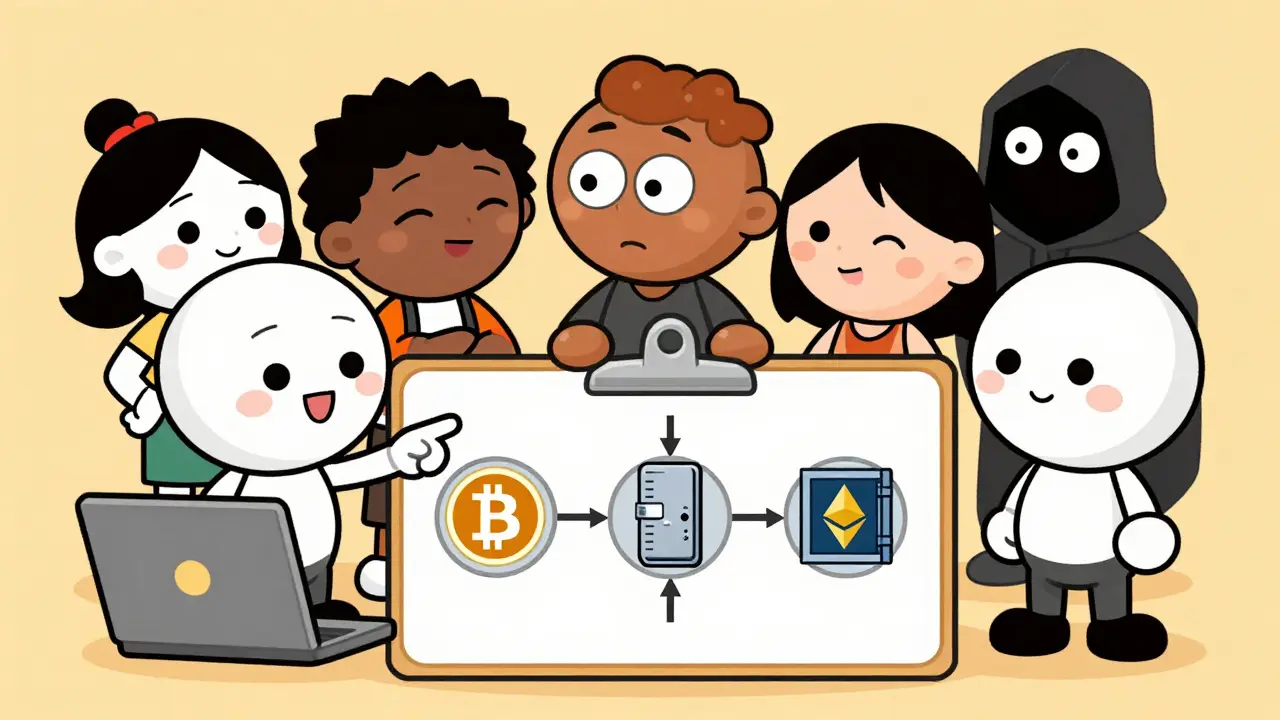
A multisig wallet requires a predefined number of authorized signatures to approve a transaction. Think of it like a corporate bank account where two directors must sign a check before it clears. In crypto terms, this is often expressed as an "M-of-N" setup. For example, a 2-of-3 multisig wallet generates three private keys. To spend funds, any two of those three keys must authorize the transaction.
Why does this matter? Let’s say one of your keys is stolen by a hacker. With a single-sig wallet, you’re bankrupt. With a 2-of-3 multisig, the hacker has only one-third of the required authority. They can’t touch your funds unless they compromise a second key. Similarly, if you lose one key due to a dead hard drive or misplaced seed phrase, you still have two left. You can access your money without panic.
The trade-off is complexity. You aren’t just backing up one piece of paper; you’re managing three. Transaction fees are slightly higher because the blockchain has to verify more data, and transactions might be slower because you have to coordinate with other signers. But for large sums, that small friction is a worthy price for peace of mind.
Top MultiSig Wallet Platforms Compared
Not all multisig solutions are created equal. Some are designed for Bitcoin purists, while others focus on Ethereum smart contracts. Here is a breakdown of the leading platforms dominating the space in 2026.
| Platform | Best For | Key Feature | Network Focus |
|---|---|---|---|
| Safe Wallet (Gnosis Safe) | Ethereum & EVM Chains | Immutable Smart Contract | Multi-chain (EVM) |
| Blue Wallet | Bitcoin Beginners | Vault Mode (Mobile-First) | Bitcoin Only |
| BitGo | Institutions | Enterprise Custody & MPC | Multi-asset |
| Casa | High-Net-Worth Individuals | Hardware-Integrated Vault | Bitcoin Only |
| Electrum | Tech-Savvy Users | Open Source Flexibility | Bitcoin Only |
Safe Wallet: The King of Ethereum
If you are dealing with Ethereum, ERC-20 tokens, or DeFi protocols, Safe Wallet (formerly Gnosis Safe) is the industry standard. It operates not as a software app you download, but as a smart contract deployed on the blockchain. This means the logic governing your wallet is immutable-no company can change the rules or freeze your funds later.
Safe Wallet manages over $100 billion in assets, used by major protocols and even Vitalik Buterin himself. You connect it using existing wallets like MetaMask, Ledger, or Trezor as signers. Because it’s self-custodial, if the Safe website goes down, you can still interact with your wallet directly through block explorers like Etherscan. It offers modular features, allowing you to add time locks, daily spending limits, or require specific addresses for certain actions.
Blue Wallet: Simplicity for Bitcoin
For Bitcoin holders who want multisig security without needing a computer science degree, Blue Wallet shines. Its "Vault" feature allows users to set up 2-of-3 or 3-of-5 multisig configurations entirely within a mobile app. It supports hardware wallets like Ledger and Trezor, making it easy to keep keys offline while signing transactions on your phone. It strips away the complex command-line interfaces of older tools, making institutional-grade security accessible to retail investors.
BitGo and Casa: Institutional Grade
BitGo is the go-to for companies and exchanges. They offer managed services where they hold one of the keys, providing a balance between self-custody and support. Their infrastructure handles disaster recovery and compliance needs that individuals rarely worry about. Casa takes a different approach, focusing on a physical hardware vault device that integrates seamlessly with their software, targeting high-net-worth individuals who want a tangible, user-friendly experience for long-term Bitcoin storage.

Multisig vs. MPC: Understanding the Security Landscape
You will often hear about Multi-Party Computation (MPC) alongside multisig. While both aim to eliminate single points of failure, they work differently. Traditional multisig splits the private key into separate parts held by different entities. MPC, however, never reconstructs the full private key. Instead, it uses mathematical algorithms to split the signing process itself.
In an MPC system, each participant holds a fragment of the key. When a transaction occurs, these fragments collaborate cryptographically to produce a valid signature without ever revealing the full key to any single party. This makes MPC resistant to certain types of attacks where a hacker might steal a complete key shard. However, traditional multisig remains preferred by many purists because the code is simpler to audit and doesn't rely on complex cryptographic assumptions. Both are robust, but understanding the distinction helps you choose the right tool for your threat model.
Setting Up Your First Multisig Wallet: A Practical Guide
Ready to upgrade your security? Here is how to approach setting up a 2-of-3 multisig wallet, which is the sweet spot for most users.
- Choose Your Platform: Decide if you are focusing on Bitcoin (Blue Wallet, Casa) or Ethereum/DeFi (Safe Wallet).
- Select Your Signers: You need three distinct devices or entities. Common setups include:
- Device 1: Your personal laptop/desktop.
- Device 2: A hardware wallet (Ledger/Trezor).
- Device 3: A trusted friend, family member, or a cold storage device kept in a safe deposit box.
- Generate Keys: Create the three xpubs (extended public keys) or deploy the smart contract. Ensure each key is generated on a clean, malware-free device.
- Define Rules: Set the threshold. For 2-of-3, ensure the software confirms that any combination of two keys can authorize a spend.
- Backup Strategy: This is critical. You don’t need to back up the whole wallet, but you must securely back up each individual private key or seed phrase associated with each signer. Store these backups in physically separate locations.
- Test with Small Amounts: Send a tiny amount of crypto to your new multisig address. Try to send it back. Make sure you can successfully gather the two required signatures.
Don’t skip the testing phase. Multisig errors can be costly if you accidentally lock yourself out by misconfiguring the signer addresses.
Common Pitfalls and How to Avoid Them
Even with superior technology, human error causes most losses. Here are the biggest traps:
- Single Point of Failure in Backup: If you store all three seed phrases in the same fireproof box, you haven’t added redundancy. Distribute them geographically.
- Trusting Unaudited Code: Stick to established platforms like Safe or BitGo. Newer, obscure multisig apps may have bugs in their implementation that could drain funds.
- Ignoring Gas Fees: On Ethereum, multisig transactions cost more in gas because they involve more data. Keep extra ETH in the wallet to cover these fees, especially during network congestion.
- Signer Availability: If your third signer is a friend who moves overseas and loses contact, you might be stuck. Consider using a professional custodian service for the third key if you lack a reliable co-signer.
The Future of Digital Asset Custody
As the crypto market matures, regulations are tightening. Institutions are moving away from hot wallets and single-key cold storage toward multisig and MPC architectures. We are seeing advancements like time-locked transactions using Bitcoin’s CheckLockTimeVerify (CLTV) script, which prevents funds from being spent until a certain date-a great feature for payroll or vesting schedules.
Cross-chain compatibility is also improving. Soon, you’ll be able to manage Bitcoin and Ethereum assets in a unified multisig interface without jumping between disparate apps. For now, the message is clear: if you hold more than you can afford to lose, stop relying on a single key. Multisig isn’t just a feature; it’s the foundation of serious digital wealth management.
Is a multisig wallet safer than a hardware wallet?
Yes, in terms of resilience. A hardware wallet protects against online theft, but if the device is lost, damaged, or compromised, you lose access to your funds. A multisig wallet adds layers of security. Even if one hardware wallet is stolen or destroyed, you still retain access to your funds as long as you have the remaining required signatures. It eliminates the single point of failure inherent in single-key systems.
What happens if I lose one key in a 2-of-3 multisig wallet?
You remain secure and functional. Since you only need two signatures to authorize a transaction, losing one key leaves you with two remaining. You can continue to send and receive funds normally. You would only lose access if you lost two or more keys simultaneously.
Are multisig wallets free to use?
Most open-source multisig platforms like Safe Wallet and Blue Wallet are free to use. However, you will pay higher network transaction fees (gas fees) compared to single-signature wallets because multisig transactions contain more data. Enterprise solutions like BitGo may charge subscription fees for their custody and support services.
Can I use a multisig wallet for everyday spending?
It is possible but often impractical for small purchases due to the coordination required and higher fees. Multisig is best suited for storing large amounts of long-term holdings. For daily spending, it is better to transfer small amounts from your multisig vault to a single-signature hot wallet.
Which is better: Multisig or MPC?
It depends on your technical comfort and threat model. Multisig is transparent, easier to audit, and widely supported. MPC offers enhanced security by never assembling the full private key, making it harder for attackers to extract keys even if they breach one device. For most users, traditional multisig provides sufficient security with less complexity.

Russ Fincham
July 3, 2026 AT 23:49You are fundamentally misunderstanding the threat model here. It is not about 'simplicity' for the retail user, it is about institutional-grade resilience against key compromise. The article glosses over the fact that multisig introduces significant operational overhead that most users cannot manage correctly. If you cannot secure three seed phrases better than one, you have added complexity without security. This is a classic case of solutionism where technology is applied to solve problems that do not exist for the average holder. Stop pretending this is essential for everyone. It is a niche tool for entities with treasury management departments.
Linda Hilliard
July 4, 2026 AT 04:34Oh, how quaint. Another article attempting to democratize security concepts that require actual cryptographic literacy. :P The notion that a 'Blue Wallet' setup is equivalent to proper self-custody is laughable. You are conflating convenience with security. True multisig requires an understanding of BIP32 derivation paths and hardware isolation. Most people using these mobile apps are still storing their keys on internet-connected devices, rendering the 'multisig' aspect moot if the device itself is compromised by malware. Please educate yourself before spreading this misinformation. :-)
Winston Lacewing
July 5, 2026 AT 15:21I feel like we are ignoring the human element entirely! 🚨 It’s not just about the tech, it’s about trust! What happens when your co-signer gets divorced? Or dies? Or decides they don’t like you anymore? 😱 I had a friend who lost access to his funds because his brother refused to sign off after a family dispute. It was a nightmare! 💔 We need to talk about the emotional toll of distributed custody. It’s not just math, it’s relationships! And relationships break! 😢
Kristine Lawson
July 6, 2026 AT 01:10I must respectfully disagree with the premise that multisig is 'essential.' In fact, I would argue that it is often detrimental to individual sovereignty. By requiring multiple parties, you inherently dilute your own control. A single signature wallet, properly secured with a hardware device and air-gapped backups, offers superior autonomy. The introduction of third-party dependencies, even if they are friends or family, creates vectors for social engineering attacks that are far more prevalent than direct private key theft. One must consider the philosophical implications of shared custody.
Tawny Holmes
July 6, 2026 AT 14:14Multisig is overrated. Hardware wallets are fine.
Jackie D
July 6, 2026 AT 18:53i totally get why ppl are scared but cmon guys its not rocket science! 🚀 i set up my safe wallet in like ten mins and now i feel so much safer knowing my eth isnt just sitting there vulnerable. the gas fees are a bummer tho, gotta keep some extra eth handy for sure. but hey, peace of mind is worth it right? dont let the tech bros scare you off, its actually pretty cool once you click through the steps. just make sure u write down those seeds somewhere safe ok?
Ruth Williams
July 8, 2026 AT 14:51The suggestion that retail investors should utilize Safe Wallet is preposterous. Smart contract risk is non-negligible. While the code may be audited, the ecosystem surrounding it is fraught with vulnerabilities. Furthermore, the reliance on EVM chains introduces consensus layer risks that Bitcoin's UTXO model avoids. Those advocating for Ethereum-based multisig solutions are ignoring the fundamental stability of the network they are building upon. Stick to Bitcoin if you value security over speculative yield farming.
Sophie Nakasako
July 9, 2026 AT 17:03This is such a fascinating topic! I think the real question isn't just about security, but about accessibility. How do we make this intuitive for everyone? Imagine a world where setting up a multisig is as easy as sharing a Netflix password. That's the kind of innovation we need. I've been experimenting with Blue Wallet and while it's easier than Electrum, there's still a learning curve. Let's keep pushing for better UX so no one gets left behind in the digital revolution!
Kristy Morrow
July 9, 2026 AT 20:23security is an illusion. whether you use multisig or mpc or whatever fancy acronym they invent next week someone will always find a way in. the system is broken from the start. why bother locking the door if the walls are made of glass? just hodl and pray i guess. typical tech bro solution to a human problem. lol
John Harman
July 10, 2026 AT 05:54Look, I've been running BitGo for my small fund and yeah, it's expensive but the support is actually there when things go wrong. Don't sleep on the enterprise stuff just because you're a solo trader. Sometimes paying for peace of mind is smarter than trying to DIY your way into a disaster. Also, MPC is getting really good now, might be worth looking into if you're worried about key extraction attacks.
Antony Lopez
July 11, 2026 AT 19:23Foreign regulations are already tightening around these platforms. American users need to be aware that using offshore multisig services could flag them for IRS scrutiny. We need domestic solutions that comply with US law. Relying on European or Asian-based custodians is a strategic error. Protect American crypto assets with American infrastructure. That's just common sense.