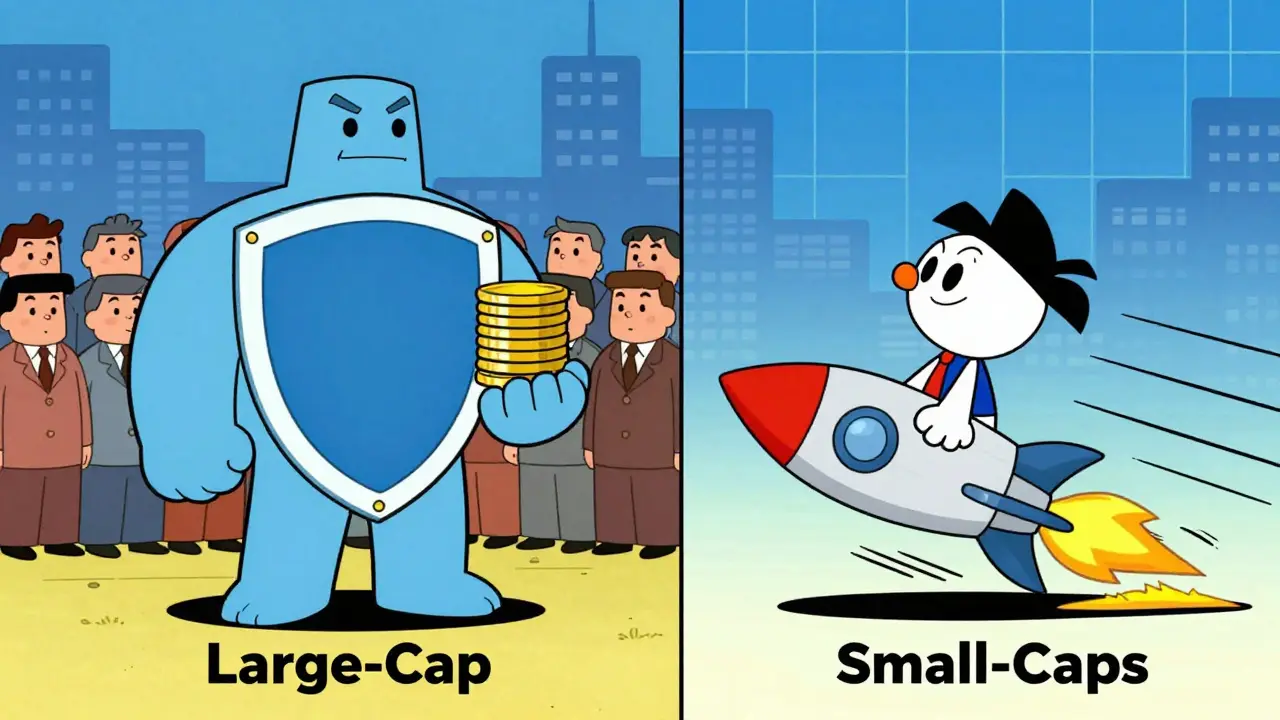
Imagine you have $10,000 to invest in cryptocurrency. You see two options. One is a coin with a price of $0.05 that promises to go to the moon next week. The other is a coin priced at $70,000 that has been around for over a decade. Which one feels safer? Most people instinctively pick the older, more expensive asset. But price alone is a trap. It doesn't tell you the whole story.
To understand what you are actually buying, you need to look at market capitalization. This single number reveals the true size, stability, and potential of a digital asset. It separates the established giants from the speculative underdogs. If you treat every coin the same, you risk losing everything on a gamble or missing out on steady growth. Let’s break down how market cap works, why the categories matter, and how to use this data to protect your portfolio.
The Math Behind the Hype
Market capitalization is not just the price of a single token. That is a common mistake beginners make. A coin can cost pennies but still be worth billions if there are trillions of them in circulation. Conversely, a coin costing thousands might only be worth millions if very few exist.
The formula is simple:
- Market Capitalization = Current Token Price × Circulating Supply
Let’s look at Bitcoin. As of mid-2026, let's say Bitcoin trades at $70,000. There are approximately 19.6 million BTC circulating. Multiply those numbers, and you get a market cap of roughly $1.37 trillion. That massive number tells you Bitcoin is an institutional-grade asset. It takes billions of dollars in new money to move its price significantly.
Now compare that to a random new token trading at $1. If it has only 1 million tokens in circulation, its market cap is just $1 million. It would take only a few thousand dollars in buying pressure to double its price. Or, a few thousand dollars in selling pressure could crash it by 50%. The math explains the volatility.
Defining the Categories: Large vs. Small
In traditional stock markets, definitions are rigid. In crypto, they are fluid because the entire market is younger and smaller than the global equity market. However, major exchanges like Binance and educational platforms like Gemini have settled on general thresholds that most investors use.
| Category | Approximate Market Cap Range | Risk Level | Liquidity | Growth Potential |
|---|---|---|---|---|
| Large-Cap Crypto | > $1 Billion | Lower (Relative) | High (Deep order books) | Moderate (Steady compounding) |
| Mid-Cap Crypto | $50 Million - $1 Billion | Moderate | Moderate | High (Established projects scaling up) |
| Small-Cap Crypto | $1 Million - $50 Million | Very High | Low (Thin order books) | Extreme (High reward / High failure rate) |
Large-cap cryptocurrencies are often called "blue chips." These include assets like Bitcoin, Ethereum, and Solana. They have survived multiple market cycles. They have real-world usage, developer communities, and regulatory attention. Because their market cap is so large, they are harder to manipulate. A whale cannot easily dump enough coins to crash the price overnight without affecting their own holdings negatively.
Small-cap cryptocurrencies, on the other hand, are the wild west. These are projects that might be launching a new feature, experimenting with a novel consensus mechanism, or simply riding a trend. Their low market cap means they are highly sensitive to news. A single tweet from a famous influencer can send a small-cap coin up 200% or down 80% in hours. This is where "gem hunting" happens, but it is also where most retail investors lose money.

The Hidden Trap: Fully Diluted Valuation
Here is where many investors get burned. When you check a site like CoinMarketCap or CoinGecko, you see two numbers: Market Cap and Fully Diluted Valuation (FDV). Always look at both.
Fully Diluted Valuation assumes all tokens that will ever exist are currently in circulation. Many modern crypto projects lock up a significant portion of their supply for developers, investors, or future rewards. Imagine a project with a current market cap of $10 million (small-cap range). Sounds cheap, right? But if the FDV is $1 billion, that means 99% of the tokens are not yet circulating. Over the next few years, those locked tokens will be released. This creates constant selling pressure as early investors cash out. The price may drop even if adoption grows, simply because the supply is flooding the market.
A high FDV relative to the current market cap is a red flag for small-cap investments. It suggests the current price is artificially low due to restricted supply, not undervalued fundamentals.
Liquidity: Can You Actually Sell?
Market cap gives you an idea of value, but liquidity tells you about accessibility. Liquidity refers to how easily you can buy or sell an asset without moving its price.
Large-cap coins trade on dozens of major exchanges. There are always buyers and sellers. You can sell $100,000 worth of Bitcoin in seconds with minimal slippage (the difference between expected price and executed price).
Small-cap coins often list on only one or two smaller exchanges. The order book-the list of pending buy and sell orders-is thin. If you try to sell a large position in a small-cap coin, you might exhaust all the buy orders at the current price. Your sale itself drives the price down, meaning you end up receiving much less than the quoted price. This is known as a "liquidity trap." Never invest money in a small-cap coin that you cannot afford to be stuck with for months or years.

Building a Balanced Portfolio
So, which should you choose? The answer is usually both, but in different proportions. Think of your portfolio like a pyramid.
- The Base (Core Holdings): Allocate the majority of your funds (e.g., 70-80%) to large-cap cryptos. These provide stability and capture the overall growth of the blockchain industry. They are unlikely to go to zero.
- The Middle (Growth Bets): Assign a moderate portion (e.g., 15-20%) to mid-cap coins. These are projects with proven technology that are still growing rapidly. They offer higher upside than large caps but with more established track records than small caps.
- The Tip (Speculative Plays): Reserve a small amount (e.g., 5-10%) for small-cap gems. Treat this money as lost. If these projects succeed, they can multiply your returns significantly. If they fail, the impact on your total net worth is manageable.
This strategy balances the safety of established networks with the explosive potential of emerging technologies. It prevents you from going all-in on a risky meme coin while keeping you exposed to the innovation happening at the edges of the market.
Common Mistakes to Avoid
Even experienced traders fall into traps when analyzing market caps. Here are three pitfalls to watch for:
- Ignoring Volume: A coin can have a decent market cap but near-zero trading volume. This indicates a lack of interest. Without volume, price movements are meaningless and exit strategies are difficult.
- Chasing Past Performance: Just because a small-cap coin went up 1000% last month doesn’t mean it will continue. Often, the initial surge marks the top. By the time it hits mainstream news, the smart money has already exited.
- Comparing Apples to Oranges: Don’t compare the market cap of a currency like Bitcoin to a utility token used within a specific decentralized application. Their value drivers are different. Compare similar assets within the same sector (e.g., Layer 1 blockchains vs. Layer 1 blockchains).
Understanding market cap categories is not about predicting the future. It is about managing your exposure to risk. Large caps offer peace of mind; small caps offer excitement. Knowing the difference ensures you sleep well at night, regardless of what the charts do tomorrow.
What is considered a large-cap cryptocurrency in 2026?
In the current crypto landscape, any asset with a market capitalization greater than $1 billion is generally classified as a large-cap. This includes major players like Bitcoin, Ethereum, and other top-tier layer-1 protocols. These assets are characterized by high liquidity, widespread exchange support, and relative price stability compared to smaller assets.
Is small-cap crypto safer than large-cap crypto?
No, small-cap crypto is significantly riskier. While it offers the potential for higher percentage gains, it comes with higher volatility, lower liquidity, and a greater chance of total loss. Small-cap projects are more susceptible to manipulation, regulatory crackdowns, and failure to deliver on technological promises. Large-caps are considered "safer" only in relative terms within the volatile crypto market.
Why is Fully Diluted Valuation (FDV) important?
FDV shows the theoretical value of a project if all its tokens were in circulation today. It is crucial for identifying inflation risk. If a project has a low market cap but a very high FDV, it means many tokens are locked and will be released later. This future supply increase can dilute the value of existing holders, causing the price to drop even if demand remains constant.
How does market cap affect liquidity?
There is a strong correlation between market cap and liquidity. Large-cap assets typically have deep order books, meaning you can buy or sell large amounts without significantly impacting the price. Small-cap assets often have thin order books, leading to high slippage. Selling a large position in a small-cap coin can crash its price, resulting in losses for the seller.
Can a small-cap coin become a large-cap coin?
Yes, this is the primary goal of "gem hunting." Projects like Solana and Avalanche started as small or mid-cap assets before growing into large-caps through successful technology development, network adoption, and ecosystem growth. However, for every success story, there are hundreds of small-cap projects that fail or stagnate, making this a high-risk investment strategy.
Nick Rice
June 16, 2026 AT 00:42Great breakdown on the mechanics here. Most people ignore the math and just chase green candles, which is how they get wrecked. The FDV trap is real though, I've seen too many projects with low market caps but massive unlocks coming up that bleed value for months.
Terry Hyland
June 16, 2026 AT 10:49It's all a scam anyway. The big players rig the game so you can't win. They print money out of thin air while we lose our savings. Don't trust these charts.
Monica Pathammavong
June 17, 2026 AT 23:42u actually think this helps? lol. ur missing the point about liquidity traps. if u cant sell it, its worthless. also ur spelling is bad.
Tim Lefebvre
June 18, 2026 AT 11:11i agree with the fdv part. lots of new tokens have crazy high fully diluted valuations even if current price looks cheap. always check the tokenomics before buying anything small cap. saves u from getting rekt later when devs dump their bags
pankaj chawla
June 19, 2026 AT 21:48This is a very balanced view. In India, we see a lot of retail investors jumping into meme coins without understanding supply dynamics. The pyramid structure suggested here is practical for risk management.
Jessica Lane
June 20, 2026 AT 10:21I appreciate the clarity on liquidity. It is often overlooked. Many beginners assume they can exit any position easily, but thin order books in small caps can lead to significant slippage. This guide is essential reading for anyone new to crypto asset allocation.
Charles Pawlikowski
June 20, 2026 AT 13:11typical woke finance advice :( make america great again by sticking to gold or btc only. no need for risky small caps that hurt the economy :)
Akeem Whittaker
June 20, 2026 AT 20:12Stick to the fundamentals. Bitcoin and Ethereum are the only ones that matter for long term holding. Small caps are gambling, not investing. Keep your portfolio simple and secure.
Manish Prajapat
June 21, 2026 AT 13:25The philosophical aspect of market cap is interesting. It represents collective belief in a project's utility. Large caps have survived cycles because they solved real problems. Small caps are experiments. One must distinguish between value creation and speculation.
John Doe
June 22, 2026 AT 11:44I lost half my portfolio chasing a small cap gem last year. The FDV was hidden in fine print. Now I only touch large caps. Sleep is worth more than potential 100x gains.
Mekz Wheoki
June 22, 2026 AT 22:49Oh look, another article telling people what they already know. If you needed to read this to understand market cap, you probably shouldn't be trading at all. Go buy an index fund and cry quietly.
Skm Shubham
June 23, 2026 AT 12:51Most readers here are degens who will ignore this and ape into the next shitcoin. The analysis is correct but the audience is flawed. You cannot teach a pig to sing.
Rob Aronson
June 24, 2026 AT 13:53Spot on regarding slippage 📉. When you execute a large sell order on a thin book, you become the liquidity provider effectively crashing the price. Always calculate the impact cost before entering a position in mid-to-small caps. Risk management is key 🔑.
Kwon Bill
June 25, 2026 AT 01:40In Asian markets, we see similar patterns with penny stocks vs blue chips. The psychological bias towards low nominal prices is universal. Market cap corrects this illusion. Good educational content for global investors.
Danna Charris
June 25, 2026 AT 19:30Finally, some sense. Most crypto twitter is noise. Focus on quality assets. Ignore the hype.
Fede Faith
June 26, 2026 AT 22:46This is a solid framework for building a resilient portfolio. I recommend everyone bookmark this. The distinction between market cap and FDV is crucial for avoiding dilution risks. Stay disciplined and stick to your allocation plan.
Josh Dodson
June 28, 2026 AT 19:22great post! i always forget to check fdv. thanks for reminding me. gonna stick to btc and eth mostly now. less stress that way haha
Suman Patil
June 30, 2026 AT 02:15Let's collaborate on understanding these metrics better. The jargon can be overwhelming but breaking it down like this helps. We should all focus on sustainable growth rather than quick flips. Peace and prosperity to all traders here.
Kumaran sowkarpet
June 30, 2026 AT 08:58Nice explanation :) In India we call this 'smart money' vs 'retail trap'. Always check the circulating supply first. Hope everyone stays safe and makes good profits :)
Mauricio Contreras Loredo
June 30, 2026 AT 16:09Yeah sure, keep telling yourself that small caps are 'high reward' until you're left holding the bag. But hey, live your best life bro. I'll be over here watching my large caps go up slowly while you panic sell.