
The Promise of Total Anonymity
Imagine a world where your cryptocurrency trades are completely invisible. No public ledger entries, no transaction history linked to your wallet address, and absolutely no record of who you are. For years, this was the dream of privacy advocates in the crypto space. Incognito pDEX is a privacy-focused decentralized exchange designed to obscure user trading activity from public blockchain ledgers while maintaining non-custodial security. Launched in November 2019 by a team based in Vietnam, it promised to deliver exactly that: a fully anonymous trading experience.
But here we are in May 2026. The landscape of decentralized finance has shifted dramatically. Regulatory scrutiny has tightened, liquidity has consolidated around major platforms, and the definition of "privacy" in crypto has become more complex. So, does Incognito pDEX still hold up? Or has it faded into obscurity? Let’s cut through the noise and look at what’s actually happening with this platform today.
How Incognito pDEX Actually Works
To understand why Incognito pDEX is different, you have to understand how most decentralized exchanges operate. When you trade on Uniswap or PancakeSwap, every transaction is recorded on the public blockchain. Anyone can trace your funds from one wallet to another. It’s transparent, yes, but it’s also completely visible.
Incognito pDEX takes a radically different approach. It operates on the Incognito blockchain, which uses shielded pools to hide transaction details. Here’s the breakdown of how it functions:
- No Registration Required: You don’t create an account. There’s no email verification, no KYC (Know Your Customer) checks, and no personal data stored on servers.
- Non-Custodial Structure: The platform never holds your funds. You retain full control of your assets throughout the entire process. The exchange acts merely as a facilitator for swapping tokens.
- Mobile-First Access: Unlike web-based DEXs, pDEX is accessed exclusively through the Incognito mobile application. This design choice prioritizes convenience and privacy but limits accessibility for desktop users.
- Zero Trading Fees: One of the most attractive features for traders is the complete absence of trading fees. While competitors charge between 0.05% and 0.3%, pDEX charges nothing.
The technology relies on a trustless model where transactions occur outside traditional public ledgers. In theory, this means your trading history cannot be linked to your identity or tracked by third parties. However, there’s a catch: this privacy comes at the cost of visibility, both for regulators and for potential liquidity providers.
The Current Reality: Untracked and Silent
If you’re looking for live trading data, you won’t find it easily. As of October 2025, CoinMarketCap classifies Incognito pDEX as an "Untracked Listing." What does that mean in plain English? It means the platform isn’t providing verifiable volume data, reserve information, or active trading pairs to major aggregators.
This status raises several red flags for anyone considering using the platform:
- Lack of Liquidity Data: Without verified volume data, you can’t assess whether there’s enough liquidity to execute large trades without significant slippage.
- No Public Market Pairs: Major tracking systems show no available market data or active trading pairs. This suggests either extremely low usage or a deliberate withdrawal from public visibility.
- Absence of Community Feedback: Unlike mainstream DEXs that generate thousands of discussions on Reddit, Twitter, and Discord, Incognito pDEX is virtually silent. There are no recent user reviews, tutorials, or community-driven resources.
In the crypto world, silence is often louder than noise. A platform that doesn’t communicate its development roadmap, feature updates, or regulatory compliance efforts leaves users guessing about its long-term viability.
Privacy vs. Liquidity: The Core Trade-Off
Let’s talk about the elephant in the room: why isn’t Incognito pDEX thriving despite its zero-fee structure? The answer lies in the fundamental tension between privacy and liquidity.
Major DEXs like Uniswap process billions in daily trading volume because they offer deep liquidity pools. Market makers, arbitrageurs, and institutional investors participate actively because they can see order books, track trends, and verify transactions. This transparency attracts capital.
Incognito pDEX, by design, removes that transparency. Here’s why that matters:
- Limited Market Maker Participation: Professional liquidity providers need visibility to manage risk. Shielded pools make it difficult for them to operate efficiently.
- Reduced Arbitrage Opportunities: Arbitrageurs help keep prices aligned across exchanges. Without public price discovery mechanisms, these opportunities diminish.
- Regulatory Pressure: Since 2023, many jurisdictions have implemented stricter requirements for transaction monitoring. Platforms that prioritize anonymity over transparency face increasing legal risks.
The result? A smaller pool of participants, thinner liquidity, and potentially worse execution prices compared to what you’d get on a transparent platform-even after accounting for fees.
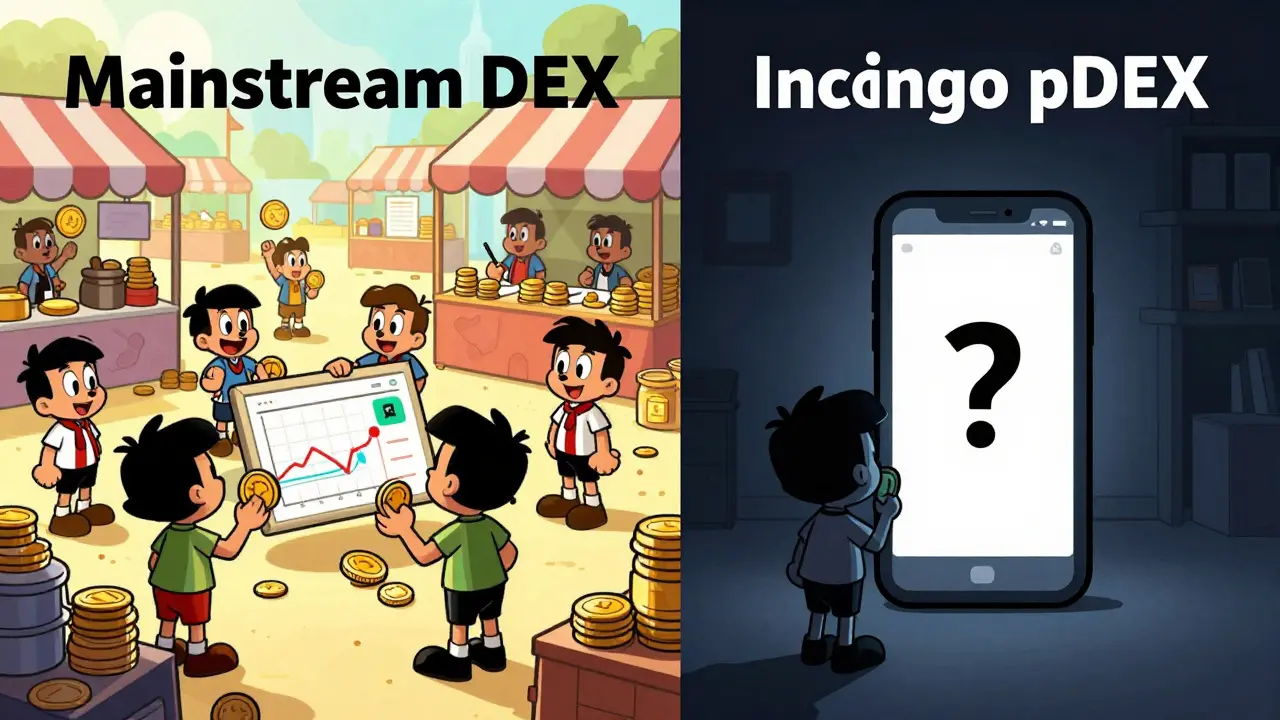
Comparing Incognito pDEX to Mainstream Alternatives
To put Incognito pDEX in perspective, let’s compare it directly with the dominant players in the decentralized exchange space. These aren’t just random choices; they represent the standard against which all other DEXs are measured.
| Feature | Incognito pDEX | Uniswap | PancakeSwap |
|---|---|---|---|
| Trading Fees | 0% | 0.05% - 0.3% | 0.05% - 0.25% |
| Privacy Level | High (Shielded Transactions) | Low (Public Ledger) | Low (Public Ledger) |
| Access Method | Mobile App Only | Web Browser + Mobile | Web Browser + Mobile |
| Liquidity Depth | Unknown/Limited | Very High ($1B+ Daily Volume) | High ($500M+ Daily Volume) |
| Registration Required | No | No | No |
| Open Source | Yes | Yes | Yes |
| Community Activity | Minimal | Extensive | Extensive |
As you can see, Incognito pDEX wins on privacy and fees but loses significantly on liquidity, accessibility, and community support. For casual users prioritizing anonymity above all else, this might still be appealing. For anyone executing meaningful trades, the lack of depth could be a dealbreaker.
Who Should Consider Using Incognito pDEX?
Not every tool fits every job. Incognito pDEX serves a very specific niche. Here’s who might benefit from using it-and who should look elsewhere.
You might consider Incognito pDEX if:
- You prioritize absolute anonymity over transaction speed or price efficiency.
- You’re making small trades where liquidity depth isn’t a critical factor.
- You prefer mobile-only interfaces and want a streamlined, app-based experience.
- You’re technically inclined and comfortable verifying open-source code yourself.
You should probably avoid Incognito pDEX if:
- You need to execute large trades quickly without significant slippage.
- You rely on real-time market data, charts, or advanced analytics tools.
- You want access to customer support or community resources.
- You’re concerned about regulatory compliance and prefer platforms with clear legal standing.
Security and Trust Considerations
When dealing with privacy-focused platforms, security questions become even more important. Since Incognito pDEX is non-custodial, your funds remain in your wallet until the moment of swap. That’s a strong point in its favor. However, the lack of public audits, limited community scrutiny, and opaque operational status introduce unique risks.
The platform is open-source, which theoretically allows anyone to review the code. But without active community engagement or regular security audits published publicly, how confident can you really be? In contrast, platforms like Uniswap undergo frequent independent audits and have massive communities watching for vulnerabilities.
Additionally, the mobile-only access model introduces device-specific risks. If your phone is compromised, your ability to interact with the exchange is at risk. Desktop users typically have more robust security setups, including hardware wallets and multi-signature solutions.
Regulatory Landscape and Future Outlook
The regulatory environment for cryptocurrency exchanges has changed drastically since Incognito pDEX launched in 2019. Governments worldwide are implementing stricter rules around transaction monitoring, anti-money laundering (AML), and know-your-customer (KYC) requirements.
Platforms that prioritize anonymity face increasing pressure. Some have been forced to add identity verification steps, while others have shut down entirely. Incognito pDEX’s current "untracked" status may reflect a strategic decision to stay under the radar-or it could signal operational challenges related to compliance.
Looking ahead, the future of privacy-focused DEXs remains uncertain. On one hand, demand for private trading solutions persists. On the other, regulatory crackdowns continue to mount. Platforms that can successfully balance privacy features with regulatory requirements may survive-but those that ignore compliance altogether risk becoming obsolete.
Practical Steps to Get Started (If You Choose To)
If you decide to try Incognito pDEX despite the caveats mentioned above, here’s what you need to do:
- Download the Incognito App: Available on iOS and Android, this is your only gateway to pDEX functionality.
- Create a Wallet: Set up a new wallet within the app. Remember, no registration is required, so keep your seed phrase secure-it’s your only backup.
- Fund Your Wallet: Transfer INC tokens or supported cryptocurrencies into your wallet address.
- Execute Trades: Use the built-in swap interface to trade tokens. Note that available pairs may be limited due to low liquidity.
- Verify Transactions: Since transactions are shielded, you won’t see them on public block explorers. Rely on the app’s internal records.
Keep in mind: there’s no customer support team to call if something goes wrong. You’re on your own.
Final Thoughts: A Niche Tool in a Changing World
Incognito pDEX represents an interesting experiment in privacy-first decentralized finance. Its zero-fee structure and shielded transaction model offer genuine benefits for users who value anonymity above all else. However, the platform’s current status-untracked, silent, and lacking liquidity-raises serious questions about its practical utility in 2026.
For most traders, the trade-offs simply aren’t worth it. The lack of liquidity, limited accessibility, and absence of community support make it difficult to recommend as a primary trading venue. But for a small subset of users who prioritize privacy above convenience, speed, or price efficiency, Incognito pDEX may still serve a purpose.
Just remember: in crypto, silence isn’t always golden. Sometimes, it’s just empty.
Is Incognito pDEX safe to use?
Incognito pDEX is non-custodial, meaning you retain control of your funds during trades. However, safety also depends on code integrity and operational transparency. The platform lacks recent public security audits and community scrutiny, introducing unknown risks. Always exercise caution when using privacy-focused platforms with limited public oversight.
Why is Incognito pDEX listed as "Untracked" on CoinMarketCap?
The "Untracked Listing" status indicates that the platform does not provide verifiable volume data, reserve information, or active trading pairs to major aggregators. This could result from low adoption, operational challenges, or a deliberate strategy to maintain privacy by avoiding public visibility.
Can I use Incognito pDEX on my computer?
No. Incognito pDEX is accessible exclusively through the Incognito mobile application on iOS and Android devices. There is no web-based interface or desktop client available, which limits accessibility for users who prefer trading on computers.
Are there any fees for trading on Incognito pDEX?
No, Incognito pDEX charges zero trading fees. This is one of its main advantages compared to mainstream DEXs like Uniswap or PancakeSwap, which typically charge between 0.05% and 0.3% per transaction. However, the lack of fees doesn’t compensate for potential liquidity issues.
What happens if I lose access to my Incognito wallet?
Since Incognito pDEX requires no registration and offers no customer support, losing access to your wallet means losing access to your funds permanently. Always securely store your seed phrase and enable any available backup options within the app. There is no recovery mechanism provided by the platform.
How does Incognito pDEX compare to Tornado Cash for privacy?
Tornado Cash is a mixer service focused on obfuscating transaction trails, while Incognito pDEX is a full exchange enabling anonymous token swaps. Tornado Cash faced severe regulatory action in 2022, leading to sanctions and shutdowns. Incognito pDEX operates differently but faces similar regulatory pressures due to its privacy focus. Both carry higher legal risks than transparent DEXs.
Is Incognito pDEX still actively developed?
There is no public evidence of active development or regular updates as of mid-2026. The platform’s "untracked" status, lack of community engagement, and absence of recent announcements suggest limited ongoing development. Users should proceed with caution given the uncertainty around long-term viability.
Can I trade Bitcoin directly on Incognito pDEX?
Can I trade Bitcoin directly on Incognito pDEX?
Bitcoin itself is not natively supported on the Incognito blockchain. You would need to use wrapped versions or bridged assets compatible with the Incognito ecosystem. Availability of specific trading pairs is unclear due to the platform’s untracked status and limited public information.
Ruben Michel
May 13, 2026 AT 19:55Your analysis is superficial at best. You fail to grasp the fundamental philosophical underpinning of privacy-first architectures. The notion that transparency equals trust is a bourgeois construct designed to facilitate state surveillance. True sovereignty lies in the ability to transact without permission or observation. Those who cling to Uniswap are merely comfortable serfs in the digital panopticon.
Gavin Wonnacott
May 13, 2026 AT 21:02I don't know why people still bother with this garbage. It's dead weight. If you're using it you're either stupid or trying to hide something illegal. Either way, stay away. I've seen better tech from my toaster. Why do we keep talking about these zombie projects? It's embarrassing.
Samara McCallum
May 14, 2026 AT 22:05i think silence is actually a form of communication isn't it? maybe the platform is just meditating on its existence while everyone else screams into the void of public ledgers. there is beauty in being unseen. perhaps we are all just shadows waiting to be recognized by the light of truth which is really just electricity flowing through wires
Sheldon Friesen
May 15, 2026 AT 18:17Oh, look at you, going off on a tangent about metaphysics! How utterly delightful! But let us ground ourselves in reality, shall we? The lack of liquidity is not a 'meditation,' it is a death sentence for any exchange! You cannot trade air! And if you try, you will lose your shirt! Please, for the love of Satoshi, read the section on slippage!
Tricia Alach
May 17, 2026 AT 03:04the problem is that ppl forget what crypto was meant 2 b. its not about fees its about freedom. incognito tried hard but the world got too loud. i miss the days when we could just swap without anyone watching. now every move is tracked. sad really. maybe we need new protocols that are smarter not just bigger.
Jan Gilmore
May 17, 2026 AT 14:17Let me explain something to you because clearly you missed the memo. Liquidity providers are rational actors. They require data to manage risk. Shielded pools obscure price discovery. Without price discovery, arbitrageurs vanish. Without arbitrage, prices diverge. Without competitive pricing, users leave. It is basic economics, not some mystical conspiracy. The project failed because it ignored market mechanics.
Caique Muniz
May 18, 2026 AT 09:30lol zero fees sounds great until you realize u cant sell anything. its like a free restaurant with no food. total waste of time. i tried it once back in 2021 and the app crashed twice. never again. why do devs think they can reinvent privacy without solving the liquidity problem? basic stuff guys.
robert Whitehead
May 19, 2026 AT 09:16The moral decay of the crypto space is evident in the continued promotion of such illicit tools. Anonymity is not a right; it is a shield for criminals. By supporting platforms like Incognito, you are actively participating in the erosion of societal safety. We should embrace transparency as a virtue, not view it as an inconvenience. This platform is a relic of a darker, less accountable time.
Mike S
May 19, 2026 AT 13:13Oh wow, another lecture on morality from someone who probably uses a VPN to watch movies. Spare me the self-righteousness. The issue isn't morality, it's viability. This thing is a ghost town. Calling it 'illicit' doesn't change the fact that it's also useless. You're preaching to an empty room, literally and figuratively. Get over yourself.
H F
May 19, 2026 AT 20:58Actually, I found the mobile interface quite charming! There is a certain elegance to the simplicity of it all. While I agree the liquidity is thin, the experience of trading without the clutter of charts and news feeds was surprisingly peaceful. Perhaps it serves a niche audience that values tranquility over volume. Who knows? Maybe it will make a comeback!
Michael Berggren
May 20, 2026 AT 08:38🌟 Great point about the user experience! However, we must remember that usability alone does not sustain a DEX. The ecosystem needs depth. 📉 I hope the developers consider integrating cross-chain bridges to boost liquidity. Innovation is key! Let's support projects that strive for balance between privacy and functionality. 💪🔒
Kiran CS
May 21, 2026 AT 17:40It is truly disheartening to witness the decline of sophisticated technological endeavors due to the short-sighted demands of the masses. The common man craves simplicity and visibility, thereby destroying the very essence of decentralized innovation. Incognito was ahead of its time, but alas, the zeitgeist favors the mundane and the compliant. A tragedy for intellectual progress.
Bijan Das
May 22, 2026 AT 04:31yeah sure it was ahead of its time. more like behind in terms of making money. nobody cares about your fancy words. if it doesnt work it sucks. simple as that. stop pretending its a noble failure. its just a bad product that died because it had no users. face it.
Ashley Rodriguez
May 23, 2026 AT 14:31i feel like we are missing the point here by focusing so much on the numbers and the liquidity because what really matters is the intent behind the technology and whether it empowers individuals to take control of their own financial destiny without needing permission from banks or governments who have always abused their power over us for centuries
Bridget Coogle
May 24, 2026 AT 07:58it is important to validate those feelings of empowerment but we must also be realistic about the risks involved. losing access to funds is a serious concern that cannot be ignored. please ensure you backup your seed phrase securely. safety first always.