
Imagine holding the keys to a vault containing billions of dollars in digital assets. Now imagine those keys are just lines of code stored on a server connected to the internet. That was the reality for many early cryptocurrency platforms, and it led to catastrophic losses when hackers breached software wallets. Today, that approach is considered negligent. The industry standard has shifted entirely to HSM key management, which uses physical devices to protect cryptographic keys. For any serious exchange operating in 2026, Hardware Security Modules (HSMs) are not just an option; they are the foundation of trust.
If you are building or securing a crypto exchange, understanding how HSMs work is non-negotiable. These devices ensure that private keys-the only things that control user funds-never exist in plaintext outside a tamper-proof boundary. This guide breaks down why HSMs matter, how they differ from cloud alternatives, and what it takes to implement them correctly without slowing down your trading engine.
The Core Problem: Why Software Wallets Fail
To understand why HSMs are critical, you first need to look at what happens when they aren't used. In a typical software-based key management system, private keys reside in memory or on disk within a general-purpose server. If that server is compromised by malware, a remote code execution vulnerability, or an insider threat, the attacker can extract the private keys. Once extracted, the attacker can sign transactions and drain funds instantly.
Hardware Security Modules solve this by creating a "root of trust". An HSM is a specialized computing device designed specifically for cryptographic operations. It generates, stores, and manages digital keys internally. Crucially, the private keys never leave the device. When a transaction needs to be signed, the data is sent into the HSM, the signature is created inside the secure chip, and only the resulting signature exits the device. The private key itself remains trapped within the hardware, protected against physical tampering and logical attacks.
This architecture eliminates the single point of failure inherent in software wallets. Even if an attacker gains full administrative access to the host server, they cannot retrieve the private keys. They can only attempt to trick the HSM into signing specific messages, which brings us to the next layer of defense: authorization policies.
FIPS Compliance and Certification Standards
Not all HSMs are created equal. For cryptocurrency exchanges, regulatory compliance and security certification are paramount. The gold standard is FIPS 140-2 certification issued by the U.S. National Institute of Standards and Technology (NIST). This standard evaluates the security of cryptographic modules based on four levels:
- Level 1: Minimum requirements, suitable for low-risk applications.
- Level 2: Requires controlled physical access and tamper-evident seals.
- Level 3: Resistant to physical attacks like probing or drilling. This is the minimum requirement for most financial institutions.
- Level 4: Highest level of protection, including environmental attack resistance (temperature, voltage) and zero-knowledge recovery.
For exchanges handling customer funds, Level 3 or Level 4 is mandatory. Dr. Matthew D. Green, a cryptography professor at Johns Hopkins University, has stated that any exchange without FIPS 140-2 Level 3+ HSMs is operating with unacceptable risk. Regulatory bodies like the New York Department of Financial Services explicitly require these certifications in their Virtual Currency Custody Guidelines. Using a lower-certified device exposes the exchange to legal liability and potential loss of license.
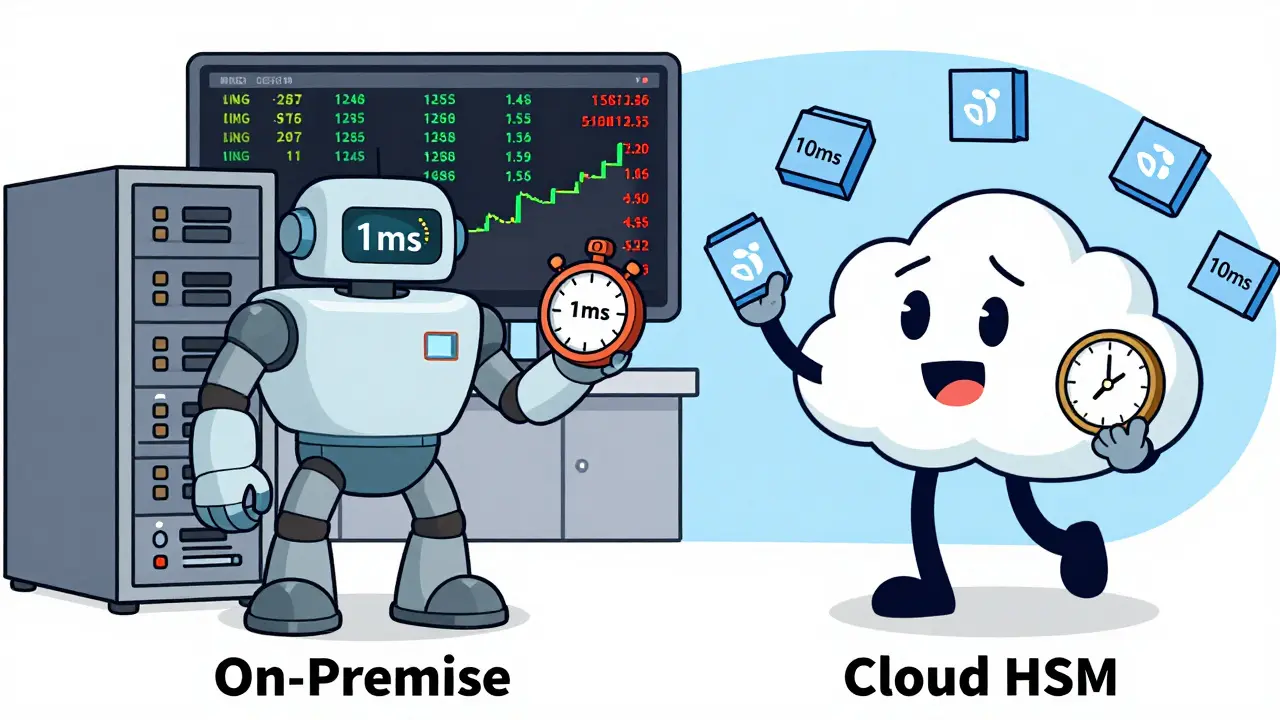
On-Premises vs. Cloud HSM Solutions
When selecting an HSM provider, exchanges face a choice between on-premises hardware and cloud-based services. Each option has distinct trade-offs regarding performance, cost, and control.
| Feature | On-Premises HSM (e.g., Thales Luna) | Cloud HSM (e.g., AWS CloudHSM) |
|---|---|---|
| Performance | High (20,000+ RSA signatures/sec) | Moderate (10,000 RSA signatures/sec) |
| Latency | 1-2 ms per operation | 5-10 ms per operation |
| Upfront Cost | High ($25,000+ per unit) | Low (Pay-as-you-go) |
| Ongoing Cost | Maintenance fees (15-20% annually) | $1.968 - $2.64 per hour |
| Data Sovereignty | Full control (keys stay in your data center) | Provider-controlled (keys in cloud region) |
| Scalability | Manual (requires purchasing new hardware) | Automatic (instant provisioning) |
On-premises solutions like the Thales Luna HSM series offer superior performance and lower latency, which is critical for high-frequency trading platforms processing thousands of transactions per minute. However, they require significant capital investment and dedicated engineering resources for maintenance. Cloud HSMs like AWS CloudHSM or Azure Dedicated HSM provide easier scalability and built-in disaster recovery through geographic replication. But they introduce network latency that can impact order book synchronization speeds.
A hybrid approach is becoming common. Many top exchanges use on-premises HSMs for hot wallets (active trading balances) to minimize latency, while using cloud HSMs for cold storage (long-term holdings) to leverage automated backup and redundancy.
Key Lifecycle Management Best Practices
Buying an HSM is only the first step. Proper key lifecycle management determines whether your system is truly secure. The lifecycle consists of six phases:
- Provisioning: Keys must be generated using true random number generators (TRNGs) within the HSM. Never generate keys on a host machine and import them.
- Deployment: Keys are assigned to specific roles (e.g., deposit address generation, withdrawal signing).
- Usage: Cryptographic operations are performed. Audit logs must record every request.
- Rotation: Keys should be rotated periodically according to organizational policy. Automated rotation scripts reduce human error.
- Archiving: Decommissioned keys are securely archived for future decryption needs (e.g., tax audits).
- Disposal: Old keys are cryptographically destroyed using secure erasure protocols.
A common mistake is treating all keys the same. Exchanges typically use a hybrid architecture where asymmetric keys (like RSA or ECDSA) control access to symmetric keys (like AES), which encrypt bulk data. This optimizes both security and performance. Additionally, multi-party authorization schemas are essential. A single engineer should never have the ability to sign a large withdrawal. Implementing a 3-of-5 multisignature scheme, where three out of five geographically distributed approvers must authorize a transaction, drastically reduces insider threat risks.

Integration Challenges and Technical Requirements
Integrating HSMs into existing exchange infrastructure is complex. Most HSMs communicate via the PKCS #11 standard interface. Developers need deep knowledge of this API to write efficient wrapper libraries. Poorly written integration code can become a bottleneck, negating the performance benefits of the HSM.
Common challenges include:
- Throughput Limits: During peak trading hours, exchanges may process over 1.4 million orders per second. Standard HSMs can struggle with this volume. Binance reported implementing specialized caching layers to handle peak loads.
- Learning Curve: Engineers often lack experience with cryptographic hardware. Thales surveys indicate that 68% of operators need 3+ months of dedicated training.
- Legacy System Compatibility: Older exchange engines may not support modern PKCS #11 versions, requiring costly refactoring.
To mitigate these issues, start with a clear key lifecycle policy before writing code. Use established SDKs provided by vendors like Thales or HID Global rather than building custom interfaces from scratch. And always test failover scenarios. HSM clusters must automatically switch to backup units if the primary node fails, ensuring 99.99% uptime.
Future Trends: Quantum Resistance and MPC
The threat landscape is evolving. As quantum computing advances, traditional encryption algorithms like RSA and ECC will become vulnerable. NIST is finalizing post-quantum cryptography standards, and HSM manufacturers are already adapting. Thales released Luna HSM 7.2 with support for CRYSTALS-Dilithium, a quantum-resistant algorithm. By 2026, exchanges must begin planning migration paths to quantum-safe HSMs to protect long-term cold storage assets.
Another major trend is the integration of Multi-Party Computation (MPC). Unlike traditional HSMs that store a single private key, MPC splits the key into shards held by different parties. No single party ever holds the complete key. Fireblocks reports that 78% of top 50 exchanges now use HSMs combined with MPC to eliminate single-point compromise risks. This technology allows for seamless key rotation without moving funds, further enhancing operational security.
What is the minimum FIPS certification level for a crypto exchange?
Exchanges should use at least FIPS 140-2 Level 3 certified HSMs. Level 3 provides resistance against physical tampering and is required by regulators like the NYDFS for virtual currency custody. Level 4 offers even higher protection but comes at a significantly higher cost.
Can I use a cloud HSM for high-frequency trading?
It depends on your latency tolerance. Cloud HSMs typically add 5-10ms of network latency per cryptographic operation, compared to 1-2ms for on-premises solutions. For ultra-high-frequency trading, on-premises HSMs are recommended. For standard spot markets, cloud HSMs are generally sufficient and offer better scalability.
How do HSMs prevent key theft during a server breach?
HSMs keep private keys isolated within a secure hardware boundary. Even if an attacker compromises the host server's operating system, they cannot extract the private keys. They can only send data to the HSM for signing, which requires proper authorization credentials that the attacker likely does not possess.
What is the role of PKCS #11 in HSM integration?
PKCS #11 is the standard application programming interface (API) used to interact with HSMs. It defines how software requests cryptographic operations like signing, encryption, and key generation from the hardware. Most commercial HSMs provide PKCS #11 drivers for Windows and Linux environments.
Is Multi-Party Computation (MPC) better than traditional HSMs?
MPC complements rather than replaces HSMs. Traditional HSMs protect a single key, which is a single point of failure. MPC splits the key into multiple shards, so no single device holds the complete key. Combining HSMs with MPC provides the highest level of security by eliminating single points of compromise and enabling seamless key rotation.