You hold a piece of paper with twelve words on it. To anyone else, it looks like a random grocery list gone wrong. But to you, those words are the master key to your entire digital life. Lose them, and your crypto is gone forever. Give them away, and someone else owns your money. This isn't just a backup; it's the cryptographic root of your identity in the blockchain world.
But how does a list of common English words turn into a complex mathematical string that controls billions of dollars? It’s not magic, and it’s not simple substitution. It’s a precise chain of cryptographic standards designed to bridge the gap between human memory and machine precision. Let’s pull back the curtain on seed phrases and see exactly how they generate private keys without ever actually containing them.
The Problem With Raw Private Keys
Before seed phrases existed, managing cryptocurrency was a nightmare for anyone who wasn’t a computer scientist. A standard Bitcoin private key is a 256-bit number. In hexadecimal format, that looks something like this:
B0183D69E6D87DC0FB6A5778633389F4453213303DA61F20BD67FC233AA33262
Try writing that down by hand. Now try reading it back months later. Did you swap an 'O' for a zero? Did you miss a character? If so, that key is useless. It points to nothing. You’ve lost access permanently. There is no "forgot password" link on the blockchain. There is no customer support team to call.
This fragility created a massive barrier to entry. People wanted to own their assets, but they couldn't reliably store the keys that controlled them. The solution had to be human-readable, error-resistant, and capable of generating multiple keys from a single source. That solution became known as the mnemonic seed phrase.
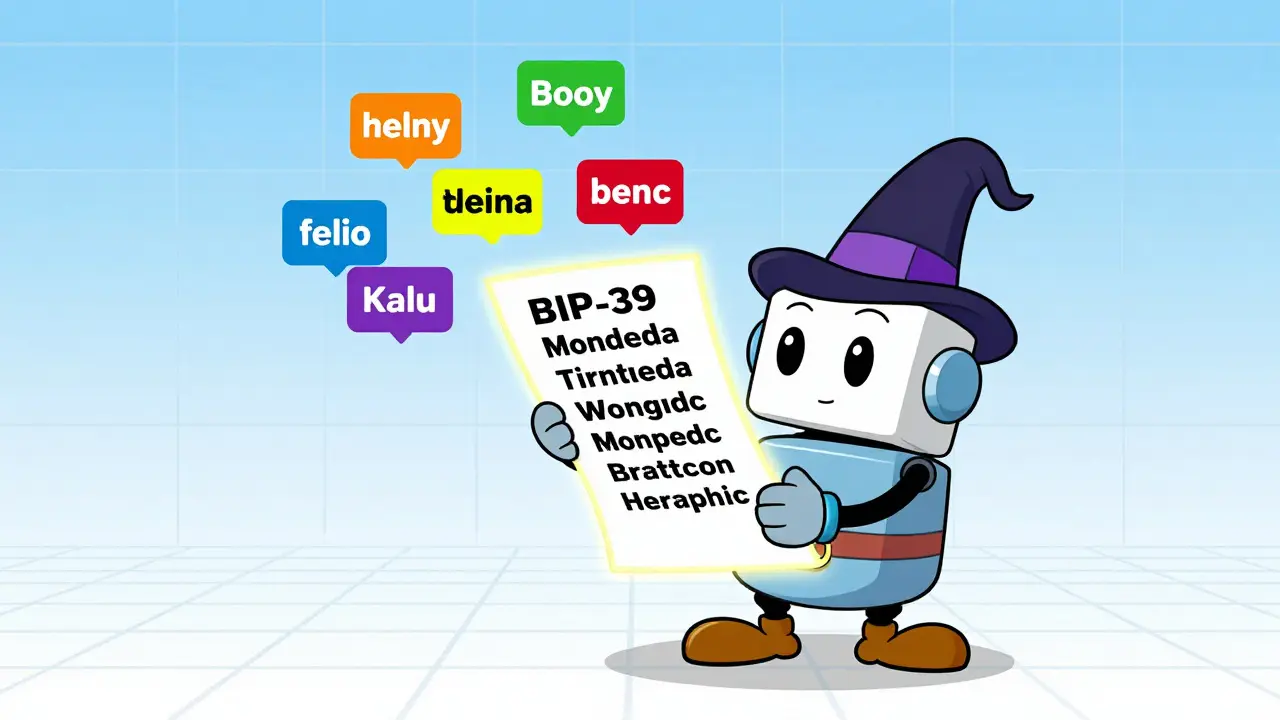
Enter BIP-39: Standardizing Human Memory
In 2013, a group including Marek Palatinus (Slush) and Pavol Rusnak from SatoshiLabs proposed BIP-39 Bitcoin Improvement Proposal 39, which standardized the creation of mnemonic seeds. Before this, different wallets used different methods, meaning you couldn't necessarily recover your funds if you switched software. BIP-39 created a universal language.
The core innovation of BIP-39 is the wordlist. It contains exactly 2,048 words. Why 2,048? Because $2^{11} = 2048$. Each word represents an 11-bit segment of data. By using words instead of raw binary or hex, the system gains two critical advantages:
- Human Readability: Words are easier to read, write, and remember than random characters.
- Error Correction: The first four letters of every word in the BIP-39 list are unique. If you write "abandon" but mean "about," the wallet knows immediately because no other word starts with "abou." This prevents silent failures where a typo leads to a dead address.
This standardization means that a seed phrase generated by a MetaMask wallet can theoretically recover funds in a Trezor device, provided both follow the same derivation paths. It created interoperability in a fragmented industry.
From Entropy to Words: The Generation Process
So, how do we get from randomness to those 12 words? The process is strictly defined and involves several cryptographic steps.
- Generate Entropy: Your wallet generates a sequence of random bits. For a 12-word phrase, it creates 128 bits of entropy. For a 24-word phrase, it creates 256 bits. This entropy must come from a high-quality random number generator (RNG). If the RNG is flawed, your security is compromised before you even start.
- Create Checksum: The wallet hashes the entropy using SHA-256. It then takes the first few bits of that hash (4 bits for 12 words, 8 bits for 24 words) and appends them to the end of the original entropy. This checksum acts as a validation code. If you mistype a word during recovery, the checksum won't match, and the wallet will reject the input.
- Split Into Segments: The combined string of entropy + checksum is divided into chunks of 11 bits each.
- Map To Words: Each 11-bit chunk is treated as a number between 0 and 2047. That number corresponds to an index in the BIP-39 wordlist. Index 0 is "abandon," index 1 is "ability," and so on.
The result is your seed phrase. Crucially, this phrase is not the private key itself. It is a representation of the seed data needed to derive it.
Deriving the Master Key: PBKDF2 and HMAC-SHA512
Once you have the words, the wallet doesn't just look them up and spit out a key. It runs them through a key derivation function. Specifically, it uses PBKDF2 Password-Based Key Derivation Function 2, which adds computational cost to brute-force attacks.
Here’s what happens inside the software:
- Input: Your mnemonic phrase becomes the "password."
- Salt: The salt is the string "mnemonic" concatenated with an optional passphrase you might add (often called the 25th word).
- Process: The function applies HMAC-SHA512 to this combination 2048 times. This repetition is intentional. It makes it slow and computationally expensive to guess the seed if someone stole your phrase but didn't have the passphrase.
The output is a 512-bit seed. This is the true master key. It never leaves the secure environment of your wallet software or hardware device. This 512-bit seed is then split into two halves: one becomes the master private key, and the other becomes the master chain code.
HD Wallets: One Seed, Infinite Keys
This is where the real power lies. Thanks to BIP-32 Hierarchical Deterministic (HD) wallet standard, which allows deriving child keys from parent keys, that single master seed can generate an infinite tree of private keys.
You don't need a new seed phrase for every transaction or every coin. Instead, the wallet uses a derivation path. Think of it like a file directory structure:
m / purpose / coin_type / account / change / address_index
For example, a common Ethereum path is m/44'/60'/0'/0/0. The wallet takes the master seed, applies a specific algorithm using the chain code, and derives a private key for that exact path. Change the last number to 1, and you get a completely different private key for a new address. All derived from the same 12 words.
This solves the backup problem elegantly. You back up one phrase, and you recover thousands of addresses across Bitcoin, Ethereum, Litecoin, and more. As long as the wallet supports the correct derivation path (defined by BIP-44 Standard for multi-currency HD wallet structures), your funds are accessible.
| Feature | Seed Phrase (Mnemonic) | Private Key |
|---|---|---|
| Format | 12 or 24 words | 64-character Hex String |
| Function | Generates all keys in a wallet | Controls a single address |
| Security Level | 128 or 256 bits (depending on length) | 256 bits |
| Error Tolerance | High (Checksum validates) | Zero (One typo = loss) |
| Recovery Scope | Entire wallet ecosystem | Single address only |
Why Security Is Still Your Responsibility
Understanding the tech helps you respect the risk. A 12-word phrase has $2048^{12}$ possible combinations. Mathematically, that’s roughly $2^{132}$ possibilities. Even though 4 bits are used for checksums, leaving 128 bits of actual entropy, this is cryptographically secure. No supercomputer can brute-force it.
However, the weak link is rarely the math. It’s the user. Security researcher Dan Guido noted that 90% of seed phrase compromises happen through physical exposure, not cryptographic breaks. People take photos of their phrases. They save them in cloud notes. They type them into fake websites.
If an attacker gets your seed phrase, they don't need to hack your wallet. They can import those 12 words into any compatible wallet software and drain every derived address instantly. The protocol assumes the seed is secret. If it’s not, the security model collapses.
Best Practices for Storage
Since the seed phrase is the ultimate authority, its storage must reflect that value. Here is how professionals approach it:
- No Digital Copies: Never store your seed phrase on a computer, phone, or cloud service. If it’s online, it’s vulnerable to malware and phishing.
- Physical Media: Write it on acid-free paper or engrave it on metal. Metal backups (like CryptoSteel) protect against fire, water, and decay. Paper burns; steel survives.
- Geographic Separation: Keep copies in different locations. A house fire or flood shouldn't destroy all your backups. Store one at home, one in a safe deposit box.
- Verify Accuracy: When you create a new wallet, many services ask you to select words in order. Don’t skip this. Mistakes here are irreversible.
Remember, the blockchain doesn't care about your intent. It only cares about the signature. If you sign a transaction with the private key derived from your seed, the network accepts it. Period.
The Future: Beyond Simple Phrases
The landscape is evolving. While BIP-39 remains the standard, new proposals aim to improve usability and security further. BIP-85 Allows deterministic derivation of secondary seed phrases from a master seed lets you create separate "sub-seeds" for different purposes (like trading vs. savings) without needing extra paper backups. These sub-seeds are derived from the main one, so losing the main seed still recovers everything.
Additionally, institutions are moving toward Multi-Party Computation (MPC), where the private key is never assembled in one place. Instead, fragments are held by different parties or devices. For retail users, however, the seed phrase remains the gold standard for self-custody. It’s simple, proven, and gives you total control.
As you navigate the crypto space, remember: not your keys, not your coins. But also, not your seed, not your keys. Understand the mechanism, respect the entropy, and guard your words as if they were gold-because in many ways, they are.
Can I use my own words for a seed phrase?
No. You must use the official BIP-39 wordlist. Humans are terrible at generating true randomness. If you pick your own words, the entropy is low, making your wallet vulnerable to brute-force attacks. Always let the wallet generate the phrase for you.
Is a 24-word phrase more secure than a 12-word one?
Yes, but marginally. A 12-word phrase provides 128 bits of security, which is already considered unbreakable with current technology. A 24-word phrase provides 256 bits of security. The extra length mainly offers better protection against physical damage (if you lose a few words) and future-proofing against quantum computing threats.
What happens if I mistype one word during recovery?
The wallet will likely reject the phrase immediately. The checksum bits included in the generation process allow the software to detect errors. If the checksum doesn't match, the wallet knows the phrase is invalid and won't attempt to derive keys, preventing you from accidentally accessing the wrong wallet.
Do different cryptocurrencies use different seed phrases?
Not necessarily. Most modern wallets use the same BIP-39 seed phrase for multiple currencies. However, they use different derivation paths (BIP-44) to generate the specific addresses for Bitcoin, Ethereum, etc. Make sure your new wallet supports the same derivation path as your old one to recover funds correctly.
Can a hacker steal my seed phrase from my device?
If your device is infected with malware, yes. Malware can record your keystrokes or screen content while you enter your seed phrase. This is why hardware wallets are recommended-they keep the seed phrase isolated from your internet-connected computer, ensuring it never leaves the secure element of the device.