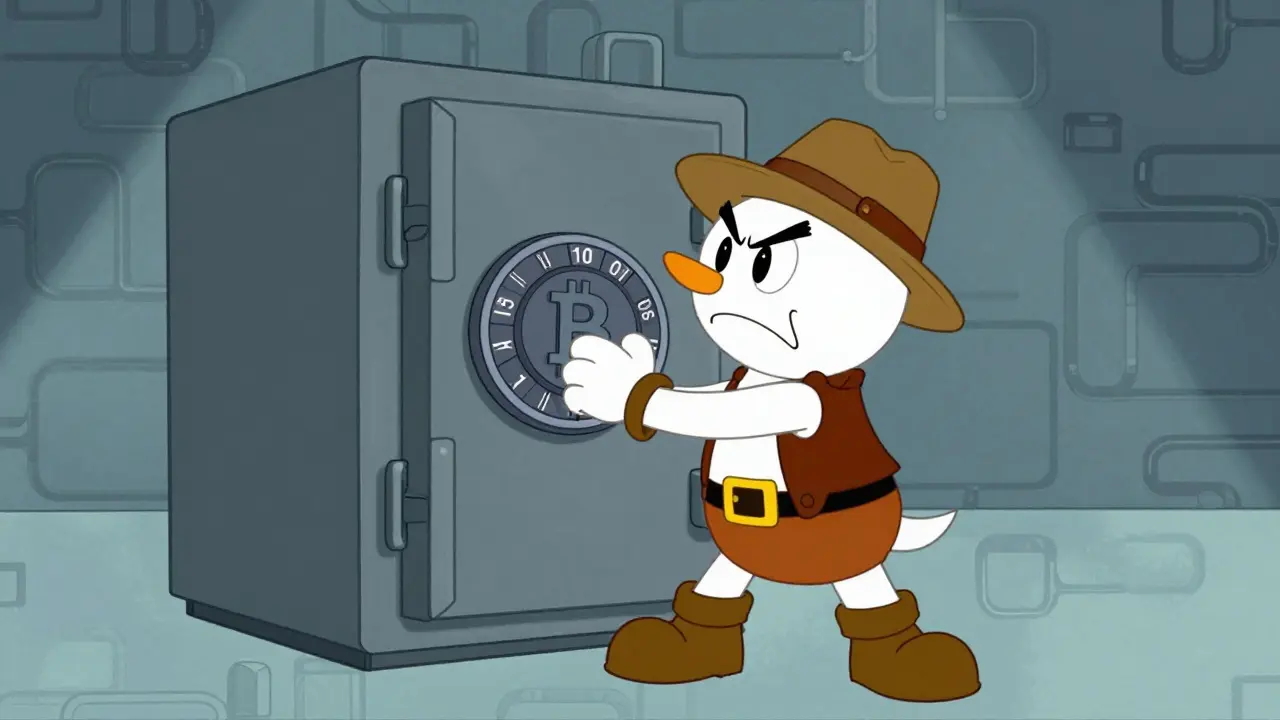
Imagine trying to open a safe by spinning the dial. You don't know the combination. You just keep turning it, checking if the lock clicks open. In the world of Bitcoin, a decentralized digital currency secured by cryptographic proof-of-work, miners are doing exactly that. But instead of a physical dial, they are spinning a digital number called a nonce, a 32-bit arbitrary number used once in block creation to generate a valid hash. Finding the correct nonce is the core mechanism that secures the blockchain, prevents double-spending, and rewards miners with new coins. It sounds simple, but the reality involves billions of calculations per second and complex workarounds when the numbers run out.
The Core Concept: What Is a Nonce?
To understand how miners find the correct nonce, you first need to know what it actually is. The term "nonce" comes from the phrase "number used once." In cryptography, it’s a random or semi-random number that has no inherent meaning other than its role in securing a specific transaction or block. In Bitcoin’s protocol, defined in Satoshi Nakamoto’s 2008 whitepaper, the nonce is a 4-byte field within the block header.
This might seem small. Four bytes can only hold values between 0 and 4,294,967,295 (roughly 4.3 billion). That’s not a huge range for modern computers. However, the goal isn’t just to pick any number. The miner must find a nonce that, when combined with the rest of the block data, produces a SHA-256 hash, a cryptographic output generated by the Secure Hash Algorithm that is unique to the input data meeting a specific target. This target is determined by the network’s difficulty level. As of late 2024, Bitcoin’s difficulty required hashes to start with roughly 19 leading zeros. The odds of hitting this randomly are astronomical-like finding one specific grain of sand on all the beaches in the world.
The Step-by-Step Mining Process
So, how does a miner actually go about finding this needle in a haystack? The process is mechanical, repetitive, and incredibly fast. Here is what happens inside an ASIC miner:
- Assemble the Block Header: The miner gathers pending transactions from the mempool, calculates the Merkle root (a summary of all transactions), adds the hash of the previous block, sets the timestamp, and selects a version number.
- Initialize the Nonce: The miner starts with a nonce value, usually zero.
- Hash the Header: The miner runs the entire block header through the SHA-256 algorithm twice (double-SHA-256).
- Check the Result: Does the resulting hash meet the difficulty target (i.e., have enough leading zeros)? If yes, the block is solved. If no, proceed to step 5.
- Increment and Repeat: The miner increases the nonce by one (0 → 1 → 2...) and hashes again. This loop continues until a valid hash is found or the nonce space is exhausted.
With modern Application-Specific Integrated Circuit (ASIC) miners like the Bitmain Antminer S21, which can perform over 335 terahashes per second, this cycle happens billions of times in a fraction of a second. A single miner can exhaust the entire 4.3-billion nonce range in less than a second. If they haven’t found a solution by then, they have to change their strategy.
When the Nonce Runs Out: Extra Nonces
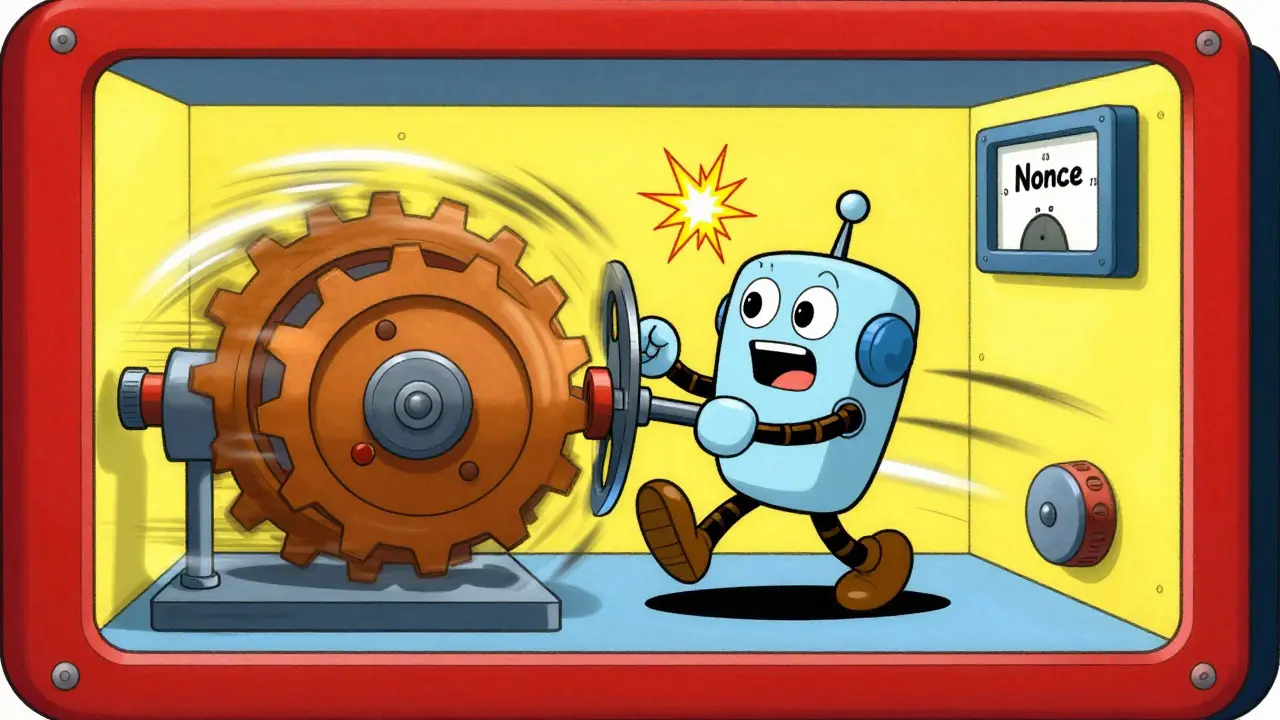
Here is where the original design meets modern hardware limitations. Since the 4-byte nonce field is so small, miners often burn through all possible values without finding a valid block. They can’t just keep counting up; they hit the ceiling at 4,294,967,295.
To solve this, miners use what is known as an "extra nonce." This isn’t a separate field in the block header itself, but rather a workaround using other mutable parts of the block. The most common method involves modifying the coinbase transaction, the first transaction in a block that allows the miner to claim the block reward and fees. Specifically, they alter the "scriptSig" or extra nonce field within the coinbase transaction. Changing even a single byte here completely changes the Merkle root of the block. A new Merkle root means a new block header, which resets the nonce counter back to zero. Now the miner has a fresh set of 4.3 billion possibilities to explore.
Miners also tweak the timestamp field. The protocol allows timestamps to drift slightly (within a two-hour window relative to the median time of previous blocks). By adjusting the seconds or minutes, miners create another variation in the header. Additionally, some advanced techniques manipulate the version field, though this is less common due to protocol constraints. Essentially, miners are dancing around the block header, tweaking every available variable to keep the hashing engine fed with new combinations.
Why Is This So Hard? The Difficulty Adjustment
You might wonder why miners can’t just build faster computers to solve this instantly. The answer lies in Bitcoin’s difficulty adjustment mechanism. The network is designed to produce one block every 10 minutes, regardless of how much computing power is added. Every 2,016 blocks (approximately every two weeks), the protocol automatically adjusts the target threshold.
If blocks are being found too quickly, the target becomes stricter (requiring more leading zeros). If they’re too slow, it loosens. As of December 2024, the global network hashrate exceeded 180 exahashes per second. To maintain the 10-minute interval, the difficulty was set such that the probability of finding a valid hash with a single attempt was infinitesimally small. This ensures that finding a nonce remains a lottery based on computational share, not speed alone. It creates a predictable issuance rate for Bitcoin, acting as a monetary policy enforced by code.
| Metric | Value / Description | Impact on Nonce Finding |
|---|---|---|
| Nonce Size | 4 bytes (32 bits) | Limits attempts to ~4.3 billion before requiring extra nonce adjustments. |
| Global Hashrate (Dec 2024) | ~180 EH/s | Requires extreme difficulty targets; individual miners have negligible chance of solo success. |
| Average Block Time | 10 minutes | Target adjusted every 2,016 blocks to maintain this average. |
| Algorithm | SHA-256 | Deterministic and asymmetric; easy to verify, hard to solve. |
| Extra Nonce Source | Coinbase Transaction | Provides infinite entropy by changing the Merkle root, resetting the nonce search space. |
The Economics and Reality of Modern Mining
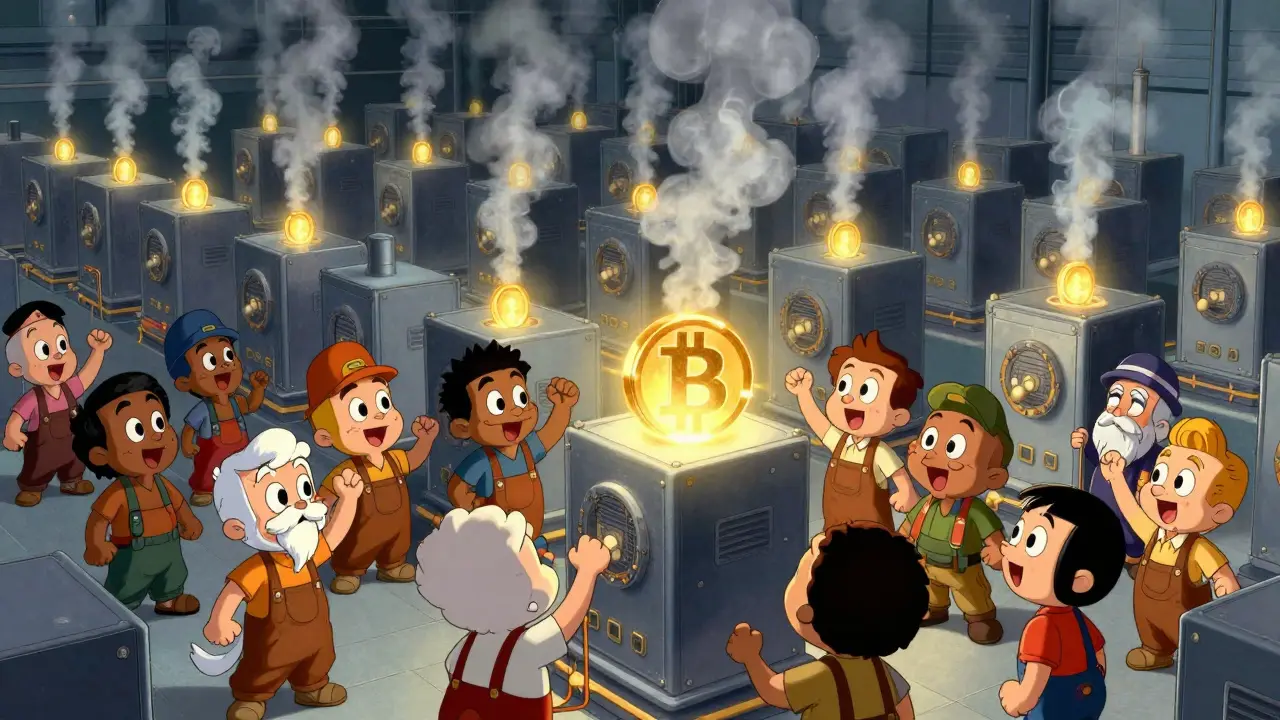
Finding the correct nonce is no longer a hobbyist activity done on a laptop. It is an industrial-scale operation. The energy consumption required to perform these trillions of hash attempts is massive. According to the Cambridge Bitcoin Electricity Consumption Index, the network consumes over 120 terawatt-hours annually, comparable to the energy usage of countries like Argentina.
For individual miners, the "luck factor" is real. Even with high-end hardware, you might mine for weeks without finding a block. This is why most miners join pools. Pool mining aggregates the hashrate of thousands of miners. When the pool finds a valid nonce, the reward is distributed among participants based on the number of "shares" they submitted. A share is essentially a partial proof of work-a hash that meets a lower difficulty target set by the pool. This provides miners with steady, smaller payouts rather than waiting months or years for a full block reward.
The centralization of mining power is a growing concern. Large pools like Foundry USA and Antpool control significant portions of the global hashrate. While the nonce-finding mechanism itself remains decentralized in theory, the economic barriers to entry mean that professional operations dominate. Innovations like merged mining and improvements in firmware efficiency (such as Braiins OS+) help miners squeeze out every bit of performance, but the fundamental challenge remains: you need immense computational power to compete in the nonce lottery.
Future Outlook: Beyond Proof-of-Work
While Bitcoin sticks to its roots, other blockchains have moved away from nonce-based mining. Ethereum, for example, transitioned to proof-of-stake in September 2022. In proof-of-stake, validators are chosen to create blocks based on the amount of cryptocurrency they hold and are willing to "stake" as collateral, eliminating the need for energy-intensive nonce guessing entirely.
However, Bitcoin’s reliance on the nonce and proof-of-work is considered its greatest security feature. The sheer cost of attacking the network-requiring 51% of the global hashrate-makes it economically unfeasible for malicious actors. As long as the value of Bitcoin justifies the energy expenditure, miners will continue to hunt for the correct nonce, securing the network one hash at a time. Proposed upgrades like the Miner Extended Commitment Field (MECF) aim to expand the entropy space further, reducing the frequency of header modifications, but the core principle remains unchanged: security through computational effort.
What happens if a miner finds the correct nonce?
When a miner finds a nonce that produces a hash below the network's difficulty target, they broadcast the new block to the network. Other nodes verify the hash and the validity of the transactions. If accepted, the block is added to the blockchain, and the miner receives the block reward (currently 6.25 BTC plus transaction fees). This event effectively "solves" the puzzle for that block.
Why is the nonce field only 4 bytes?
The 4-byte limit was part of the original Bitcoin protocol design by Satoshi Nakamoto. At the time, it was sufficient because computational power was low. Today, it is too small for modern ASICs, which is why miners rely on "extra nonces" in the coinbase transaction to generate additional variations. Changing the block header structure now would require a hard fork, which the community is hesitant to do.
Can I mine Bitcoin with my home computer?
Technically, yes, but economically, no. The difficulty is so high that a standard CPU or GPU will likely never find a valid nonce. You would spend more on electricity than you would earn in rewards. Solo mining is only viable for those with access to cheap electricity and industrial-grade ASIC hardware, and even then, joining a pool is recommended for consistent returns.
What is the difference between a nonce and a hash?
The nonce is an input variable that the miner changes. The hash is the output produced by running the block header (including the nonce) through the SHA-256 algorithm. The goal is to find a specific nonce that results in a hash meeting the network's difficulty criteria. Think of the nonce as the combination you try, and the hash as the result indicating whether the safe opened.
Does Ethereum still use nonces for mining?
No. Ethereum transitioned from proof-of-work to proof-of-stake in September 2022 during "The Merge." In proof-of-stake, there is no mining, no nonce guessing, and no energy-intensive hashing competition. Validators are selected probabilistically based on their staked ETH, making the concept of a mining nonce obsolete on the Ethereum mainnet.