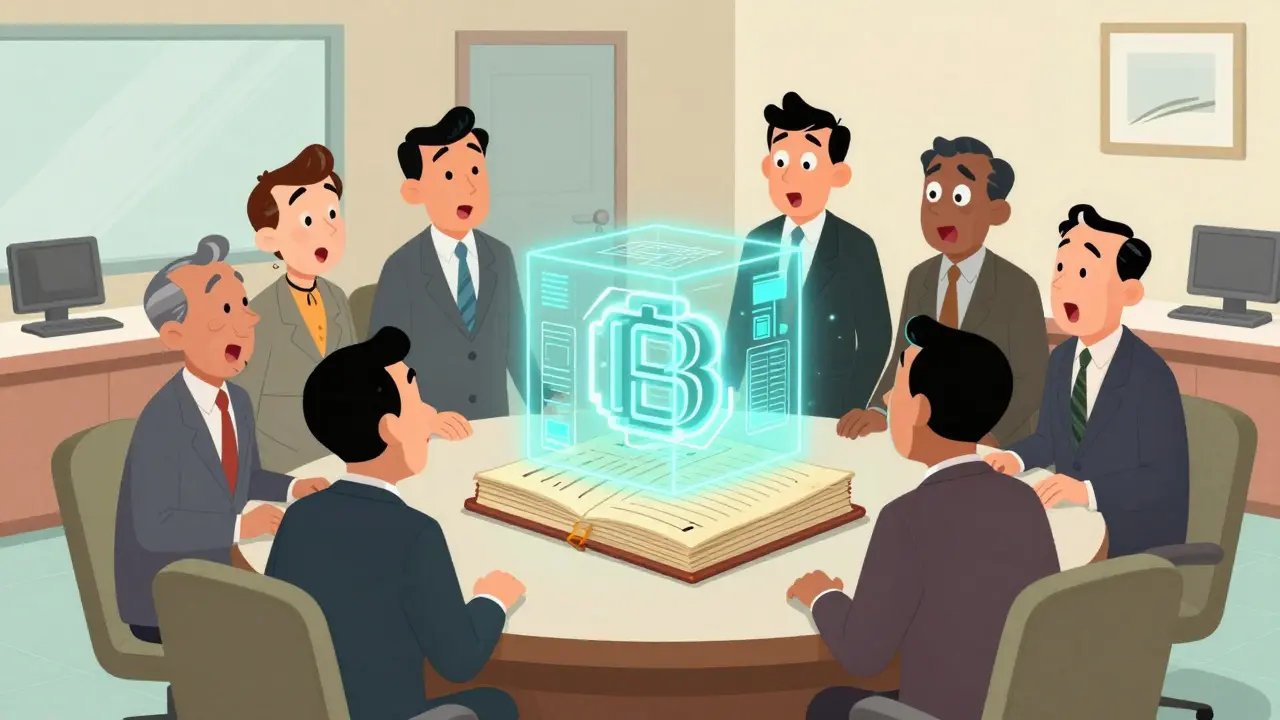
For years, the big banks treated blockchain like a weird science experiment-something to talk about in a slide deck but not actually put into production. That changed. By 2026, we've moved past the "experiment" phase. Roughly 90% of major financial institutions are no longer just asking what blockchain is; they are actively deploying it to move money, manage assets, and cut out the middleman. The shift is massive: the blockchain in finance market, which sat at $8.1 billion in 2023, is now sprinting toward a projected $80.2 billion by 2032.
But this isn't just about Bitcoin or hype. It's about efficiency. Banks are tired of settlement times that take days and fees that eat into margins. They are looking for a way to make money move as fast as an email. The real story here is financial institution blockchain adoption, where the goal is to replace clunky legacy systems with a shared, digital ledger that everyone trusts.
The Big Move: Turning Real Assets Into Tokens
One of the most impactful changes is Asset Tokenization is the process of converting rights to a real-world asset into a digital token on a blockchain. Think of it as taking a physical building, a piece of gold, or a private equity fund and breaking it into millions of tiny, digital pieces that can be traded instantly.
BlackRock has already led the charge here with tokenized funds, proving that the world's largest asset managers see the value. Why does this matter? Because it unlocks liquidity. Normally, selling a piece of commercial real estate takes months of paperwork and legal headaches. With tokenization, that asset can be traded in seconds. Experts predict that tokenization could push capital markets to over $16 trillion by 2030.
This isn't just for the ultra-wealthy. By breaking assets into smaller fractions, banks can offer "fractional ownership," allowing regular investors to put small amounts of money into high-yield private markets that were previously locked behind a multi-million dollar entry fee.
Fixing the Nightmare of Cross-Border Payments
If you've ever sent money to another country, you know the pain: high fees, "intermediary banks" taking a cut, and a waiting period that feels like an eternity. Traditional networks like SWIFT are reliable, but they're slow. Blockchain changes the math by allowing for near-instant settlement.
Financial giants are using specific tools to kill the wait time. For example, JPM Coin is a permissioned blockchain platform designed for JPMorgan's institutional clients to transfer payments instantaneously. Similarly, RippleNet provides the infrastructure for banks to settle cross-border transactions in seconds rather than days.
| Feature | Traditional Banking (SWIFT) | Blockchain Solutions |
|---|---|---|
| Settlement Time | 1-5 Business Days | Seconds to Minutes |
| Cost Structure | High (Multiple Intermediaries) | Low (Direct Peer-to-Peer) |
| Availability | Banking Hours Only | 24/7/365 |
| Transparency | Opaque until completion | Real-time on-chain tracking |

The Rise of Institutional DeFi
For a long time, DeFi (Decentralized Finance) was the wild west-full of anonymous users and risky protocols. But the banks have found a way in. They aren't necessarily using public, permissionless chains for everything, but they are adopting the logic of DeFi: automated lending and borrowing via smart contracts.
The numbers are staggering. Total borrowing in the DeFi sector has surged by 959% since 2022, hitting $19.1 billion. Platforms like Aave, an Ethereum-based lending protocol, have become a benchmark for institutional participation, holding a dominant 45% market share as of mid-2025. Banks are using these protocols to manage liquidity more efficiently, allowing them to lend and borrow assets without needing a manual underwriting process for every single transaction.
This is often referred to as "Permissioned DeFi." It gives banks the efficiency of a smart contract but adds a layer of KYC (Know Your Customer) and AML (Anti-Money Laundering) checks to satisfy regulators. They get the speed of the blockchain without the legal risk of dealing with anonymous wallets.
CBDCs and the New Monetary Infrastructure
Governments aren't sitting on the sidelines. The emergence of CBDCs (Central Bank Digital Currencies) is perhaps the biggest catalyst for infrastructure upgrades. Unlike Bitcoin, a CBDC is a digital form of a country's sovereign currency, issued and regulated by the central bank.
Why should a regular bank care about CBDCs? Because they provide the "rails" for everything else. When a central bank launches a digital currency, it forces every commercial bank to upgrade its tech stack. This makes it much easier for banks to integrate stablecoins and other digital assets into their existing systems. France has already positioned itself as a leader here, with its central bank driving aggressive adoption initiatives that other European nations are now mimicking.
The strategic risk for banks is high. If a bank doesn't issue its own digital versions of assets or stablecoins, it risks losing the deposits that serve as its reserves. In a world where money moves instantly, a slow bank is a dead bank.

The Reality Check: Why Isn't Everything on Blockchain Yet?
If the benefits are so great, why is the transition taking years? Because banks are running on "legacy code"-software from the 1980s and 90s that is terrifying to touch. Integrating a cutting-edge blockchain ledger with a 30-year-old mainframe is like trying to plug a Tesla charger into a steam engine.
Beyond the tech, there is the regulatory headache. Banks operate in a world of strict rules. Moving to a decentralized system creates a paradox: how do you have a "distributed" ledger while still maintaining a central point of accountability for the law? This is why we see so many "consortiums," where banks team up to create private blockchains. They want the tech, but they want to keep the keys.
We also can't ignore scalability. While Ethereum and other chains have improved, handling the volume of the global financial system-trillions of dollars in daily volume-requires a level of throughput that is still being perfected. However, the trend is clear: the cost of *not* adopting blockchain is now higher than the cost of the implementation struggle.
Will blockchain replace traditional banks?
Not exactly. Instead of replacing banks, blockchain is replacing the *plumbing* banks use. Banks will still manage accounts and provide loans, but they will do it using blockchain as the underlying ledger to make things faster and cheaper.
Is asset tokenization safe for investors?
When handled by regulated institutions like BlackRock or JPMorgan, yes. The safety comes from the legal framework backing the token. The token is just a digital receipt for a real-world asset that is still legally owned and protected by standard securities laws.
What is the difference between a CBDC and a Stablecoin?
A CBDC is issued by a government (like the Federal Reserve) and is legal tender. A stablecoin is usually issued by a private company (like Circle or Tether) and maintains its value by backing it with reserves, such as US dollars or Treasury bills.
How does blockchain reduce costs in trade finance?
Trade finance usually involves a mountain of paper documents (bills of lading, letters of credit) moving between exporters, importers, and banks. Blockchain digitizes these documents into a single shared record, removing the need for manual verification and courier services, which can add trillions in efficiency gains by 2030.
Do I need to know how to code to understand institutional blockchain?
Not at all. For most people, the blockchain part will be invisible. You'll just notice that your international transfer arrived in seconds instead of days, or that you can buy a fraction of a high-end rental property through your banking app.
What Happens Next?
If you are a business owner or an investor, the next few years will be about "on-ramping." You'll likely start seeing your bank offer digital asset custody-essentially a secure vault for your tokens. From there, expect to see a shift where your traditional bank account and your digital wallet merge into one interface.
For those in the industry, the priority is now the "last mile" of integration. The pilots are over. The focus is now on scaling these systems to handle millions of users without crashing and ensuring that the regulatory framework in the US and EU keeps pace with the tech. We are moving toward a world where the financial system doesn't close on weekends and money moves at the speed of light.
Noel Mandotah
April 28, 2026 AT 18:34Oh wow, a "digital ledger." How revolutionary. 🙄 It's basically just a fancy database with a marketing budget. Groundbreaking stuff!
debra hoskins
April 29, 2026 AT 12:24The whole notion of "liquidity" in this context is a mirage. Wrapping a stagnant asset in a digital cloak doesnt magically make it desirable or liquid. It just makes the bubble more colorful.
Pramendra Singh
April 30, 2026 AT 07:09It is truly heartening to see how this technology can bridge gaps between different economies. Hopefully, this leads to more inclusive financial growth for everyone involved.
Kathleen Warren
May 1, 2026 AT 19:35I think it's really nice that regular people can finally get into these big investments. It feels like the doors are finally opening for everyone, not just the super rich.
Wayne Gillis
May 3, 2026 AT 02:55YOOO! 🚀 This is insane! I wonder if my local credit union is doing this yet? I bet they're still using fax machines lol! 😂 Imagine buying 0.0001% of a skyscraper in Miami! 🌴🏙️ Let's goooo!
Amanda Macy
May 3, 2026 AT 09:03We are essentially redefining the nature of trust. By moving trust from an institution's reputation to a mathematical proof, we change the social contract of finance itself. It is a subtle but profound shift in how humanity perceives value and ownership over time.
Chloe Fletcher
May 4, 2026 AT 15:02This is a total game changer! 🌟 We need to keep pushing for these upgrades because the old system is just too slow. It's time for the banks to step up or get left behind! 💪🔥
Ralph Espinosa
May 4, 2026 AT 21:40I completely agree with the points made here!!! The integration of CBDCs will likely be the catalyst that forces the most stubborn institutions to modernize their stacks!!! It is an exciting time for fintech!!!
Mitali Rajvanshi
May 5, 2026 AT 04:54The focus on permissioned DeFi makes sense for the big players. It's a safe middle ground for them to test the waters without risking everything.
Aaron Zeiler
May 5, 2026 AT 08:17Wait, actually... let me dive deeper into the tokenization part. When you look at the current infrastructure, the real magic isn't just the token itself but the smart contracts that automate compliance. Imagine a world where dividends are paid out automatically the millisecond they are earned, without any human intervention. We're talking about an entirely new layer of financial automation. This means lower overhead for the funds, which theoretically should lead to lower fees for us. But, of course, banks will try to keep those fees high as long as they can. The real fight will be over who controls the 'oracle' that feeds real-world data into the blockchain. If the data is wrong, the token is worthless. That's the vulnerability. We need decentralized oracles to make this truly robust. Otherwise, we're just trading one centralized point of failure for another. But overall, the move toward T+0 settlement is the only thing that actually matters here. Everything else is just dressing. If I can move a billion dollars in a second, the rest of the plumbing is secondary. It's all about the velocity of capital in the end. That's where the real power lies.