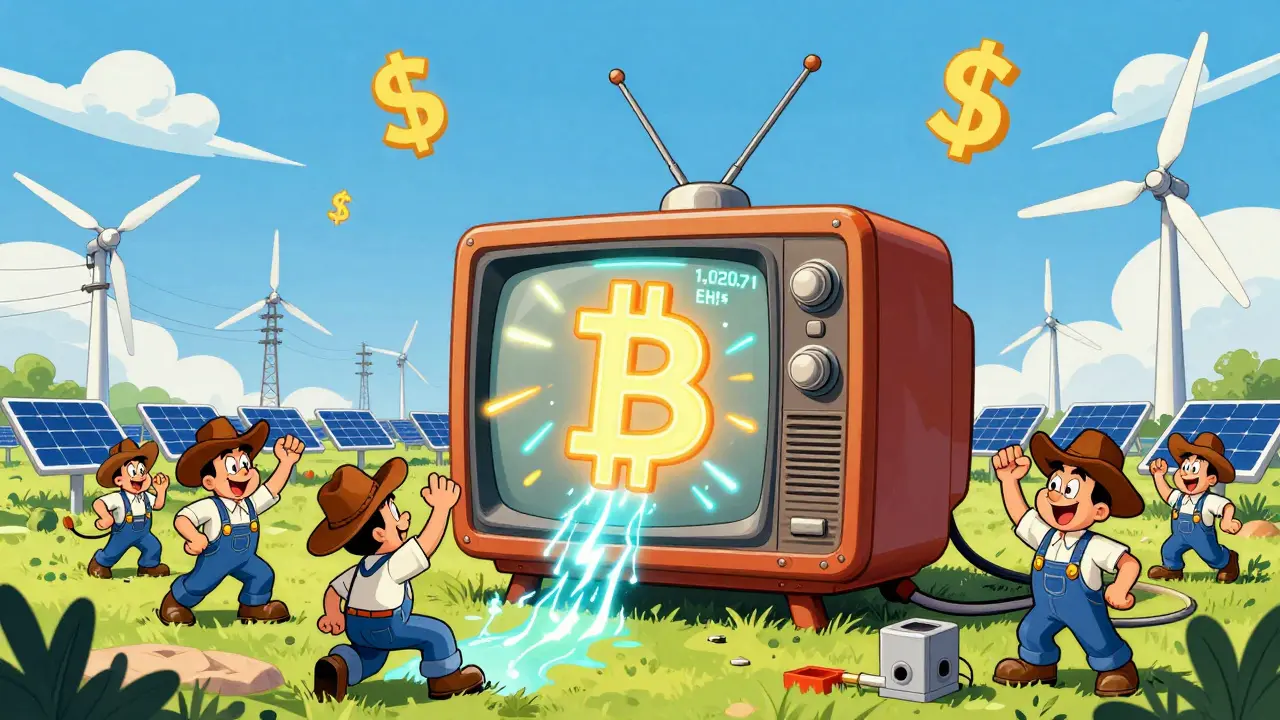
Bitcoin isn’t just digital money-it’s a global machine. And like any machine, it needs power. Not electricity alone, but computational power-massive amounts of it-running nonstop to keep the network secure and transactions confirmed. That’s the hash rate. And where that power comes from tells you more about Bitcoin’s future than any price chart ever could.
What Is Bitcoin Hash Rate, Really?
Think of the Bitcoin network as a giant, global computer. Every second, thousands of machines-called ASIC miners-are racing to solve complex math problems. The faster they solve them, the more secure the network becomes. The total speed of all these machines combined? That’s the hash rate. It’s measured in exahashes per second (EH/s). As of October 2025, the network is humming along at around 1,020.71 EH/s. That’s over a quintillion calculations per second.
This number isn’t static. It jumps up and down based on electricity prices, new mining gear hitting the market, and even weather. When Bitcoin’s difficulty adjusts every two weeks, miners either ramp up or shut down based on whether they’re still making money. The all-time high? 1,441.84 EH/s, hit in September 2025. That’s more than double what it was just five years ago.
Why Geography Matters More Than Ever
Early Bitcoin mining happened on home PCs. Then it moved to garages. Then warehouses. Today, it’s all about scale. And scale means energy. And energy means location.
Miners don’t care about borders. They care about cheap electricity, stable regulations, and reliable cooling. That’s why the map of Bitcoin mining has completely changed since 2021. Before then, China controlled over 60% of the hash rate, mostly because of subsidized coal power in Xinjiang and cheap hydropower in Sichuan. When China banned mining overnight in June 2021, the whole network dropped by nearly half. But it didn’t die-it relocated.
Today, the world’s mining power is spread across just a handful of countries. And the distribution tells a story about power, policy, and profit.
The Top Five Countries Controlling Bitcoin’s Mining Power
As of October 2025, here’s where the hash rate actually lives:
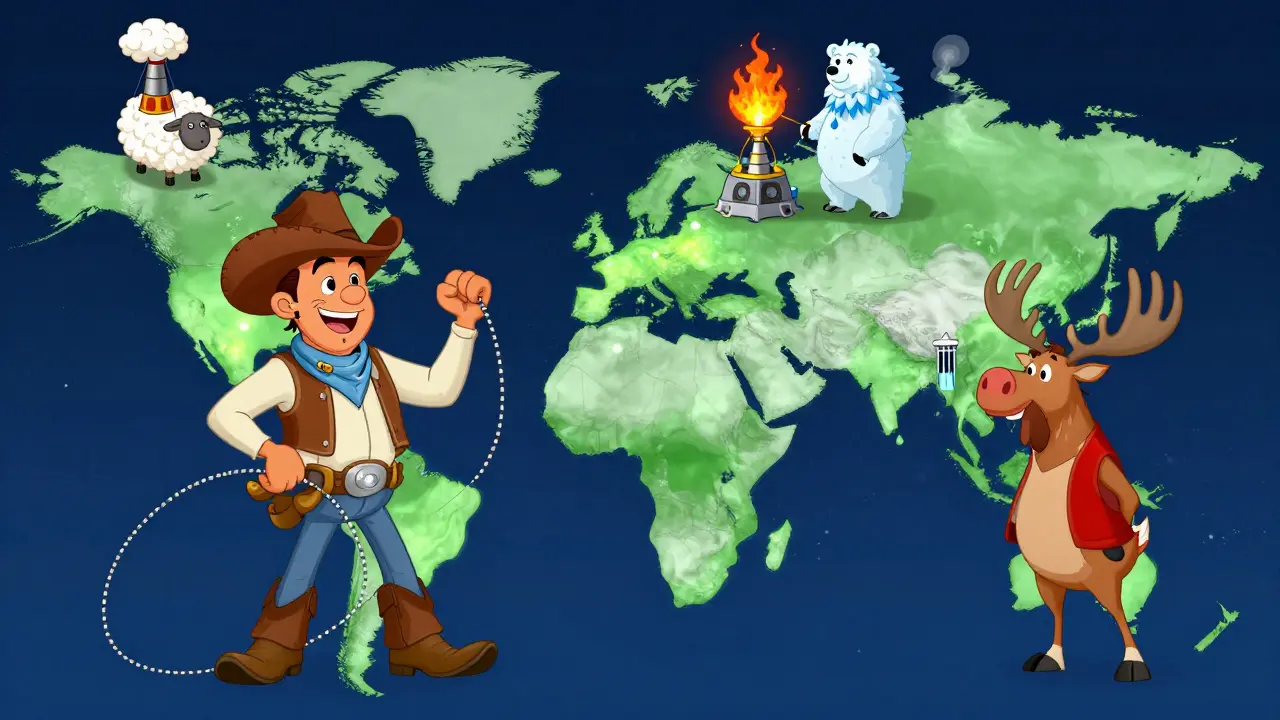
- United States: 44% - The undisputed leader. Texas alone accounts for nearly 25% of the global total, thanks to deregulated energy markets, abundant wind and solar power, and tax incentives. Miners flock to places like Fort Worth and Abilene, where they can plug directly into the grid during off-peak hours and even sell excess heat to greenhouses.
- Kazakhstan: 12% - Once a top-three miner, Kazakhstan still holds strong. Low electricity costs and government tax breaks attracted miners after China’s ban. But recent regulatory crackdowns and power shortages have started pushing some operations out.
- Russia: 10.5% - Russia’s mining boom isn’t about cheap power-it’s about waste. In remote areas like Siberia, oil companies flare off excess natural gas (a byproduct of drilling) that would otherwise burn uselessly. Miners have turned that waste into profit, running ASICs on gas that would’ve been lost to the atmosphere.
- Canada: 9% - Alberta and Quebec are the powerhouses here. Alberta uses natural gas, while Quebec leans on massive hydroelectric dams. Both provinces offer stable grids and cold climates that naturally cool mining rigs. Canada’s regulatory clarity keeps institutional investors comfortable.
- Nordic Countries (Iceland & Norway): 8% combined - These two are the green giants. Iceland runs nearly all its mining on geothermal energy. Norway uses 96% hydropower. Their carbon footprint is near zero, making them magnets for ESG-focused mining funds and institutional players.
Iran sits at 4.2%, despite sanctions and rolling blackouts. It’s a reminder that even under pressure, miners find ways to keep running-often using subsidized electricity meant for households.
How Do We Even Know Where Miners Are?
You might think this data comes from government reports or satellite images. It doesn’t. It comes from mining pools-groups of miners who combine their power to increase their chances of earning rewards. Pools like BTC.com, Poolin, and Foundry track where miners connect from using IP addresses. But here’s the catch: many miners use VPNs to hide their location, especially in countries with uncertain laws.
That means the numbers aren’t perfect. Countries like Germany and Ireland often show up with higher-than-expected hash rates because miners route through servers there to avoid detection. The Cambridge Centre for Alternative Finance tries to correct for this with exclusive data partnerships, but even their maps are delayed by one to three months.
Still, the trends are clear. The U.S. isn’t just winning-it’s pulling away. And countries with unstable grids or unclear regulations are losing ground fast.
The Role of Mining Pools and Centralization Risks
Miners don’t usually work alone. Over 90% of Bitcoin mining happens through pools. These pools act like co-ops: you plug in your machine, and the pool handles the payout distribution. The biggest pools control huge chunks of the network. But here’s the good news: no single pool controls more than 20% of the hash rate right now. That’s far below the 51% threshold that would allow a single entity to manipulate transactions.
Still, concentration is growing. Foundry USA and AntPool together hold nearly 35% of the network. That’s not a crisis yet-but it’s a warning. If one pool gets too big, or if a country suddenly shuts down mining, the network’s security could weaken overnight.

Energy Use and Sustainability: The Big Question
Bitcoin mining uses a lot of electricity. In 2022, it consumed more than Finland’s entire national grid. Today? It’s stabilized. Thanks to better ASICs and a shift to renewables, Bitcoin’s energy use in 2025 is comparable to Australia’s or the Netherlands’. That’s still a lot-but it’s not growing exponentially anymore.
Here’s the twist: over 90% of Bitcoin’s total supply has already been mined. That means miners now rely almost entirely on transaction fees for income. To stay profitable, they need to cut costs-and the cheapest way is to use energy that’s either free (like flared gas) or renewable (like hydro or geothermal).
That’s why Iceland and Norway are winning. Their mining operations have near-zero emissions. Meanwhile, coal-powered mining in places like Kazakhstan or parts of Russia is under increasing pressure from investors and regulators. ESG funds are pulling out. Insurance companies are refusing coverage. The era of dirty Bitcoin mining is ending-not because of bans, but because it’s no longer profitable.
What’s Next? The Future of Mining Geography
Looking ahead, three things will shape where Bitcoin mining goes next:
- Regulatory clarity - Countries that offer stable rules and tax incentives will keep attracting capital. The U.S. state-by-state competition is a model others are trying to copy.
- Energy efficiency - New ASICs are 35% more efficient than last year’s models. That means miners in expensive energy markets can now compete. But only if they upgrade. Smaller operators without capital will get squeezed out.
- Heat reuse - Some mining farms are now piping excess heat into homes, greenhouses, and even swimming pools. In Canada, one project heats 200 homes in winter. That turns a cost into revenue-and makes mining more socially acceptable.
Emerging markets with cheap renewables-like Paraguay, Georgia, or even parts of Africa-could rise if they build the infrastructure and legal framework. But right now, the winners are the ones with stable grids, cold climates, and clean energy.
Why This All Matters to You
Even if you don’t mine Bitcoin, this distribution affects you. A more geographically diverse network is harder to shut down. A network powered by renewables is more sustainable. A network where miners are spread across multiple countries is more resistant to political pressure.
When the U.S. became the top miner, Bitcoin didn’t become American. It became more resilient. When Iceland and Norway stepped in, Bitcoin became greener. When Russia turned waste gas into mining fuel, it proved the network could adapt to absurd conditions.
Bitcoin’s hash rate isn’t just a number. It’s a living map of global energy, policy, and innovation. And right now, it’s telling us one thing: the future of Bitcoin belongs to the places that can deliver clean, cheap, and reliable power.
What country has the highest Bitcoin hash rate in 2025?
As of October 2025, the United States leads with 44% of the global Bitcoin hash rate. Texas is the top U.S. state, thanks to deregulated energy markets and abundant renewable power. No other country comes close in terms of scale and stability.
Why did China lose its dominance in Bitcoin mining?
China banned Bitcoin mining in June 2021, citing energy consumption and financial risks. Before that, China controlled over 60% of the global hash rate, mostly through coal-powered farms in Xinjiang and hydropower plants in Sichuan. The ban forced miners to relocate, triggering a global reshuffling of mining power that led to the U.S., Kazakhstan, and Russia becoming the new leaders.
Is Bitcoin mining bad for the environment?
It depends on where it’s done. In places using coal or gas, yes-mining has a high carbon footprint. But over 50% of Bitcoin mining now runs on renewable energy, according to the Cambridge Centre for Alternative Finance. Countries like Iceland and Norway use nearly 100% clean power, and many U.S. miners use excess wind and solar that would otherwise go to waste. The trend is clearly moving toward sustainability.
How do mining pools affect Bitcoin’s decentralization?
Mining pools let small operators combine their hash power to earn more consistent rewards. But they also concentrate control. If one pool controls over 51% of the network, it could theoretically manipulate transactions. Right now, the biggest pool controls under 20%, so the network remains secure. However, the growing concentration among a few large pools is a long-term risk that the community monitors closely.
Can Bitcoin mining be done anywhere with electricity?
Technically, yes-but not profitably. You need stable, low-cost electricity, reliable internet, and cooling systems. In places with frequent blackouts, high electricity rates, or poor infrastructure, mining loses money fast. That’s why mining is concentrated in regions with industrial-grade power and favorable regulations-not in homes or small towns without those supports.
Jayakanth Kesan
December 20, 2025 AT 05:08Mmathapelo Ndlovu
December 21, 2025 AT 15:27Tristan Bertles
December 23, 2025 AT 07:33Earlene Dollie
December 24, 2025 AT 17:59Grace Simmons
December 25, 2025 AT 09:55Aaron Heaps
December 25, 2025 AT 20:20Naman Modi
December 27, 2025 AT 19:23Megan O'Brien
December 28, 2025 AT 14:27Tyler Porter
December 29, 2025 AT 00:45chris yusunas
December 29, 2025 AT 21:56Rishav Ranjan
December 31, 2025 AT 02:33Dusty Rogers
January 1, 2026 AT 13:14Amit Kumar
January 2, 2026 AT 19:10Steve B
January 4, 2026 AT 10:55Kevin Karpiak
January 6, 2026 AT 10:32Rebecca F
January 7, 2026 AT 15:45Rachel McDonald
January 9, 2026 AT 10:23Collin Crawford
January 9, 2026 AT 18:25