Imagine earning a living from your art or music without handing over half your income to a platform. For decades, the traditional creator economy has operated on a simple but harsh rule: the middleman takes the lion's share. But that model is cracking. The blockchain creator economy is emerging as a direct alternative, offering creators full ownership of their work and a cut of every resale. It’s not just a tech buzzword anymore; it’s a financial shift that could redefine how value flows from artist to fan.
The Core Problem with Traditional Platforms
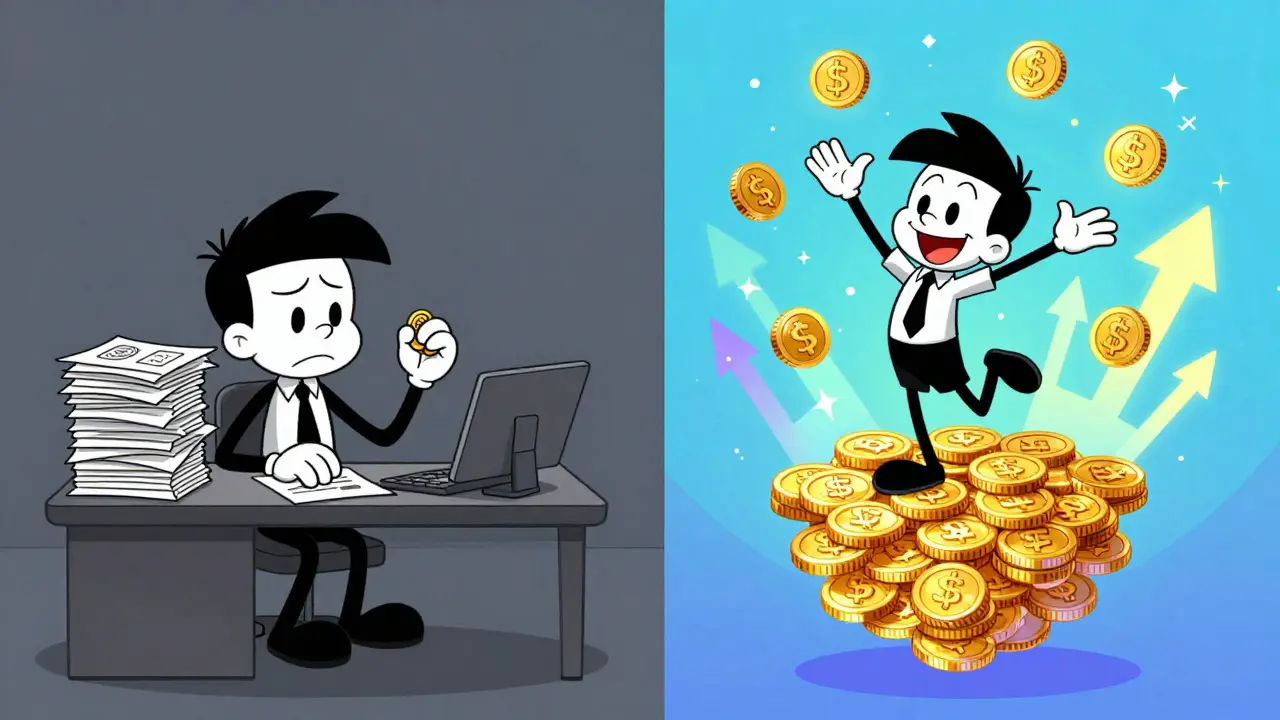
To understand why blockchain is gaining traction, you have to look at the current state of digital creation. In 2023, the global creator economy was valued at roughly $250 billion. Yet, nearly half of full-time creators earned less than $15,000 annually. Where did the money go? Mostly to intermediaries. Platforms like YouTube, Spotify, and Patreon typically take cuts ranging from 30% to 50%. If you sell a digital artwork for $100, you might keep $50 or less after fees, taxes, and payment processing delays.
Blockchain changes this equation by removing the central authority. Instead of a company holding your data and deciding when to pay you, smart contracts handle the distribution automatically. This means if a collector buys your piece for $100, the smart contract ensures you get your agreed-upon share instantly, with no waiting period and no hidden deductions. The platform fee drops to a mere 1-2.5%, which covers only the technical infrastructure costs. For many creators, especially those in emerging markets where banking access is limited, this isn't just about saving money-it's about getting paid at all.
How the Technology Actually Works
You don’t need to be a coder to use these tools, but understanding the basics helps you avoid pitfalls. The backbone of this ecosystem consists of three main components: the network, the asset, and the payment method.
- Networks: Most creator activities happen on Layer-1 blockchains like Ethereum, Solana, or Polygon. Ethereum remains the most secure and established, while Polygon and Solana offer faster speeds and lower transaction fees (gas). As of 2025, sustainable blockchain solutions consume 99.95% less energy than early proof-of-work systems, largely due to the shift to proof-of-stake mechanisms.
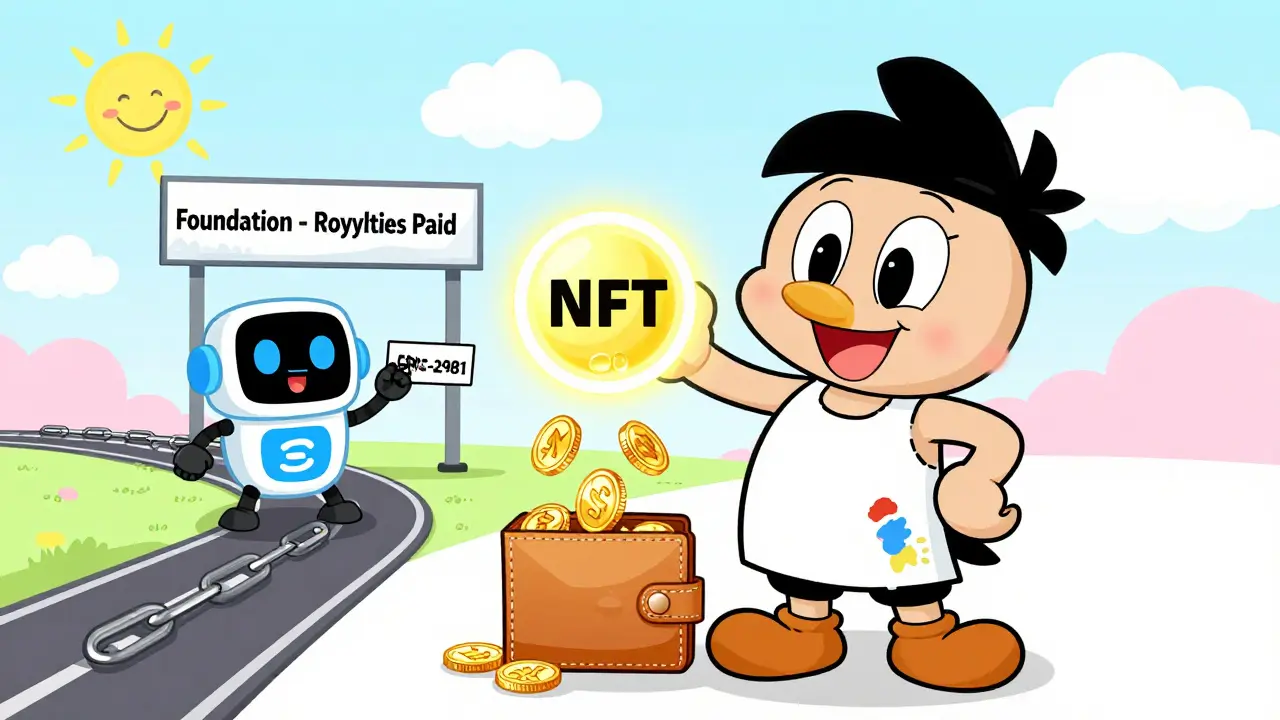
- NFTs (Non-Fungible Tokens): These are digital certificates of ownership. When you mint an NFT, you’re creating a unique token on the blockchain that proves someone owns a specific digital item. The key feature here is programmability. You can set a royalty percentage-usually 5-10%-that automatically pays you whenever that NFT is resold on a secondary market.
- Stablecoins: Cryptocurrencies like Bitcoin can be volatile. To solve this, most creator platforms use stablecoins like USDC or DAI, which are pegged to the US dollar. This allows creators to receive predictable income. Payments settle in 15-30 seconds, compared to 3-5 business days for traditional international bank transfers.
Smart contracts tie these elements together. They are self-executing agreements stored on the blockchain. If a song is streamed on a decentralized platform like Audius, the smart contract can distribute revenue to the artist, producer, and label simultaneously based on pre-set percentages. There is no invoice to chase and no accounting dispute.
Comparing Blockchain vs. Traditional Platforms
The differences aren't subtle. While traditional platforms win on user interface simplicity and built-in audience discovery, blockchain wins on financial control and long-term value retention. Here is a side-by-side look at the critical metrics for a creator considering the switch.
| Feature | Traditional Platforms (e.g., YouTube, Spotify) | Blockchain Platforms (e.g., Mirror, Audius) |
|---|---|---|
| Platform Fees | 30% - 50% | 1% - 2.5% |
| Secondary Sales Royalties | None (Creator earns once) | 5% - 10% (Automated via Smart Contracts) |
| Payment Speed (International) | 3 - 5 Business Days | 15 - 30 Seconds |
| Data Ownership | Platform Owns User Data | Creator Owns Content & Data |
| Currency Volatility Risk | Low (Fiat Currency) | Moderate (Mitigated by Stablecoins) |
| Discoverability Tools | High (Algorithmic Feeds) | Low to Moderate (Community-Driven) |
Notice the trade-off. You gain financial freedom but lose some of the algorithmic magic that pushes new content to millions of strangers. On traditional platforms, the algorithm decides who sees your work. On blockchain platforms, community engagement and social sharing drive visibility. This requires a different marketing strategy, focusing on building a loyal, direct-to-consumer audience rather than relying on passive traffic.
Real-World Impact: Success Stories and Challenges
Theory is great, but does it work in practice? The answer is yes, but with caveats. Consider Nigerian musician Tems. In 2024, she earned $1.2 million from secondary NFT sales of her album 'Born in the Wild'. By comparison, she made only $187,000 from traditional streaming platforms for the same release. That’s a massive difference, driven entirely by the ability to earn from fans who resell or trade her digital collectibles.
However, not every story is a success. A common complaint among new users is the complexity of wallet management. According to a 2025 usability study, 68% of new creators needed two to three weeks to become proficient with non-custodial wallets. Security is another major concern. Phishing attacks remain a risk, with 14% of surveyed creators reporting total asset loss due to scams. This highlights a crucial point: in the blockchain creator economy, you are your own bank. If you lose your private key, there is no customer support line to call.
For creators in the Global South, the benefits often outweigh the learning curve. A blogger in Nairobi shared how switching to USDC payments solved months of delayed transfers from French advertisers. What used to take three months now takes minutes. Built In’s 2025 survey found that 78% of creators in Lagos, Jakarta, São Paulo, and Mumbai reported increased income stability after adopting blockchain payment systems.
The Role of AI and Future Trends
We are currently at an intersection where Artificial Intelligence (AI) and blockchain are merging. As AI-generated content floods the internet, authenticity becomes a premium. Blockchain provides a solution through zero-knowledge proofs and digital provenance. Platforms like Deepfake Passport use these technologies to verify that a piece of content is original and created by a specific human, not an AI model. This creates a new market for verified human creativity.
Another significant trend is the integration of AI training data monetization. Through platforms like Ocean Protocol, creators can license their datasets directly to AI companies. Instead of giving away your work for free to train algorithms, you can charge a fee via smart contracts. This turns your past creative output into a recurring revenue stream.
Regulation is also catching up. The EU’s MiCA regulations, effective in January 2025, provide a clear framework for crypto assets. In the US, while still fragmented, 28 states have varying levels of clarity. By Q1 2025, 37 countries had established clear cryptocurrency frameworks. This regulatory maturation reduces the fear factor for mainstream adoption. Gartner predicts that by 2030, blockchain will generate $3.1 trillion in new business value, signaling that this is not a niche experiment but a fundamental infrastructure shift.
Getting Started: A Practical Guide
If you’re ready to dip your toes in, here is a straightforward path to entry. You don’t need to spend thousands of dollars upfront.
- Set Up a Wallet: Start with a non-custodial wallet like MetaMask (for Ethereum/Polygon) or Phantom (for Solana). Keep your seed phrase safe offline. Do not store large amounts of crypto on exchange accounts if you plan to hold long-term.
- Choose Your Network: For beginners, Polygon or Solana are recommended due to low transaction fees. Ethereum mainnet is more expensive but offers the deepest liquidity and security.
- Select a Platform: Decide what you want to create. For writing, try Mirror. For music, look at Audius. For visual art, Foundation or SuperRare are strong options. Each has its own community and fee structure.
- Mint Your First Item: Start small. Mint a single piece of content as an NFT. Set a royalty rate of 5-10%. Use a stablecoin like USDC for pricing to avoid volatility confusion.
- Build Community: Since discoverability is lower, engage actively on Discord servers and Twitter/X. Join communities like the 'Blockchain Creators' subreddit, which has over 45,000 members.
Budget-wise, expect to spend time rather than money. Most creators report needing 15-20 hours of learning to master basic operations. Gas fees on Layer-2 networks are often under $1 per transaction, making experimentation affordable.
Frequently Asked Questions
Is the blockchain creator economy only for artists?
No. While digital art and music see the highest adoption, writers, journalists, educators, and even corporate influencers are using these tools. Any creator who produces digital assets or wants to bypass high platform fees can benefit from blockchain infrastructure.
Do I need to know how to code to use these platforms?
Not necessarily. Most modern creator platforms have user-friendly interfaces that abstract away the complex coding. You interact with buttons and forms, similar to traditional web apps. However, understanding basic concepts like wallets and gas fees is essential to avoid costly mistakes.
What happens if I lose my wallet password?
In a non-custodial system, there is no password reset button. You must back up your 12- or 24-word seed phrase in a secure physical location. If you lose both the device and the seed phrase, access to your assets is lost forever. This is the primary trade-off for having full ownership.
Are blockchain transactions expensive?
It depends on the network. Ethereum mainnet can have high fees during congestion, but Layer-2 solutions like Polygon or Arbitrum reduce fees by up to 98%. On average, a transaction on these optimized networks costs less than $1, which is comparable to credit card processing fees.
How do taxes work with blockchain earnings?
Taxes vary by jurisdiction, but generally, selling an NFT or receiving stablecoin payments is a taxable event. Tools like Koinly automate the tracking of these transactions, generating reports compatible with standard tax software. Always consult a local tax professional familiar with digital assets.
Rod Sidoroff
August 24, 2026 AT 21:18Let us be honest for a moment, shall we? You are all still waiting for the next big thing to save your creative soul. The blockchain creator economy is not a savior; it is merely a new cage with digital bars. I have watched this cycle repeat itself since the dot-com era, and every time, the 'disruptors' become the new middlemen. Do not mistake infrastructure for innovation. The real value lies in the human connection you are too lazy to cultivate without a platform algorithm feeding you crumbs. Wake up.
Jade Brown
August 26, 2026 AT 15:17The liquidity fragmentation across these disparate L1s is frankly a nightmare for any serious portfolio management strategy. You are essentially betting on network effects that haven't fully coalesced yet. The tokenomics of most creator platforms are designed to extract value from early adopters rather than distribute it equitably. It's a classic Ponzi scheme dressed up in smart contract clothing. Watch out for the rug pulls, folks.
Stephanie Millar
August 27, 2026 AT 15:55I find it quite fascinating how the technology shifts, don't you?! In my experience working with artists here in London, the barrier to entry remains the primary hurdle! Many talented individuals simply do not wish to learn about gas fees or seed phrases! They just want to create! Perhaps the user interface needs to be less intimidating and more welcoming to those who are not tech-savvy by trade!
Phelan Deihl
August 27, 2026 AT 17:56I think the point about the learning curve is valid. I spent weeks just figuring out which wallet to use before I even minted anything. But once it clicked, the feeling of owning my own data was pretty nice. No more worrying about an algorithm burying my work after three days.
Lance Konig
August 28, 2026 AT 22:48You are all missing the forest for the trees. The real issue is not the technology, but the lack of a unified standard for metadata. Without interoperability, we are just building silos. Ethereum might be secure, yes, but the cost of entry is prohibitive for the average creator. Solana is faster, but the centralization risks are non-trivial. We need a Layer-2 solution that actually scales without sacrificing decentralization. Until then, this is all theoretical fluff.
Dina Lazarova
August 29, 2026 AT 18:28One must consider the tax implications carefully. In many jurisdictions, every swap of stablecoins can be considered a taxable event. This administrative burden often outweighs the savings from reduced platform fees. It is a complex web of regulations that few creators are prepared to navigate. One should consult a professional before diving in headfirst.
Alexander Scheel
August 30, 2026 AT 01:13Oh, how delightful. Another utopian vision of a world where everyone is paid fairly and no one gets scammed. How refreshing to see such naive optimism in the face of harsh economic realities. Let us hope the 'smart contracts' are indeed smart enough to prevent the inevitable exploitation. Or perhaps they are just another way for the rich to get richer while the poor lose their keys.
Susan Kiley
August 30, 2026 AT 04:33Finally, someone is talking about the REAL issues! 😂 The volatility risk is so underrated. I lost half my earnings because ETH dipped while I was waiting for my payment to settle. Stablecoins help, but only if you trust the issuer. It's like playing with fire, isn't it? 🔥 But hey, at least we're not giving 50% to YouTube anymore! 🚀
Calliope Clio
August 31, 2026 AT 07:26Meh. Just another trend. 🙄 I've seen this movie before. First it was Web3 gaming, now it's Web3 art. The hype dies down, and we're left with empty wallets and confused users. Who actually wants to buy an NFT of a JPEG when they could just download it for free? The market is saturated with low-quality content. 💸
Leah Humphrey
August 31, 2026 AT 21:23The integration of AI training data monetization via Ocean Protocol is the most under-discussed aspect of this entire ecosystem. By licensing datasets directly, creators can turn passive assets into active revenue streams. This decouples income from audience size, which is a significant paradigm shift for independent artists. The potential for recurring revenue is substantial if the legal frameworks catch up.
Jennifer Ulmer
September 2, 2026 AT 17:48I agree with the idea that authenticity is becoming a premium. With AI making it so easy to fake things, knowing that something was made by a real person feels special. Blockchain helps prove that. It's a simple concept, but it changes how we value creativity.
Patrick Pat
September 3, 2026 AT 22:01Sure, sure, 'financial freedom'. Tell that to the guy in Lagos who got phished and lost his life savings. The security model assumes a level of technical literacy that doesn't exist for the very people this is supposed to help. It's a bit ironic, isn't it? Decentralized finance for the unbanked, but only if you can afford a hardware wallet and understand zero-knowledge proofs.
Claudio Perrone
September 5, 2026 AT 16:11it's all about the vibes man!! i dont care about the gas fees or the layer 2 stuff. i just want to sell my music and get paid fast. if it takes 3 weeks to figure out the wallet its over. keep it simple. the future is here and it smells like crypto and burnt computers lol
Hicham Mounir
September 7, 2026 AT 01:31It really is amazing how much control creators can take back. I remember when we had to wait months for royalties from labels. Now, with smart contracts, it's instant. It feels like a breath of fresh air. If you're considering it, just start small. Don't worry about being perfect. The community is generally supportive if you show up and engage.
Sarah Campbell
September 8, 2026 AT 02:03Who cares about some foreign currency? 🇺🇸 We should be using the Dollar! USDC is fine, but why bother with all this crypto nonsense? It's just a way for tech bros to make money off our backs. Stick to what works: Spotify and Patreon. At least you know where your money is going. Don't let these globalists trick you! 👍
Ami Elizabeth
September 9, 2026 AT 06:37honestly just happy the fees are lower. doesnt matter if its eth or solana as long as i get my cut. the whole process is a bit confusing tho but whatever. its better than the old way for sure.
michelle aguilar
September 10, 2026 AT 08:57It is truly exhausting, isn't it?! The constant need to stay vigilant against scams! One wrong click and everything is gone! There is no customer service, no safety net! Just you, your seed phrase, and the cold hard reality of self-custody! It demands a level of discipline that most casual creators simply do not possess! Be careful out there!