When you hear "DAO," you might think of a futuristic company run by robots or a bunch of strangers voting on blockchain. But real DAOs aren’t sci-fi. They’re groups of people using code to make decisions together-no CEOs, no boardrooms. Some have won big. Others collapsed in public. If you want to understand what DAOs actually do, you need to look at the ones that mattered.
Uniswap DAO: The DeFi Giant That Runs Itself
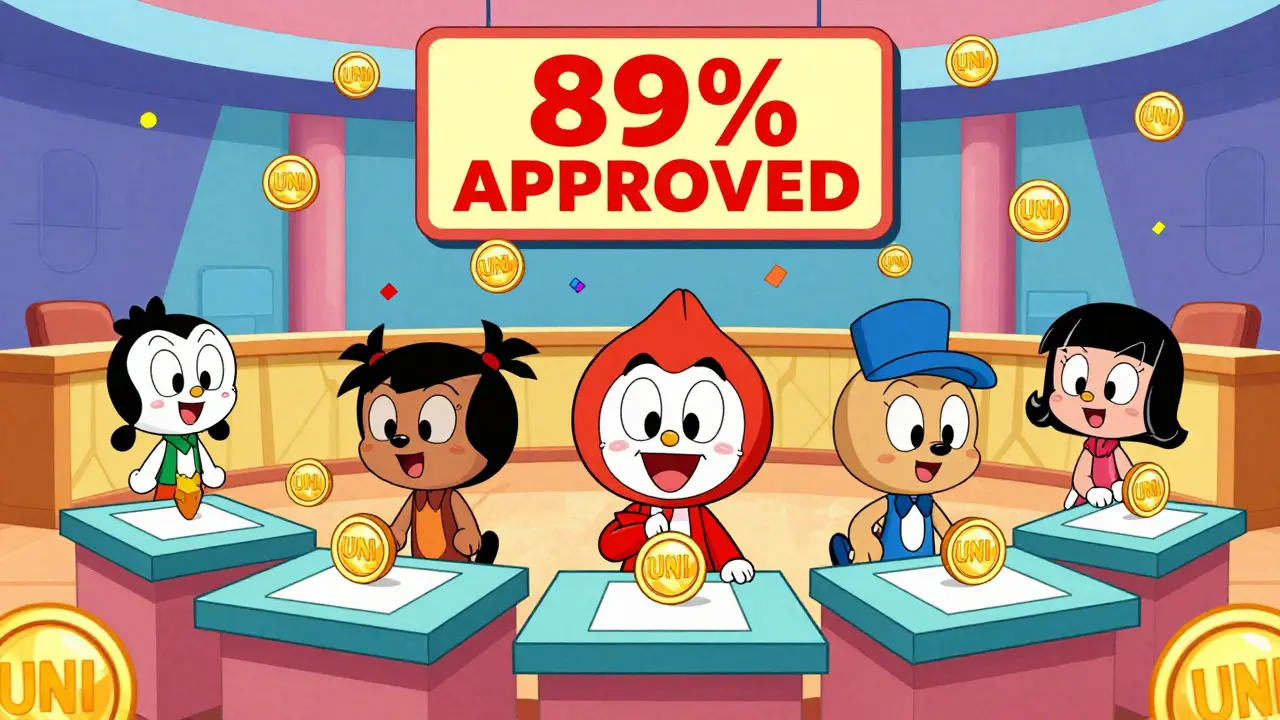
Uniswap isn’t just a crypto exchange. It’s a DAO. Since its launch in 2018, it’s processed over $1.2 trillion in trades. But here’s the wild part: no company owns it. No team makes the rules. Instead, 1.2 billion UNI token holders vote on upgrades, fee changes, and treasury spending. In 2023, a proposal to shift 10% of protocol fees to the community treasury passed with 89% approval. That’s not a fluke. It’s how Uniswap stays alive.
But there’s a catch. Voter turnout? Around 3.2%. That means a tiny fraction of holders decide the fate of a $10 billion protocol. The top 1% of UNI holders control over 40% of votes. Critics call it plutocracy. Supporters say it’s the price of openness. Either way, Uniswap proves DAOs can scale-just not perfectly.
The LAO: When DAOs Become Venture Capital Firms
The LAO, launched in 2019, wasn’t trying to build software. It wanted to fund startups. And it did-67 of them. Members pooled ETH to invest in early-stage Web3 projects. Each member got voting rights proportional to their stake. Projects like Chainlink and Polygon got early backing from The LAO before they were household names.
Here’s what made The LAO work: it didn’t pretend to be fully on-chain. It operated as a Delaware LLC under U.S. law. That meant it could legally invest, sign contracts, and hold equity. Most DAOs can’t do that. The LAO’s hybrid model gave it real-world power while keeping governance decentralized. By Q2 2023, its treasury held $32 million. That’s not a side project. It’s a functioning investment fund.
ConstitutionDAO: The $47 Million That Almost Bought a Founding Document
In November 2021, a group of strangers on the internet raised $47 million in 72 hours. Their goal? Buy a copy of the U.S. Constitution at Sotheby’s auction. They didn’t have a legal structure. No bank account. No CEO. Just a DAO called ConstitutionDAO, built on Ethereum.
They almost won. The bid hit $43.2 million. But Sotheby’s required a legal entity to finalize the purchase. ConstitutionDAO had none. The auction ended. The money was returned. Critics called it a failure. But here’s what no one talked about: 16,000 people from 150 countries coordinated without a single corporate email. They raised more than any venture fund in history-in less than three days. That’s the power of decentralized trust.
Friends With Benefits (FWB): A DAO That’s Also a Social Club
FWB isn’t about money. It’s about belonging. With over 12,000 members, it’s one of the largest social DAOs. To join, you need 38 FWB tokens. That’s not cheap. But once you’re in, you get access to private Discord channels, IRL meetups in Berlin and NYC, and exclusive NFT drops. Members vote on events, art commissions, and even who gets invited.
FWB doesn’t make money from sales. It makes money from culture. It’s hosted parties with artists like Snoop Dogg. It launched a music label. It turned a token into a passport. And it’s all governed by its members. No corporate sponsor. No ads. Just a community that decided, together, to build something beautiful.
Gitcoin DAO: Fixing the Internet’s Public Goods Problem
Most open-source software runs on volunteer work. Developers build tools like Ethereum wallets or blockchain explorers. But they rarely get paid. Gitcoin DAO changed that. It uses quadratic voting to fund open-source projects. Contributors submit proposals. Token holders vote. Funding goes to the projects with the most community support-not just the loudest voices.
Why quadratic voting? Because in normal voting, a single wallet with 10,000 tokens can drown out 10,000 people with one token each. Gitcoin’s system gives more weight to broad support. In 2023, it distributed $18 million to 1,200 projects. OpenSea, MetaMask, and even Wikipedia got funding from it. Gitcoin proves DAOs can solve problems traditional institutions ignore.
MakerDAO: The Backbone of Decentralized Finance
MakerDAO runs DAI, the most widely used stablecoin in crypto. It’s not backed by banks. It’s backed by crypto collateral locked in smart contracts. And it’s governed entirely by MKR token holders. Every change-interest rates, collateral types, risk limits-is voted on by the community.
It’s been running since 2017. It survived the 2020 "Black Thursday" crash when ETH dropped 50% in hours. MakerDAO’s emergency vote to adjust stability fees kept DAI pegged to $1. That’s not luck. That’s governance in action. With over $8 billion in locked collateral and 1.5 million active voters, MakerDAO is the most mature DAO on Earth. It’s also one of the few with a full-time team managing off-chain coordination-another sign that pure decentralization isn’t always practical.
Failure Stories: What Went Wrong
Not every DAO thrives. PleasrDAO tried to buy Wu-Tang Clan’s only album, "Once Upon a Time in Shaolin," for $10 million in 2022. The bid failed-not because of money, but because members couldn’t agree on how to manage the asset. Some wanted to release it publicly. Others wanted to keep it private. The debate dragged on for months. The album stayed unsold. The DAO lost momentum.
Then there’s The DAO-the original. Launched in 2016, it raised $150 million in ETH. A hacker exploited a flaw in its code and drained $60 million. The Ethereum community had to hard fork the blockchain to recover the funds. It was controversial. But it also forced the whole industry to rethink security, code audits, and governance design. Without that failure, today’s DAOs wouldn’t exist.
Why DAOs Work (And Why They Don’t)
DAOs succeed when they have:
- Clear rules-voting thresholds, proposal formats, timelines
- Enough members-DAOs with under 100 active participants have a 71% failure rate
- Real-world integration-The LAO’s LLC structure gave it legal teeth
- Low friction-Snapshot voting lets people vote without paying gas fees
They fail when:
- Voting is too slow-some proposals take two weeks to pass
- Only a few wallets control votes-51% of Curve DAO proposals were decided by the top 10 holders
- There’s no onboarding-67% of new users quit after the first failed vote
What’s Next for DAOs?
DAOs aren’t replacing corporations tomorrow. But they’re changing how we build things. Gartner predicts 10% of big companies will use DAO structures for specific teams by 2025. The Ethereum Foundation is working on EIP-5805, a new standard to make governance tokens more reliable. And hybrid DAOs-those with legal wrappers-are growing fastest. Bain & Company found they survive 68% longer than pure on-chain DAOs.
The future isn’t all code or all lawyers. It’s both. DAOs that learn to work with traditional systems will win. The ones that try to replace them? They’ll vanish.
What is a DAO exactly?
A DAO, or Decentralized Autonomous Organization, is a group that operates through smart contracts on a blockchain. Members vote on decisions using tokens, and rules are enforced by code-not people. There’s no CEO or headquarters. Everything from spending money to hiring contractors is decided by the community.
Can anyone join a DAO?
Technically, yes. You just need a crypto wallet and some tokens. But many DAOs have entry barriers-like owning a minimum number of tokens or being invited. Some, like Friends With Benefits, require you to hold 38 tokens just to apply. Others, like The LAO, only allow accredited investors under U.S. law.
Are DAOs legal?
In most places, they exist in a gray area. Only three U.S. states-Wyoming, Tennessee, and Utah-have laws recognizing DAOs as legal entities. Elsewhere, they’re treated as unincorporated associations. That means if a DAO gets sued, members could be personally liable. That’s why many DAOs now partner with legal entities like LLCs to protect members.
How do DAOs make money?
It depends on the DAO. DeFi DAOs like Uniswap earn fees from trades. Investment DAOs like The LAO profit from startup investments. Social DAOs like FWB make money from NFT sales, events, and memberships. Philanthropy DAOs like Giveth distribute funds to causes. Some don’t make money at all-they’re funded by member contributions.
Do I need to be a coder to participate in a DAO?
No. Most DAOs don’t require coding skills. You can vote on proposals, join Discord discussions, or help with marketing. But understanding how to use a wallet, read a proposal, and track votes takes time. The average new member takes 8-12 weeks to feel comfortable. Tools like Snapshot make voting easier-no blockchain transactions needed.
What’s the biggest risk in joining a DAO?
The biggest risk is losing money because of bad decisions. If a DAO votes to fund a project that fails, your tokens could lose value. Or worse-if the DAO gets hacked or exploited, your funds might vanish. There’s also legal risk: if the DAO breaks a law, members could be held responsible. Always research the DAO’s structure, treasury, and governance history before joining.
DAOs are messy. They’re slow. Sometimes they’re unfair. But they’re also the first real attempt at building organizations without bosses. They’re not perfect. But they’re real. And they’re here to stay.
Lucy de Gruchy
March 15, 2026 AT 15:10Uniswap’s 3.2% voter turnout isn’t governance-it’s a cult of whales with access to Telegram bribe channels. And don’t pretend it’s "open." The top 1% hold 40% of votes? That’s not decentralization. That’s plutocracy with a blockchain sticker on it. The whole thing is a performance art piece for VCs who think "tokenomics" is a real economic theory.
Lauren J. Walter
March 17, 2026 AT 13:12So... we’re calling this "democracy" now? 😂
Tobias Wriedt
March 19, 2026 AT 11:27FWB is literally a social club for rich people who think NFTs are art. 🤡 I’ve seen their Discord. Half the members are just there to flex their Bored Ape. This isn’t a DAO-it’s a gated Instagram account with a smart contract.
S F
March 20, 2026 AT 04:39ConstitutionDAO was a joke. Americans raised $47M to buy a document we already have 13 copies of? And then they lost because they didn’t have a lawyer? 🇺🇸 We don’t need DAOs. We need better public schools.
Angelica Stovall
March 21, 2026 AT 10:50MakerDAO survived Black Thursday? Lol. It was saved by a centralized team of devs who manually patched the system. That’s not decentralized. That’s just a startup with a fancy name. The whole DAO myth is a scam to get dumb people to buy tokens.
Taylor Holloman.
March 21, 2026 AT 18:52I’ve been lurking in a few DAOs now-Gitcoin, FWB, even a tiny one for local art grants-and honestly? It’s messy. People argue. Votes drag. Sometimes nothing happens. But sometimes? Someone who never had a voice gets to decide something real. Like funding a mural in Detroit or a translator for a Ukrainian dev. It’s not perfect. But it’s the first time I’ve seen tech actually try to be fair. Even if it’s slow. Even if it’s weird.
Bryan Roth
March 22, 2026 AT 07:44Let’s stop pretending DAOs are either utopias or disasters. They’re experiments. Some fail. Some work. The LAO? Brilliant hybrid. ConstitutionDAO? Beautiful chaos. The DAO hack? Tragic but necessary. DAOs aren’t about replacing corporations-they’re about giving people a chance to build something together without permission. That’s revolutionary. Even if 90% of them crash. Even if the voting interface is clunky. Even if someone uses an emoji in every comment.
iam jacob
March 24, 2026 AT 06:47you guys are all just delusional. i saw a dao proposal once. it took 3 weeks. the guy who made it was a 19 y/o in his mom’s basement. he used a template. no one read it. the vote passed. now the treasury is gone. i’m not mad. i’m just disappointed. we could’ve had pizza. instead we got this.
Jesse Pals
March 25, 2026 AT 17:40Gitcoin’s quadratic voting is genius. I voted for a dev building a privacy tool for refugees. He got $20k. I didn’t have a big wallet. I had one token. And it counted. That’s the dream. Not the whales. Not the lawyers. Just regular people with a little skin in the game. DAOs ain’t perfect. But they’re trying. And that’s more than banks ever did.
Diane Overwise
March 27, 2026 AT 09:30Ohhhhh myyyyy GAWD. ConstitutionDAO? 😭😭😭 I cried. I literally cried. It was so beautiful. Like a group of strangers on the internet saying "we believe in something bigger than ourselves." And then they lost? 🥺🥺🥺 But the energy? The spirit? The memes? The 16,000 people who didn’t know each other but showed up? That’s the future. The future is soft. The future is kind. The future is not a corporation.
Ann Liu
March 27, 2026 AT 13:43Correction: MakerDAO didn’t "survive" Black Thursday because of governance. It survived because of overcollateralization and a pre-approved emergency parameter change. The community vote was a formality. The real decision was made by the MKR tokenomics model. Also, the "1.5 million active voters" is misleading-most are bots or inactive wallets. Real active voters? Closer to 12,000.
Dionne van Diepenbeek
March 28, 2026 AT 10:07DAOs are just crypto bros with a voting app
Graham Smith
March 29, 2026 AT 10:45The entire premise is ontologically incoherent. A DAO cannot be autonomous if it relies on human actors to interpret proposals, coordinate off-chain governance, and resolve disputes via Discord. The blockchain merely provides the veneer of decentralization while the actual power resides in the dev teams, treasury managers, and legal wrappers. This isn’t governance-it’s theater with a gas fee.
Katrina Smith
March 29, 2026 AT 13:28uniswap is a joke. 3% voter turnout? yeah that’s democracy. next you’ll tell me the guy who owns 500k uniswap is the same guy who voted for every proposal since 2020. lol. i’d rather work at starbucks.
Anastasia Danavath
March 31, 2026 AT 00:51so like... what even is the point? 🤷♀️