
Back in June 2021, if you were checking CoinMarketCap on your phone during a coffee break, you might’ve seen a pop-up: "Join the ElonDoge Mission. Earn free EDOGE tokens." It looked like a fun side quest-space-themed, Dogecoin-inspired, and backed by one of the biggest crypto data sites. For five days, thousands clicked, completed quizzes, and watched short videos. In return, they got EDOGE tokens. Free money, right?
Turns out, it wasn’t free money. It was a snapshot of a moment in crypto history-when meme coins exploded, platforms like CoinMarketCap jumped on the bandwagon, and a $20,000 airdrop felt like a big deal. Now, in early 2026, those same tokens are worth less than a penny per billion. Here’s what really happened.
What Was the ElonDoge x CoinMarketCap Airdrop?
The ElonDoge x CoinMarketCap Mission was a five-day promotional event in June 2021. It wasn’t a scam, but it wasn’t a long-term investment either. CoinMarketCap, which had already built a reputation for tracking crypto prices and offering "learn and earn" campaigns, teamed up with ElonDoge-a meme coin project built on the Binance Smart Chain. The goal? Get people to learn about EDOGE while handing out tokens like candy.
The campaign was simple: sign up, complete five quick tasks (like reading a blog post or watching a video), and claim your share of 50 billion EDOGE tokens. The total value? $20,000. At the time, that sounded generous. For comparison, CoinMarketCap’s own YouTube airdrop around the same time gave away $10,000 in USDT and NFTs. This one was bigger, and it rode the same hype wave as Dogecoin’s 2021 surge.
ElonDoge wasn’t just a token. It was part of a bigger ecosystem. Behind it was EDAO, a governance token that let holders vote on things like NFT auctions, partnerships, and new token launches on ElonFuel-a launchpad tied to the project. The idea was to build a decentralized community, not just another meme coin.
How Did EDOGE Tokens Perform After the Airdrop?
Right after the airdrop ended, EDOGE had a tiny spike. A few thousand people held it. Some sold immediately. Others held on, hoping it would become the next Dogecoin.
It didn’t.
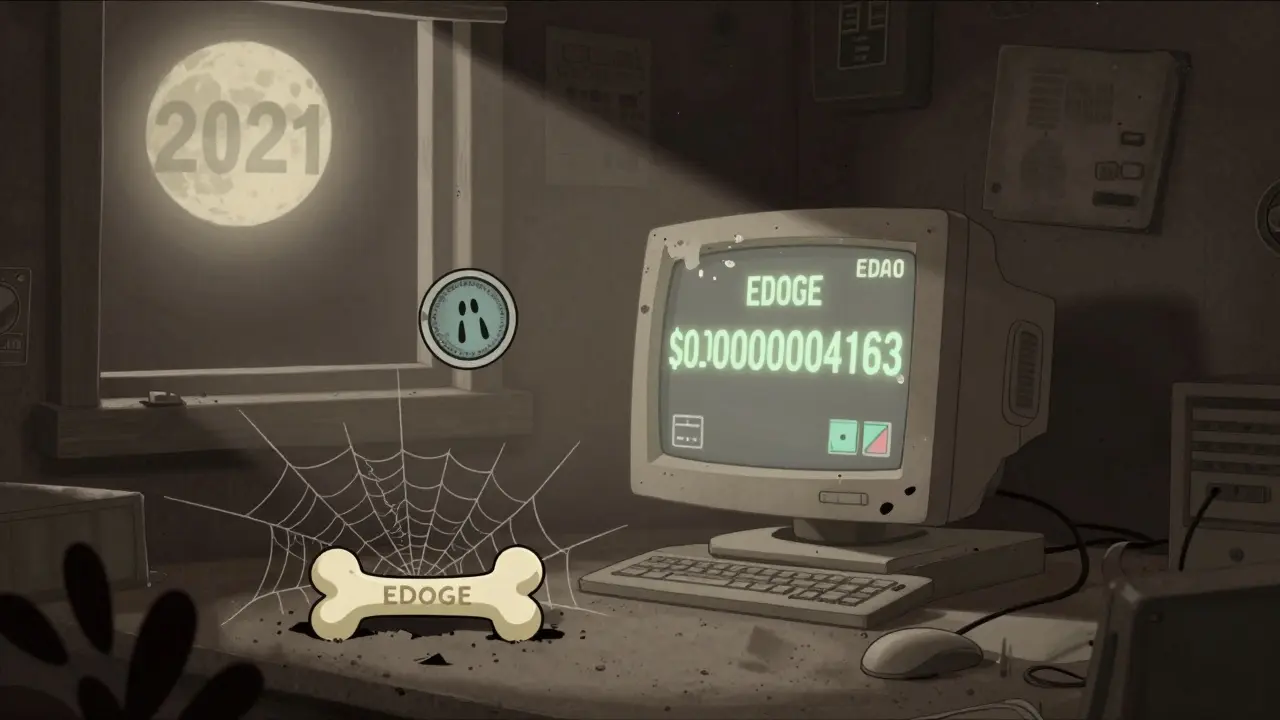
Today, EDOGE trades at $0.000000004163 USD. That’s less than half a cent per billion tokens. The 24-hour trading volume? Barely noticeable. On most days, fewer than 100 trades happen. That’s not a market-it’s a graveyard with a live price feed.
Compare that to other Doge-style tokens from the same era. MOONDOGE trades at $0.0000828 with $2,395 in daily volume. MOON DOGE? It’s down to $0.00000000000007076 with just $42 in volume. Even the Doge-1 Mission to the Moon token, which launched around the same time, still has over 2,000 holders and a $124,000 market cap. EDOGE doesn’t even crack the top 5,000 coins on CoinMarketCap anymore.
Why? Because hype doesn’t last. The 2021 meme coin boom was fueled by social media, celebrity tweets, and FOMO. Once the market cooled, projects without real utility or strong teams collapsed. ElonDoge had no team announcements, no roadmap updates, and no major partnerships after June 2021. The EDAO governance token? It’s still listed on PancakeSwap, but no one’s voting on anything.
Why Did CoinMarketCap Do This Airdrop?
CoinMarketCap didn’t launch EDOGE. They didn’t create it. They didn’t even invest in it. But they did promote it-and that’s the key.
Back in 2021, CoinMarketCap was trying to grow its user base beyond just price checkers. They wanted to be seen as an educational platform. Their "learn and earn" campaigns were perfect for that. Users got free tokens. CoinMarketCap got more traffic, more subscriptions, and more credibility as a crypto hub.
This wasn’t the first time they did this. They’d done similar campaigns with Polkadot, Chainlink, and other projects. But partnering with a meme coin? That was new. It showed they were willing to ride the wave-even if it was silly.
It worked. Thousands signed up. The campaign trended. But once the five days were over, CoinMarketCap moved on. Today, their airdrop page shows zero active campaigns. The historical section? Still loading. They’ve shifted focus to more serious tokens and educational content. The ElonDoge airdrop? Just a footnote now.

What About the EDAO Governance Token?
ElonDoge’s creators claimed EDAO was the "brain" of the ecosystem. With 100,000 tokens created at launch, 2% went to liquidity on PancakeSwap. The rest was meant to be distributed to early supporters, including airdrop participants.
Here’s the catch: no one’s using it. There are no active proposals. No NFT auctions have been voted on. No new launchpads have been approved. The GitHub repo? Empty. The Twitter account? Last tweet was in August 2021.
EDAO was supposed to give holders real power. But without community engagement, governance tokens are just digital paper. They need people to vote, to debate, to care. That never happened with EDAO.
Compare that to real governance tokens like UNI or MKR. They have active forums, regular votes, and clear outcomes. EDAO? It’s a ghost town.
Was This Airdrop Worth It?
If you participated and sold your EDOGE tokens right after the airdrop? You probably made a few dollars. Maybe $5. Maybe $20. If you held on? You lost almost everything.
But the real question isn’t about money. It’s about timing.
This airdrop happened at the peak of the meme coin frenzy. People were buying Dogecoin because Elon Musk tweeted. They were jumping on Shiba Inu because it was "the next Doge." ElonDoge was just another name in the crowd. CoinMarketCap gave it legitimacy-briefly. But legitimacy doesn’t mean value.
Most people who got EDOGE didn’t even know what blockchain it ran on. They didn’t know how to store it. They didn’t know what EDAO was. They just saw "free crypto" and clicked.
That’s the danger of these campaigns. They attract attention, not adoption.
What Can You Learn From This?
If you’re thinking about joining a future airdrop, here’s what to look for:
- Is the project real? Check if the team has public profiles, past projects, or GitHub activity.
- Is there utility? Does the token do something beyond trading? Governance? Staking? NFTs? Or is it just a ticker symbol?
- Is the platform trustworthy? CoinMarketCap is legit-but that doesn’t mean every project they promote is.
- What’s the supply? EDOGE had 50 billion tokens. That’s huge. More supply = lower price per token. Airdrops often flood the market.
- What’s the volume? If a token has less than $10,000 in daily trading, it’s hard to sell. Don’t hold something you can’t cash out.
Most airdrops are marketing tools-not investments. Treat them like free samples. Try them. Learn from them. But don’t bet your savings on them.
Is ElonDoge Still Alive?
Technically, yes. EDOGE still shows up on CoinMarketCap. It still trades on PancakeSwap. The contract address hasn’t been abandoned.
But no one’s building. No one’s talking. No one’s buying. The project has been silent for over four years.
It’s not dead. It’s just… forgotten.
That’s the fate of most meme coins that rode the 2021 wave without a plan. They get a flash of attention. Then they vanish into the noise.
The ElonDoge x CoinMarketCap airdrop was a fun experiment. It taught thousands what crypto airdrops felt like. But it also showed how quickly hype can turn to dust.
If you still have EDOGE tokens in your wallet? You can sell them-if you can find a buyer. But don’t expect much. And don’t expect a comeback.
Some airdrops become legends. Most become cautionary tales. This one? It’s the latter.
Did anyone make money from the ElonDoge airdrop?
Some people made a few dollars by selling EDOGE right after the airdrop ended in June 2021. Those who held onto the tokens saw their value drop by over 99.99% within a year. Today, EDOGE is worth less than half a cent per billion tokens, making it nearly impossible to cash out profitably.
Can I still claim ElonDoge tokens from the 2021 airdrop?
No. The five-day airdrop campaign ended in June 2021, and the claiming window closed permanently. CoinMarketCap no longer lists it as an active or historical campaign on their airdrop page. Any site claiming to still distribute EDOGE is likely a scam.
Is EDOGE still traded anywhere?
Yes, EDOGE is still listed on PancakeSwap and tracked by CoinMarketCap, but trading volume is extremely low-often less than $10 per day. Most exchanges delisted it years ago due to lack of activity. It’s technically tradable, but not liquid.
What’s the difference between EDOGE and EDAO?
EDOGE is the original meme token distributed in the airdrop. EDAO is the governance token meant to let holders vote on ecosystem decisions like NFT auctions and new token launches. While EDOGE had no utility beyond speculation, EDAO was designed to give users control. But neither has seen any real activity since 2021.
Why did CoinMarketCap partner with a meme coin?
In 2021, CoinMarketCap was expanding its "learn and earn" campaigns to attract new users. Partnering with high-profile meme coins like ElonDoge helped them drive traffic and engagement during the peak of the crypto hype cycle. It was a marketing move, not a vote of confidence in the project’s long-term value.
Are there any similar airdrops happening now?
As of early 2026, CoinMarketCap has no active airdrops listed. Their focus has shifted to educational content and partnerships with more established blockchain projects. Other platforms like Binance and Coinbase still run occasional airdrops, but they’re typically tied to new token launches with clear utility, not meme coins.


CHISOM UCHE
January 14, 2026 AT 01:49EDOGE’s collapse is a textbook case of tokenomics misalignment: 50B supply with zero utility, no vesting schedule, and a governance token (EDAO) that was never activated. The airdrop was a liquidity injection disguised as community building-classic meme coin theater. The real failure? No mechanism to retain holders post-distribution. Compare to UNI’s gradual unlock and DAO voting incentives; EDAO was just a static contract with a fancy name.
Sarah Baker
January 15, 2026 AT 23:59Okay but imagine being one of those people who clicked ‘claim’ during lunch, thinking, ‘free crypto!’ and then just… forgot about it for four years. 😭 Now you open your wallet and see 0.000000004163 USD. It’s not a loss-it’s a cosmic joke. But hey, you learned something! And that’s worth more than any token.
Chidimma Okafor
January 16, 2026 AT 12:01What strikes me most is the elegance of the deception: CoinMarketCap, a bastion of crypto legitimacy, became the unwitting herald of ephemeral hype. The airdrop was not a betrayal-it was a mirror. We, the users, were complicit in the theater. We mistook visibility for value, spectacle for substance. EDOGE was never meant to endure; it was designed to be a fleeting spark in the dark. And yet, we lit the match anyway.
Michael Jones
January 17, 2026 AT 02:55EDAO’s failure was structural. Governance tokens require active participation, transparent proposals, and measurable outcomes. None existed. The contract was deployed, the tokens distributed, and then silence. No governance forums, no GitHub commits, no community calls. This wasn’t negligence-it was abandonment. A project that doesn’t evolve doesn’t survive, regardless of initial hype.
Stephanie BASILIEN
January 18, 2026 AT 13:44Let’s be honest-this was never about crypto. It was about data harvesting. CoinMarketCap knew exactly what they were doing: incentivizing sign-ups with glittering tokens while collecting IPs, wallet addresses, and behavioral patterns. The EDOGE token? A honeypot. The real asset was the user data. They monetized attention, not blockchain. And we were the product.
Deb Svanefelt
January 18, 2026 AT 20:35There’s something quietly tragic about EDOGE. It wasn’t malicious-it was merely indifferent. Like a child’s drawing left on the fridge, then forgotten. People poured their curiosity into it, clicked, watched, claimed. And then… nothing. No grand reveal, no community rally, no roadmap. Just silence. It makes me wonder: how many of our digital dreams are just ghosts in the machine, waiting for someone to care enough to remember them?
Telleen Anderson-Lozano
January 20, 2026 AT 18:11Wait-so you mean… people actually held these? For years? And didn’t sell? I mean… I get it, hope is powerful-but also, like… did they even check the price once? I’m not judging, I’m just… wow. Also, CoinMarketCap’s shift to serious projects? Smart. They knew the meme wave was a tide, not a tsunami. And they got out before the beach got washed away.
Haley Hebert
January 22, 2026 AT 15:13i still have like 12 billion edoge in my wallet and i swear i forget about it until i open metamask and go ‘ohhhh right… that thing’ 😅 i don’t even know how to sell it anymore, the liquidity pool is so tiny. but it’s kinda like a little time capsule. reminds me of when crypto felt like a fun game, not a gamble. still gives me warm fuzzies, even if it’s worthless.
Jill McCollum
January 22, 2026 AT 17:42yo i did that airdrop 😭 i thought edoge was gonna be the next doge. i even told my cousin ‘this is it, we’re rich!’ lol. i didn’t even know what bsc was. i just clicked ‘claim’ and got 200k tokens. now i got like 0.00000000084 usd. but hey, i learned not to trust free crypto 😂
Hailey Bug
January 24, 2026 AT 09:44EDAO’s abandonment is a cautionary tale for governance token design. Without active participation, incentive structures, or developer engagement, governance tokens are digital paperweights. Compare to MakerDAO’s quarterly votes or Aragon’s transparent proposal system-EDAO had none of that. It wasn’t a failure of the idea; it was a failure of execution and follow-through. No community, no governance.
Dustin Secrest
January 26, 2026 AT 05:11EDOGE was never meant to be a currency. It was a cultural artifact-an echo of 2021’s collective delusion. The real question isn’t ‘why did it fail?’ but ‘why did we believe?’ We gave meaning to a token with no purpose because we wanted to believe in something, anything, that felt new. That’s not crypto failure. That’s human nature.
Stephen Gaskell
January 26, 2026 AT 08:07Free crypto? Nah. It was a scam. CoinMarketCap sold out. They’re American. They don’t care about you. They just wanted clicks. You got nothing. Move on.