
Using fake documents to get into a crypto exchange isn’t just a clever hack-it’s a federal crime with prison time attached. People think they can slip through KYC checks with a Photoshopped driver’s license or a deepfake video, but the system isn’t that easy to fool anymore. And even if they do, the fallout isn’t just losing access to their account. It’s fines, asset seizures, and years behind bars.
How Document Forgery Actually Works in Crypto
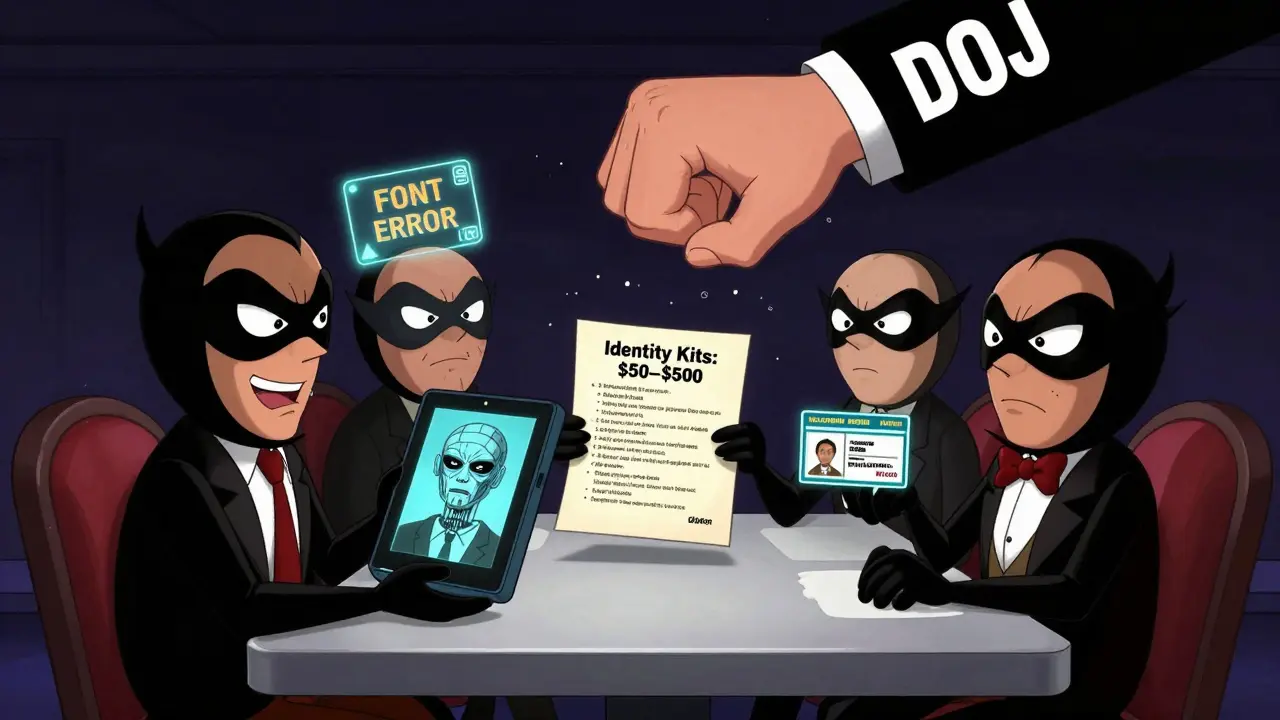
Fraudsters don’t just upload a bad ID. They build full identity packages. That means a fake government-issued ID, a forged utility bill with a real address, and sometimes even AI-generated video that blinks and turns its head just right during live verification. These aren’t amateur efforts. On dark web marketplaces, complete fake identity kits cost between $15 and $500, depending on how realistic they are. Some include documents from real countries like the U.S., Canada, or Germany, making them harder to spot.Deepfake technology has made this worse. Instead of static images, fraudsters now use synthetic video that mimics real human behavior-subtle eye movements, slight head tilts, even breathing patterns. These videos are recorded or generated in real time using virtual cameras to trick automated systems into thinking a real person is sitting in front of the screen. Some systems used to rely on just holding up an ID to the camera. Now, they ask you to nod, smile, or read a random phrase. But even those checks are being beaten.
Exchanges with weak verification systems are the targets. Smaller platforms, especially those outside the U.S., often skip multi-layer checks to keep onboarding fast. That’s exactly what fraudsters look for. They don’t waste time on Binance or Coinbase-they go after the ones that say “verified in 60 seconds.”
Federal Charges You Didn’t See Coming
This isn’t a traffic ticket. In the U.S., using fake documents to access a crypto exchange triggers multiple federal laws at once. You’re not just committing forgery-you’re committing wire fraud, securities fraud, and possibly money laundering.The Department of Justice treats this like any other financial fraud scheme. If you use fake documents to open an account, deposit illicit funds, trade crypto, and cash out, you’re laundering money. That’s a 20-year sentence per count. If you’re part of a group running dozens of fake accounts, prosecutors will charge you with conspiracy, which adds more years on top.
And it’s not just the person making the fake ID. If you buy one, use it, and move crypto through it, you’re just as guilty. The law doesn’t care if you were told it was “just a template.” Intent matters. If you knew the document wasn’t real and used it to access a platform, you’re on the hook.
Prosecutors don’t need to prove you stole money. They just need to show you used false documents to bypass a federal compliance system. That’s enough. The SEC, FinCEN, and DOJ work together on these cases. One agency finds the pattern, the others follow the money.
Exchanges Aren’t Innocent Bystanders
It’s not just users who get in trouble. Exchanges that don’t verify properly can be fined millions-or shut down.In 2022, Kraken paid a $30 million settlement to OFAC for allowing accounts linked to sanctioned individuals to operate. They didn’t break the law on purpose, but their verification system was too weak. That’s the standard now: if you don’t have advanced detection tools, you’re liable.
Regulators expect exchanges to use more than just ID scans. They need document inconsistency checks-like mismatched fonts, wrong hologram patterns, or altered serial numbers. They need deepfake detection that looks at micro-movements in the eyes, unnatural lighting reflections, or AI-generated artifacts in the skin texture. Some systems now cross-check your ID with public records, utility databases, and even social media profiles to spot contradictions.
Platforms that ignore these standards aren’t just risking fines. They’re opening themselves up to lawsuits from victims. If someone loses $500,000 because your system let a fraudster in, you could be sued for negligence. That’s not theoretical-it’s already happening in class-action suits.
How Detection Systems Are Fighting Back
The arms race between fraudsters and verification tech is real-and exchanges are winning, for now.Modern KYC systems don’t rely on one check. They stack them. First, they scan the document and analyze its physical properties: is the paper texture real? Is the ink magnetic? Is the font exactly what the issuing agency uses? Then they run the photo through AI that detects synthetic faces-things like unnatural eyelash shadows, mismatched pupil sizes, or inconsistent skin tone gradients.
Some systems now require liveness tests that change every time. One moment you’re asked to blink twice, the next you’re told to spell your name backward while tilting your head. The system doesn’t just record the video-it analyzes the timing, the speed, the micro-expressions. A human can fake a smile. An AI can’t perfectly replicate the way a real person’s cheeks move when they laugh.
Every time a forgery is caught, it gets added to a global database. That means if someone uses the same fake ID on Exchange A, and then tries it on Exchange B six months later, the system flags it immediately. Fraudsters are learning this the hard way: they can’t reuse the same documents. They have to keep making new ones, which gets expensive and risky.
What Happens If You Get Caught
Let’s say you’re caught. What’s next?First, your accounts get frozen. All your crypto-real and fake-is seized. Then, federal agents show up. They don’t send a warning email. They knock on your door with a warrant.
You’ll be charged under multiple statutes:
- Wire Fraud (18 U.S.C. § 1343): Using electronic communication to commit fraud. Up to 20 years.
- Identity Theft (18 U.S.C. § 1028): Possessing or using another person’s identifying information. Up to 15 years.
- Money Laundering (18 U.S.C. § 1956): Moving funds to hide their origin. Up to 20 years.
- Conspiracy (18 U.S.C. § 371): Working with others to commit fraud. Up to 5 years, but often added to other charges.
Sentences aren’t handed out one at a time. They stack. If you’re found guilty on three counts, you could face 40+ years. Judges don’t go easy on these cases. The loss amount matters. If you moved $100,000 in stolen crypto, you’re looking at a longer sentence than if you moved $5,000.
And it’s not just prison. The government can seize your car, your house, your savings-even money in accounts that weren’t involved in the fraud. Asset forfeiture is automatic in federal fraud cases.

Why This Is Getting Harder to Get Away With
Five years ago, you could get away with a bad ID. Today, you can’t.Regulators now require exchanges to report suspicious activity within 30 days. If you use a fake document and move crypto out within 48 hours, the system flags it as high-risk. Automated tools trace the wallet addresses. If that wallet has ever been linked to a known scam or dark web marketplace, it’s automatically flagged for review.
International cooperation has improved too. If you’re in Brazil and use a fake U.S. ID to access a U.S.-based exchange, the FBI can request data from Brazilian banks. The EU and U.S. now share financial intelligence through joint task forces. There’s no safe jurisdiction anymore.
And the penalties keep getting harsher. In 2024, the DOJ announced a new priority: targeting “KYC circumvention” as a top-tier financial crime. That means more agents, more audits, and more prosecutions.
Real Cases. Real Prison.
In 2023, a 28-year-old man in Texas was sentenced to 14 years for creating over 80 fake IDs to access crypto exchanges. He used them to steal $2.3 million in Bitcoin and Ethereum. He didn’t even try to hide his identity-he used the same phone number and IP address across all accounts. The system caught him because of a mismatched driver’s license hologram.In another case, a group in Ukraine used AI-generated video to bypass biometric checks on three different exchanges. They moved $7 million before being caught. All five members got 10-18 years each. The judge called it “a calculated attack on the financial infrastructure of the digital economy.”
These aren’t outliers. They’re examples of what’s happening every week.
What You Should Do Instead
If you can’t pass KYC, don’t try to cheat it. That’s not a workaround-it’s a suicide mission.Use a regulated exchange. Use your real documents. If your country doesn’t allow crypto access, wait. If you’re worried about privacy, use a self-custody wallet and buy through peer-to-peer platforms with escrow. But don’t fake your ID. The risk isn’t worth it.
And if you’re running an exchange? Invest in real verification tech. Don’t cut corners. The cost of a good KYC system is a fraction of a single fine-or a single lawsuit.
The message is simple: document forgery for crypto access doesn’t lead to wealth. It leads to federal court. And the system is built to catch you.
Is it illegal to use a fake ID to sign up for a crypto exchange?
Yes. Using a fake government document to bypass KYC checks is a federal crime in the U.S. and many other countries. It’s treated as wire fraud, identity theft, and potentially money laundering. Penalties include up to 20 years in prison per charge, fines, and asset forfeiture.
Can crypto exchanges get in trouble for letting fake IDs through?
Absolutely. Exchanges that fail to implement proper verification systems can face massive fines from regulators like the SEC, FinCEN, and OFAC. In 2022, Kraken paid $30 million for lax compliance. Exchanges can also be sued by victims who lost money due to their weak security.
How do exchanges detect deepfake videos during verification?
Modern systems use AI to spot unnatural patterns: inconsistent lighting in the eyes, robotic blinking, mismatched skin tones, or unnatural head movements. Some check for micro-artifacts left by generative AI, like blurred edges around hair or strange reflections on glasses. These are invisible to humans but easy for algorithms to flag.
Can I get away with it if I only use the fake ID once?
No. Even a single use can trigger automated fraud detection. Exchanges report suspicious activity to law enforcement, and blockchain analysis can trace your transactions back to you-even if you used a VPN. The system doesn’t need proof of multiple uses. One fraudulent account is enough for an investigation.
What happens to my crypto if I’m caught using fake documents?
All funds in the account tied to the fake ID will be frozen and seized by federal authorities. You won’t get them back, even if you didn’t steal them. The government treats crypto in fraud cases like cash from a bank robbery-it’s considered proceeds of crime and subject to forfeiture.
Are there legal ways to access crypto if my country bans it?
Yes. You can use peer-to-peer platforms like LocalBitcoins or Paxful with escrow protection. You can also use non-KYC decentralized exchanges like Uniswap or PancakeSwap with a self-custody wallet. But never use fake documents. There’s always a legal path-just not a fast or easy one.
Michael Richardson
January 11, 2026 AT 06:55Oh wow, another government propaganda piece. Next they'll say breathing is illegal if you're not on the approved list. Free crypto, free life.
Krista Hoefle
January 12, 2026 AT 00:16lol who even cares anymore. KYC is just big brother with a crypto twist. they want ur id, ur face, ur soul. chill.
Emily Hipps
January 13, 2026 AT 10:30Hey everyone - if you’re thinking about cutting corners, just pause for a second. This isn’t about being ‘smart’ - it’s about protecting your future. You don’t wanna be the person explaining to your kids why you missed their graduation because you thought a fake ID was worth it. You got this. Stay safe, stay legal.
Jessie X
January 15, 2026 AT 08:35they make it sound like its the end of the world but honestly if you just use a p2p platform you’re fine. no one cares what you do as long as you dont move money through exchanges with your fake doc
Kip Metcalf
January 16, 2026 AT 04:06fake docs = bad idea. period. just use coinbase or binance like a normal person. why make life harder?
Frank Heili
January 16, 2026 AT 16:45Let me break this down real simple: the systems detecting deepfakes now use 3D facial mapping, micro-expression timing analysis, and spectral reflectance to detect synthetic skin texture. Most fraudsters use off-the-shelf tools that leave artifacts like inconsistent iris dilation or unnatural eyelid closure latency. Even the $500 deepfake kits from dark web shops get flagged 87% of the time now. It’s not about being ‘smart’ - it’s about being statistically doomed. And yes, the global database cross-references every failed attempt across 200+ exchanges. You’re not getting a second chance.
Natalie Kershaw
January 16, 2026 AT 17:28Y’all need to stop thinking of this like a hack. KYC isn’t the enemy - it’s the firewall. If you’re scared of giving your real info, maybe crypto isn’t the right space for you yet. There are legit P2P routes, self-custody wallets, even privacy coins if you’re worried about tracking. But faking docs? That’s not freedom - that’s a one-way ticket to federal paperwork. You’re better than that.
Jacob Clark
January 17, 2026 AT 10:59WAIT - WAIT - WAIT. Did you just say the DOJ is now treating this as a TOP-TIER FINANCIAL CRIME?!?!?!?!? That’s insane!! I mean, like… what if you’re just trying to protect your privacy?!?!? They’re literally criminalizing anonymity now?!?!? And don’t even get me started on Kraken’s $30M fine - that’s just the tip of the iceberg!! This is the beginning of the end of financial freedom!! I’ve been saying this for YEARS!!
Mujibur Rahman
January 18, 2026 AT 20:33UK exchanges are now required under AMLR2024 to implement behavioral biometrics - keystroke dynamics, mouse movement patterns, even how you hold your phone during verification. Most US-focused tools don’t account for this. If you’re using a fake US ID from the EU or UK, the system will flag you not because of the document - but because your typing rhythm doesn’t match the claimed nationality. It’s not about the ID. It’s about the human behind it.
Danyelle Ostrye
January 19, 2026 AT 11:19everyone’s acting like this is some big secret but if you’ve ever used a VPN to access a crypto site you already know they’re watching. fake ID? you’re just making it easier for them to lock you down.
Jennah Grant
January 19, 2026 AT 21:02Modern KYC stacks include not just document analysis but also digital footprint correlation - social media activity, device fingerprinting, even geolocation metadata from uploaded photos. If your ‘US driver’s license’ was uploaded from a device that’s only ever been in Nigeria, the system auto-rejects it. No human even looks at it. The AI doesn’t care if you’re ‘innocent’ - it cares about statistical deviation.
Dennis Mbuthia
January 21, 2026 AT 04:06Let me tell you something, folks - this isn’t just about crypto, this is about the entire collapse of American sovereignty! The government, the banks, the tech giants - they’re all in cahoots to strip you of your rights! You think they care that you’re trying to get access to your own money? NO! They want you dependent! They want you begging for permission to own digital assets! And now they’ve got the law on their side - forged documents? That’s just the excuse they’ve been waiting for to lock you up and throw away the key! I’ve seen it coming since 2016 - and now it’s here - and you’re all just sitting there like sheep waiting to be sheared! Wake up!!
Dave Lite
January 21, 2026 AT 11:29just use a hardware wallet + uniswap + p2p. no KYC. no stress. no jail. 🤝😎
Becky Chenier
January 21, 2026 AT 18:40The legal framework surrounding digital identity fraud is evolving rapidly. While the article emphasizes federal consequences, it’s worth noting that many jurisdictions outside the U.S. have adopted similar but distinct penalties under their own financial crime statutes. For example, the EU’s AMLD6 explicitly criminalizes synthetic identity creation in digital financial contexts. The global harmonization of enforcement is accelerating, making cross-border evasion increasingly untenable.
Staci Armezzani
January 22, 2026 AT 10:43If you’re reading this and thinking ‘I can get away with it’ - I get it. I’ve been there. But here’s the truth: the moment you use a fake document, you’re not just risking your crypto - you’re risking your freedom. And no, your VPN won’t save you. The system doesn’t need to catch you red-handed. One mismatched hologram, one AI-detected blink, one flagged wallet address - and your life changes forever. Don’t gamble with your future. Use the legal paths. They exist. They’re slower, sure - but they don’t end in handcuffs.
Michael Richardson
January 23, 2026 AT 17:52oh wow so now you can’t even use your cousin’s old license if he moved to canada? that’s just great. america is becoming a police state with a blockchain overlay.