Article
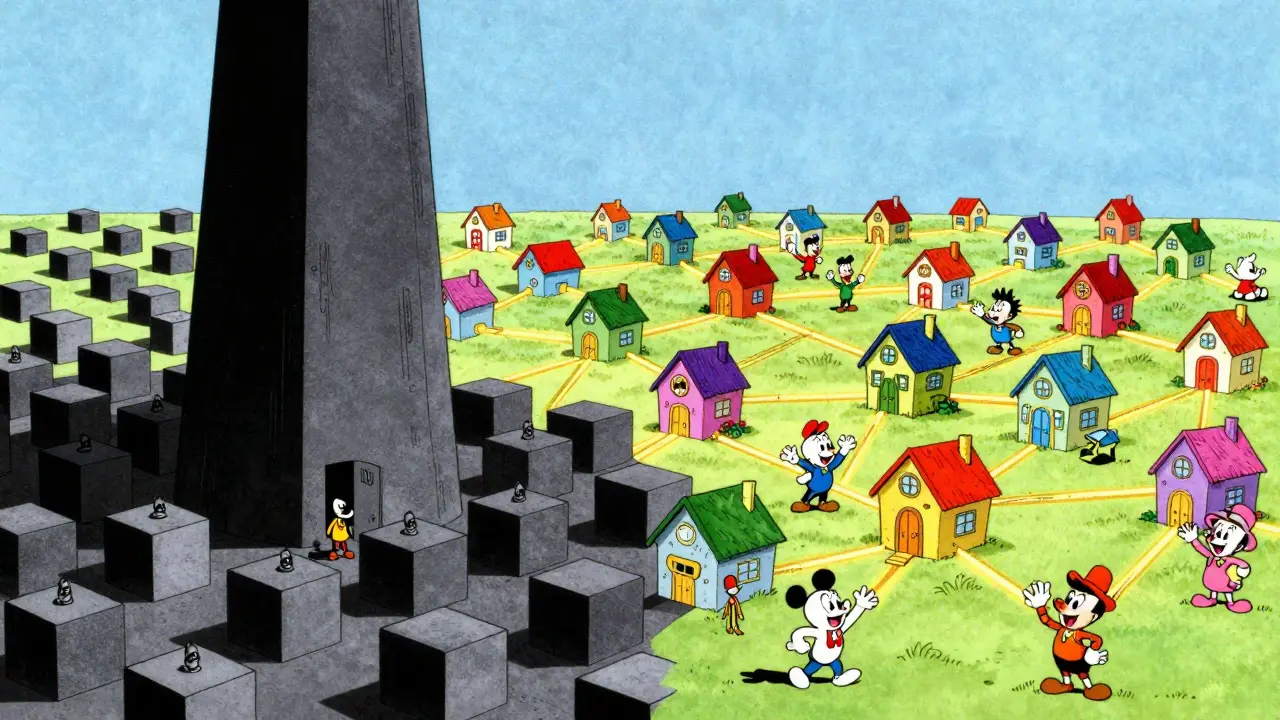
You’ve probably felt that sinking feeling when a platform bans your account overnight or sells your personal preferences to advertisers. That frustration is exactly why Decentralized Social Networks represent a massive shift in how we connect online. Unlike the giants you know, these platforms run on blockchain technology to distribute control across a network of nodes rather than centralizing it under a single entity. As of early 2026, this isn't just theory anymore; it's a growing ecosystem where users actually own their digital identities.
Think of it this way: when you post on standard sites, you're essentially renting space. If the landlord decides to raise prices or change the rules, you have nowhere to go. With blockchain-based social media, you build your house on land you actually own. The core idea emerged around 2016, gaining serious traction by 2023, and now we're seeing mature infrastructure that handles millions of daily interactions.
How Decentralized Social Media Actually Works
To understand the shift, you need to look under the hood. Traditional apps like Facebook or X store your photos, comments, and follower counts on their private servers. You access them via login credentials, but you don't control the data. In contrast, Blockchain serves as distributed ledger technology that records transactions across multiple computers to ensure data integrity and security.
Every post, like, or follow becomes a transaction on this public ledger. Because the ledger is shared across thousands of computers worldwide, no single company can delete your content unilaterally. For example, Mastodon uses the ActivityPub protocol, which allows different servers (called instances) to talk to each other. If your server gets shut down, you can move your profile to a new host and keep your followers intact. It's like moving houses without changing your address number.
Other networks take it further by adding financial layers. Lens Protocola blockchain-native social graph built on Polygon that functions as an open protocol for building web3 social applications treats your social connections as non-fungible tokens. This means your friends list isn't just a database entry; it's a digital asset you hold in your wallet. You can port this entire network identity to different interfaces without losing any relationships. Currently, over 7,000 posts per second are handled on optimized Layer 2 solutions like Polygon, bridging the gap between old and new internet standards.
Why Choose Web3 Over Traditional Apps?
The primary driver here is user sovereignty. In the centralized world, algorithms decide what you see, often hiding content that doesn't fit an advertiser's agenda. On decentralized platforms, you curate your own feed. A 2023 analysis showed that centralized platforms harvested roughly $171 billion in ad revenue that year by monetizing user data without direct compensation. In the Web3 model, that value flows back to creators.
Security is another major factor. While centralized platforms suffered from massive outages affecting billions of users annually, decentralized networks maintained near-perfect uptime due to their distributed architecture. There is no single point of failure. If one node goes offline, the rest of the network keeps functioning smoothly. Additionally, privacy metrics show stark contrasts: decentralized networks like Mastodon collect zero user data by design, whereas traditional platforms track average of nearly 1,900 data points per user annually.
However, it's not all sunshine. Censorship resistance is a double-edged sword. While it protects free speech, it also means harmful content is harder to remove. Reports indicate a 37% higher incidence of extremist content on unmoderated fediverse instances compared to mainstream sites. This creates a need for community-driven moderation rather than corporate policy enforcement, requiring more effort from users to curate their experience.
Top Platforms to Consider
If you're ready to switch, you'll encounter several distinct options, each with a unique approach to decentralization. Here’s how the major players stack up:
| Platform | Protocol/Base | User Experience | Best For |
|---|---|---|---|
| Lens Protocol | Polygon / NFT | Modern App Interface | Creators seeking monetization |
| Mastodon | ActivityPub | Twitter-like Text Posts | Privacy-focused discussions |
| Farcaster | Ethereum / Off-chain | Hibrid Speed/Safety | Developers and builders |
| Pixelfed | ActivityPub | Photo Sharing | Instagram alternatives |
FarcasterA permissionless social network that stores social graph data on IPFS and Ethereum has gained significant traction for balancing speed with security. It uses off-chain storage for media to keep costs low while keeping the social graph on-chain. Farcaster Network launched its beta in late 2022 and has since evolved into a full-stack protocol. Meanwhile, Lens appeals to those who want to earn tokens for engagement, though it requires managing a cryptocurrency wallet like MetaMask.
The Economics of Earning Online
Monetization is where these networks truly diverge from the past. In the old economy, you needed millions of followers to make rent money. In the token economy, micro-transactions allow small communities to thrive financially. Top creators on Lens reported earning between $500 to $2,000 monthly in 2023 through revenue-sharing models. These earnings come directly from the value created-tips, subscription tiers, and ad revenue share-rather than reliance on volatile brand deals.
However, don't expect instant riches. Studies found that 61% of content creators earned less than $5 monthly on decentralized platforms. Success depends heavily on community size and engagement frequency. Niche communities, such as the 'Indie Music Collective' on PeerTube, grew rapidly with creators retaining 95% of revenue versus 30-45% on centralized platforms. This suggests that while mass monetization is still developing, niche profitability is already viable.
Getting Started Without the Headache
The biggest barrier remains the setup process. Getting started typically involves four steps: installing a cryptocurrency wallet, funding it with cryptocurrency ($10-$50 minimum for gas fees), selecting a platform-specific integration, and learning interaction mechanics. The learning curve is substantial, with new users requiring approximately 8-12 hours to become proficient.
To make this easier, many modern clients now offer abstracted experiences. Instead of manually signing every message, you approve sessions with biometric verification. Documentation quality varies significantly-Lens Protocol maintains comprehensive developer documentation with a 97% completeness rating, while smaller platforms often lack adequate onboarding resources. Community support is primarily volunteer-driven, with response times averaging 18 hours on Discord channels versus under 2 hours for centralized customer support.
Regulatory Challenges and Future Outlook
Looking ahead to 2026, regulatory uncertainty remains the biggest risk. The EU's Digital Services Act mandates centralized moderation entities, potentially conflicting with fundamental decentralized architecture. Legal experts express concern that evolving digital asset regulations could inadvertently stifle innovation through poorly tailored compliance requirements. Despite this, the global decentralized social media market is projected to reach $1.84 billion by 2028.
We are currently in the "slope of enlightenment" phase according to industry hype cycles, predicting mainstream adoption between 2026-2028 if scalability challenges are resolved. The roadmap includes further improvements like Ethereum's Dencun upgrade, which reduced transaction costs by 90% for social applications. Industry trajectory points toward consolidation, leaving 3-5 dominant protocols by 2026. If you are willing to navigate the initial friction, you gain a digital life that you actually control.
Can I transfer my followers from Twitter to a decentralized network?
Direct migration is technically impossible because the databases are closed. However, you can import your username and profile photo. Some tools allow bulk downloading of your content history to republish on the new network.
Do I need to pay gas fees to post?
It depends on the protocol. On-chain platforms like Lens require gas fees for interactions stored on the blockchain. Federated systems like Mastodon generally do not charge per-post fees, though instance hosting costs may apply.
Is my data truly private on these networks?
Your social graph and activity are visible on the public ledger, but you control who sees specific content. You aren't tracked across the web for advertising purposes, unlike traditional platforms where tracking cookies follow you everywhere.
What happens if my wallet is lost?
If you lose your private keys, you lose access to your account permanently. There is no "forgot password" function. Backup phrases should be written down physically and stored securely, separate from your device.
Are there mobile apps available?
Yes, third-party developers have built client apps for iOS and Android compatible with protocols like Lens and Mastodon. Always verify the app source to ensure it isn't requesting unnecessary permissions beyond standard authentication.
Sean Carr
March 28, 2026 AT 05:55The security aspects alone make it worth the hassle. Plus owning your own data feels right. Decentralization is definitely the future we have been waiting for.
Zackary Hogeboom
March 30, 2026 AT 04:45Been stuck on twitter looking for alternatives for years now. Glad to see something working in 2026.
Tiffany Selchow
March 31, 2026 AT 22:08Typical corporate nonsense disguised as freedom. Why do we need crypto for posting pictures again. Sounds like another tech bubble trying to fix things nobody asked for.
Cara Boyer
April 2, 2026 AT 08:32Actully the surveillance state is already tracking everythng you touch :) The ledger is transperant because they want us to see nothing. Trust the system less and more nodes matter :)
Addy Stearns
April 3, 2026 AT 06:05When we consider the fundamental nature of human connection we must realize it relies on trust. That trust was broken by centralized entities holding our keys too tight. Now we stand at a precipice where the architecture itself dictates the ethics of interaction. History shows that power concentrated inevitably leads to corruption and manipulation of truth. Blockchain offers a way to distribute that power back to the individual citizens. It requires significant effort but the reward is true digital sovereignty. We cannot allow advertisers to define our identity through hidden algorithms anymore. The shift is not just technical but deeply philosophical in its implications. Imagine a world where speech cannot be silenced by distant boardroom decisions. That vision becomes tangible through these decentralized protocols today. It forces us to confront what community means when boundaries are porous yet defined. The economic models also shift value away from extraction toward creation directly. Creators get paid fairly which changes how art is produced fundamentally. This ecosystem encourages participation rather than passive consumption habits. Security becomes personal responsibility instead of a black box service guarantee. Ultimately we are reclaiming the public square from private monopolies effectively.
We are seeing history unfold right before our eyes.
Raymond K
April 3, 2026 AT 21:39Gas fees r coming down fast now too. Everone should try it out before its to late. The fature is bright and open ended! Yipee!
Jamie Riddell
April 5, 2026 AT 05:31i understand why people hesitate with the learning curve privacy matters more than ever in our daily lives hope this helps anyone feeling lost in the transition period
Chris R
April 7, 2026 AT 03:49Different regions might adopt different protocols based on local needs. It is encouraging to see infrastructure supporting cross border interaction. We must ensure access remains equitable for developing nations.
Markus Church
April 8, 2026 AT 11:22One must acknowledge the regulatory hurdles still present globally. Efficiency gains are evident though adoption metrics remain low currently. Continued observation is required before full endorsement.
Alex Kuzmenko
April 9, 2026 AT 05:30theres som concerns bout safety if u lose your keys i think people need better backup solutions first cant rely on memory for secriteety glad ur explaing this tho
Elizabeth Akers
April 10, 2026 AT 17:52seems easier than older tech gonna give mastodon another shot soon nice write up honestly love the vibe of it
Alex Lo
April 11, 2026 AT 20:55We have waited so long for this change. Dont let the fear mongering stop u from joining. The revolution is happening right now guys!!!
Jay Starr
April 12, 2026 AT 13:13One misstep could cost everything held in those wallets. Anxiety is part of the process clearly. I am nervous but curious about outcomes.
Matt Bridger
April 13, 2026 AT 03:37Most readers will fail to grasp the nuance presented here Only the truly educated minds can navigate these complexities successfully It is obvious most lack the requisite financial literacy needed Do not expect me to waste time explaining basics to the masses
Lisa Miller
April 13, 2026 AT 11:21It is great to see income potential shifting. Please share if you find new apps easily. Looking forward to updates!
Beverly Menezes
April 15, 2026 AT 10:35Everyone should try to learn about this technology soon.
Michael Nadeau
April 17, 2026 AT 02:53Individual agency is being restored slowly over time. We witness history unfolding before our eyes quietly.