
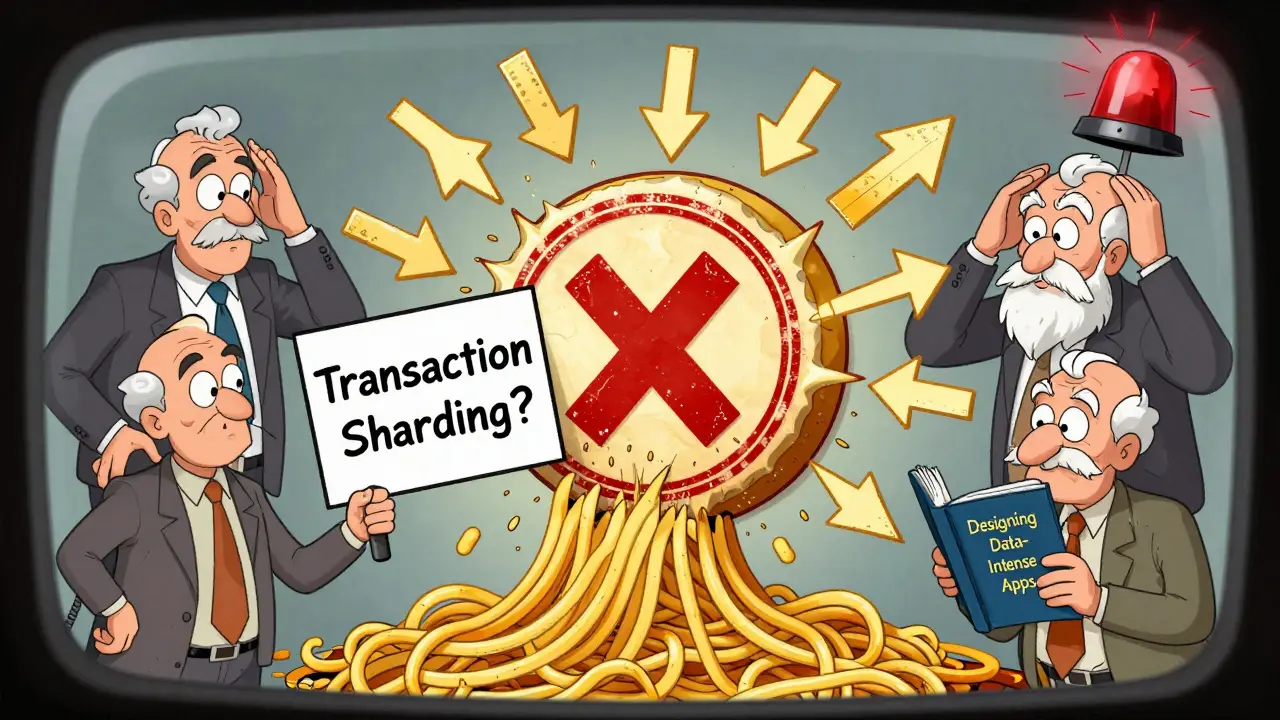
There’s a lot of noise around the term transaction sharding-especially in blockchain circles. You’ll hear it in whitepapers, seen in marketing slides, and even mentioned in developer forums. But here’s the truth: transaction sharding doesn’t exist as a real technical concept. It’s a misunderstanding, a misnomer, and worse, it’s led teams to waste months chasing something that isn’t there.
What people think they mean when they say "transaction sharding" is actually data sharding-a well-documented, decades-old technique used by Google, Amazon, and Netflix to handle massive datasets. The confusion comes from mixing up what gets split with how transactions behave across those splits. Let’s cut through the noise.
What Is Data Sharding?
Data sharding is about splitting your database into smaller, manageable pieces-called shards-and spreading them across multiple servers. Think of it like dividing a giant spreadsheet into 10 smaller ones, each stored on a different computer. Each shard holds a portion of the data, and queries are routed to the right shard based on a key-like a user ID, order number, or wallet address.
There are four main ways to do it:
- Range-based sharding: Data is split by value ranges. For example, user IDs 1-1000 go to Shard A, 1001-2000 to Shard B. Used in MySQL Cluster.
- Hash-based sharding: A hash function (like MurmurHash3 or SHA-256) turns a key into a number that maps to a specific shard. This gives even distribution. Cassandra uses this to achieve 98.7% balance across shards.
- Directory-based sharding: A lookup table tells the system where each key lives. Vitess uses this with consistent hashing.
- Geo-sharding: Data is stored near users. Amazon DynamoDB Global Tables keep EU data in Frankfurt, US data in Virginia-cutting latency to 200-300ms.
Why do companies use it? Because single databases hit walls. At 100TB+, query speed drops, writes slow down, and backups take days. Sharding fixes that. Netflix handles over 500K queries per second by sharding user timelines by account ID. Shopify cut query latency from 1,200ms to 85ms after switching to hash-based sharding on their order tables.
Hardware-wise, each shard node needs at least a 4-core CPU, 16GB RAM, and 1Gbps network. MongoDB, Cassandra, and Vitess all recommend these specs for production.
Why "Transaction Sharding" Is a Myth
Now, here’s where things go off the rails. "Transaction sharding" sounds like it should mean splitting up transactions-like sending one transaction to Shard A and another to Shard B. But transactions aren’t things you shard. They’re operations: "debit Account A, credit Account B." That’s one atomic action. You can’t split it like data.
As Martin Kleppmann wrote in Designing Data-Intensive Applications: "There is no such thing as transaction sharding-sharding always refers to data partitioning, while transactions may span multiple shards creating coordination challenges."
When people say "transaction sharding," they usually mean one of two things:
- They’re trying to run a transaction that touches data on multiple shards (a cross-shard transaction).
- They’ve been sold a product that claims to "shard transactions" to make scaling easier.
Both are wrong. You can’t shard transactions. You can only manage them across shards-and that’s hard.
Dr. Andy Pavlo from Carnegie Mellon put it bluntly in his 2022 SIGMOD keynote: "The term transaction sharding is a misnomer; transactions aren’t sharded, data is-what people really mean is distributed transactions across shards."
Baron Schwartz from Percona reviewed over 200 production systems and never saw one that "sharded transactions." James Coleman, a Cassandra committer, called it marketing fluff: "Vendors use 'transaction sharding' to hide how messy distributed transactions really are."
What Happens When Transactions Cross Shards?
Here’s the real problem: when a transaction needs to update data on two different shards, you need distributed transaction protocols. These are slow, complex, and fragile.
Two common methods:
- Two-phase commit (2PC): The coordinator asks all shards to prepare, then commits. If one shard fails, the whole transaction rolls back. It’s reliable but adds 3-5x latency compared to single-shard ops.
- Saga pattern: Break the transaction into steps. Each step is its own local transaction. If one fails, you run compensating actions to undo previous steps. More flexible, but harder to debug.
Performance hits are real. MongoDB 6.0 took 3-5x longer to commit cross-shard transactions than single-shard ones. Even in 2023, Microsoft’s research showed state-of-the-art systems still suffer a 2.3x latency penalty for multi-shard operations.
That’s why e-commerce platforms avoid cross-shard shopping carts. Gartner found a 40-60% performance drop when cart data spans shards. Fintech startups have lost $50K+ trying to force atomic cross-shard payments without proper compensation logic.
Sharding vs Alternatives
Is sharding always the answer? No. Here’s how it stacks up:
| Method | Scalability | Consistency | Complexity | Best For |
|---|---|---|---|---|
| Data Sharding | 10-100x write scalability | Eventual (CAP: Availability) | High | High-volume apps (Twitter, Shopify) |
| Replication | Low (copies data, doesn’t split it) | Strong | Low | Read-heavy apps (news sites) |
| Database Partitioning | 2-5x scalability | Strong | Medium | Single-instance scaling (PostgreSQL) |
Sharding wins on scale. It lets you handle petabytes of data. But it loses on consistency. You can’t have both strong consistency and massive scale without trade-offs.
Common Mistakes and How to Avoid Them
People mess up sharding in predictable ways. Here are the top three:
- Choosing bad shard keys: If you shard by "region," you’ll end up with one shard full of users from the US and others nearly empty. Use high-cardinality keys like user ID, wallet address, or transaction hash.
- Trying to do cross-shard joins: Queries that need data from multiple shards are slow. Design your data model to avoid them. Store related data together on the same shard.
- Ignoring hotspotting: If 10% of your users make 90% of the transactions, one shard gets overloaded. Use dynamic shard splitting (like Google Spanner does) or hash-based sharding to spread load.
Amazon’s DB blog says: "Select shard keys that are frequently queried and have high cardinality." That’s your golden rule.
Also, don’t try to build sharding from scratch. Use proven tools: Vitess for MySQL, Citus for PostgreSQL, or cloud-native options like AWS Aurora or Google Spanner. MongoDB 7.0 (Dec 2023) improved cross-shard transactions by 60%-but you still need to design around them.
Who Uses Sharding Today?
Sharding isn’t niche. It’s mainstream:
- 78% of Fortune 500 companies use data sharding (DB-Engines 2023).
- 32% of the market is AWS Aurora, 24% Google Spanner, 19% Azure Cosmos DB.
- 65% of enterprises use hybrid sharding-mixing range and hash methods.
In blockchain, sharding is used in Ethereum 2.0 to split the network into 64 shards, each handling a subset of transactions and state. That’s data sharding applied to a consensus layer-not "transaction sharding." The blockchain shards store account balances and contract states. Transactions are routed to the right shard based on sender/receiver addresses.
Even crypto projects that claim "transaction sharding" are really just sharding data and using distributed consensus protocols to coordinate across shards. The term is misleading. The technique is real.
What’s Next for Sharding?
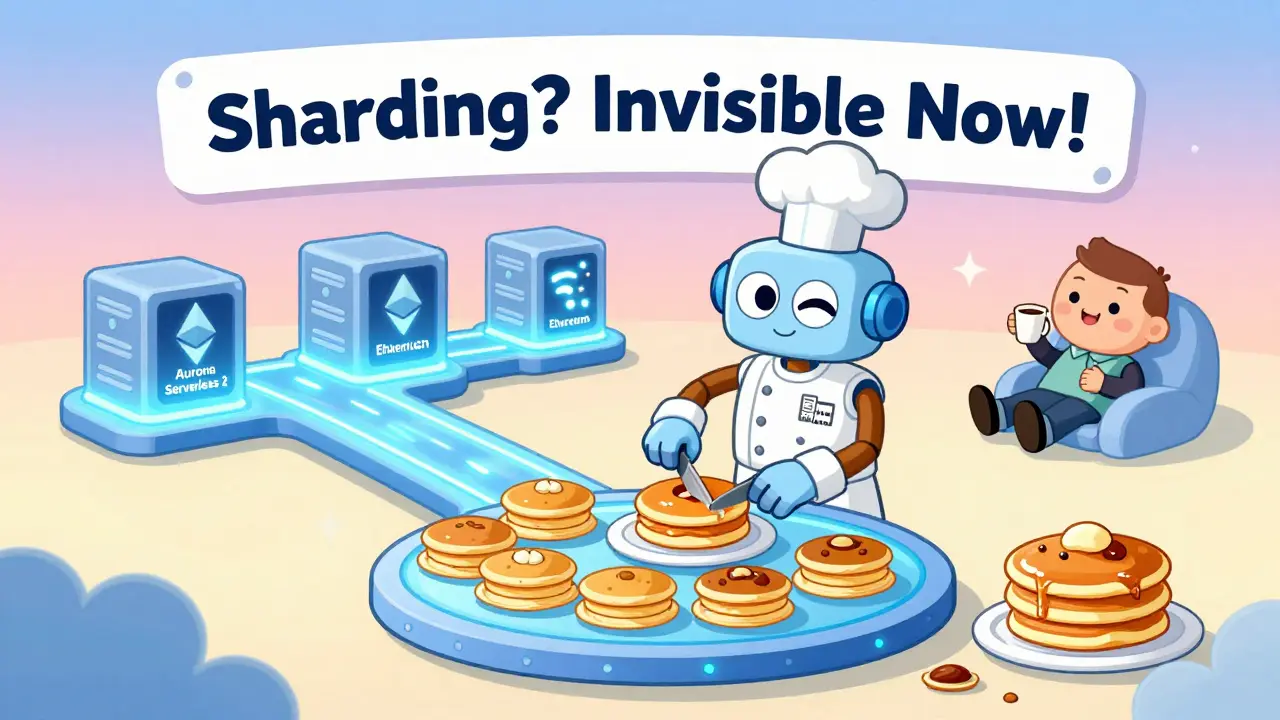
The future isn’t about sharding transactions-it’s about hiding sharding entirely.
Google’s "Oscars" project (announced Nov 2023) aims to make sharding invisible to apps. You write code like you’re on a single database. Behind the scenes, the system auto-splits data, rebalances shards, and routes queries.
AWS Aurora Serverless v2 auto-shards data as load grows. AI-driven shard management is coming: Gartner predicts 40% of new sharding setups by 2025 will use ML to predict hotspots and rebalance automatically.
Meanwhile, the confusion around "transaction sharding" is fading. Stack Overflow saw a 62% drop in questions using that phrase from 2021 to 2023. More developers are learning the right terminology.
But here’s the bottom line: if someone sells you a "transaction sharding" solution, walk away. Ask them how they handle cross-shard transactions. If they can’t explain 2PC, Saga, or latency trade-offs-they’re selling vaporware.
Data sharding works. It’s powerful. It’s used by the biggest systems on earth. But it’s not magic. It’s engineering. And it demands respect.
Is transaction sharding a real thing in blockchain?
No. "Transaction sharding" is not a technical term. In blockchain systems like Ethereum 2.0, data (account states, contract code) is sharded across nodes. Transactions are assigned to shards based on sender/receiver addresses. The system coordinates transactions across shards using consensus protocols, but it doesn’t "shard" the transactions themselves.
What’s the difference between sharding and replication?
Sharding splits your data across multiple servers-each holds a unique piece. Replication copies the entire dataset to multiple servers. Sharding improves write scalability. Replication improves read speed and availability. You can use both: shard your data, then replicate each shard for redundancy.
Can I use data sharding for my crypto app?
Yes-if you’re handling high-volume transactions or large state data. Wallets, NFT marketplaces, and DeFi protocols benefit from sharding. But avoid cross-shard operations like transferring assets between wallets on different shards. Design your data model to keep related data (like user balances and transaction history) on the same shard.
What’s the best shard key for a blockchain wallet system?
Use the wallet address itself. Wallet addresses are unique, high-cardinality, and frequently queried. Hash the address to distribute evenly across shards. Avoid using timestamps, chain IDs, or token types-they create hotspots and uneven loads.
How do I know if my system needs sharding?
If your database is over 10TB, writes are slower than 100ms, or you’re hitting hardware limits on a single node, it’s time to consider sharding. For blockchain apps, if your node sync takes more than 30 minutes or you’re dropping transactions under load, sharding can help. Don’t shard early-it adds complexity. Optimize first, shard only when necessary.