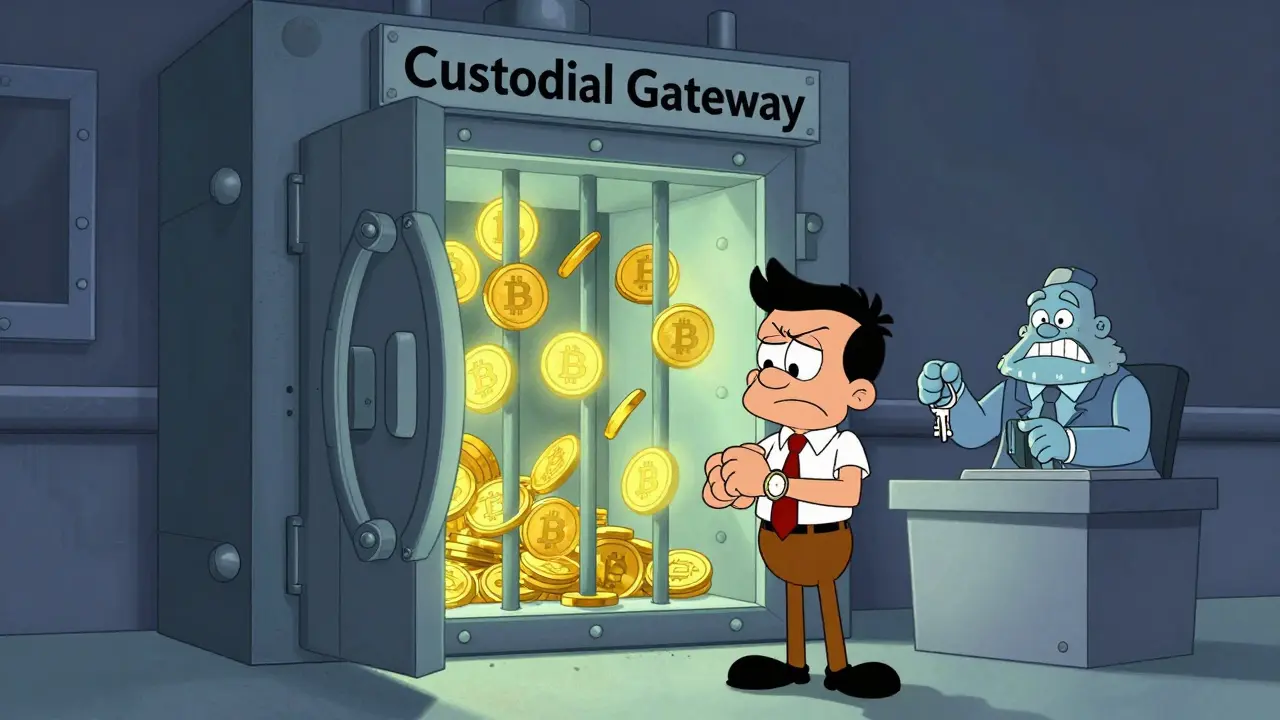
Imagine you just sold a digital product. The customer clicks "Pay" with Bitcoin. You watch the transaction hit the blockchain. But instead of the money landing in your pocket, it sits in a vault controlled by the payment processor. You can't touch it until they decide to release it-usually days later, often after taking a cut for converting it to dollars.
That is the reality for most merchants using traditional Crypto Payment Gateway, which is software that processes cryptocurrency transactions for online businesses, handling address generation, verification, and settlement. For years, the industry copied the banking model: centralized processors hold your funds, manage the risk, and dictate the rules. But as the space matures, three distinct architectures have emerged to handle this flow. They are custodial, non-custodial, and hybrid models. Each one changes who owns the keys, how fast you get paid, and what risks you accept.
The Custodial Model: Convenience at the Cost of Control
The Custodial Gateway is a payment processing system where the provider holds the private keys and manages the funds on behalf of the merchant. This architecture mimics Stripe or PayPal. When a customer pays, the funds go into a wallet owned by the gateway provider. The provider credits an internal balance to your account dashboard. Later, they might convert that crypto to fiat currency and deposit it into your bank account.
Why do merchants use this? Because it is easy. If you are used to traditional banking, this feels familiar. You don't need to worry about securing hardware wallets or understanding blockchain confirmations. The gateway handles the messy parts, including compliance checks like KYC (Know Your Customer) and AML (Anti-Money Laundering).
However, there is a catch. You do not own your funds while they sit in that platform. You hold an IOU. If the gateway gets hacked, goes bankrupt, or decides to freeze your account due to a policy violation, your money is stuck. PayRam, a vocal critic of this model, points out that custodial gateways often charge around 1% in fees plus hidden spreads on currency conversion, effectively replicating the friction many people seek to escape by using crypto in the first place.
The Non-Custodial Model: Sovereignty and Direct Settlement
In a Non-Custodial Gateway is a payment infrastructure that facilitates transactions without ever holding user funds or accessing private keys. the gateway acts purely as a messenger. It generates a unique payment address for each invoice, monitors the blockchain for incoming payments, and sends a notification (webhook) to your store when the payment is confirmed. Crucially, the funds move directly from the customer's wallet to yours. The gateway never touches the money.
This architecture relies on extended public keys (XPUBs). You provide the gateway with your XPUB-a mathematical key that can generate infinite receiving addresses but cannot spend funds. The gateway uses this to create fresh addresses for every sale. Since the gateway never has your private keys, it cannot steal your funds, freeze your account, or delay your payout.
Solutions like BTCPay Server pioneered this approach. More recently, platforms like Aurpay and NOWPayments have brought this model to a broader audience, supporting hundreds of cryptocurrencies. For solo founders and indie hackers, this is the gold standard. There are no chargebacks because crypto is irreversible. There are no payout holds because the money is already in your wallet. There are no account freezes because the software provider has no power over your assets.
Of course, this puts the burden of security on you. If you lose your private keys, there is no customer support team to reset them. You must manage your own treasury. But for many, the trade-off is worth it for the sake of censorship resistance and total ownership.
The Hybrid Approach: Best of Both Worlds?
Hybrid Gateway is a payment solution that combines elements of both custodial and non-custodial architectures, allowing merchants to choose how funds are handled. attempts to bridge the gap. These systems allow merchants to configure different flows. For example, you might set up automatic fiat conversion for small daily sales (custodial flow) while keeping large direct crypto payments in your own wallet (non-custodial flow).
FinchTrade describes this as combining the operational simplicity of custodial services with the control of self-custody. In practice, this means the gateway maintains both internal ledgers for pooled funds and direct integration paths for merchant wallets. This flexibility is attractive to larger enterprises that need some level of regulatory reporting and instant liquidity but also want to retain direct access to certain assets.
However, hybrid models add complexity. You have to understand which funds are sitting in the provider's custody and which are in your wallet. If the custodial side fails, you still face counterparty risk. It is a pragmatic compromise, but it requires careful configuration to avoid accidental exposure.

Comparing the Architectures
| Feature | Custodial | Non-Custodial | Hybrid |
|---|---|---|---|
| Fund Control | Gateway Provider | Merchant | Split / Configurable |
| Settlement Speed | Days (T+1 to T+7) | Instant (On-Chain) | Variable |
| Fees | ~1% + Conversion Spreads | Low / Flat Subscription | Mixed |
| Counterparty Risk | High | None | Medium |
| Technical Barrier | Low | Medium (Wallet Management) | Medium-High |
| Chargebacks | Possible (Policy-based) | Impossible | Depends on Flow |
Security and Trust Models
The way you secure your business depends entirely on the architecture you choose. In a custodial setup, you rely on the provider's institutional-grade security. Companies like Cobo emphasize that professional custodians use cold storage, hardware security modules (HSMs), and multi-party computation (MPC) to protect billions in assets. But if their hot wallets are breached, your funds are exposed.
In a non-custodial setup, the threat model shifts to you. The gateway cannot steal your funds, but you must ensure your private keys are safe. Modern tools make this easier. For instance, TxNod is a non-custodial multi-chain crypto payment gateway designed for developers and solo founders. allows merchants to connect hardware wallets like Ledger or Trezor directly via WebHID or WebUSB. The private keys never leave the device. TxNod only sees the public keys needed to generate addresses. Furthermore, its TypeScript SDK re-verifies every payment address locally before showing it to the customer, ensuring the gateway cannot trick you into sending funds to the wrong place. This "trustless" verification is a critical feature for high-security operations.
For those worried about the learning curve, remember that non-custodial does not mean "self-hosted node." Many modern non-custodial gateways handle the blockchain monitoring for you. You just need to manage your wallet security.
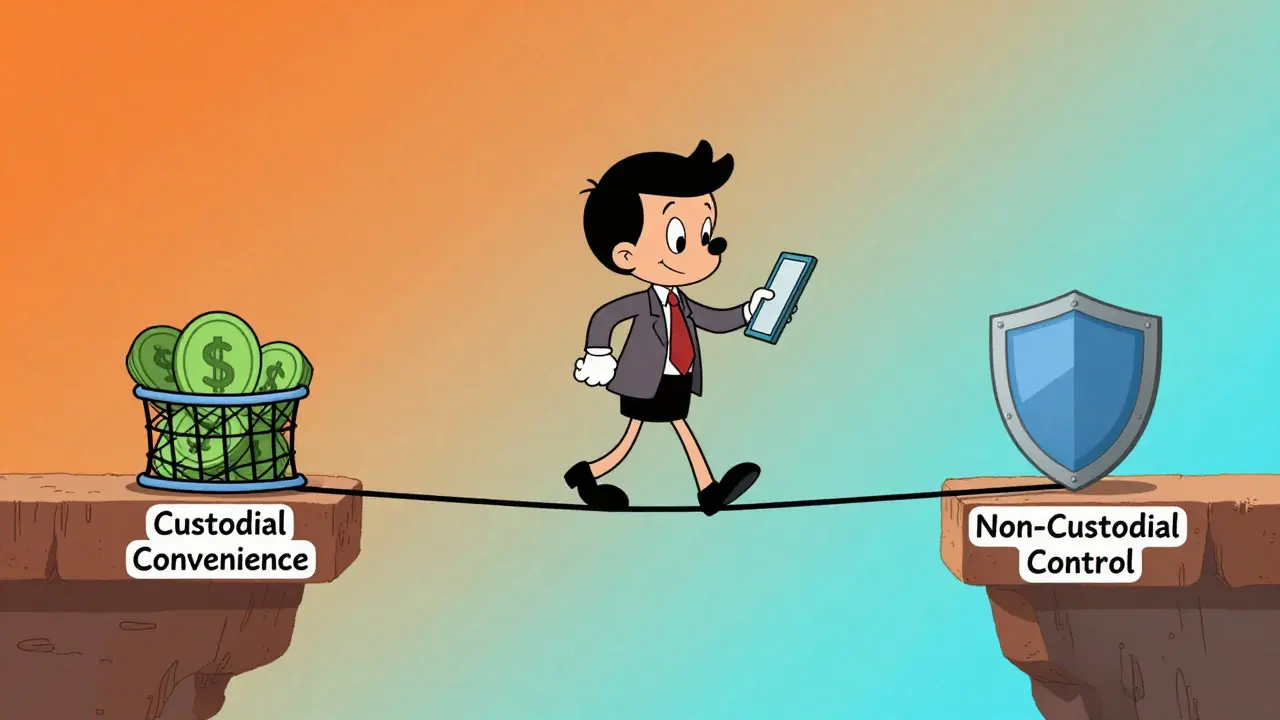
Who Should Choose What?
If you are a large enterprise requiring strict regulatory compliance, automated fiat settlements, and dedicated support teams, a custodial gateway might be necessary despite the risks. The convenience and integrated reporting often outweigh the loss of direct control for big corporations.
If you are a solo founder, indie hacker, or running a pet project, a non-custodial gateway is likely your best bet. You want zero chargebacks, no account freezes, and immediate access to your revenue. Tools like TxNod cater specifically to this demographic, offering flat-rate pricing (no percentage cuts) and simple integration via AI coding agents or SDKs. You keep 100% of your value, minus minimal network fees.
If you operate in a gray area-perhaps accepting crypto for high-risk goods but needing some fiat off-ramp options-a hybrid model offers flexibility. However, proceed with caution. Ensure you clearly understand which transactions are being held in custody and which are settling directly.
The Future of Crypto Payments
The trend is moving toward greater merchant sovereignty. As tooling improves, the technical barrier to entry for non-custodial solutions drops. Developers are building better UX layers around raw blockchain data. We are seeing a shift away from "bank-like" crypto processors toward infrastructure that respects the peer-to-peer nature of digital assets.
Whether you prioritize ease-of-use or absolute control, understanding these three architectures is essential. Don't just sign up for a service because it looks familiar. Ask yourself: Who holds my keys? How fast do I get paid? And what happens if the provider disappears? The answers will determine the right architecture for your business.
What is the main difference between custodial and non-custodial crypto payment gateways?
The main difference lies in fund control. In a custodial gateway, the provider holds your funds in their wallets and settles them to you later, often converting to fiat. In a non-custodial gateway, funds go directly from the customer to your personal wallet; the provider never holds your money or private keys.
Are non-custodial gateways safer than custodial ones?
They eliminate counterparty risk. Since the provider cannot access your funds, they cannot freeze your account or lose your money in a hack of their hot wallets. However, you become responsible for securing your own private keys. If you lose your seed phrase, you lose your funds permanently.
Do non-custodial gateways charge higher fees?
Often, non-custodial gateways are cheaper. Custodial providers charge ~1% plus conversion spreads to cover liquidity and compliance costs. Non-custodial providers typically charge lower flat fees or subscription rates since they do not handle fund custody or conversion.
Can I use a hybrid gateway for specific products?
Yes. Hybrid architectures allow you to configure different settlement paths. You might route stablecoin payments directly to your wallet (non-custodial) while routing volatile crypto through the provider for instant fiat conversion (custodial).
How do non-custodial gateways generate payment addresses?
They use your Extended Public Key (XPUB). You provide this public key to the gateway. The gateway derives unique, one-time addresses for each invoice from this key. It can generate addresses but cannot spend the funds sent to them.