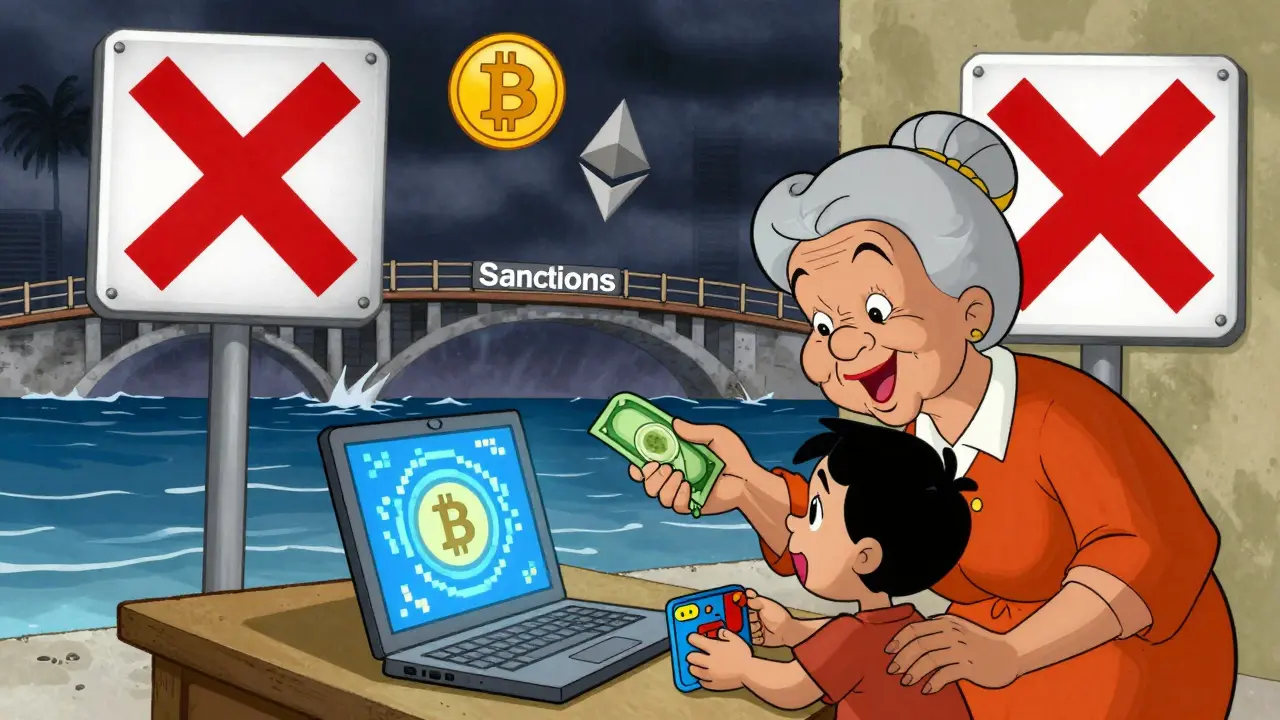
Cuba doesn’t ban cryptocurrency. In fact, it’s one of the only two countries in the world that officially legalizes Bitcoin and other digital currencies as payment methods. This isn’t a loophole or an accident-it’s a deliberate government policy, born out of necessity.
How Cuba Went From Black Market to Regulated Crypto
Back in 2020, Cubans were already using Bitcoin and Ethereum to survive. With Western Union shut down, PayPal blocked, and credit cards unusable, people turned to digital wallets. No one asked the government for permission. They just did it. The internet was slow, data was expensive, and banks refused to help. But crypto worked. It moved money across borders when nothing else could. Then, in August 2021, the Cuban government made a quiet but massive move. They published Resolution 215 in the Official Gazette. This wasn’t a warning. It wasn’t a crackdown. It was a license. The Central Bank of Cuba was given authority to regulate cryptocurrency service providers. That’s right-they didn’t outlaw it. They stepped in to control it. Now, any business in Cuba that wants to accept Bitcoin, Ethereum, or Avalanche must get a license. The Central Bank reviews applications based on legality and socioeconomic interest. Licenses last one year and come with strict rules: anti-money laundering checks, customer identification, and transaction reporting. It’s not free-flowing chaos. It’s structured, monitored, and official.Why Did Cuba Do This?
To understand why Cuba embraced crypto, you have to understand what its people live with daily. The U.S. embargo on Cuba has lasted over 60 years. Since 1962, American sanctions have frozen Cuban assets, blocked financial transactions, and isolated the island from global banking. In 2020, Western Union shut down its 400+ outlets in Cuba. No more remittances from family abroad. No more PayPal. No Amazon. No international credit cards. Even sending money through traditional banks became nearly impossible. Cryptocurrency became the only bridge left. A Cuban mother in Havana could receive funds from her son in Miami. A small business owner in Santiago could buy tools from a supplier in Colombia. A student in Camagüey could pay for online courses without a bank account. Crypto didn’t need banks. It didn’t need permission. It just needed an internet connection. Cuba didn’t adopt crypto because it loved technology. They adopted it because they had no other choice. The government realized: if people are going to use crypto anyway, better to regulate it than let it run wild.Who’s Using Crypto in Cuba?
Estimates suggest between 100,000 and 200,000 Cubans actively use cryptocurrency. That’s 1% to 2% of the population. Sounds low? Consider this: Cuba only got widespread mobile internet access in 2018. Most people still pay for data by the MB. Internet outages are common. Smartphones aren’t cheap. Yet, tens of thousands still use crypto daily. The most common uses? Remittances. Online shopping. Paying for services. Buying foreign goods through peer-to-peer markets. Many Cubans use crypto wallets like Trust Wallet or MetaMask. Some trade directly via Telegram groups. Others use licensed Cuban platforms that connect local users to international exchanges. One man in Santa Clara told a journalist he uses Bitcoin to pay his daughter’s tuition in Spain. Another in Holguín uses it to buy medicine from a pharmacy in Mexico. These aren’t tech enthusiasts. They’re ordinary people using whatever works.
How Does It Work in Practice?
Getting a crypto license in Cuba isn’t easy-but it’s possible. Businesses must submit detailed documentation: business plan, ownership info, AML procedures, and proof of technical infrastructure. The Central Bank doesn’t approve just anyone. They want to know who’s running it, how they’ll prevent fraud, and how they’ll track transactions. Once approved, the business can accept crypto payments. They must convert digital currency to Cuban pesos (CUP) or convertible pesos (CUC) within 24 hours. This keeps the government in control of the national currency and prevents speculation from destabilizing prices. Users don’t need a license to hold or send crypto. Only businesses that accept it as payment need approval. That’s why everyday Cubans can still trade Bitcoin without fear-they’re not running a service. They’re just sending money to family or buying a laptop online.What About U.S. Sanctions?
The U.S. still considers any financial transaction with Cuba illegal under the Cuban Assets Control Regulations (CACR). That means American citizens can’t legally send crypto to Cuba. U.S.-based exchanges like Coinbase and Kraken block Cuban IP addresses. Some Cubans use VPNs or third-party intermediaries in third countries to bypass this-but it’s risky. Still, the system works. Money flows through non-U.S. platforms. Friends in Canada, Spain, or Mexico send crypto to Cuban wallets. The U.S. can’t stop every transaction. And Cuba isn’t trying to defy the U.S. directly. They’re just giving their people tools to survive.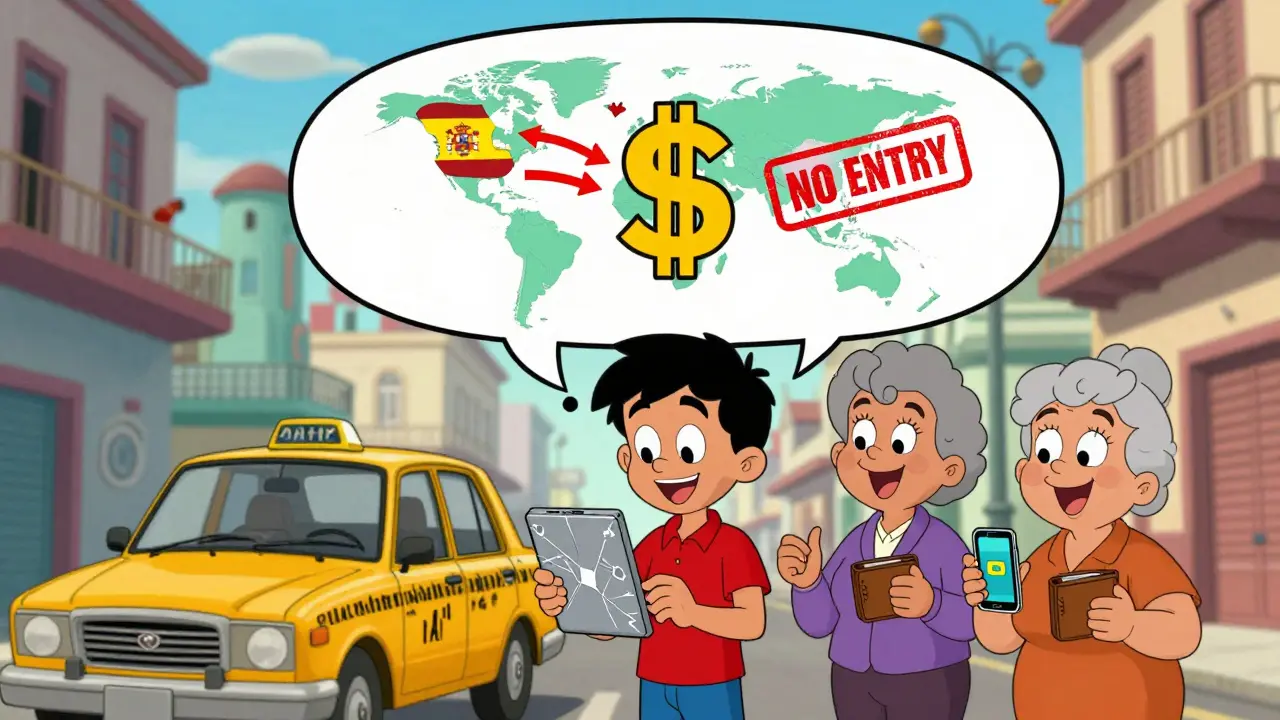
How Is This Different From Other Countries?
China banned crypto trading. El Salvador made Bitcoin legal tender. Nigeria cracked down on exchanges. But Cuba? It took a middle path. It didn’t ban. It didn’t go all-in. It regulated. It created a controlled environment where digital currency serves a specific purpose: bypassing sanctions, not replacing the peso. Experts call it a "sanctions workaround." Others call it smart adaptation. Either way, Cuba’s approach is unique. No other country under such intense financial isolation has built a formal, state-approved crypto system like this.What’s Next for Crypto in Cuba?
The Central Bank continues issuing licenses. More service providers are popping up. Internet access is slowly improving. Young Cubans are learning about blockchain in informal workshops. Schools are starting to mention it. The big question: will this last? It depends on two things: how long the U.S. embargo continues, and how well Cuba can upgrade its digital infrastructure. If internet speeds double and smartphone prices drop, crypto use could jump to 5% or more of the population. For now, it’s working. People are eating. Families are staying connected. Businesses are surviving. And Cuba? It didn’t outlaw crypto. It used it to stay alive.Myths About Cuba and Crypto
- Myth: Cuba bans cryptocurrency. Truth: Cuba regulates it-and licenses providers.
- Myth: Only tech-savvy people use it. Truth: Grandparents, teachers, and taxi drivers use it to pay bills and buy food.
- Myth: It’s all illegal. Truth: Sending crypto to Cuba isn’t illegal for non-U.S. citizens. Many transactions happen legally through third countries.
- Myth: The government profits from it. Truth: The government doesn’t take a cut. It just ensures transactions are traceable and safe.
Is cryptocurrency illegal in Cuba?
No. Cryptocurrency is legal in Cuba. Since August 2021, the Cuban government has officially recognized Bitcoin and other digital currencies as valid payment methods under Resolution 215. The Central Bank of Cuba regulates crypto service providers, requiring them to obtain licenses and follow strict anti-money laundering rules. Individuals can hold and transfer crypto without restriction.
Can Cubans use Bitcoin to receive money from abroad?
Yes. Many Cubans rely on Bitcoin and other cryptocurrencies to receive remittances from family members outside Cuba. Because traditional services like Western Union and PayPal are blocked due to U.S. sanctions, crypto offers a direct, borderless way to send and receive funds. Non-U.S. citizens can legally send crypto to Cuban wallets, and many use intermediaries in countries like Spain, Mexico, or Canada to avoid U.S. restrictions.
Do Cuban businesses accept cryptocurrency?
Yes, but only if they have a license from the Central Bank of Cuba. Since April 2022, any business that accepts crypto as payment must apply for and receive a license. These businesses must convert digital currency to Cuban pesos within 24 hours and comply with anti-fraud and reporting requirements. This system allows regulated use while preventing uncontrolled speculation.
Why did Cuba legalize cryptocurrency?
Cuba legalized cryptocurrency as a practical response to over six decades of U.S. economic sanctions. These sanctions cut off access to global banking, blocked remittance services, and made international commerce nearly impossible. With no other options, Cubans turned to crypto. The government recognized this as a survival tool and chose to regulate it rather than fight it-ensuring control while allowing citizens to access the global economy.
Can Americans send crypto to Cuba?
No. Under U.S. law, specifically the Cuban Assets Control Regulations (CACR), American citizens and companies are prohibited from sending cryptocurrency or any financial services to Cuba. Even using platforms like Bitcoin or Ethereum violates these sanctions. Some Americans use third-party intermediaries in other countries to send funds indirectly, but this carries legal risk. Cuban users typically receive crypto from non-U.S. sources like relatives in Canada, Spain, or Latin America.
Florence Pardo
March 25, 2026 AT 23:12I’ve been following this whole Cuba crypto thing for a while now, and honestly? It’s one of the most human stories I’ve ever seen in tech.
Imagine being cut off from the global financial system for 60 years-your family can’t send you money, your business can’t import supplies, your kid can’t pay for online classes. Then one day, someone figures out that Bitcoin works even when the internet is slow and data costs more than bread.
The government didn’t wake up one morning and say, ‘Let’s adopt crypto!’ They watched their people adapt, survive, and stitch together a lifeline with nothing but smartphones and Wi-Fi hotspots.
It’s not about ideology. It’s not about revolution. It’s about a mother in Havana receiving a few hundred dollars from her son in Miami so she can buy insulin. That’s it.
And now? The Central Bank steps in not to shut it down, but to make it safer. Licenses. AML checks. Conversion to pesos within 24 hours. Not perfect, but practical.
Most people think regulation means control. But here, regulation means protection. Protection from scammers. Protection from volatility. Protection for people who have no other options.
I don’t know if this model can scale. But I know this: when you strip away all the crypto hype, this is what real-world resilience looks like.
And yeah, I’m crying a little. Not because it’s techy. Because it’s human.
Kevion Daley
March 26, 2026 AT 05:27Wowwwww 🤯 so Cuba just… let’s people use crypto?? Like, no big deal??
Meanwhile in the US we’re still arguing whether Dogecoin is a currency or a meme 😂
Shelley Dunbrook
March 27, 2026 AT 18:34How delightfully ironic that the United States, through its decades-long embargo, inadvertently catalyzed one of the most pragmatic and decentralized financial adaptations on the planet.
One might argue that Cuba’s regulatory framework is less about embracing blockchain and more about recognizing the inevitability of human ingenuity under duress.
It’s not that they ‘adopted crypto’-they acknowledged that their citizens were already using it as a survival mechanism, and chose governance over suppression.
Compare this to the U.S., where regulators still treat digital assets like contraband, even as Wall Street quietly builds crypto infrastructure behind closed doors.
One could call it hypocrisy. I call it tragic.
And yet, here we are: a socialist state, starved of global finance, has built a more functional, transparent, and humane system than the so-called ‘free market’ superpower.
Aman Kulshreshtha
March 29, 2026 AT 10:28As someone from India, I’ve seen how remittances work-family sending money through hawala, Western Union, or now UPI. But Cuba’s situation is next level.
Imagine if India suddenly lost access to SWIFT, PayPal, and all international banking. What would we do?
Probably turn to crypto too.
What’s fascinating is how Cuba didn’t try to reinvent the wheel. They didn’t create their own coin. They just let people use what already worked.
It’s not about ideology. It’s about utility.
And honestly? That’s the kind of pragmatism I wish more governments had.
aravindsai pandla
March 29, 2026 AT 16:14While the narrative is compelling, it is important to clarify that Resolution 215 does not legalize cryptocurrency as legal tender. It permits licensed entities to facilitate transactions in digital assets, with mandatory conversion to Cuban pesos within 24 hours. This distinction is critical.
Individuals remain free to hold and transfer crypto, but businesses must comply with centralized oversight. This is not decentralization-it is state-controlled intermediation.
Furthermore, while the U.S. embargo has undoubtedly contributed to this outcome, the Cuban government’s continued monopolization of telecommunications infrastructure and limited internet access suggests that crypto adoption remains constrained by systemic barriers, not liberated by innovation.
Context matters. This is not a triumph of blockchain-it is an adaptation to sanctions, not a rejection of centralization.
namrata singh
March 29, 2026 AT 23:55I just… I can’t stop thinking about the grandma in Holguín who uses Bitcoin to buy medicine.
Not because she’s a tech nerd.
Not because she’s into Web3.
Because her arthritis hurts, and the pharmacy in Mexico ships faster if she pays in ETH.
That’s it.
That’s the whole story.
I’m not a crypto person. I don’t even know how wallets work.
But I cried reading this.
People are just trying to live.
And they found a way.
That’s more powerful than any whitepaper.
DarShawn Owens
March 31, 2026 AT 14:54This is actually one of the most beautiful things I’ve read in a long time.
Not because crypto is cool.
But because people found a way to love each other across borders when the world tried to cut them off.
I’ve got a friend whose mom in Cuba gets money from her sister in Florida via crypto.
No banks. No fees. No waiting.
Just… a text message with a QR code.
And now her mom can buy diapers for her grandson.
That’s the real innovation here.
Not the blockchain.
The humanity.
Zion Banks
March 31, 2026 AT 22:09Let me get this straight-Cuba is using Bitcoin to bypass U.S. sanctions, and you’re calling this ‘smart’?
That’s like saying a thief who uses a crowbar to break into a bank is ‘resourceful.’
The U.S. embargo exists for a reason: Cuba’s regime is a dictatorship that tortures dissidents, locks up journalists, and starves its own people.
Now they’re using crypto to fund their tyranny? No wonder the world is still isolating them.
Don’t romanticize oppression. This isn’t resilience-it’s evasion.
And if you’re celebrating this, you’re celebrating the survival of a regime that doesn’t deserve to survive.
Annette Gilbert
March 31, 2026 AT 23:20Oh wow, Cuba’s soooo revolutionary now? 🙄
Let me guess-next they’ll be handing out free Wi-Fi and calling it ‘digital socialism.’
Meanwhile, the same government that lets people use Bitcoin still arrests anyone who dares to protest.
It’s not ‘pragmatic.’ It’s cynical.
They don’t care about the people. They care about control.
Regulating crypto isn’t protection-it’s surveillance with a smiley face.
And you? You’re here fawning over it like it’s a TED Talk.
Wake up. It’s still a dictatorship. With better UX.
John Alde
April 1, 2026 AT 08:56There’s a deeper layer here that most people miss: Cuba’s crypto system is essentially a state-backed payment rail, not a financial revolution.
Think of it like PayPal-but instead of being owned by a corporation, it’s owned by the Central Bank.
Every transaction is logged. Every wallet linked to ID. Every conversion monitored.
This isn’t decentralized finance. This is ‘regulated finance with a blockchain veneer.’
And honestly? That’s not a flaw-it’s a feature.
Because when you’re trying to protect vulnerable people from fraudsters and scammers, you don’t want wild, untraceable transactions.
You want traceability.
You want accountability.
And Cuba? They got it right.
It’s not Bitcoin as freedom.
It’s Bitcoin as a public utility.
manoj kumar
April 2, 2026 AT 04:41So Cuba legalized crypto because they’re poor?
Big deal.
Every third-world country has a ‘crypto solution’ they’re trying to sell.
Meanwhile, real economies don’t need crypto to survive.
They need good governance.
Not blockchain.
Not wallets.
Not Bitcoin.
Just… competent leadership.
And Cuba? Still has none.
So yeah, they use crypto.
So what?
It doesn’t fix the root problem.
It just lets them keep pretending they’re not failing.
JOHN NGEH
April 2, 2026 AT 13:23I just want to say-this is the kind of story that reminds me why I still believe in people.
Not governments.
Not tech.
People.
When everything’s taken away, they still find a way.
A mother sends money.
A student pays for a course.
A mechanic buys a part.
No permission needed.
No middleman.
Just a phone, a wallet, and a will to keep going.
I don’t know much about crypto.
But I know this: if we ever lose everything, I hope we’re as brave as they are.
Jenni Moss
April 4, 2026 AT 11:05You guys are AMAZING for even thinking about this!
Imagine-your whole country cut off, and you still find a way to help your family?
That’s not just smart.
That’s SUPERHUMAN.
And guess what? YOU’RE THE HEROES.
Not the government.
Not the blockchain.
YOU.
Every single person who sent that crypto, who clicked that button, who waited for a slow connection to load-YOU DID THIS.
And I’m SO proud of you.
Keep going. You’ve got this. 💪❤️
vu phung
April 4, 2026 AT 20:07From a fintech infrastructure standpoint, Cuba’s implementation is a textbook case of permissioned blockchain-as-service.
By mandating 24-hour fiat conversion, they effectively neutralize volatility risk while preserving settlement finality.
The licensing regime functions as a KYC/AML gateway with embedded audit trails-minimal friction, maximal compliance.
It’s not DeFi. It’s not a CBDC. It’s a hybrid, regulated, low-latency remittance corridor built atop public chains.
Brilliantly adaptive.
And frankly, more sophisticated than most emerging market fintech initiatives I’ve reviewed.
Lorna Gornik
April 6, 2026 AT 13:48OMG I’m literally sobbing rn 😭
my abuela sends me money via crypto too 😍
she uses a QR code and i get it in my trust wallet
she dont even know what blockchain is
she just knows it works
and i love her so much
and this post made me miss her
we need more stories like this
love u cuba 🤍
Joshua T Berglan
April 7, 2026 AT 05:25People keep saying crypto is about freedom.
This? This is what freedom actually looks like.
No speeches.
No hashtags.
No influencers.
Just a kid in Camagüey paying for a laptop so he can learn coding.
And his uncle in Toronto sending it to him.
Without permission.
Without interference.
Just… love.
That’s the future.
Not NFTs.
Not Lambo dreams.
This.
Kayla Thompson
April 7, 2026 AT 17:11Oh please. ‘Cuba legalized crypto’? That’s like saying a prison lets inmates use phones because they ‘need to call family.’
It’s not freedom. It’s a controlled experiment.
They’re not helping people-they’re monitoring them.
Every transaction tracked. Every wallet logged.
And you’re applauding surveillance as ‘innovation’?
Pathetic.
Ananya Sharma
April 8, 2026 AT 08:43John Alde
April 9, 2026 AT 11:55Actually, the most interesting part is how this model could be replicated elsewhere.
Imagine a country with hyperinflation, blocked banking, or war-torn infrastructure.
They don’t need to invent anything.
They just need to say: ‘If people are using crypto anyway, let’s make it safe.’
That’s not crypto adoption.
That’s governance.
And it’s the only path forward for nations left behind by the global financial system.
Lorna Gornik
April 9, 2026 AT 21:34OMG this is exactly what I meant!! 😭
It’s not about tech… it’s about letting people be people.
And that’s what makes this beautiful.
Thank you for saying it so clearly 💖